
Chief Growth Officer: Role, Responsibilities, Salary, and When to Hire One
A Chief Growth Officer owns revenue across marketing, sales, and product — full-time or fractional. Here's the role, salary benchmarks, and how to decide.
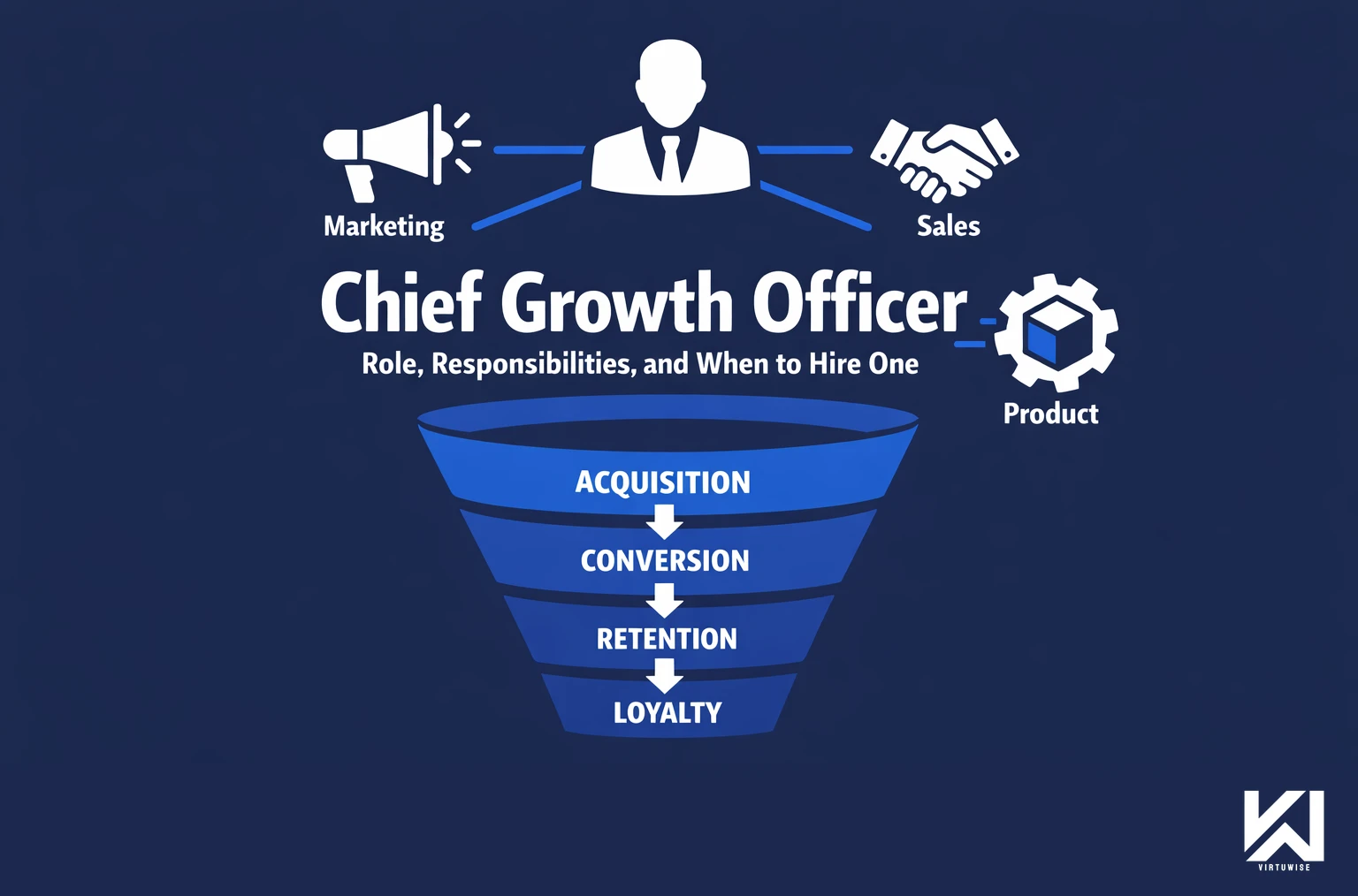
A Chief Growth Officer is a relatively new C-suite title, and its scope varies more from company to company than almost any other executive role — which makes it a genuinely confusing title to hire for, research salary benchmarks on, or even define cleanly. Some companies use it as a more ambitious rebrand of the CMO role. Others use it to mean a genuinely cross-functional owner of the entire revenue funnel, with authority over marketing, sales, and product.
This guide covers what a Chief Growth Officer actually does, what the role typically requires, what it pays, how it differs from a CMO, and when a fractional CGO is a better fit than a full-time hire.
What Does a Chief Growth Officer Do?
A Chief Growth Officer owns revenue growth as a company-wide outcome, not a single department's output. That's the core distinction from more traditional C-suite marketing or sales titles: a CGO's mandate typically spans acquisition, activation, retention, and expansion — the full funnel — with the authority to move budget and priority between marketing, sales, and product to hit a shared growth number.
Core areas a CGO typically owns:
Growth strategy and target-setting
Defining the company's growth strategy — which channels, which segments, which product motions drive the most efficient growth — and setting the targets the rest of the executive team is held to.
Cross-functional alignment
Marketing, sales, and product often optimize for different, sometimes conflicting metrics when no one owns the combined outcome. A CGO's job is aligning those functions around one growth number, with the authority to reallocate resources when one function's plan doesn't serve the shared goal.
Full-funnel ownership
Where a CMO's mandate typically stops at generating and qualifying demand, and a CRO's starts at converting it, a CGO owns the funnel end to end — including retention and expansion, which are often under-resourced when no single executive is accountable for them.
Growth experimentation and data infrastructure
Building the testing and measurement infrastructure to know what's actually driving growth versus what just looks like it is — and having the authority to reallocate spend based on that evidence quickly.
Board and executive reporting
Translating growth performance into the language a board or CEO needs: not channel-level marketing metrics, but revenue growth, efficiency, and forward-looking pipeline health.
Chief Growth Officer Job Description
A typical CGO job posting includes:
- Core responsibility: Own company-wide growth strategy and the combined growth number across marketing, sales, and product
- Reports to: CEO or board
- Manages: Often a cross-functional team spanning marketing, growth/product, and sometimes sales leadership — structure varies significantly by company
- Requirements: Typically 10+ years of senior marketing, growth, or revenue leadership; experience owning a P&L or revenue target directly; cross-functional leadership experience; a track record of measurable growth at a comparable company stage
- Key skills: Data-driven decision-making, cross-functional influence without always having direct authority over every function, experimentation and testing infrastructure experience, board-level communication
The single most common thing separating a strong CGO candidate from a weak one isn't marketing expertise specifically — it's evidence of successfully driving alignment across functions that don't naturally report to the same person.
Chief Growth Officer Salary
| Role | Typical Compensation |
|---|---|
| Full-time CGO — growth-stage company | €200,000–€350,000 total comp (base + bonus/equity) |
| Full-time CGO — enterprise | €350,000+ total comp |
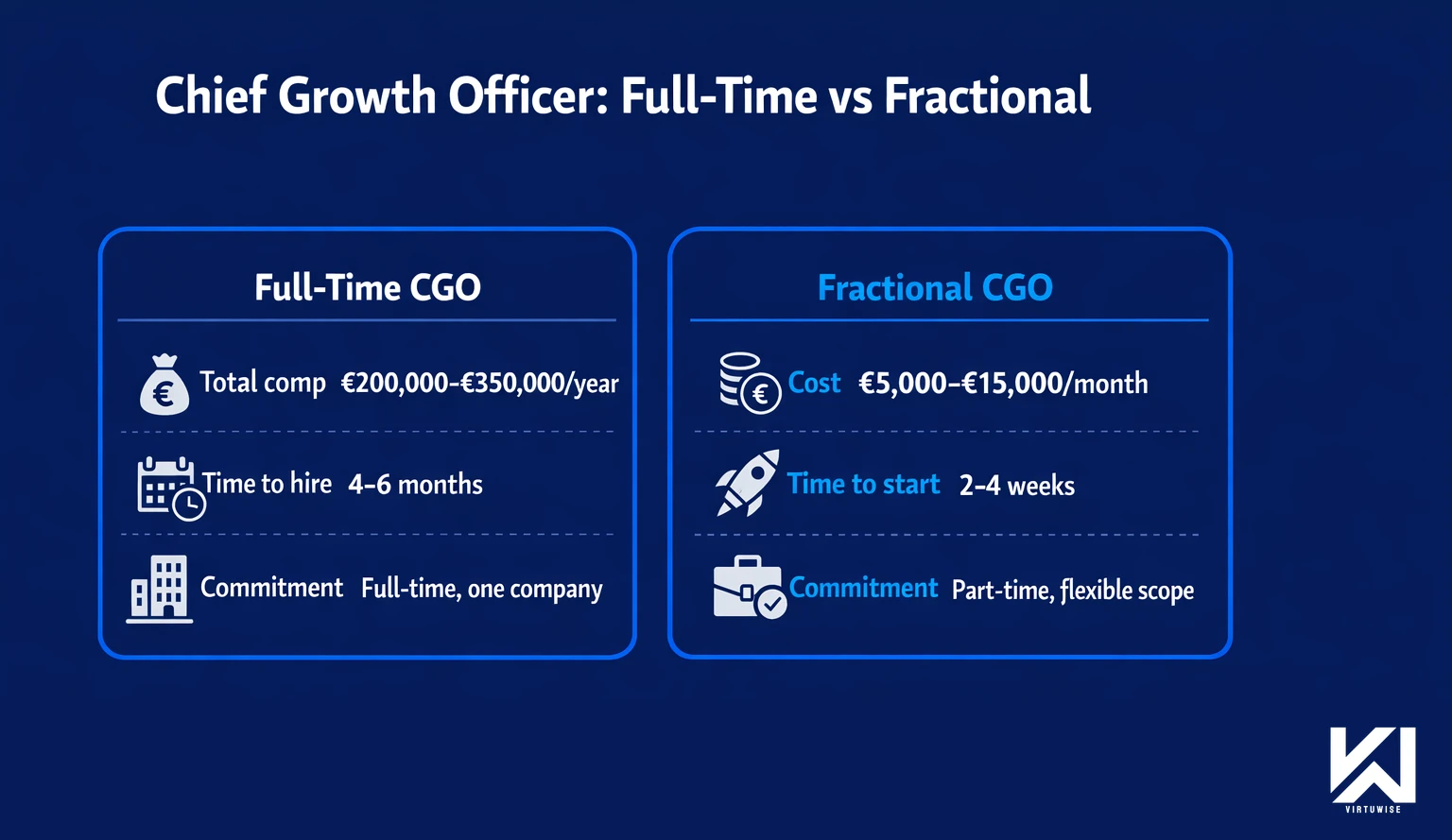
| Fractional CGO | €5,000–€15,000/month, scope-dependent |
Full-time CGO compensation typically includes meaningful equity at earlier-stage companies, reflecting the strategic weight of the role. Fractional CGO engagements are priced by scope and time commitment — a few hours a week of strategic oversight sits at the lower end; hands-on cross-functional leadership with team management responsibility runs toward the higher end.
The comparison that actually matters for most companies isn't the fractional rate against zero — it's against the full total comp, search time (CGO searches commonly run 4-6 months given the role's relative newness and narrower candidate pool), and the risk of a senior mis-hire in a role this cross-functional and consequential:
Chief Growth Officer vs. CMO: What's the Real Difference
The honest answer is that these roles overlap substantially, and many companies use the titles close to interchangeably — especially below enterprise scale, where one senior marketing/growth executive often ends up doing both jobs regardless of which title is on the door.
Where there's a real distinction:
| Factor | CMO | Chief Growth Officer |
|---|---|---|
| Core mandate | Marketing outcomes — brand, demand gen, marketing team performance | Growth as a company-wide outcome across marketing, sales, product |
| Funnel ownership | Typically acquisition and demand generation | Full funnel — acquisition through retention and expansion |
| Authority over other functions | Usually marketing only | Often has influence or authority over sales and product priorities too |
| Best fit for | Companies where marketing is the primary growth lever | Companies where growth depends on coordinating multiple functions |
If your growth problem is specifically a marketing problem — positioning, demand generation, brand — a CMO (fractional or full-time) is the more precisely scoped hire. If your growth problem spans functions that aren't currently coordinated toward a shared number, the broader CGO mandate is the better fit. In practice, a strong fractional Growth Partner engagement often covers this same broad, cross-functional ground regardless of which title gets used to describe it.
Fractional Chief Growth Officer
A fractional Chief Growth Officer provides the same strategic mandate as a full-time CGO — growth strategy, cross-functional alignment, full-funnel ownership — on a part-time basis, typically a set number of hours or days per week rather than a full-time seat.
This model fits the CGO role particularly well, for a few reasons specific to how the role actually functions:
The role is inherently more strategic than execution-heavy
A CGO's highest-value work — setting strategy, aligning functions, making resource-allocation calls — doesn't require 40 hours a week the way running a team's day-to-day execution does. A fractional arrangement matches the role's actual time demands more naturally than most executive titles.
The candidate pool is narrower and the title is newer
Because "Chief Growth Officer" is a less standardized title than CMO or CRO, full-time searches often run longer and produce fewer genuinely qualified candidates. A fractional engagement sidesteps that search bottleneck — you're evaluating for the actual skill set (cross-functional growth leadership) rather than filtering a smaller candidate pool by title history.
Companies often need the function before they need the headcount
Many growth-stage companies have a real cross-functional alignment problem before they have the budget or organizational maturity to justify a full-time C-suite hire at CGO comp levels. A fractional CGO delivers the strategic function — and can help build the case, and the internal readiness, for a full-time hire later if the company grows into needing one.
When to Hire a Chief Growth Officer
A CGO — fractional or full-time — tends to be the right call when:
- Marketing, sales, and product are optimizing for different metrics with no one accountable for the combined growth outcome
- You're past product-market fit and need to systematize what's driving growth rather than rely on ad hoc wins
- Retention and expansion are under-resourced because no single executive owns them alongside acquisition
- You're preparing for a funding round and need one credible growth story spanning functions, not three disconnected departmental narratives
- Cross-functional friction between marketing, sales, and product is visibly slowing growth, not just an internal annoyance
It's a weaker fit when your growth challenge is narrowly scoped to one function — in which case a more precisely titled hire (a fractional CMO, a VP of Sales) is a cleaner match for the actual problem.
Where VirtuWise Fits In
VirtuWise's Fractional Growth Partner service covers the same cross-functional ground a fractional CGO engagement does — a revenue engine audit across your growth functions, followed by optional ongoing Advisory or hands-on Implementation. Whether the right title for what you need is "fractional CMO" or "fractional CGO" often matters less than whether the engagement actually has the cross-functional mandate to move things.
Full details at virtuwise.io/pricing or on the Fractional Growth Partner services page.
Frequently Asked Questions
What does a Chief Growth Officer do?A Chief Growth Officer owns revenue growth across the functions that drive it — typically marketing, sales, and often product or customer success — rather than being responsible for a single department's output. Where a CMO owns marketing outcomes and a CRO owns sales outcomes, a CGO owns the combined growth number and has the authority to move budget and priority between functions to hit it.
What is a Chief Growth Officer's job description?A typical CGO job description covers: setting company-wide growth strategy and targets, owning the full funnel from acquisition through retention and expansion, aligning marketing, sales, and product around a shared growth number, running experimentation and data infrastructure to find what actually moves revenue, and reporting growth performance to the board or CEO. Requirements typically include 10+ years of senior marketing or revenue leadership experience, cross-functional team leadership, and a track record of measurable revenue growth.
How much does a Chief Growth Officer make?A full-time Chief Growth Officer at a mid-market or growth-stage company typically earns €200,000–€350,000 in total compensation (base plus bonus/equity), rising higher at enterprise scale. A fractional Chief Growth Officer typically costs €5,000–€15,000/month depending on scope and time commitment — a fraction of the full-time total comp, without the multi-month search and full-time headcount commitment.
What is a fractional Chief Growth Officer?A fractional Chief Growth Officer provides the same strategic growth leadership as a full-time CGO — setting growth strategy, aligning functions, owning the growth number — on a part-time basis, typically working with the company for a set number of hours or days per week. It's the same model as a fractional CMO, adapted to the broader, more cross-functional CGO mandate.
Is a Chief Growth Officer the same as a CMO?No, though the roles overlap significantly. A CMO owns marketing specifically — brand, demand generation, marketing team performance. A CGO owns growth as an outcome across marketing, sales, and often product, with the authority to move resources between those functions to hit a company-wide growth number. Many companies use the titles close to interchangeably in practice, especially at smaller scale, but the CGO mandate is formally broader.