
AEO vs SEO: What's the Difference and Do You Need Both?
AEO and SEO get sold as separate disciplines needing separate budgets. Here's what's actually different, what's the same, and why running them together works better.
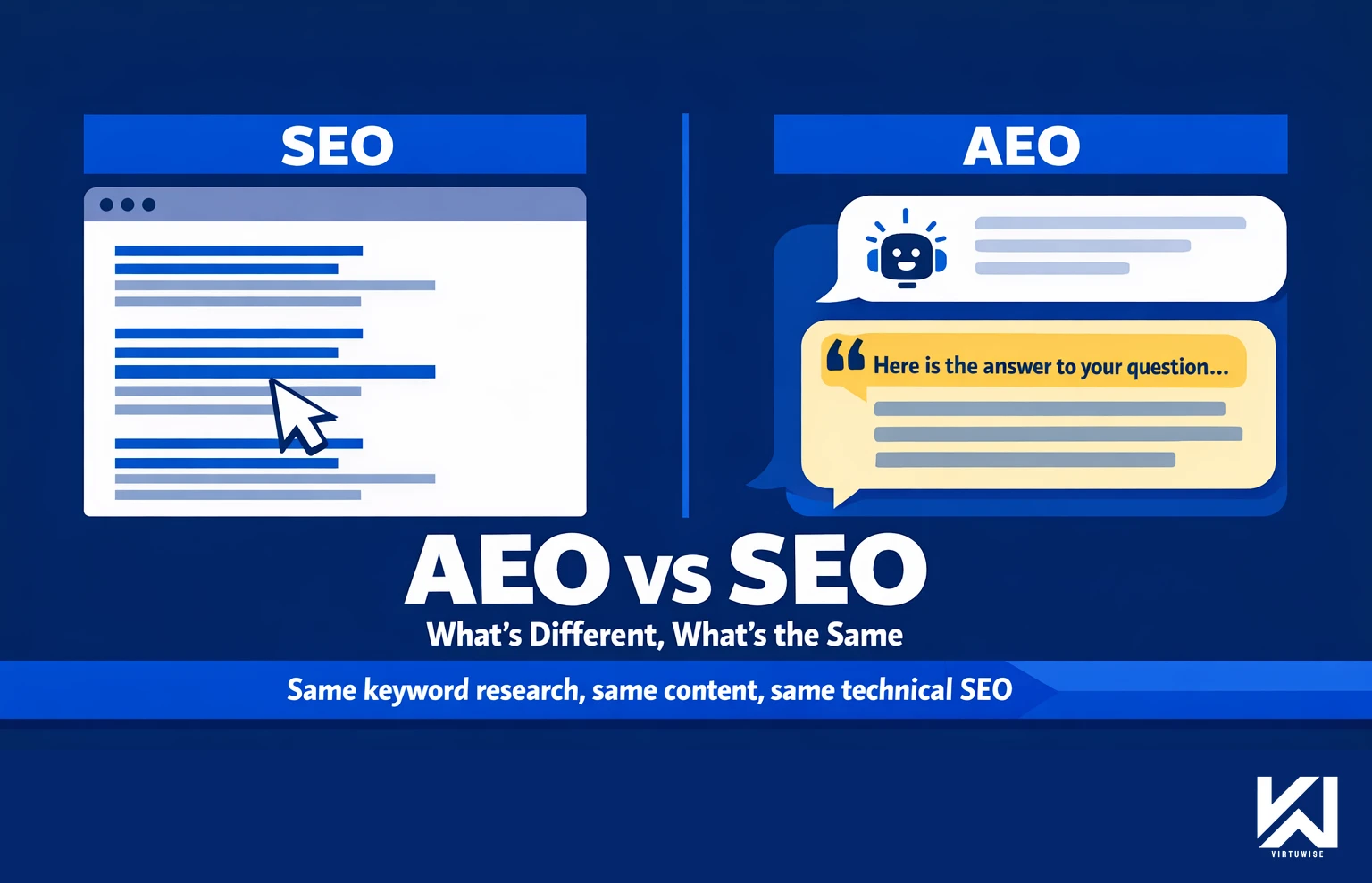
AEO has become one of those terms that agencies rushed to sell as a brand-new discipline requiring a brand-new budget line — separate strategy, separate deliverables, separate monthly retainer from SEO. Some of that is real: AI answer engines do behave differently from Google's traditional ten blue links, and content that ranks doesn't automatically get cited by ChatGPT or Perplexity.
But a lot of it is repackaging. Strip away the new vocabulary and much of what's sold as "AEO strategy" is the same keyword research, the same content quality work, and the same technical SEO foundation that's always mattered — with a few genuinely new additions layered on top.
This guide covers what's actually different between AEO and SEO, what's the same, and why treating them as one engagement — not two separate budgets — is the more accurate way to think about both.
What Is AEO?
AEO (answer engine optimization) is the practice of making content easy for AI systems — ChatGPT, Claude, Perplexity, and Google's AI Overviews — to find, understand, and cite directly in a generated answer. Instead of a user clicking through a ranked link, the AI extracts a fact, a definition, or a recommendation from your content and presents it directly, often without any click to your site at all.
The core AEO-specific additions on top of standard SEO work are:
AI-crawler accessibility
AI models crawl the web through their own bots — GPTBot (OpenAI), ClaudeBot (Anthropic), PerplexityBot — separate from Googlebot. A site's robots.txt can block these bots even while allowing Googlebot, which silently removes a site from AI-generated answers without affecting Google rankings at all. Checking and correcting this is a genuinely new, AEO-specific task.
Structured data for extraction
Schema markup (FAQPage, HowTo, Article) helps AI systems parse facts, questions, and answers out of a page's content more reliably than parsing prose alone. This has always mattered for SEO rich snippets too, but it matters more for AEO, where the entire value proposition is a machine extracting a specific fact correctly.
Answer-shaped content structure
Content written with clear, self-contained, quotable passages — a direct definition in the first sentence of a section, a specific number instead of a vague range — extracts more cleanly into an AI answer than content that builds its point gradually across several paragraphs. This is a real, learnable difference in how content should be structured, not just written.
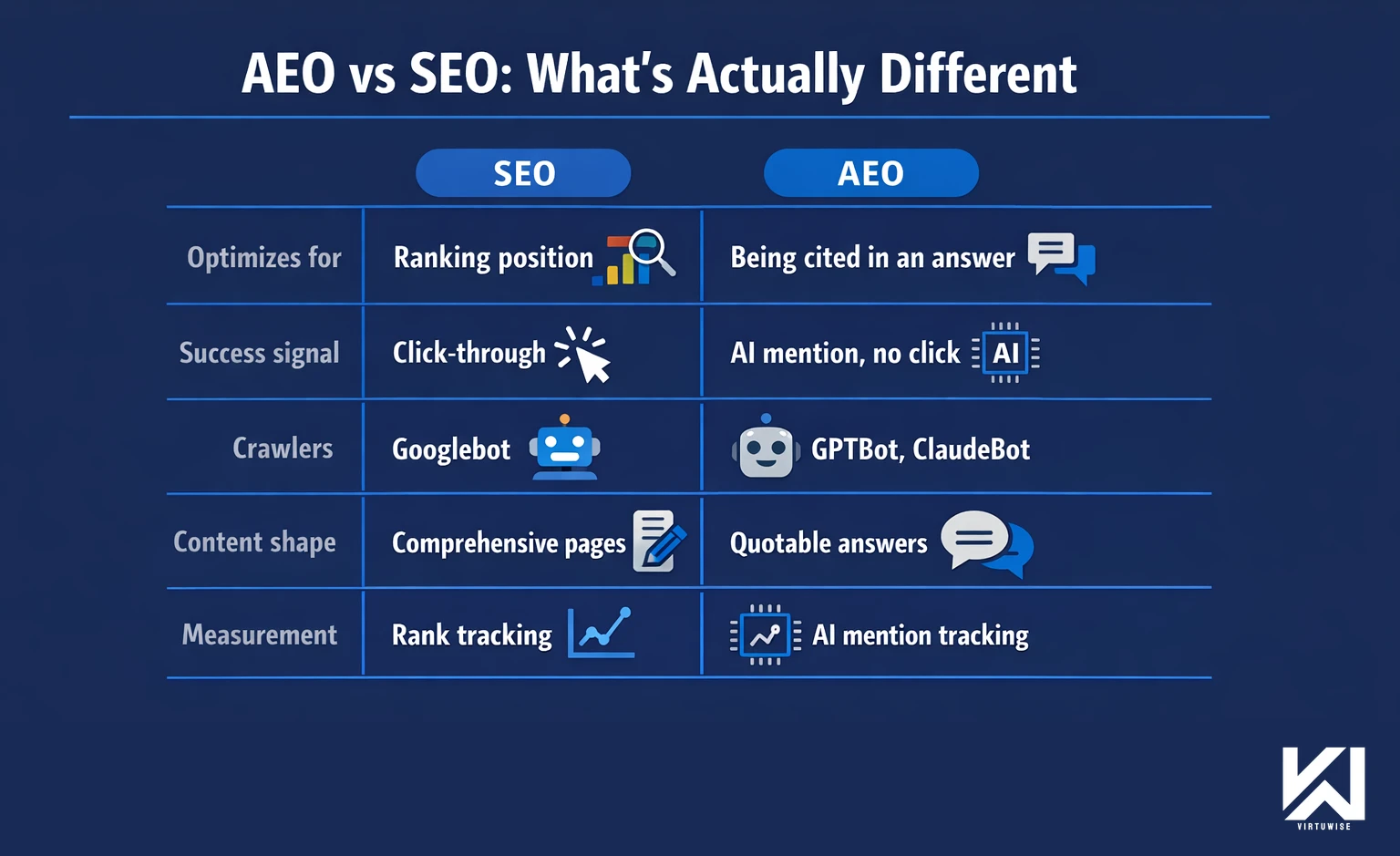
AEO vs SEO: What's Actually Different
| Factor | SEO | AEO |
|---|---|---|
| Optimizes for | Ranking position in a list of links | Being the fact/answer an AI extracts and cites |
| Success signal | Click-through from a search results page | Citation or mention inside a generated answer, often with no click |
| Crawlers involved | Googlebot, Bingbot | GPTBot, ClaudeBot, PerplexityBot, Google-Extended, plus Googlebot |
| Content shape | Comprehensive coverage, internal linking, engagement signals | Direct, quotable, self-contained answers near the top of a section |
| New technical layer | Core Web Vitals, indexation, sitemaps | robots.txt rules for AI crawlers, structured data for extraction |
| Measurement | Rank tracking, organic traffic, click-through rate | AI-platform mention tracking, AI-referral traffic, manual query testing |
The differences are real, but narrower than most "AEO strategy" pitches suggest — a handful of specific, additive changes on top of the same underlying discipline, not a parallel one:
What's the Same
This is the part most "AEO strategy" content skips, because it's less exciting to sell as a new service: the majority of what makes content perform well in AI answers is identical to what's always made content perform well in Google.
Keyword and intent research
AI models still need a query to answer. Understanding what your buyers actually ask — and structuring content around those real questions rather than guessed topics — is the same foundational research SEO has always required.
Content quality and genuine expertise
Generic, interchangeable content that could have been written about any company in your category performs poorly in both channels for the same reason: neither Google's ranking systems nor an AI model's citation selection reward content with nothing specific to say.
Technical site health
A site with crawlability problems, broken pages, or slow load times has the same problems whether Googlebot or GPTBot is trying to access it. Technical SEO work isn't AEO-specific, but AEO fails without it just as much as SEO does.
Backlinks and authority signals
AI models' training and retrieval processes lean on the same signals of established authority that search engines have used for years — sites that are cited, linked to, and referenced by other credible sources. Link building isn't obsolete for AEO; if anything, it matters more, since AI systems have limited ability to independently verify a source's credibility beyond signals like this.
Why AEO and SEO Should Be One Engagement, Not Two
Selling AEO as a separate retainer from SEO means selling the same keyword research and the same content production twice, under two different names. The genuinely new AEO-specific work — AI-crawler accessibility, structured data, answer-shaped content structure — is additive, not a parallel workstream requiring its own strategy phase, its own content calendar, and its own budget line.
The practical case for running them together:
- One piece of content serves both purposes. An article written with clear, quotable passages and solid keyword targeting ranks in Google and gets cited by AI models — it doesn't need a separate "AEO version."
- The technical foundation is shared. Fixing crawlability, adding structured data, and improving site health serves both Googlebot and AI crawlers simultaneously.
- Reporting is more honest. A single engagement reporting on organic rankings, AI-platform mentions, and traffic from both sources gives a real picture of total search visibility — not two disconnected reports that make it hard to tell what's actually working.
Is AEO Replacing SEO?
No — and treating it that way is a mistake some companies are making right now, redirecting budget away from SEO to chase a channel that, while growing quickly, still represents a fraction of the search traffic Google sends. Google remains the dominant source of B2B search traffic by a wide margin, and Google's own AI Overviews are themselves built on the same crawling and ranking infrastructure that classic SEO has always targeted.
AEO is additive: a real, growing, and increasingly measurable channel worth investing in — on top of SEO, not instead of it.
How VirtuWise Runs SEO and AEO
VirtuWise treats SEO and AEO as one engagement because the evidence above says they should be: shared keyword research, shared content, shared technical foundation, with the AEO-specific work — AI-crawler accessibility, structured data, answer-shaped content — built in rather than sold as a second retainer.
Inbound (SEO & AEO) starts at €3,500/month — one engagement covering both. Full details at virtuwise.io/pricing or on the SEO & AEO services page.Frequently Asked Questions
What is AEO?AEO (answer engine optimization) is the practice of making content easy for AI systems — ChatGPT, Claude, Perplexity, Google AI Overviews — to find, understand, and cite in their generated answers. It includes AI-crawler accessibility (not blocking GPTBot, ClaudeBot, PerplexityBot), structured data, and content written with clear, directly-quotable passages rather than only long narrative prose.
What's the actual difference between AEO and SEO?SEO optimizes for ranking in a list of links a human clicks through. AEO optimizes for being the fact an AI model extracts and cites directly in its answer, often without the user ever clicking a link. The practical differences are narrower than the marketing around AEO suggests: AI-crawler accessibility, structured data, and answer-shaped content structure — layered on top of the same keyword research, content quality, and technical foundation SEO already requires.
Do I need a separate AEO budget from my SEO budget?No, for most B2B companies. AEO and SEO share the same foundation — the same keyword and intent research, the same content, the same technical site health. Running them as one engagement avoids paying twice for the same research and content work under two different names. Agencies selling AEO as an entirely separate retainer are usually re-selling the same deliverable with a new label.
Is AEO replacing SEO?No. Google still drives the majority of B2B search traffic, and classic SEO fundamentals — technical health, content quality, backlinks — remain the foundation AI answer engines build their own crawling and ranking on top of. AEO is an addition to SEO, not a replacement for it. Companies that drop SEO investment to chase AEO are optimizing for a smaller, faster-growing channel at the expense of their largest existing one.
How do I know if AEO is working?Track brand and content mentions in AI-generated answers (manually testing your target queries in ChatGPT, Claude, and Perplexity, or using an AI-visibility monitoring tool), referral traffic from AI platforms in your analytics (increasingly visible as a distinct traffic source), and whether your content appears in Google AI Overviews for your target queries. These are newer, noisier signals than classic SEO rank tracking, but they're measurable.