
Cold Email Response Rates: 2026 Benchmarks and How to Beat Them
What's a good cold email response rate in 2026? Industry benchmarks by sector, sequence type, and what separates 1% reply rates from 9%+. Based on data from 200,000+ B2B outreach contacts.
Most cold email campaigns underperform not because the channel is dead — but because teams benchmark themselves against the wrong numbers.
"Is 2% a good reply rate?" We hear this question constantly. The answer: it depends entirely on what you're comparing it to. The average B2B cold email sits at 1–3% replies. But well-structured campaigns targeting the right audience with the right message routinely hit 7–12%. The best ones push 15% or higher.
This guide breaks down what the numbers actually mean in 2026, which variables move them the most, and what the top-performing outbound teams do differently.
What Is a "Good" Cold Email Response Rate?
Response rate measures the percentage of cold email recipients who replied — positive, negative, or neutral. It's the metric that matters most: an opened email that goes unanswered generates zero pipeline.
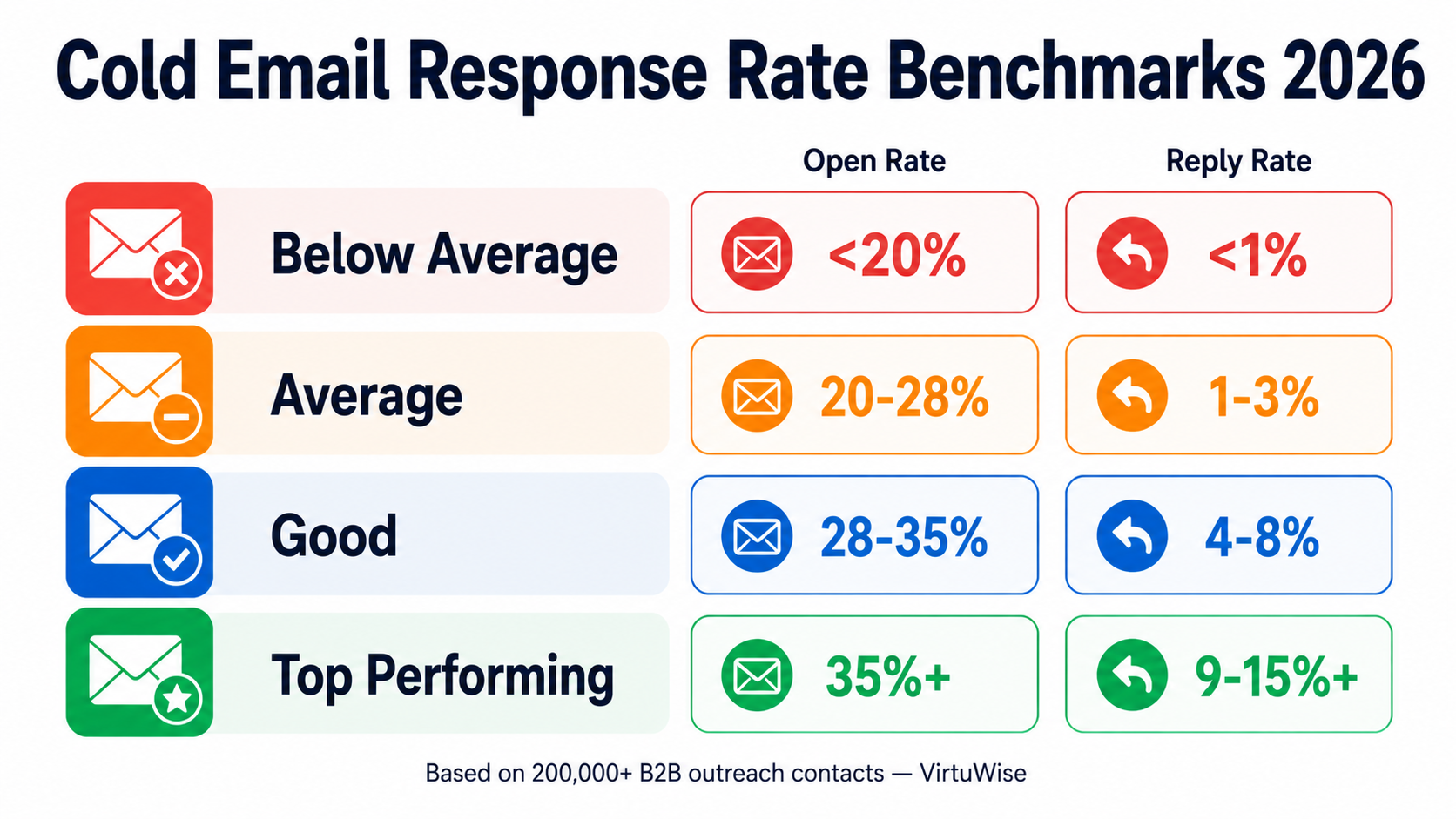
Here's how the industry breaks down in 2026:
| Performance Tier | Open Rate | Reply Rate | What It Signals |
|---|---|---|---|
| Below average | < 20% | < 1% | Poor list quality or generic messaging |
| Average | 20–28% | 1–3% | Decent targeting, template-level copy |
| Good | 28–35% | 4–8% | Strong ICP, personalized sequences |
| Top-performing | 35%+ | 9–15% | Precise targeting + high-quality copy + follow-up |
| Exceptional | 40%+ | 15%+ | Account-based, highly researched, senior sender |
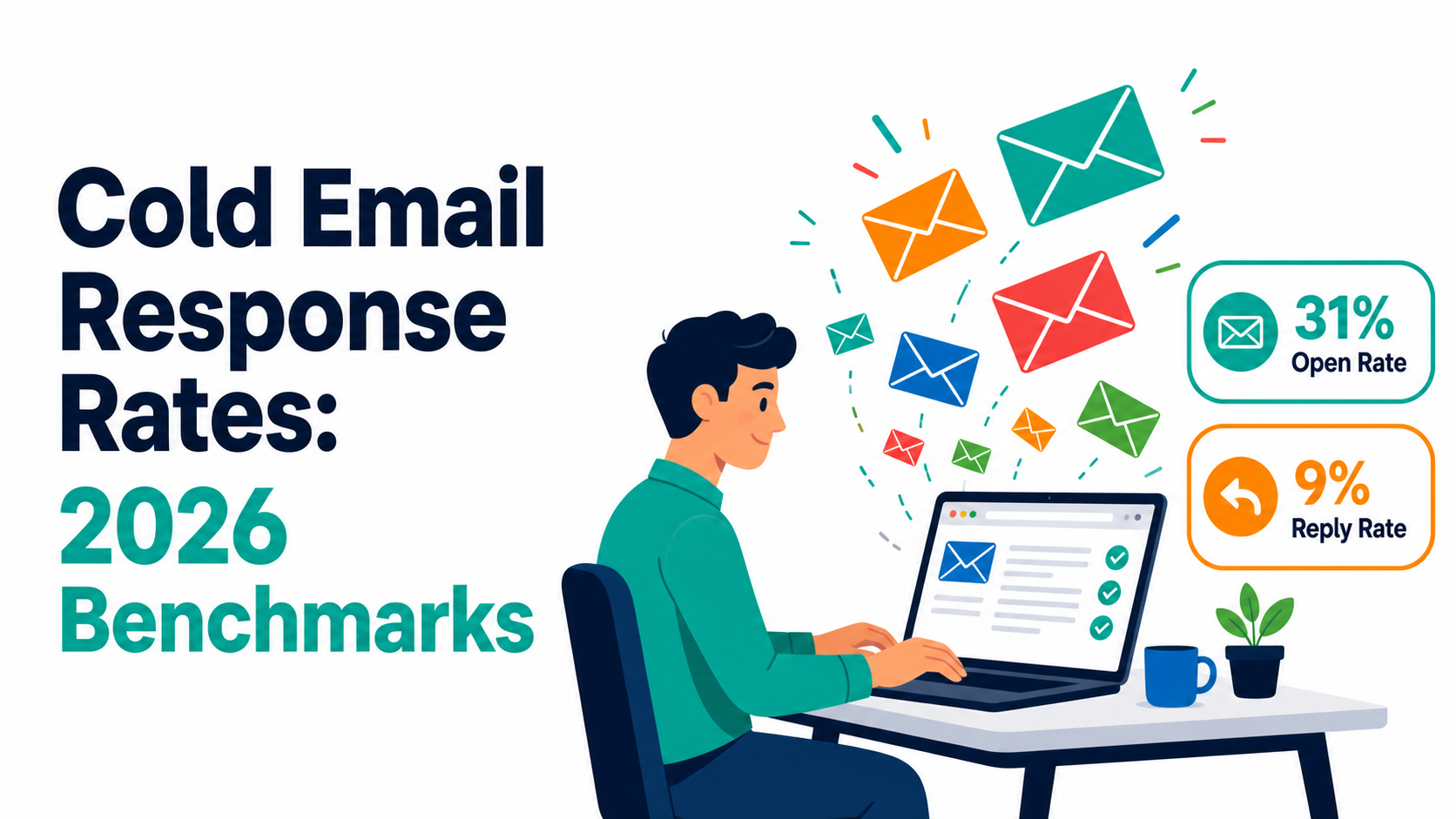
Across our campaigns at VirtuWise, reaching 200,000+ B2B decision-makers in fintech, gaming, and IT services, we consistently see 31% average open rates and 9% average response rates — roughly 3x the industry baseline.
The gap between 2% and 9% is not luck. It comes down to five measurable variables.
The 5 Variables That Determine Your Reply Rate
1. List Quality (Accounts for ~40% of results)
The most technically perfect email sent to the wrong person generates nothing. Most campaigns fail at targeting, not copywriting.
What separates high-quality lists:
- Verified work emails (not generic info@ addresses)
- Specific job titles matching actual buying authority
- Companies that match your ICP by size, industry, and tech stack
- Recent signals: hiring, funding, product launches, leadership changes
A list of 500 well-matched prospects will outperform a list of 5,000 loosely matched ones in both reply rate and qualified pipeline.
2. Subject Line
Your subject line determines whether the email gets opened. Industry data consistently shows:
- Personalized subject lines (including company name or a specific reference) improve open rates by 26–35%
- Short subject lines (3–7 words) outperform longer ones
- Question-based subjects generate higher curiosity and open rates
- Avoid spam triggers: "free," "guaranteed," excessive punctuation (!!!)
High-performing subject lines in B2B cold email:
Quick question, [First Name]
[Mutual connection] suggested I reach out
[Company Name] + [Your Company]?
Re: [specific problem they likely have]
What kills open rates: generic lines like "Checking in" or "Following up on my previous email."
3. Email Copy and Personalization
The body of your email has one job: give the recipient a reason to reply.
In 2026, personalized emails generate 2.5x higher reply rates than templated ones. But personalization does not mean mentioning someone's first name — that is table stakes. It means:
- Referencing their specific business context ("I saw you recently expanded into Germany...")
- Connecting your offer to a visible pain point ("Your team is scaling sales without an SDR function yet...")
- Making the ask feel small and natural ("Would it make sense to connect for 15 minutes?")
Optimal cold email structure:
- Opening hook — one sentence that shows you did your homework
- The connection — why you are reaching out to them specifically
- The value — what outcome you help create (concrete, not vague)
- The ask — one specific, low-friction call to action
- Signature — real person, real company, real contact info
Optimal length: 50–125 words. Longer emails see diminishing returns in reply rate after 150 words.
4. Follow-Up Sequence
If you send one email and stop, you are leaving most of your replies on the table.
Industry data on multi-touch sequences:
- 44% of salespeople give up after one follow-up
- 80% of replies in cold email campaigns come from follow-up emails #2, #3, or #4
- Sequences with 4–6 touches generate 3x more replies than single-touch outreach
Optimal follow-up cadence for B2B:
Day 1: Initial email Day 3–4: Follow-up #1 — add value, do not just "check in" Day 7–8: Follow-up #2 — different angle or social proof Day 14: Follow-up #3 — the "breakup" email (often gets the most replies)Each follow-up should stand on its own. Never send "Just bumping this up" — it signals no value was added.
5. Technical Deliverability
You can have the best list and the best copy, but if your emails land in spam, nothing else matters.
The technical checklist for 2026:
- SPF, DKIM, and DMARC records properly configured
- Dedicated sending domain — never send cold email from your main company domain
- Warmup period — new domains need 4–8 weeks of gradual warmup before full volume
- Sending limits — stay under 50–100 emails/day per mailbox to avoid throttling
- Bounce rate — keep below 2%; higher bounce rates trigger spam filters
Broken deliverability looks like good open rates on paper (bots open everything) but zero replies.
Cold Email Benchmarks by Industry
Response rates vary significantly by vertical. Here are 2026 benchmarks based on campaign data:
| Industry | Average Open Rate | Average Reply Rate |
|---|---|---|
| Fintech / Payments | 28–35% | 6–10% |
| IT Services / Software Dev | 25–32% | 4–8% |
| SaaS | 22–30% | 3–7% |
| Gaming / iGaming | 30–38% | 7–11% |
| Manufacturing | 18–25% | 2–5% |
| Logistics | 20–28% | 3–6% |
| Professional Services | 24–32% | 4–7% |
What the Top 10% Do Differently
After analyzing hundreds of B2B outbound campaigns, the pattern is consistent. Teams with 8%+ reply rates share these habits:
They send fewer emails, not more.The instinct is to scale volume. The reality is that narrower, more researched lists almost always outperform broader blasts — both in reply rate and in lead quality.
They treat follow-up as a separate strategy.Each follow-up email has a different angle: first adds a case study, second references an industry event, third opens the door to a future conversation. None says "just checking in."
They A/B test consistently.Two subject line variants. Two opening sentences. Two CTAs. The difference between a 4% and 9% reply rate is often one element discovered through testing.
They track reply quality, not just reply quantity.A high volume of "not interested" replies inflates reply rate but signals bad targeting. The real metric is qualified positive replies — responses from people who match your ICP and express interest.
They obsess over deliverability.The best copy in the world means nothing if it lands in spam. High performers audit their deliverability monthly and rotate sending domains proactively.
Common Mistakes That Kill Reply Rates
Sending to purchased lists without verification.Unverified lists typically have 20–40% invalid emails. This destroys deliverability and tanks reply rates.
Pitching in the first email.Cold email is not advertising. A first email that leads with pricing, features, and a hard ask feels like spam — because it is. The goal of email #1 is to start a conversation, not close a deal.
Using one sequence for all prospects.A €50M fintech scale-up and a bootstrapped SaaS startup need completely different messaging. One template for both means neither feels relevant.
Ignoring unsubscribes and bounces.Continuing to email people who have asked to be removed is not just bad practice — in Europe, it is a GDPR violation with real consequences.
Setting it and forgetting it.Cold email requires ongoing optimization. If you launch a sequence and never adjust based on performance data, results will degrade over time.
How to Improve Your Cold Email Response Rate: Quick Audit
If your campaigns are underperforming, run through this checklist:
List: Are you targeting verified contacts at companies that match your ICP? Is your targeting narrow enough? Subject line: Is it personalized and specific? Under 7 words? Free of spam triggers? Email body: Is it under 125 words? Does it mention a specific context relevant to the recipient? Is the CTA one simple, low-friction ask? Sequence: Are you sending at least 3–4 touches? Is each follow-up adding new value? Deliverability: Are SPF, DKIM, DMARC configured? Are you using a separate sending domain? Is your bounce rate below 2%?If you answer "no" to more than two of these, that is where the performance gap lives.
The Bottom Line
A 1–3% cold email response rate in 2026 is not inevitable — it is the result of generic lists, generic copy, and single-touch sequences. With proper targeting, personalized messaging, and a structured follow-up cadence, 7–12% is achievable for most B2B teams.
The businesses that treat cold email as a system — not a broadcast — consistently outperform those chasing volume.
Want to see what a properly structured cold email campaign looks like for your industry? VirtuWise runs outbound email campaigns for fintech, gaming, and IT companies across EU and US markets — with an average 31% open rate and 9% response rate across active campaigns. View our case studies or get in touch to discuss what is possible for your pipeline.
Related reading: 5 Steps to Turn B2B Email Outreach Into a Predictable Revenue Channel B2B Lead Generation Channels That Actually Work in 2026