
Link Building Services: What to Expect, What They Cost, and How to Choose a Provider
Link building services vary from relationship-based outreach to link farms selling risk as authority. Here's what to expect, what it should cost, and how to tell them apart.
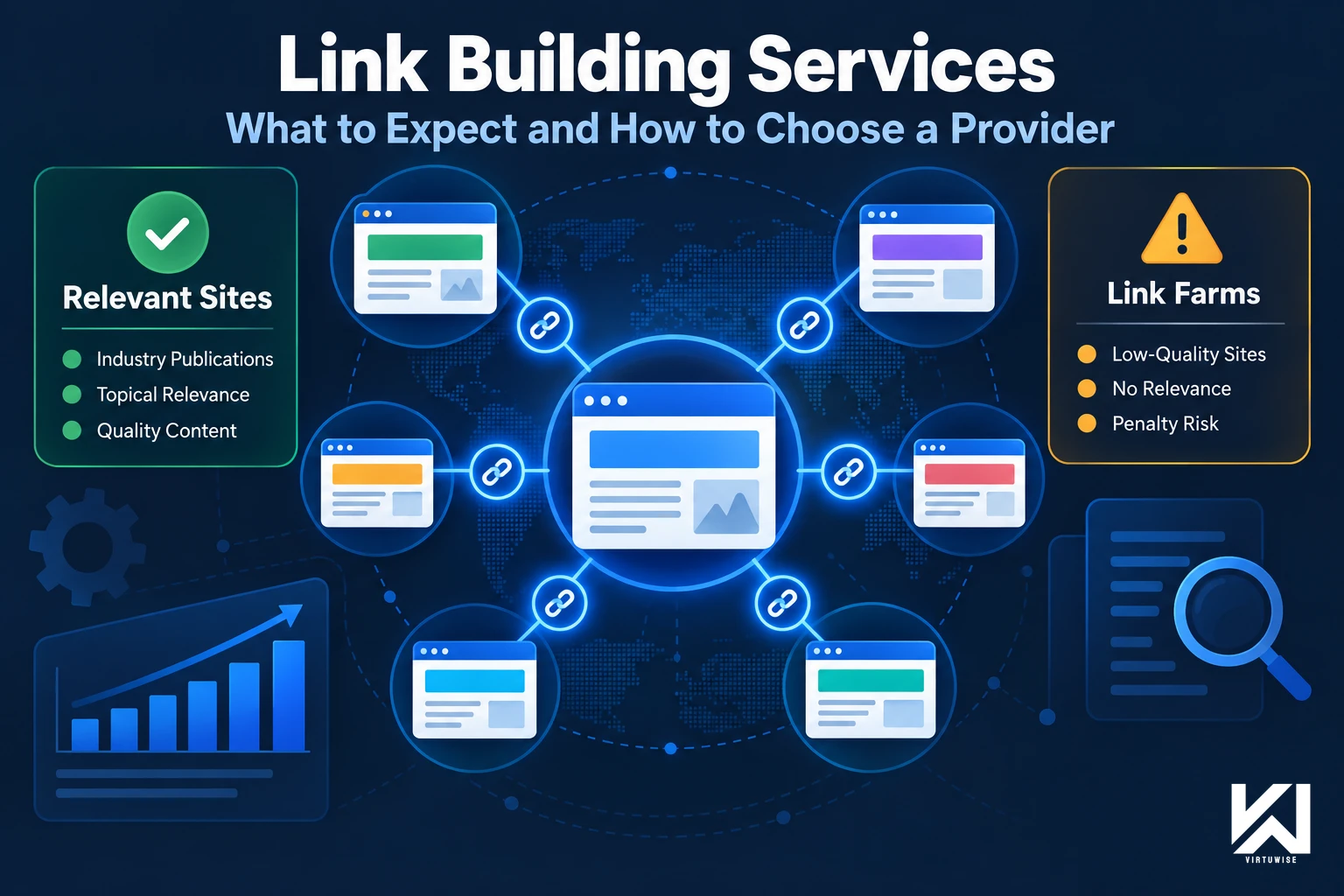
Link building services all promise the same outcome: more authoritative backlinks, better rankings. What's actually behind that promise varies more than almost any other SEO service — from genuine relationship-based outreach on sites your buyers read, to bulk link farms and private blog networks selling risk dressed up as authority.
The difference is rarely visible in a sales call. It shows up months later, when one company's rankings compound steadily and another's site takes a manual action from Google for unnatural links.
This guide covers what link building services should actually include, why quality varies so dramatically, what B2B link building specifically requires, what it should cost, and how to evaluate a provider before signing.
What Link Building Services Include
A complete link building engagement covers more than "getting links." A real program includes:
Backlink audit and competitor gap analysis
Understanding your current link profile — what's working, what's toxic, and where competitors have authority you don't — before starting outreach. Providers who skip this and go straight to outreach are guessing at priorities.
Niche and publication mapping
Identifying the specific sites your actual buyers read, reference, or trust — not a generic list of "high DA" sites available to any client regardless of industry. This mapping work is what separates relevant placements from ones that look fine on a metrics dashboard and do nothing for actual authority.
Outreach and relationship building
Real conversations with real site owners and editors — pitching genuinely useful content or a partnership angle, not a templated mass email. This is the labor-intensive part that bulk providers skip entirely in favor of purchased placements.
Content and asset creation
Many of the strongest links come from content built specifically to earn them — original research, data studies, tools, or genuinely useful resources — rather than being pitched at existing pages. Providers offering "link building" with no content component are usually buying placements, not earning them.
Digital PR and newsworthy angles
For B2B companies with a genuine story — funding news, proprietary data, a notable hire, a contrarian take on an industry trend — digital PR can earn links at a scale relationship outreach alone can't match.
Reporting on relevance, not just volume
A link count is the easiest thing to report and the least useful on its own. Real reporting covers domain relevance, referring page traffic, and placement context — whether a link sits in genuinely useful content or a thin, unrelated page built to hold it.
Why Link Building Quality Varies So Dramatically
The pitch is nearly identical across providers: authoritative links, white-hat methods, transparent reporting. The execution is where it diverges completely.
Relevance-first outreach vs. volume-first placement
Quality providers prioritize whether a real buyer in your niche would ever see or trust the placement. Volume-first vendors optimize for a number — links delivered per month — regardless of topical relevance. A single relevant placement on a site your buyers actually read outperforms a dozen generic links search engines have spent years learning to discount.
Earned and paid placements vs. link farms and PBNs
Legitimate paid placements (sponsored content on a real, editorially-run publication with genuine traffic) are a normal part of digital PR. Link farms and private blog networks are a different category entirely — networks of low-quality sites that exist only to sell links, carrying real risk of a Google manual action regardless of how the invoice describes them.
Real editorial standards vs. pay-to-publish networks
A placement on a site with genuine traffic, real editorial oversight, and content readers actually engage with is a fundamentally different asset than a guest post on a site that exists purely to host paid links. Both can look identical in a spreadsheet of "links delivered" — the difference only shows up when you visit the site.
Disavow hygiene as an ongoing practice vs. a one-time favor
Toxic and spammy backlinks accumulate on every site over time — from scrapers, old link schemes, or a previous provider's bad work. Quality providers monitor and disavow on an ongoing basis. Providers who never mention disavow work are either not looking, or building links that will need disavowing themselves eventually.
Link Building Services Evaluation Checklist
| Criterion | What to Ask | Red Flag Answer |
|---|---|---|
| Link sourcing | Where do links come from — how are sites vetted for relevance? | "We have a network of sites" |
| Reporting depth | Do you report relevance and traffic, or just a link count? | Link count only, no context per placement |
| Guaranteed metrics | Do you guarantee Domain Authority or Domain Rating increases? | "Yes, guaranteed DA increase" |
| Disavow practice | Is toxic-link monitoring ongoing or a one-time audit? | "We did that when we onboarded you" |
| Content component | Do you create content to earn links, or only pitch existing pages? | Outreach only, no content offered |
| Vertical references | References from clients in a comparable industry? | Only generic case studies, no live references |
B2B Link Building: Why It's Different
B2B link building carries specific requirements that generic SEO link building doesn't always account for.
Narrower, more specific relevant-site pools
A B2C brand can often find hundreds of loosely relevant lifestyle or news sites. A B2B company selling payment infrastructure or DevOps tooling has a much narrower pool of genuinely relevant industry publications, and each one matters more because there are fewer of them.
Longer sales cycles reward compounding authority
B2B buyers research extensively before a sales conversation. Authority built through consistent, relevant link building compounds over the months a typical B2B buying committee spends evaluating options — a longer payoff window than most consumer SEO, which rewards patience over volume.
Technical and industry publications matter more than general press
A mention in a niche technical publication or industry trade press often carries more real authority signal — and more actual referral value — for a B2B company than a broader, less relevant news placement most B2C link building chases.
Executive visibility as a link-building asset
Original commentary, data, or a genuine point of view from a company's own executives is a specifically B2B-shaped link-building lever — journalists and industry publications look for expert sources, and a credible executive voice earns citations that generic content outreach can't.
Link Building Agency vs. In-House: What to Expect
A specialized link building agency brings existing relationships, established outreach infrastructure, and content production capacity that takes years to build in-house. The tradeoff is quality control — you're trusting an external team's judgment on which placements actually represent your brand well.
What a competent link building agency should deliver from month one:
- A backlink audit and prioritized gap analysis specific to your competitors, not a generic checklist
- A niche-relevant publication list, built for your industry, not reused across unrelated clients
- Transparent reporting on relevance and placement context, not just a monthly link count
- A clear answer on disavow practice and toxic-link monitoring
Choosing a Link Building Company: Red Flags to Rule Out
Certain answers should end an evaluation immediately, regardless of price:
- Guaranteed Domain Authority increases — DA/DR are third-party metrics no provider controls or can honestly guarantee.
- A fixed link count with no relevance discussion — "50 links a month" without any mention of niche fit or site quality is a volume pitch, not a link building strategy.
- No willingness to name example placements or references — legitimate providers can show real examples in a comparable industry.
- Pricing dramatically below market — link building requires real outreach labor or real paid placement cost; prices far below the benchmarks below usually mean link farms or PBNs.
What Link Building Services Should Cost
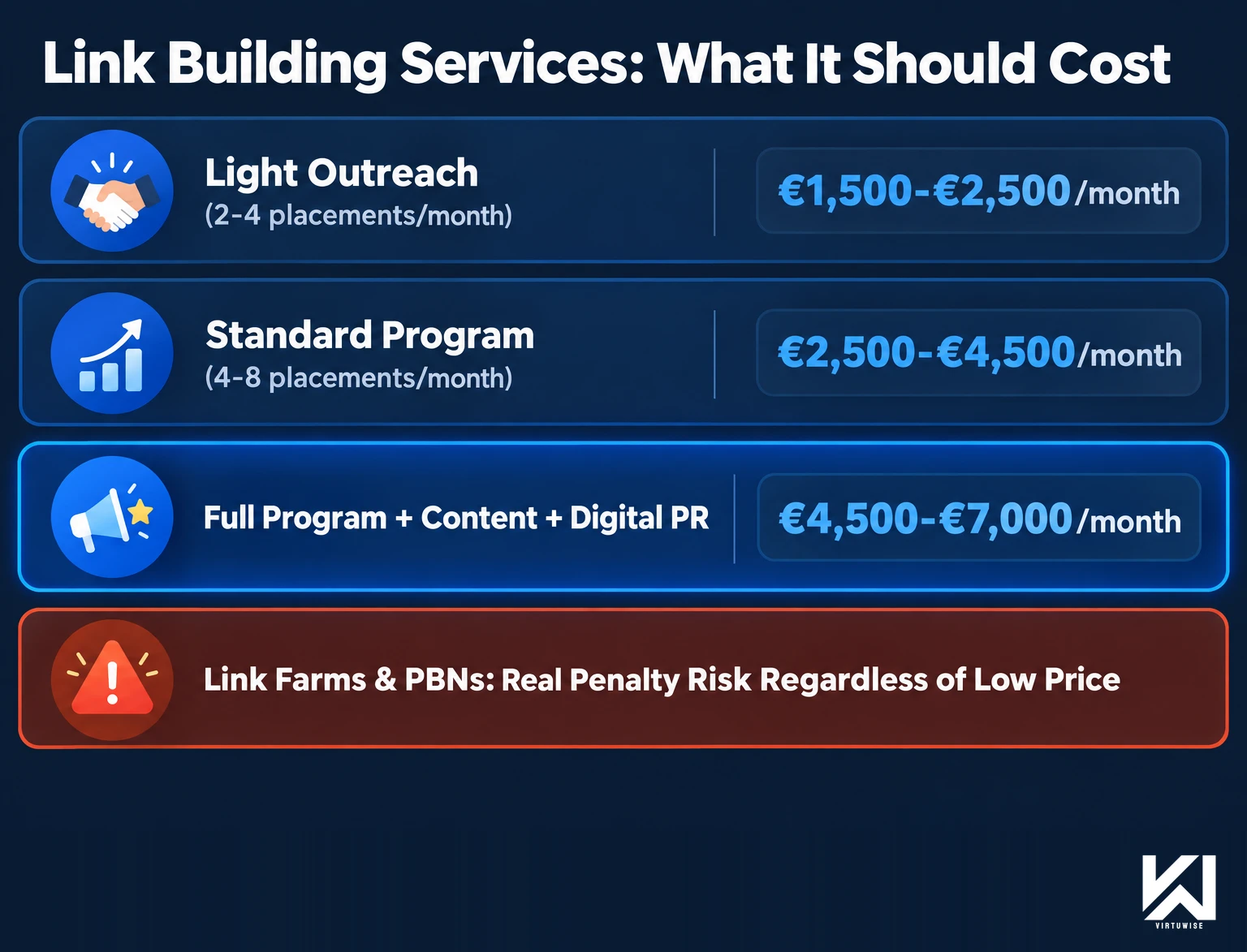
| Scope | Typical Monthly Cost |
|---|---|
| Light outreach (2-4 placements/month) | €1,500–€2,500/month |
| Standard program (4-8 placements/month) | €2,500–€4,500/month |
| Full program with content + digital PR | €4,500–€7,000/month |
Below €1,000/month for meaningful placement volume is close to impossible without link farms or PBNs — genuine outreach and vetted placements simply cost more in labor and site fees than that budget allows. The relevant benchmark isn't cost per link; it's relevance and durability of the placements you're actually getting.
Put side by side, the real cost difference between doing this properly and cutting corners looks like this:
How VirtuWise Runs Link Building
VirtuWise's link building runs relevance-first, scoped alongside an active SEO & AEO engagement rather than as a standalone tactic — earned authority only compounds into rankings and AI citations when there's genuinely strong content and technical work underneath it. No directories, no link farms, no PBNs, regardless of niche or budget.
Link building scopes and prices separately from the core SEO & AEO engagement — talk to us about fit on a call. Full details at virtuwise.io/pricing or on the Link Building services page.Frequently Asked Questions
What do link building services include?A complete link building engagement includes a backlink audit and competitor gap analysis, niche publication mapping, outreach and relationship building, content or asset creation to earn placements, and ongoing disavow hygiene for toxic links — reported on relevance and placement context, not just a raw link count.
How much do link building services cost?Link building services typically range from €1,500/month for a light outreach program to €4,500-€7,000/month for a full program including content creation and digital PR. Below roughly €1,000/month for meaningful volume usually signals link farms or private blog networks rather than genuine outreach.
What's the difference between a link building agency and link farms or PBNs?A legitimate link building agency earns placements through relevance-based outreach or vetted paid placements on real, editorially-run publications with genuine traffic. Link farms and private blog networks are collections of low-quality sites that exist purely to sell links — they carry real risk of a Google manual action, regardless of how the pricing or contract describes the service.
Is B2B link building different from general SEO link building?Yes. B2B link building works with a narrower pool of genuinely relevant industry and trade publications, rewards compounding authority over B2B's longer sales cycles, and benefits specifically from executive visibility and original data as link-earning assets — levers that don't map as directly onto consumer-focused link building.
Should I add link building to an existing SEO program, or is it standalone?Link building works best scoped alongside an active SEO program rather than as an isolated tactic. Links point authority at content — without strong content and technical SEO underneath it, that authority has less to actually convert into rankings or AI citations.