
AI for SEO: What to Automate and What Still Needs a Human
How to use AI for SEO without hurting rankings: what AI does well, what still needs a human, where the risks are, and how to split the work between tools and your team.
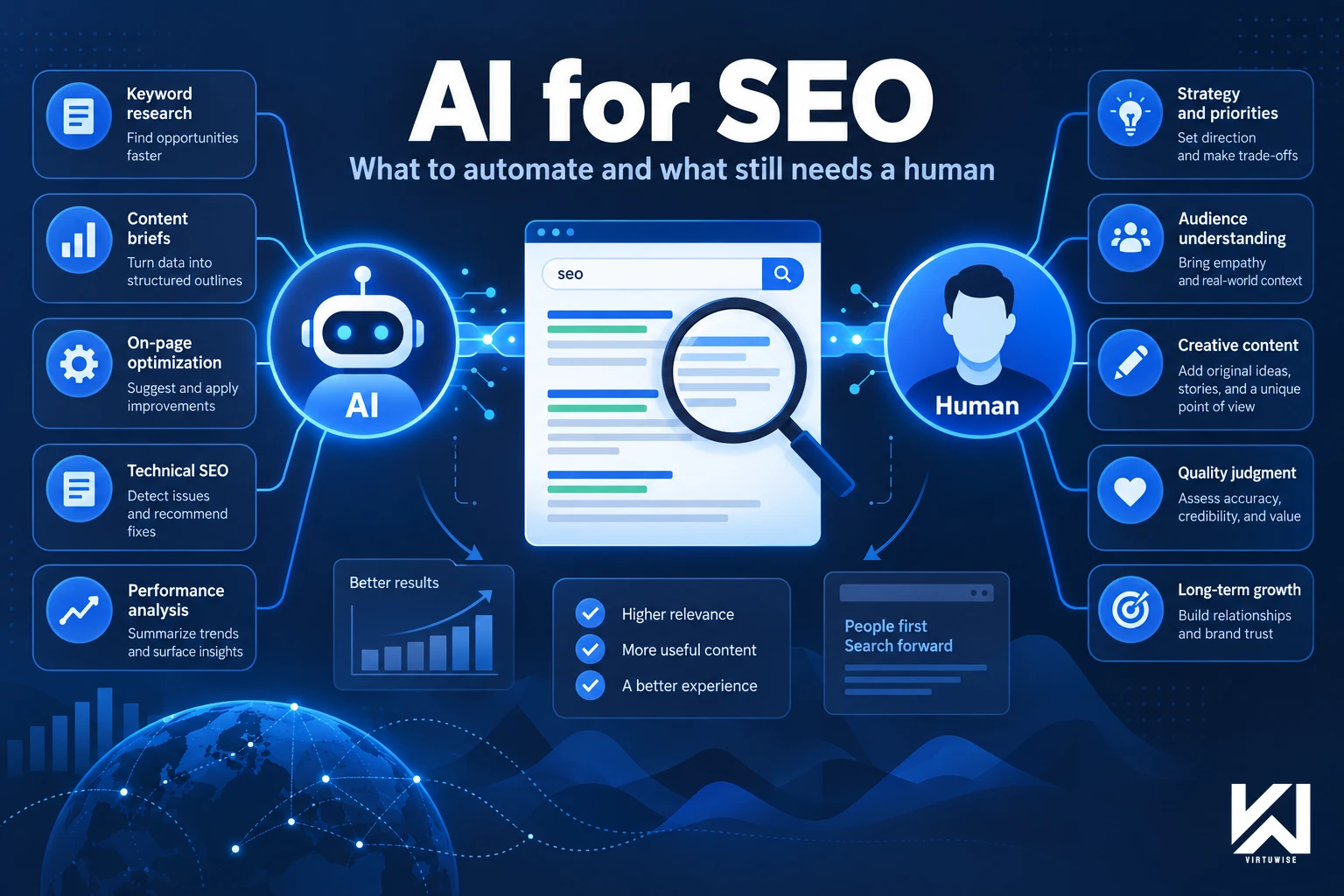
AI is useful for SEO when it speeds up the work a person still owns, and risky when it replaces the person. It is good at processing large amounts of data, grouping keywords, drafting briefs and producing first versions. It is not good at deciding what your company should rank for, what is true, or which sources deserve to link to you. Those decisions need a human who is accountable for the result.
This guide shows where AI for SEO earns its place, where a human has to stay in charge, which risks to watch, and how to divide the work so you get the speed without the downside.
What AI Does Well in SEO
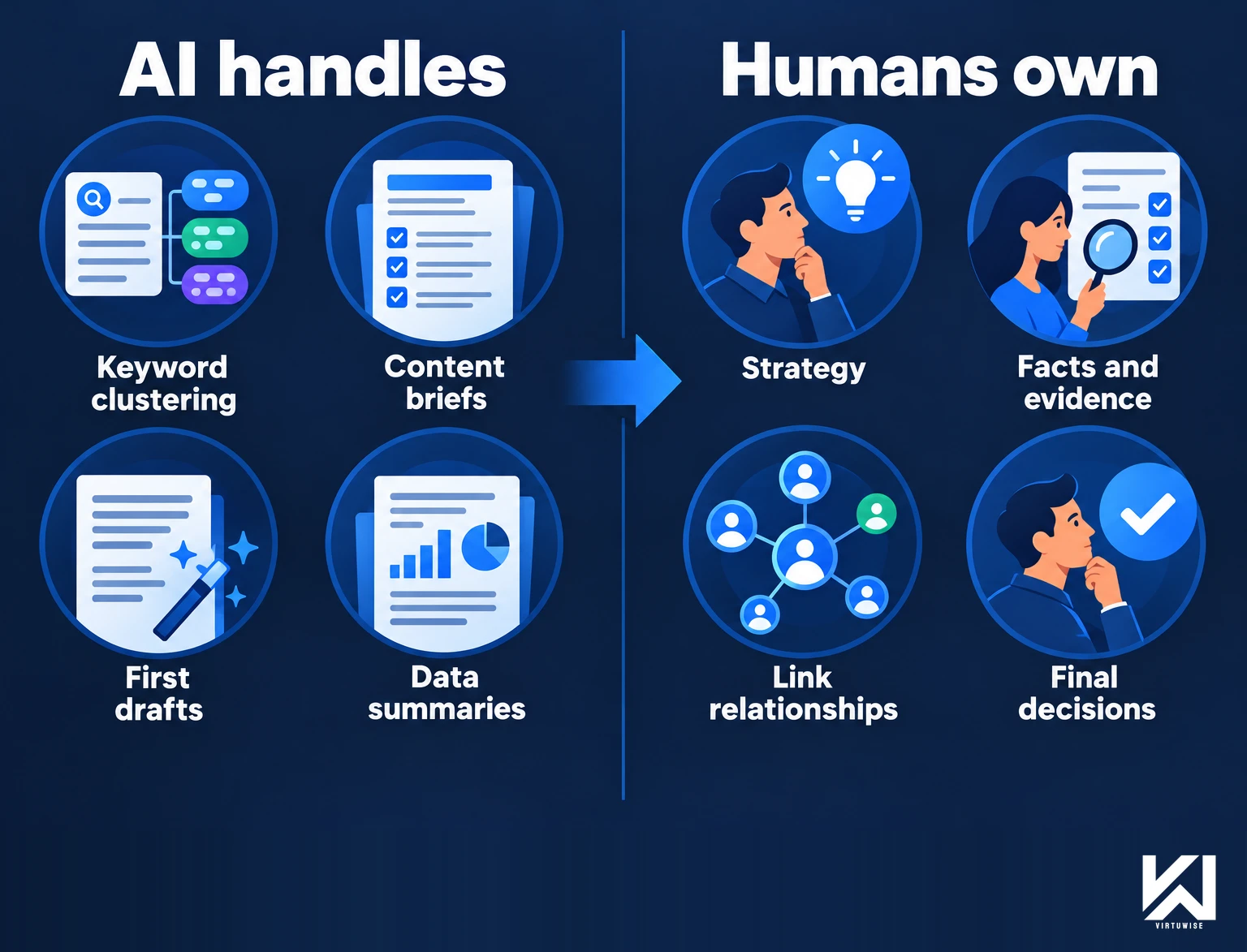
AI performs best on tasks that are repetitive, data-heavy and easy to check. In SEO that includes:
- Keyword grouping and topic clustering. Sorting thousands of queries into themes that become pages or articles.
- Drafting content briefs. Turning a keyword and a list of competing pages into a first outline with questions to answer and entities to cover.
- First drafts and rewrites. Producing a starting version that an editor then corrects and improves.
- Meta titles and descriptions at scale. Generating variations that a person selects and tests.
- Technical data summaries. Reading crawl exports and log files and surfacing patterns for a specialist to verify.
- Schema and structured data. Generating markup that is then validated.
- Refresh suggestions. Comparing an old article to current results and listing what is missing.
- Internal linking suggestions. Proposing related pages that a person approves.
In every item above, AI produces a candidate and a person decides. That is the pattern that works.
What Still Needs a Human
Strategy and prioritisation
Deciding which queries are worth pursuing, in which markets, for which buyer, requires knowing your business: margins, sales cycle, who actually buys. A tool can list keywords. It cannot tell you that ten searches from the right buyer are worth more than a thousand from the wrong one.
Original experience and evidence
Search engines and AI answer engines look for content that shows real experience: first-hand data, named examples, specific numbers from real work. AI can only recombine what already exists. Anything that makes your article worth citing has to come from your team.
Fact-checking
AI can produce confident statements that are wrong, including invented statistics and sources. Every claim in published content needs a person to verify it against a real source.
Link and relationship building
Earning links from sites your buyers read depends on relevance and relationships. This is where automated outreach does the most damage, and it is why we scope link building as relationship work, not volume.
Technical judgement
A crawl tool can flag a hundred issues. Deciding which five explain a traffic drop, and in what order to fix them, is judgement. Our guide to a technical SEO audit explains the difference between a scan and an audit.
Voice, positioning and quality control
Content that sounds like everyone else gives readers and AI answer engines no reason to pick yours. An editor who knows your positioning keeps it distinct.
Who does what
| Task | What AI can do | What a human must do |
|---|---|---|
| Keyword research | Group and cluster large lists | Choose targets by buyer value and market |
| Content briefs | Draft outline and questions | Set angle, add proof, approve |
| Writing | Produce a first draft | Add experience, fix facts, edit voice |
| Meta tags | Generate variations | Select and test |
| Technical SEO | Summarise crawl and log data | Prioritise and decide fixes |
| Link building | Suggest prospects | Build relationships, judge relevance |
| Internal linking | Suggest links | Approve based on site structure |
| Reporting | Compile data | Interpret and decide next actions |
The Risks of Using AI for SEO
- Scaled low-value content. Google's spam policies address content produced at scale mainly to manipulate rankings, however it is made. Publishing large volumes of unedited AI text is the fastest way to fall into that category.
- Inaccurate claims. Wrong statistics and invented sources damage trust and can get your content ignored by answer engines.
- Generic content. If your page says what the top ten results already say, there is no reason for it to rank or be cited.
- Weak E-E-A-T signals. No named author, no experience, no evidence. AI cannot supply these for you.
- Over-automated outreach. Bulk automated link pitches produce low-quality links and can harm your reputation with the sites you want to earn links from.
AI Changes What SEO Is For
AI is also changing where your audience looks. People increasingly get answers from AI assistants and AI summaries in search results, which choose a few sources to cite. Being one of them depends on clear structure, factual accuracy, real expertise and authority. That is the idea behind answer engine optimisation, which we cover in AEO vs SEO. It makes the human part of SEO more important, not less: the things AI engines favour are exactly the things AI cannot fake for you.
How to Use AI in Your SEO Workflow
- Start with strategy written by a person. Define the buyer, the markets and the keywords that matter before using any tool.
- Use AI for research and first drafts. Briefs, clustering, outlines and drafts are where it saves the most time.
- Assign a human owner to every piece. A named person verifies facts, adds experience and signs off.
- Add proof AI cannot generate. Client results, real examples, your own numbers.
- Check before publishing. Facts, links, structure and whether the page says something the top results do not.
- Measure outcomes, not output. Track rankings, qualified traffic and meetings, not the number of articles produced.
How VirtuWise Uses AI in SEO and AEO
VirtuWise SEO and AEO is run as one service by a team, with AI used to speed up research, drafting and analysis and a named person owning strategy, facts and the final edit on everything we publish. Every engagement starts with a combined SEO and AI-crawler audit, then content and links are built on a technically sound foundation. Inbound starts at €3,500 per month and is priced as one service. Details on the pricing page.
If you are comparing providers, the questions in our guides to B2B SEO services and SEO content writing services apply equally to any agency that says it uses AI: ask who checks the facts and who is accountable for results.
Frequently Asked Questions
Can AI replace SEO specialists?No. AI can speed up research, drafting and data analysis, but it cannot decide strategy, verify facts, build relationships or take responsibility for results. In practice, it makes a good SEO team faster and gives a weak process more ways to go wrong.
Is AI-generated content bad for SEO?Not by itself. Google's spam policies target content created at scale mainly to manipulate rankings, not the tool used to write it. Unedited AI content that adds nothing new is the risk. AI-assisted content that is fact-checked, edited and backed by real experience can perform well.
What should I automate in SEO?Automate repetitive, data-heavy tasks that are easy to verify: keyword clustering, content brief drafts, meta tag variations, technical data summaries, schema generation and internal link suggestions. Keep strategy, fact-checking, link building and final editorial decisions with a person.
What is an AI SEO agency?An AI SEO agency uses AI tools to speed up SEO work. The label tells you little by itself. What matters is who is accountable for strategy and quality, how facts are checked, and how results are reported.
How does AI affect SEO in 2026?AI answer engines and AI summaries in search now cite a limited number of sources, so authority, accuracy and clear structure matter more. Optimising for being cited, on top of ranking, is what answer engine optimisation covers.
Related reading: