
AI Sales Outreach: The Complete B2B Guide for 2026
AI sales outreach tools promise to automate prospecting and personalise at scale. Here's how to use them effectively, where they fall short, and what a working 2026 stack looks like.
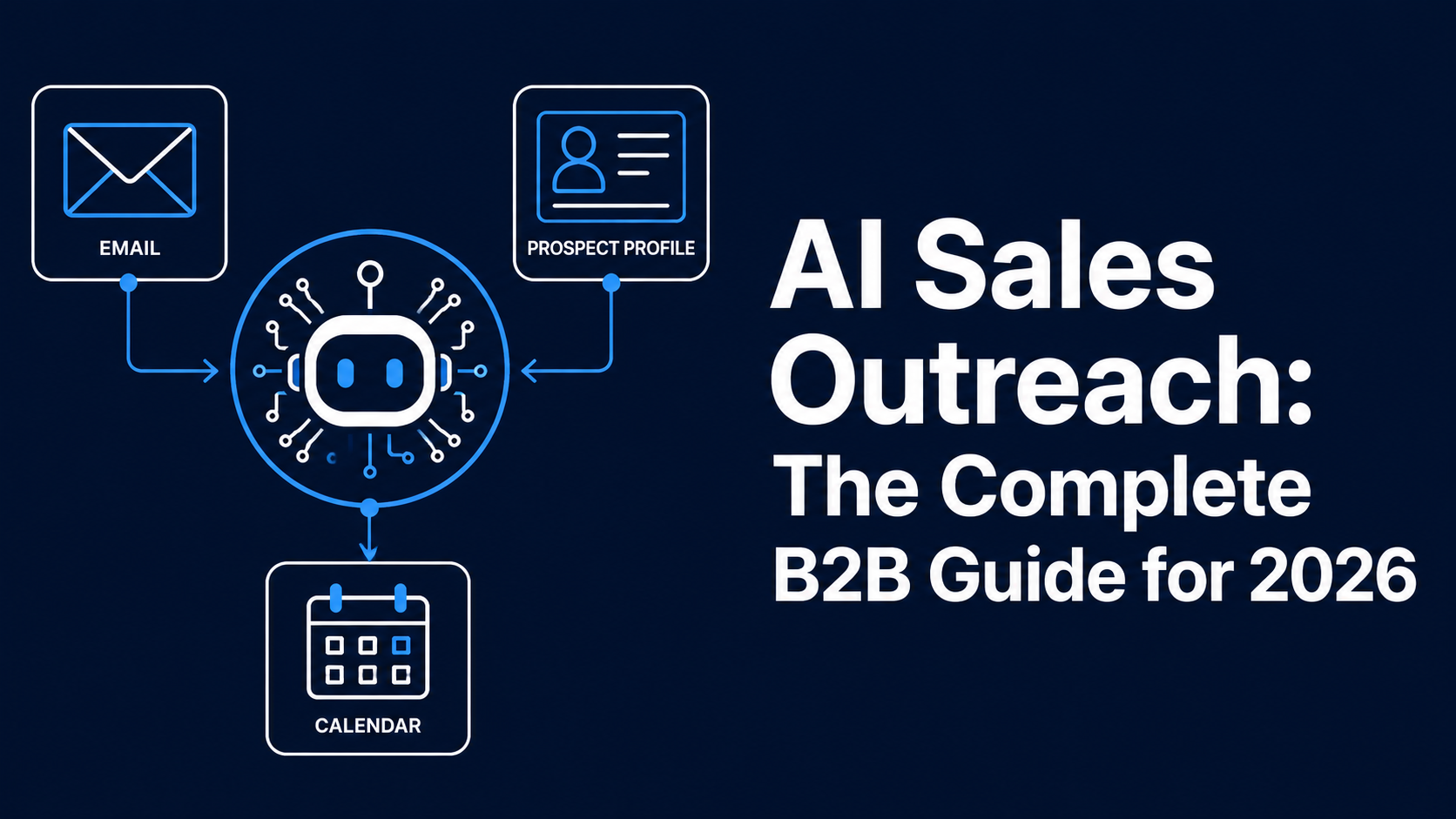
AI has changed what's possible in B2B sales outreach. Tasks that once required hours of manual research — building prospect lists, writing personalised first emails, scheduling follow-up sequences — can now be partially or fully automated. The vendors promise a future where outbound runs itself.
The reality is more specific. AI sales outreach tools work extremely well for certain tasks and poorly for others. The sales teams getting real results from these tools in 2026 are using them for what they're genuinely good at: speed, scale, and first-draft production. They're not expecting the AI to replace the judgment, adaptability, and relationship intelligence that actually close deals.
This guide covers how AI sales outreach tools work, which use cases they fit, what to avoid, and how to build a stack that generates consistent B2B pipeline without burning your sender reputation or your prospects' patience.
What AI Sales Outreach Actually Means in 2026
"AI sales outreach" covers a range of capabilities that vendors often conflate. Before evaluating tools, it helps to separate the distinct functions:
- AI prospecting: using AI to identify and qualify target accounts based on ICP criteria, pulling from data providers like Apollo, Clay, or LinkedIn
- AI email writing: generating personalised first-line copy, full email drafts, or subject lines based on prospect research
- AI sequencing: automating multi-touch outreach across email and LinkedIn with adaptive timing and conditional logic
- AI reply handling: responding to inbound replies based on intent classification — sorting positive replies from auto-replies, objections, and out-of-office messages
- AI personalisation at scale: inserting context from LinkedIn activity, company news, or firmographic data into templated outreach at volume
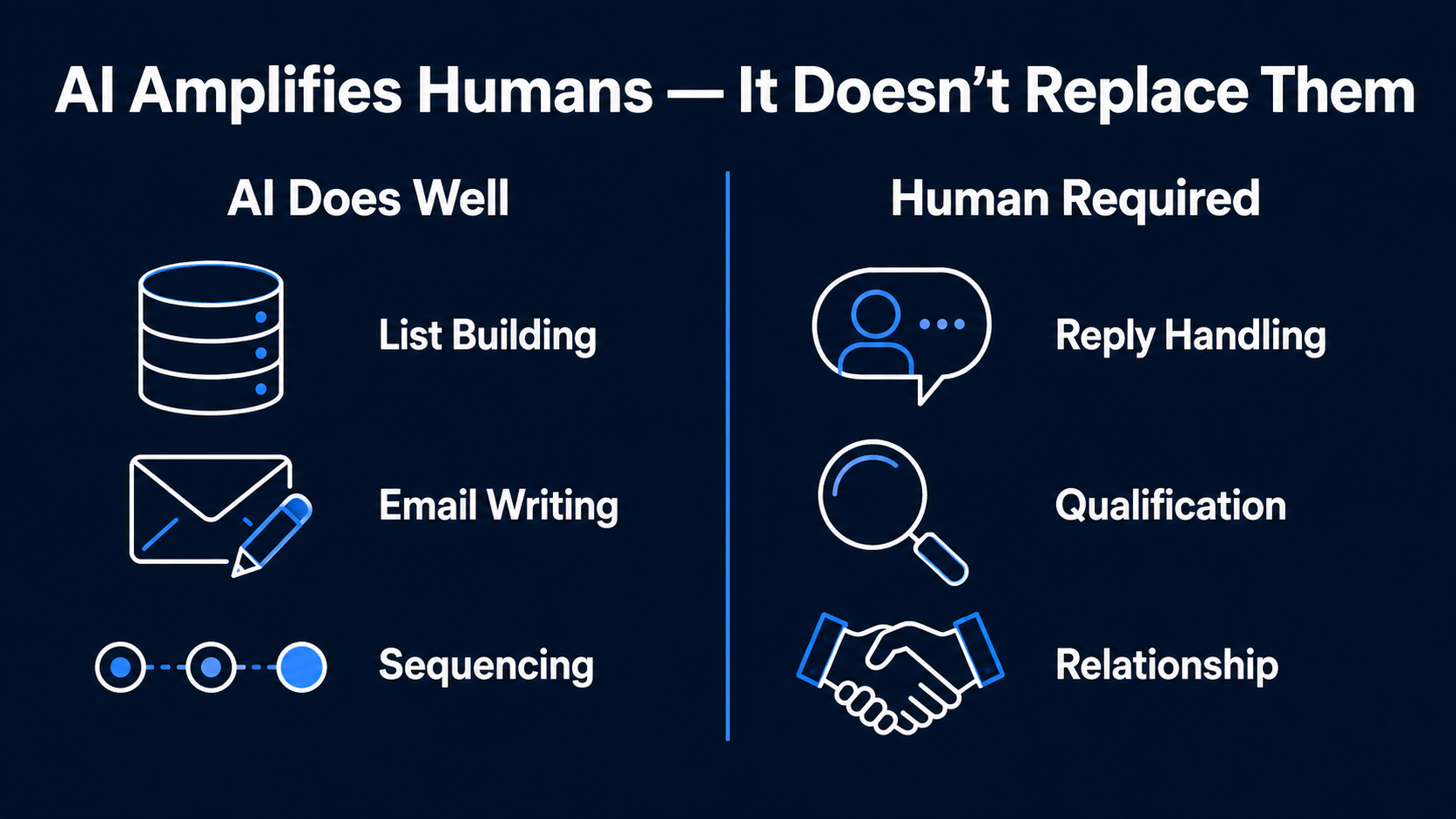
These functions exist on a spectrum from task automation (the AI assists a human) to full agent automation (the AI operates independently). The further along that spectrum you go, the more you're relying on the AI to make judgment calls it isn't reliably good at yet.
Where AI Outreach Works Well
High-volume prospecting
Building a qualified prospect list from scratch is one of the highest-leverage applications of AI in outbound. With tools like Clay, you can pull account data from multiple sources, enrich with firmographic signals, filter by ICP criteria, and output a scored list in an hour. The equivalent manual research takes days.
For teams running outbound at scale — 500+ prospects per month — this capability changes the economics of SDR work fundamentally.
First-line personalisation
The most consistent value AI delivers in email outreach is personalised first lines. Researching each prospect's LinkedIn activity, recent company news, or job postings and writing a relevant first sentence is exactly the kind of repetitive, pattern-based task LLMs handle well.
The quality ceiling matters here: AI-generated first lines that feel generic ("I noticed your company recently expanded into new markets") are worse than no personalisation. The value requires a quality bar — reviewing AI output before sending, at least during calibration.
Follow-up sequence execution
AI-powered sequencers (Outreach, Salesloft, Instantly, Lemlist, Apollo) remove the follow-up execution burden from SDRs entirely. Sequences run on time, at scale, without human memory as a dependency. For teams where SDR follow-up consistency was a problem, this alone drives measurable pipeline improvement.
A/B testing at scale
AI outreach tools make it practical to test subject lines, CTAs, email length, and send timing across large sample sizes. The data available from running 5,000+ outreach emails through a structured A/B framework gives insight into what works in your market that would take months to gather through manual testing.
Where AI Outreach Falls Short
Reply handling
Handling inbound replies is the most significant gap in current AI outreach capability. A prospect replying "we're in the middle of a merger — ask me again in Q4" requires contextual judgment, timing sensitivity, and relationship memory. Most AI tools either route all replies to a human (limiting the automation value) or attempt to handle them with rule-based logic that produces occasional embarrassing misfires.
For high-value accounts, all reply handling should involve a human. AI can classify reply intent — positive, objection, not-now, referral — but the response itself should come from a person who understands the account context.
Genuine personalisation vs. pattern matching
There's a meaningful difference between AI-generated personalisation and genuine personalisation. AI tools insert relevant context drawn from data sources. A skilled human SDR who has read the prospect's recent conference talk, understands their company's current strategic challenge, and writes with genuine curiosity produces a different quality of outreach.
In competitive enterprise markets, buyers have been trained to recognise AI-generated personalisation. The bar for what reads as genuine is rising. Teams that rely entirely on AI personalisation without human review are increasingly sending email that gets ignored.
Complex qualification
Multi-stakeholder enterprise accounts require qualification that goes beyond firmographic matching. Understanding a prospect's buying process, budget cycle, internal champions, and current vendor relationships requires conversation — not data enrichment.
AI prospecting tools can get you to the door. What happens at the door requires human capability.
High-trust B2B verticals
In markets like fintech, iGaming, healthcare, and enterprise SaaS, buyers evaluate vendors partly on trust signals built through personal relationships, references, and reputation. AI-automated outreach at scale in these markets can damage brand perception among the small, interconnected buyer communities that matter. Volume without calibration is worse than targeted manual outreach.
Building Your AI Outreach Stack for 2026
The right stack depends on your market, volume targets, and internal capability. Here's a framework that works for most B2B outbound operations:
Layer 1: Data and enrichment
The quality of your outreach is constrained by the quality of your prospect data. No AI personalisation layer compensates for a poorly segmented list.
- Apollo.io: broad coverage, good for initial list building and email data
- Clay: the most flexible enrichment tool in the market; connects to 100+ data providers, supports custom AI enrichment logic
- LinkedIn Sales Navigator: essential for account and contact identification in B2B
- Clearbit / Coresignal: firmographic enrichment for account-level data
Most teams use Clay as the orchestration layer, pulling data from Apollo and LinkedIn and running custom enrichment logic to produce a scored, personalised prospect list.
Layer 2: AI writing and personalisation
- Clay AI columns: generates personalised first lines, email drafts, and account research summaries directly in the enrichment workflow
- GPT-4 or Claude via API: for custom personalisation logic that goes beyond standard Clay columns
- Lavender: real-time email quality scoring and AI suggestions inside Gmail or Outlook
- Copy.ai / Jasper: for bulk email draft generation with template libraries
The practical workflow: Clay enriches the list and generates a personalised first line per contact; the email template handles the rest; a human reviews a sample (10–20%) before launch.
Layer 3: Sequencing and delivery
- Instantly.ai / Lemlist: high-volume cold email infrastructure with deliverability tooling
- Apollo sequences: for teams already using Apollo for prospecting
- Outreach / Salesloft: enterprise-grade sequencing with CRM integration and advanced analytics
- Expandi / Waalaxy: LinkedIn outreach automation with safety limits
The critical deliverability consideration: AI-generated email at scale requires serious sender reputation management. Warming inboxes, rotating sending domains, monitoring spam placement rates, and staying below provider rate limits are non-negotiable for teams sending 1,000+ emails per week.
Layer 4: Reply management
- Instantly AI replies: automated classification and draft responses for common reply types
- Smartlead reply categorisation: sorts positive, negative, and neutral replies with intent classification
- Human review for all ICP-qualified positive replies
The Deliverability Problem No One Talks About Enough
AI outreach at scale creates a deliverability problem that didn't exist before. When 10,000 vendors are all using the same AI-generated personalisation patterns, email providers adapt their spam detection to catch those patterns.
Key deliverability risks in 2026:
- AI detection by spam filters. Gmail and Microsoft Defender have improved their ability to detect AI-generated email patterns. Content that reads as template-generated at scale — even with first-line personalisation — has lower inbox placement rates than genuinely human-written email.
- Sending reputation decay. High-volume outreach campaigns that generate low engagement rates (opens below 30%, replies below 2%) damage sender reputation over time. Poor-fit lists accelerate this.
- Domain burning. Sending campaigns from your primary company domain at scale is a permanent reputation risk. Dedicated sending domains, properly warmed, are required infrastructure for any team sending 500+ emails per week.
Best practices:
- Domain warming: 30–45 days minimum before any cold outreach volume
- Send limits: start below 50 emails/day per inbox; scale gradually
- Monitoring: weekly inbox placement testing (GlockApps, MxToolbox) as a standard operational metric
- List hygiene: validate every email address before sending; bounce rates above 3–5% damage domain reputation materially
AI Outreach Metrics: What to Track
Standard outreach metrics apply, but with AI-specific benchmarks:
| Metric | Good | Investigate if below |
|---|---|---|
| Open rate (cold) | 35–55% | 25% |
| Reply rate (cold) | 3–8% | 1.5% |
| Positive reply rate | 1–3% | 0.5% |
| Inbox placement rate | 85%+ | 75% |
| Bounce rate | <2% | >3% |
| Unsubscribe rate | <0.3% | >0.5% |
AI-specific metric to add: personalisation relevance rate — the percentage of AI-generated first lines or personalised sections that a human reviewer would rate as genuinely relevant (vs. generic or inaccurate). Review a random sample weekly. If relevance drops below 70%, retrain your enrichment logic.
Common AI Outreach Mistakes
Volume as a substitute for quality
The most common failure mode: teams use AI to increase outreach volume without improving list quality or personalisation quality. The result is a larger number of irrelevant emails, lower reply rates, faster domain reputation decay, and a pipeline that doesn't grow proportionally with spend.
AI amplifies your outreach operation — in both directions. A well-calibrated operation scales effectively. A poorly calibrated one fails faster and louder.
No human review layer
Removing all human review from AI outreach is a risk that most B2B teams underestimate. AI-generated content contains errors, outdated information, and occasionally embarrassing misfires (incorrect company name, wrong market, hallucinated fact). A lightweight review process — sampling 10–20% of outbound before sending — catches the failure modes without eliminating the scale benefit.
Over-relying on AI reply handling
Automated reply handling creates pipeline leakage. Positive replies that get classified as neutral and receive an automated follow-up, rather than a human conversation, lose momentum and trust. The economics don't justify full automation of reply handling for ICP-qualified accounts.
Neglecting the sequence beyond the first email
AI tools tend to focus on the first touch — the personalised opener, the compelling subject line. But most responses come on the second, third, or fourth touch. Sequence quality matters as much as first-email quality. Plain-text follow-ups that add value (a relevant case study, a specific question, a short insight) outperform AI-generated multi-step sequences that read like a content funnel.
What This Means for Your Outbound Strategy
AI sales outreach in 2026 is best understood as an infrastructure upgrade for human sales development, not a replacement for it. The tasks it automates — prospecting, first-draft writing, sequence execution, reply classification — free up human SDR capacity for the tasks that genuinely require human capability: qualification conversations, relationship development, and the adaptive judgment that turns warm interest into booked pipeline.
Teams that get this right combine AI infrastructure with human quality control. They use AI to increase reach and speed; they invest the time saved into improving conversation quality, not reducing headcount to zero.
The vendors promising fully autonomous outbound haven't solved the reply handling problem, the qualification problem, or the trust problem. When they do, the calculus will change. In the meantime, the advantage goes to teams who use AI thoughtfully — as a force multiplier for skilled humans, not a replacement for them.
How VirtuWise Runs AI-Assisted Outbound
VirtuWise operates as an outsourced sales development function for B2B companies that want the infrastructure and expertise of a full SDR team without the overhead of building one internally.
Our outbound operation uses AI tooling across every layer of the process — enrichment, personalisation, sequencing, reply classification — but with human oversight at every stage that matters. We review list quality before launch, check personalisation accuracy before sending, and handle all qualified replies with experienced team members who understand your market.
The result is outbound that scales without the failure modes: no domain burns, no embarrassing automation misfires, no pipeline leakage from mis-handled replies.
Our pricing:- Starter: €1,500/month — 1 channel, managed outreach for up to 300 prospects/month
- Growth: €2,500/month — multi-channel, AI-powered enrichment, full sequence management
- Scale: €4,000/month — dedicated team, multiple ICPs, advanced reporting
Full details at virtuwise.io/pricing.
Frequently Asked Questions
Does AI sales outreach actually work in 2026?Yes, with important caveats. AI outreach works well for prospecting, first-line personalisation, and sequence execution. It works poorly for reply handling, complex qualification, and high-trust B2B verticals where buyers are sophisticated about AI-generated content. Teams using it as a force multiplier for human SDRs get better results than those expecting full automation.
What's the best AI outreach tool in 2026?There is no single best tool — the right stack depends on your volume, market, and internal capability. Clay is the most powerful enrichment and personalisation layer. Instantly and Lemlist are strong for cold email infrastructure. Apollo covers prospecting and sequencing in one platform. Most effective operations use 2–3 tools in combination.
How does AI personalisation affect deliverability?AI-generated email patterns are increasingly recognisable by spam filters. Inbox placement rates are lower for high-volume AI outreach compared to manually written email, particularly with Gmail and Microsoft Exchange. Deliverability management — domain warming, sending limits, inbox placement monitoring — is mandatory infrastructure for any team sending at scale.
How many emails can I send per day with AI outreach?A healthy sending operation starts at 30–50 emails per inbox per day during warm-up, scaling to 80–150 after 30–45 days. Running multiple warmed inboxes across dedicated domains allows volume scaling. Teams sending 1,000+ emails per day need a serious domain infrastructure and active deliverability monitoring.
Should I use AI to handle replies automatically?For initial intent classification (sorting positive from negative and auto-replies), yes. For responding to ICP-qualified positive replies, no. Automated responses to warm prospects cost pipeline. The math on fully automated reply handling doesn't hold for enterprise B2B where a single closed deal is worth tens of thousands of euros.
How does AI outreach differ from spam?The distinction is relevance and consent. AI outreach that targets a precisely defined ICP with genuinely relevant personalisation, respects unsubscribes immediately, and maintains sender reputation through list hygiene is legitimate B2B marketing. High-volume, low-relevance AI outreach to poorly segmented lists with no quality control is spam — and damages both deliverability and brand.