
Ideal Customer Profile (ICP): How to Build One That Actually Works
An ideal customer profile is the foundation of effective B2B sales and marketing. Here's how to build one from real data — plus a template you can use today.
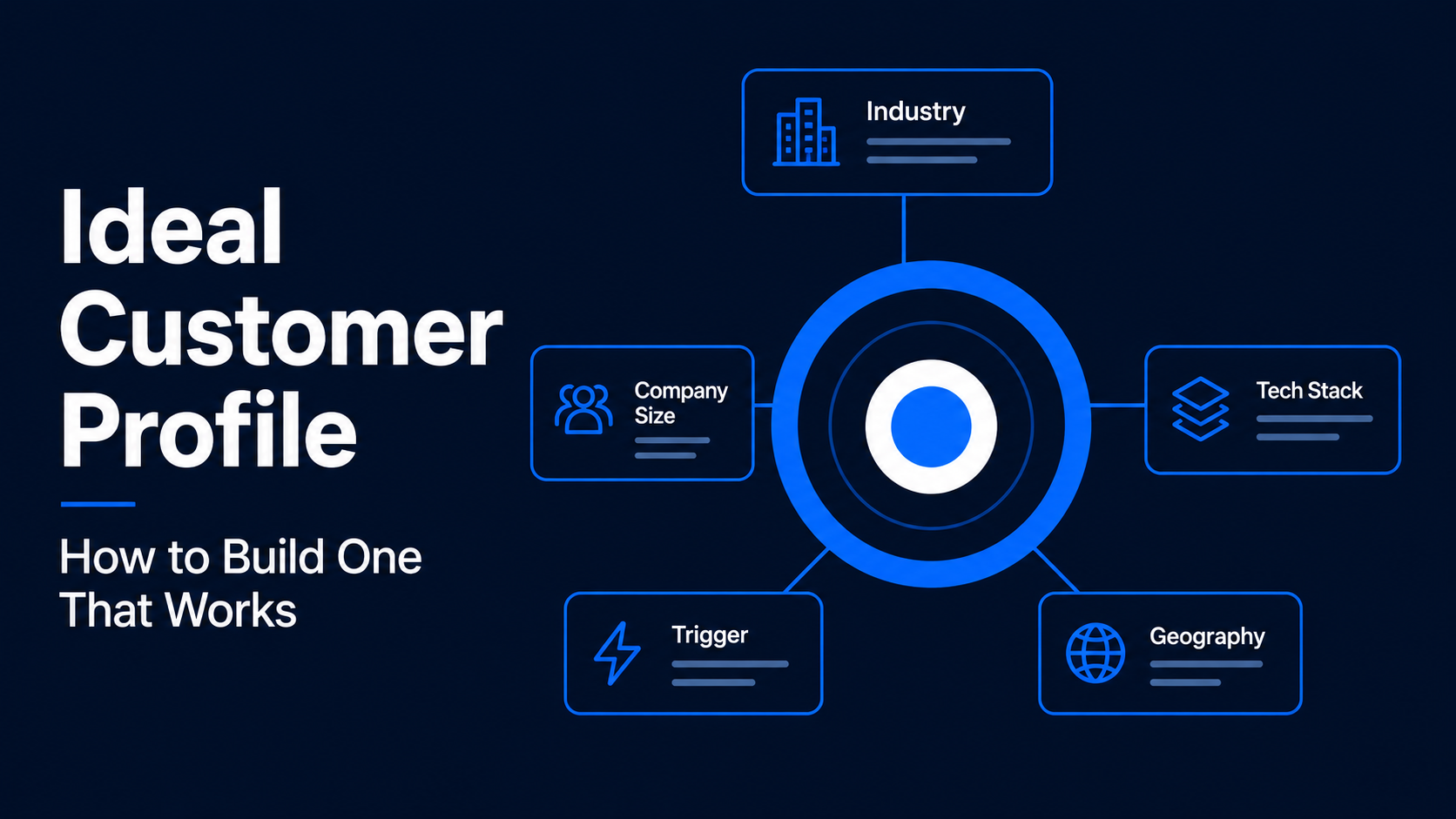
Every B2B sales and marketing conversation eventually comes back to the same question: who exactly are we selling to?
Most companies have an answer. The problem is that it's usually too broad, based on assumptions rather than data, and not specific enough to be actionable. "Mid-market SaaS companies" is a description of a market segment. "Series B SaaS companies with 50–200 employees, selling to enterprise buyers in regulated industries, using Salesforce and Outreach, where the VP of Sales owns the budget" is an ICP.
The difference matters because every downstream decision in your go-to-market — who you prospect, how you message, which content you create, where you spend paid budget — becomes more effective when it's built on a specific, data-driven ICP.
This guide covers what an ICP is, how it differs from a buyer persona, how to build one from your existing customer data, and how to put it to work across your sales and marketing operation.
What Is an Ideal Customer Profile?
An ideal customer profile (ICP) is a detailed description of the type of company — not individual — that gets the most value from your product or service, is most likely to buy, and is most likely to retain and expand.
It defines the account-level characteristics that predict:
- High close probability
- Fast sales cycle
- High retention and expansion
- Strong ROI for the customer (and therefore strong referral potential)
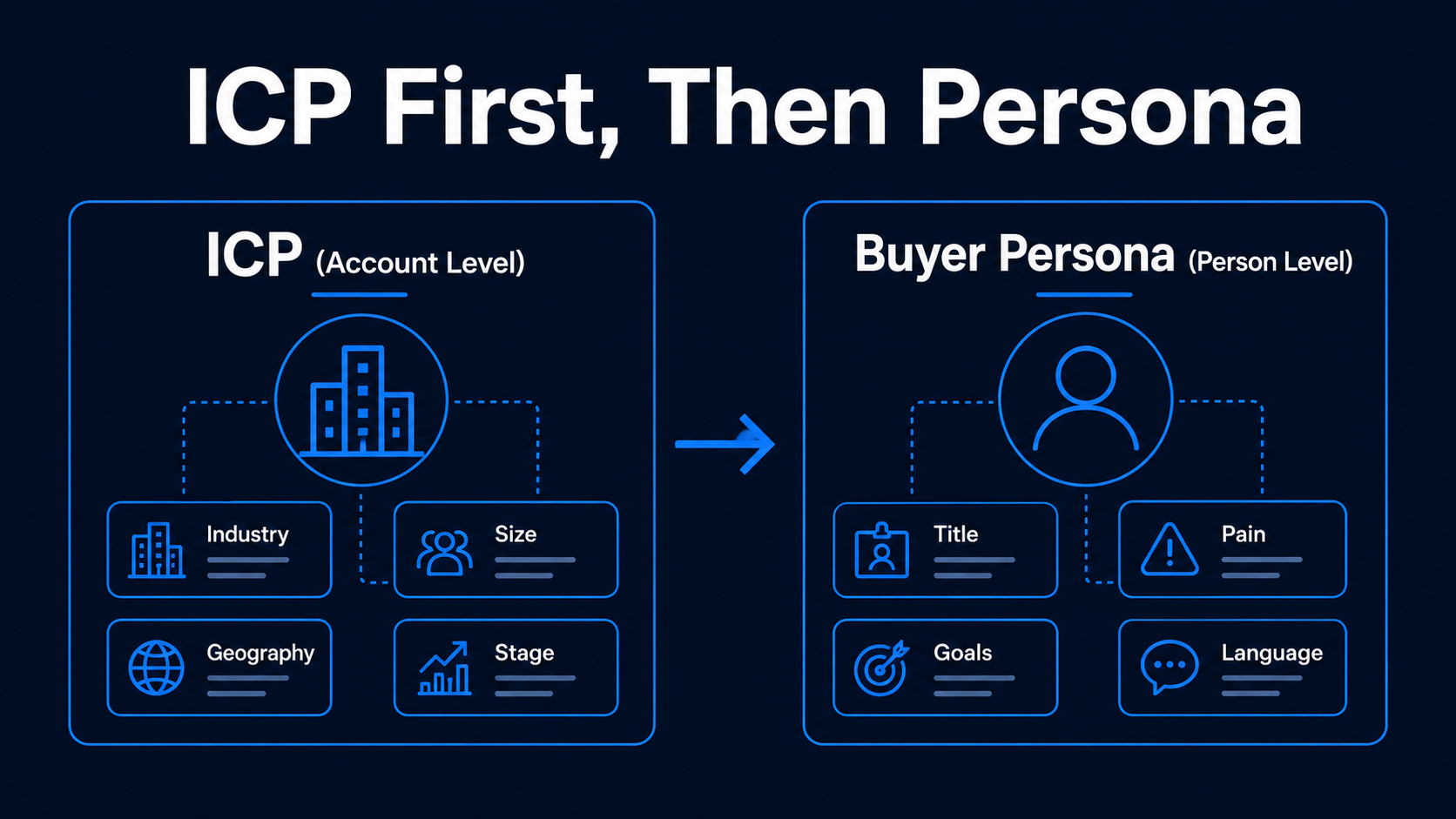
An ICP is account-level, not person-level. It describes the company: industry, size, geography, technology stack, business model, growth stage, and the specific situation that makes your offer relevant to them.
The persona — which describes the individual buyer — is a separate construct built on top of the ICP.
ICP vs Buyer Persona: The Difference
The two concepts address different questions:
- ICP asks: which companies should we be targeting?
- Buyer persona asks: within those companies, who do we talk to and how?
Both are necessary. Neither replaces the other.
| ICP | Buyer Persona | |
|---|---|---|
| Question answered | Which companies should we target? | Who do we talk to, and how? |
| Unit of analysis | Account / company | Individual / role |
| Used for | List building, account prioritisation, territory planning | Messaging, content, objection handling |
| Comes first? | Yes — without ICP, personas describe people at the wrong companies | No — builds on ICP |
| How often to update | Annually, or after major product/market changes | When ICP changes or new buyer insights emerge |
A B2B company selling compliance software to financial services firms has:
- ICP: EMEA-licensed payment processors and e-money institutions with 50–500 employees, under PSD2/EMD2 obligations, using legacy compliance tooling
- Persona: the Chief Compliance Officer or VP Compliance who owns the tooling budget and is accountable for audit findings
The ICP tells you which companies to target. The persona tells you who to reach, what language resonates, and what their specific anxieties and motivations are.
For outbound sales and marketing, the ICP comes first. Without a clear ICP, persona work produces detailed profiles of people at companies that will never buy from you.
Why Most B2Bs Have a Weak ICP
The most common ICP failure modes:
- Built on gut rather than data. The founding team's intuition about who the customer should be, rather than who has actually bought, retained, and expanded.
- Too broad to be actionable. "Any B2B company with 50+ employees" describes a market, not an ICP. An ICP should be specific enough that you could name 300–500 target accounts from it.
- Never updated. An ICP built at Series A may not reflect the reality of who buys at Series B or C. As the product evolves and the customer base grows, the ICP should be revisited annually at minimum.
- Not shared across sales and marketing. An ICP that lives in a strategic document but isn't embedded in how SDRs build lists, how AEs qualify, and how marketers target ads produces inconsistent execution and disagreements about lead quality.
How to Build Your ICP from Data
The most reliable ICP is built backwards from your best existing customers. Here's the process:
Step 1: Pull your customer data
Export your full customer list with the following fields (from your CRM or billing system):
- Company name
- Industry / vertical
- Company size (headcount, revenue if available)
- Geography
- Contract value (ACV)
- Retention / expansion history
- Sales cycle length
- Lead source
Step 2: Segment by customer quality
Define "best customer" for your business. This typically means: highest ACV, shortest sales cycle, longest retention, highest expansion rate, lowest support burden. Score each customer against these dimensions and identify your top 20–30%.
Step 3: Find the patterns
Within your best customers, what patterns emerge across:
- Industry and vertical
- Company size range (headcount, revenue)
- Growth stage (startup, scale-up, enterprise, enterprise division)
- Technology stack (what tools do they use that indicate fit or trigger for your product?)
- Business model (SaaS, services, marketplace, etc.)
- Geography and regulatory context
- The specific pain or trigger that drove them to buy
You're looking for clustering — the 3–5 characteristics that appear disproportionately in your best accounts.
Step 4: Identify the trigger
Beyond firmographics, the most actionable ICP element is the trigger: the specific situation or event that caused your best customers to start looking for a solution like yours.
Common B2B triggers:
- Headcount crossing a threshold (hiring their 10th SDR, crossing 50 employees)
- Entering a new market or geography
- A regulatory change affecting their industry
- A specific technology migration (moving from HubSpot to Salesforce, implementing a new ERP)
- Funding event (Series A/B often unlocks SDR and marketing budget)
- Leadership change (new VP Sales, new CMO)
Triggers convert ICP from a static profile into an actively useful prospecting signal.
Step 5: Validate with your sales team
The ICP built from data should be stress-tested with the people who spend time with customers. What patterns do AEs observe in deals that close quickly vs. those that stall? What objections appear only in certain account types? Sales intuition often captures signals that don't show up in CRM data.
ICP Template
Use this as a starting structure and fill in from your data:
Account-Level Criteria- Industry/Vertical: [e.g. B2B SaaS, Fintech, iGaming, Cybersecurity]
- Company Size: [headcount range and/or revenue range]
- Geography: [specific countries, regulatory zones, or markets]
- Growth Stage: [startup, scale-up, Series B+, enterprise division]
- Business Model: [SaaS, services, marketplace, platform]
- Tech stack indicators: [e.g. uses Salesforce + Outreach, uses HubSpot, specific ERP]
- Infrastructure signals: [e.g. has a sales team, has a marketing function, runs paid ads]
- Current pain: [what specific problem are they experiencing?]
- Trigger event: [what happened or is about to happen that makes now the right time?]
- Why now: [what creates urgency — regulatory pressure, growth milestone, competitive threat?]
- Too small: [below X employees / ACV that doesn't justify sales effort]
- Wrong model: [e.g. B2C companies, agencies, non-profits]
- Poor-fit verticals: [industries where you have lost disproportionately]
Using Your ICP in Outbound Sales
A completed ICP immediately improves several parts of the outbound sales process:
List building: ICP criteria map directly to filters in Apollo, LinkedIn Sales Navigator, Clay, and other data tools. Instead of pulling everyone in a vertical, you're pulling accounts that match 4–5 specific criteria. List quality improvement is typically significant — 2–3x higher reply rates on well-targeted lists vs. broad-vertical lists. Personalisation: ICP-specific triggers (new funding, market expansion, specific tech stack) give SDRs genuine personalisation inputs beyond first name and company name. "I saw you recently expanded into Germany" or "I noticed you're running Outreach — have you looked at [specific integration]?" requires an ICP signal to work at scale. Qualification: ICP criteria become the first-pass qualification gate. A contact at a company that matches the ICP gets different handling than a contact at a company that doesn't. ICP-matched contacts go into active sequences; non-ICP contacts go into lower-touch nurture. Messaging: ICP specificity allows you to write messaging that speaks to the specific situation your best customers recognise. Generic "we help B2B companies" messaging is replaced by "we work with Series B SaaS companies building their first outbound function" — which resonates with exactly the right people and is transparently irrelevant to everyone else.For a broader view of how ICP feeds into the full pipeline, see our guide to B2B lead generation channels in 2026.
ICP for Different B2B Models
ICP looks different depending on your business model:
SaaS: Strongest ICPs define by growth stage, tech stack, and the specific workflow or problem the software solves. Trigger events (funding, team expansion, tooling change) are high-signal. Services / outsourcing: ICP is often defined by the situation rather than static firmographics. A company building their first sales team, entering a new market, or scaling past a headcount inflection is a higher-fit prospect than one that already has a mature in-house function. Marketplace / platform: Two-sided ICPs are more complex — you need separate ICPs for each side of the marketplace, often with different channels and messages for each. Enterprise: ICP narrows significantly as ACV increases. An enterprise ICP might describe 200–400 companies globally rather than thousands. Precision and account-level research matter more than scale.How Often to Revisit Your ICP
ICP is not a one-time exercise. It should be reviewed when:
- Your product or service offering significantly changes
- Win rates shift (either improving or declining) — a signal that the ICP may have drifted from reality
- A significant new vertical or account type emerges in your customer base
- You enter a new market or geography
- Annually as part of go-to-market planning
The test of a good ICP review: after the process, can you give your SDR team a list of 300–500 target accounts that they could start working tomorrow? If yes, the ICP is specific enough to be operational. If not, it needs more granularity.
How VirtuWise Uses ICP in Outbound
At VirtuWise, ICP definition is the first and most important step in every client engagement. Before writing a single outreach message or building a single list, we work with our clients to define:
- Which account characteristics predict deal closure (from their won account data)
- Which triggers to watch for in the market
- Which exclusion criteria prevent wasted outbound effort
This ICP work directly determines the quality of the pipeline we build. An SDR operation running on a vague ICP produces volume without conversion. One running on a specific, data-backed ICP produces qualified meetings at 2–3x the rate.
Learn more about how we approach prospecting in our B2B prospecting guide, lead qualification guide, and demand generation agency guide.
Our pricing:- Lead Generation: €3,000/month — ICP research, personalised outreach, meeting booking and scheduling, weekly reporting
- Lead Generation Plus: €5,000/month — everything in Lead Generation, plus multi-channel outreach (LinkedIn + email + messengers), A/B testing, higher volume
- Business Development: €7,000/month — full-cycle business development, dedicated senior sales manager, online and offline representation, custom strategy
- Inbound (SEO & AEO): €3,500/month — SEO and AEO run as one service: keyword strategy, content, technical fixes, and AI-crawler visibility (structured data, llms.txt)
- Fractional Growth Partner: Custom — a revenue engine audit, then optional ongoing Advisory or hands-on Implementation
Full details at virtuwise.io/pricing.
For end-to-end execution, see our business development services.
Frequently Asked Questions
How specific should my ICP be?Specific enough that you could name 300–500 companies from it. If the criteria you've defined could apply to 50,000 companies, it's not an ICP — it's a market segment description. Test specificity by attempting to build a list from your criteria. If the resulting list is unmanageably large and seemingly undifferentiated, narrow it.
How is ICP different from TAM (Total Addressable Market)?TAM is the universe of companies that could theoretically benefit from your product. ICP is the subset of those companies where you have the highest probability of winning, at the best economics. TAM might be 50,000 companies; your ICP might be 2,000 of them. You target the ICP, not the TAM.
Can you have multiple ICPs?Yes — many B2B companies have 2–3 ICPs representing different market segments with different economics. Managing multiple ICPs requires separate messaging, separate lists, and often different sales processes. When starting out, it's usually better to focus on the single strongest ICP until that motion is working, then expand.
What if I'm early-stage with limited customer data?Build a hypothesis ICP from first principles (who is most likely to have the pain you solve, with budget, and ability to act?) and validate it through your first 20–30 sales conversations. Every discovery call should update your ICP — note which account characteristics correlate with genuine interest and which don't. After 30 conversations, you'll have enough signal to define a data-backed ICP.
Does ICP apply to inbound as well as outbound?Yes. Inbound leads should also be filtered through ICP criteria. Not every inbound inquiry is worth pursuing. Applying ICP to inbound routing — prioritising ICP-matched inbound over non-ICP inbound — improves conversion rates and AE productivity.