
Lead Qualification: How to Filter Your B2B Pipeline in 2026
Lead qualification separates buyers from browsers. Here's how to build a qualification framework that improves your close rate without losing pipeline to over-filtering.
Most B2B sales teams have two pipeline problems running simultaneously. The first: not enough leads. The second: too many of the wrong ones clogging the pipeline, consuming sales capacity, and distorting forecasts.
Lead qualification is the process that resolves the second problem. Done well, it ensures your sales team spends their time on accounts that can actually close — and identifies early, before significant effort is invested, which opportunities aren't worth pursuing.
This guide covers how lead qualification works, the frameworks that B2B teams use in practice, how qualification differs from lead scoring, and how to build a process that improves pipeline quality without over-filtering and losing real opportunities.
What Is Lead Qualification?
Lead qualification is the process of evaluating whether a lead or prospect has sufficient fit, intent, and readiness to justify continued sales investment.
A qualified lead is one where there is evidence — not just hope — that the account has a genuine problem you can solve, the authority and budget to act on it, and the timing to move forward within a meaningful horizon.
An unqualified lead is one that fails one or more of those criteria. It might be the right company but the wrong timing. The right vertical but the wrong contact. The right intent but no budget. Qualification determines which is which before your sales team invests hours in a discovery call that was never going to close.
The distinction between a lead and a qualified lead matters enormously for pipeline accuracy. A pipeline full of unqualified leads produces unreliable forecasts, frustrated sales teams, and conversion rates that obscure what's actually working.
Why Lead Qualification Fails in B2B
Before covering how to do qualification well, it helps to understand why it fails.
The most common failure modes:
- Qualifying on firmographics alone. Company size, industry, and revenue are necessary conditions but not sufficient. A €50M fintech company is a good-fit account — unless the budget is locked for 18 months, the decision-maker you're talking to has no authority, or a competitor is already embedded. Firmographic fit is the starting point, not the endpoint.
- Skipping disqualification. Sales teams are often rewarded for advancing opportunities, not killing them. The incentive structure works against honest disqualification. A pipeline full of "possible" and "maybe" opportunities is not a pipeline — it's a list of unresolved uncertainties.
- Qualifying too early or too late. Over-qualifying inbound before any human conversation means losing opportunities that would have qualified through discovery. Under-qualifying (accepting everything into the pipeline) creates the opposite problem. The right qualification checkpoint is after enough information exists to make an informed judgment — usually after a first conversation.
- Using the wrong criteria. Qualification criteria that don't reflect what actually predicts deal closure produce misleading results. The best qualification criteria are derived from looking backward at your won accounts and identifying what they had in common.
Lead Qualification Frameworks
Several frameworks exist for structuring B2B qualification. Each has strengths and limitations:
BANT
Budget, Authority, Need, Timeline. The oldest and most widely taught framework.
- Budget: Does the prospect have budget allocated (or allocable) for this kind of purchase?
- Authority: Are you speaking to the economic buyer or the person who can influence them?
- Need: Is there a genuine problem your product solves?
- Timeline: Is there a concrete reason to act within a specific timeframe?
BANT's limitation is that it assumes a relatively linear, single-buyer purchase process. For complex B2B deals with multiple stakeholders and longer cycles, it understates the qualification complexity.
MEDDIC / MEDDPICC
Metrics, Economic Buyer, Decision Criteria, Decision Process, Identify Pain, Champion (Competition added in MEDDPICC).
More comprehensive than BANT. MEDDIC asks:
- What are the measurable business outcomes the buyer wants to achieve?
- Who controls the budget and has final authority?
- What criteria will be used to make the selection decision?
- What is the decision-making process, and who is involved?
- What pain is the champion experiencing, and is it severe enough to drive action?
MEDDIC is more appropriate for enterprise deals where the sales cycle involves multiple stakeholders, formal procurement processes, and complex internal approval chains.
CHAMP
Challenges, Authority, Money, Prioritisation.
CHAMP flips the BANT order to lead with Challenges — the idea being that understanding the buyer's problem before qualifying on budget and authority produces better conversations. Practically, it's BANT with a different emphasis on sequencing.
Which framework to use
| Framework | Best For | Key Strength | Key Limitation |
|---|---|---|---|
| BANT | Mid-market B2B, shorter cycles, inbound leads | Simple, fast to apply | Assumes linear single-buyer process |
| MEDDIC / MEDDPICC | Enterprise deals, multi-stakeholder, >€50K ACV | Comprehensive, maps full buying process | Requires more discovery time; can feel interrogative |
| CHAMP | Outbound-first teams, consultative selling | Leads with buyer challenges, not budget | Less structured on procurement process |
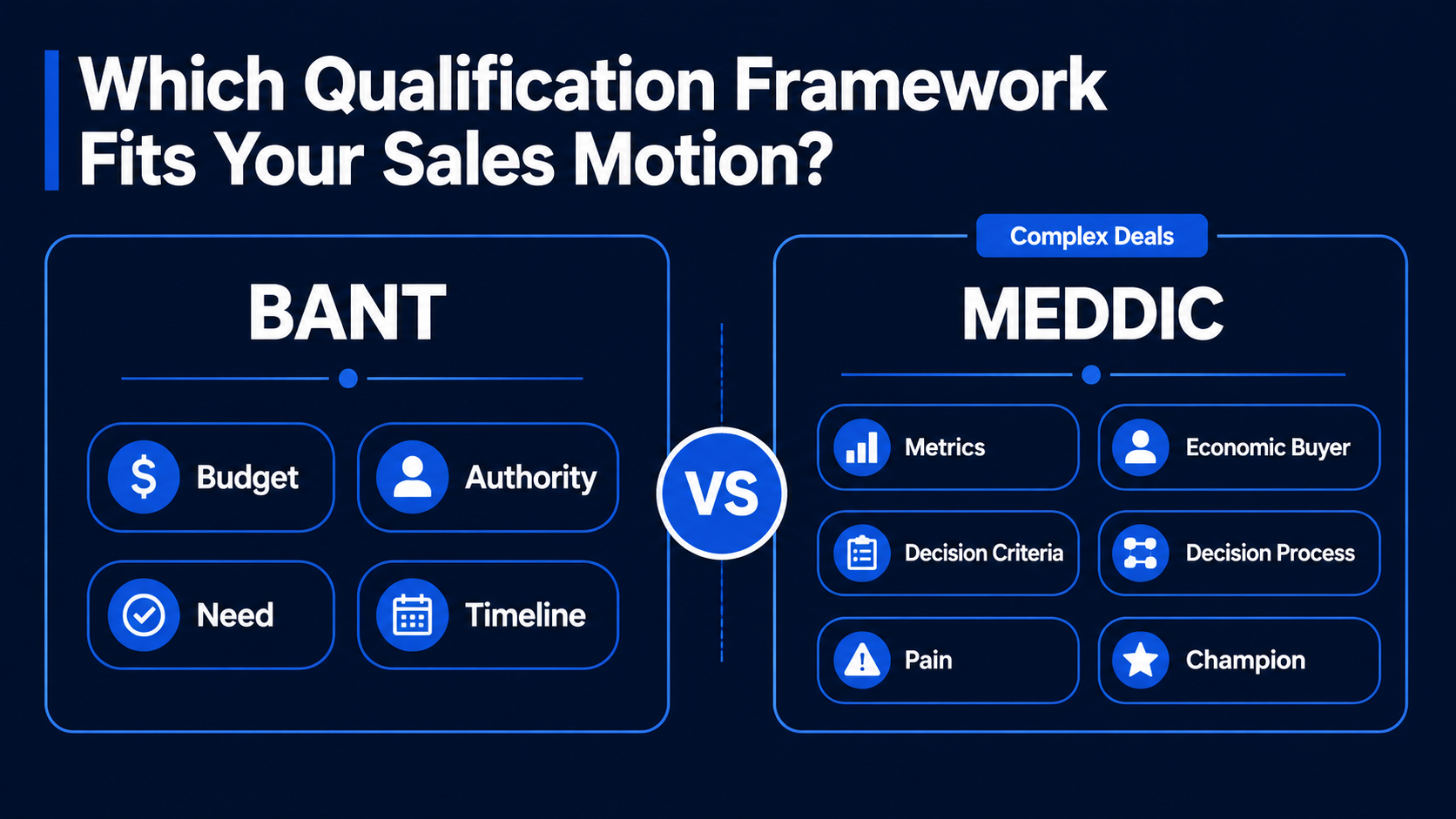
For most B2B mid-market deals, BANT provides sufficient structure if applied honestly. For enterprise deals above €50K ACV, MEDDIC produces more accurate qualification and better forecast accuracy. The framework matters less than applying it rigorously and consistently.
Lead Scoring vs Lead Qualification
Lead scoring and lead qualification address different problems and should not be confused.
Lead scoring is a quantitative system that assigns point values to prospect behaviors and attributes — website visits, email opens, content downloads, company size, job title — to prioritise outreach and follow-up. It's useful for triage in high-volume inbound environments. Lead qualification is a qualitative judgment made through conversation — understanding the prospect's situation, need, authority, and timing in enough depth to assess whether the opportunity is real.The two are complementary. Lead scoring helps you prioritise which leads to call first. Lead qualification determines, through actual conversation, whether those leads are worth pursuing.
Over-relying on lead scoring creates false confidence. A prospect who scored 85 points (opened 4 emails, visited the pricing page twice) may have no budget, no authority, and no timeline. Lead scoring predicts engagement; qualification determines intent and fit.
How to Build a B2B Lead Qualification Process
A functional qualification process has four components:
1. Define your qualification criteria
Start with your won accounts from the past 12–18 months. What did they have in common? Size, vertical, tech stack, the pain they articulated, the trigger that drove them to buy? This is your empirical ICP — not a theoretical one.
From this, build a qualification checklist with three tiers:
- Must-have criteria: without these, the deal won't close (e.g. budget authority, a specific pain)
- Strong indicators: present in most won accounts, absence is a warning sign
- Nice-to-have: present in some won accounts, not decisive
2. Define qualification stages
Different depths of qualification are appropriate at different stages:
- Pre-SDR (MQL → SQL): Light qualification — does this contact match ICP firmographics and have an intent signal? Worth a first outreach.
- Post-first-conversation (SQL → SAO): Full BANT or MEDDIC qualification. Is there a real opportunity here?
- Late-stage (SAO → Opportunity): Champion identified, decision process understood, competitive position assessed.
3. Make disqualification explicit
Disqualification is as important as qualification. Define clear criteria for removing opportunities from the pipeline: no budget in the next 12 months, no authority contact identified, no pain articulated after two calls, competitive displacement that makes win probability below 10%.
Disqualification is not failure — it's accuracy. A salesperson who disqualifies a dead opportunity quickly and moves to the next one is more productive than one who nurtures a 5% probability deal for six months.
4. Review and calibrate
Qualification criteria decay. Markets change, ICPs evolve, and what predicted deal closure 18 months ago may not predict it today. Quarterly reviews of qualification criteria against pipeline outcomes — comparing what you qualified vs. what actually closed — keep the system calibrated.
Common Lead Qualification Mistakes
Over-qualifying inbound. Requiring all four BANT criteria before accepting a meeting means turning away prospects who would have revealed budget and authority through conversation. Some qualification happens before the meeting; most happens during it. Accepting self-qualification. Prospects often tell you what they think you want to hear. "We have budget" is not the same as "we have approved budget allocated to this category." Probing questions rather than acceptance of surface answers produce more reliable qualification. Not qualifying on timeline. A prospect with perfect fit, real pain, and genuine authority who won't be able to act for 18 months is not a Q1 pipeline opportunity. Timeline qualification isn't about excluding them — it's about placing them in the right pipeline stage and applying the right follow-up rhythm. Single-threaded accounts. Qualifying through one contact in an enterprise deal is a risk. If that contact leaves, is overruled, or wasn't as authoritative as they presented, the deal stalls. Multi-threading — identifying and building relationships with multiple stakeholders — is both a qualification activity (you learn more about the decision process) and a risk mitigation strategy.How VirtuWise Approaches Lead Qualification
At VirtuWise, qualification is built into how we operate as an outsourced SDR function. We don't just book meetings — we ensure the meetings we book are with prospects that meet your ICP criteria, have an articulated need, and are worth your sales team's time.
Our process:
- ICP qualification criteria defined at programme start, based on your won account data
- SDR-level qualification before booking (firmographic fit, pain signal identified)
- Discovery qualification during first call (authority, timeline, competitive situation)
- Handoff with full qualification notes — so your AE walks into every meeting informed
This reduces the time your commercial team spends on discovery calls that go nowhere and improves the conversion rate from meeting to qualified opportunity.
Our pricing:- Lead Generation: €3,000/month — ICP research, personalised outreach, meeting booking and scheduling, weekly reporting
- Lead Generation Plus: €5,000/month — everything in Lead Generation, plus multi-channel outreach (LinkedIn + email + messengers), A/B testing, higher volume
- Business Development: €7,000/month — full-cycle business development, dedicated senior sales manager, online and offline representation, custom strategy
- Inbound (SEO & AEO): €3,500/month — SEO and AEO run as one service: keyword strategy, content, technical fixes, and AI-crawler visibility (structured data, llms.txt)
- Fractional Growth Partner: Custom — a revenue engine audit, then optional ongoing Advisory or hands-on Implementation
Details at virtuwise.io/pricing.
Frequently Asked Questions
What's the difference between MQL and SQL?A Marketing Qualified Lead (MQL) has shown sufficient engagement or fit to be worth outreach — typically defined by lead scoring. A Sales Qualified Lead (SQL) has been through an initial qualification conversation and meets the criteria for active sales pursuit. MQL → SQL conversion rate is a key pipeline efficiency metric; industry benchmarks range from 13–27% for B2B.
How many qualification criteria are too many?More than 5–6 hard criteria creates over-qualification and pipeline starvation. Focus on the criteria that most reliably predict deal closure based on your actual won account data. Theoretical criteria that haven't been validated against real outcomes often reflect wishful thinking about the ideal customer rather than who actually buys.
Should SDRs or AEs do qualification?SDRs typically perform initial ICP and intent qualification before booking meetings. AEs perform deeper qualification during discovery calls. The handoff point matters — SDRs should qualify enough to ensure the meeting is worth the AE's time, but not so deeply that they're doing the AE's job before the relationship has been established.
What happens to leads that don't qualify?Disqualified leads should not disappear from your system. They go into a nurture sequence based on their disqualification reason: no timing → contact in 6 months; no budget → contact at next budget cycle; no authority → find a different contact at the same account. Disqualified today does not mean disqualified forever.
How do you qualify without being pushy?Qualification through conversation is most effective when framed as trying to understand whether you can actually help — not as interrogating the prospect. Questions like "What would need to be true for this to be a priority in Q3?" or "Who else would typically be involved in a decision like this?" feel natural in a discovery context and produce qualification information without feeling like an interrogation.