
Outbound Sales Strategy: How to Build a B2B Engine That Works in 2026
A working outbound sales strategy starts with ICP and ends with a repeatable sequence. Here's how to build one from scratch — channels, messaging, metrics, and common mistakes.
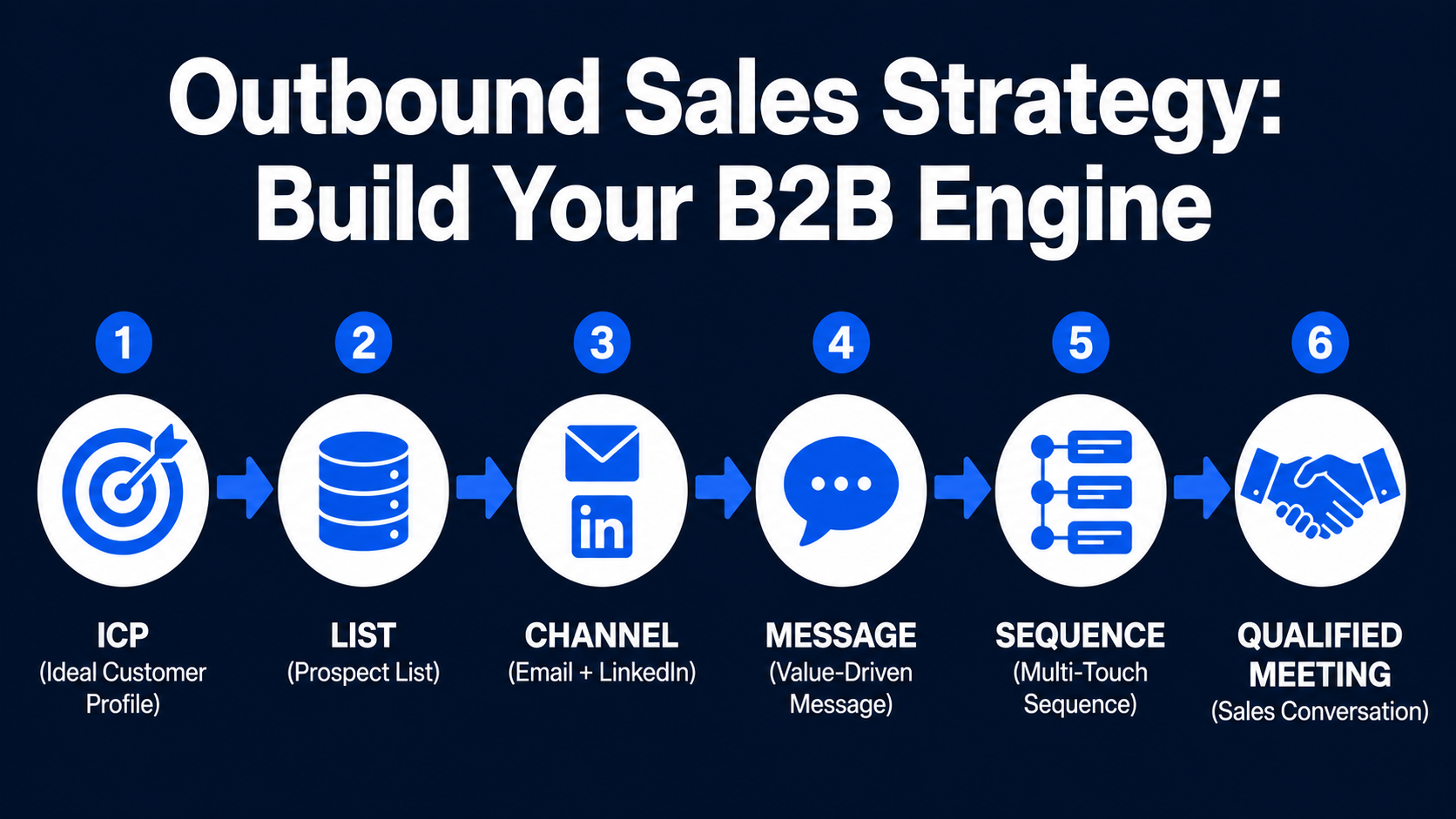
Outbound sales is the most direct path to B2B pipeline. It doesn't wait for buyers to find you. It takes your message to the exact companies and people most likely to benefit from what you offer.
Done well, outbound creates predictable, scalable revenue. Done poorly, it burns your sender reputation, exhausts your team, and produces the false conclusion that "outbound doesn't work."
The difference between the two is almost always strategic, not tactical. It's not about which tool you use or how many emails you send. It's about whether the foundation — ICP, list quality, messaging, sequence structure — is built correctly before the first contact is made.
This guide covers how to build an outbound sales strategy from scratch: every component, in the right order, with the metrics that tell you whether it's working.
The Six Components of an Outbound Sales Strategy
A complete outbound sales strategy has six interdependent components. Weakness in any one of them limits the output of the others.
- ICP: who you're targeting
- List: who specifically to contact
- Channel mix: how to reach them
- Messaging: what to say
- Sequence: when and how often to reach out
- Qualification: how to filter what comes back
The most common outbound failures remove one of these from the equation — usually skipping ICP rigour in favour of speed, or skipping sequence discipline in favour of a single touch.
Step 1: Define Your ICP with Enough Specificity to Build a List
An ICP too broad to generate a specific list of target accounts is not an ICP — it's a market description.
The test: can you go to Apollo or LinkedIn Sales Navigator right now and build a list of 300–500 accounts that match your ICP criteria? If not, the ICP needs more specificity.
Beyond standard firmographics (size, industry, geography), a strong ICP for outbound adds:
- Trigger signals: what events create urgency? (Funding, headcount growth, geographic expansion, contract expiry, technology migration, leadership change)
- Tech stack indicators: what tools does your ICP use that signal fit or pain? (A specific CRM, a legacy system they're migrating away from, a platform that integrates with yours)
- Exclusion criteria: what types of accounts waste your team's time? (Too small, wrong business model, competitors, accounts where you consistently lose)
A detailed ICP built from your won account data rather than theoretical assumptions is the highest-leverage investment in outbound performance. For a full framework, see our guide to building an Ideal Customer Profile.
Step 2: Build Lists That Actually Qualify
List quality is the single largest variable in outbound performance. A well-targeted 500-account list outperforms a 5,000-account generic list on every metric that matters.
The tools:
- LinkedIn Sales Navigator: for ICP-matched contact identification with job title, seniority, industry, and company filters
- Apollo.io: for contact data, email verification, and basic enrichment
- Clay: for advanced enrichment — pulling trigger signals, tech stack data, company news, and custom AI-generated personalisation inputs
- Clearbit / Coresignal: for firmographic enrichment
The process:
- Define ICP criteria as a set of filters
- Pull accounts from Sales Navigator or Apollo matching those criteria
- Enrich with trigger signal data (funding, job postings, news)
- Prioritise the list by signal strength — accounts with active triggers get contacted first
- Verify contact data (email validation before sending)
List hygiene matters: bounce rates above 3–5% damage sender reputation materially. Validate all email addresses before your sequence starts. See our full breakdown of B2B prospecting for sourcing and enrichment workflows.
Step 3: Choose Your Channel Mix
In 2026, the most effective B2B outbound runs across two primary channels:
Cold email
Highest volume, lowest cost, well-understood mechanics. Works for ICPs where business email addresses are findable and where the decision-maker reads their own inbox (generally true for VP-level and below in companies under 1,000 employees; less reliable for C-suite at enterprise).
Benchmarks for good execution: 40–55% open rate, 3–8% reply rate, 1–3% positive reply rate.
Higher trust, lower volume capacity, better for relationship-building alongside outreach. Works particularly well for senior buyers, small-world industries (fintech, iGaming, legal tech), and markets where the buying decision is relationship-dependent.
Benchmarks for good execution: 30–40% connection acceptance, 8–15% reply rate of connected prospects.
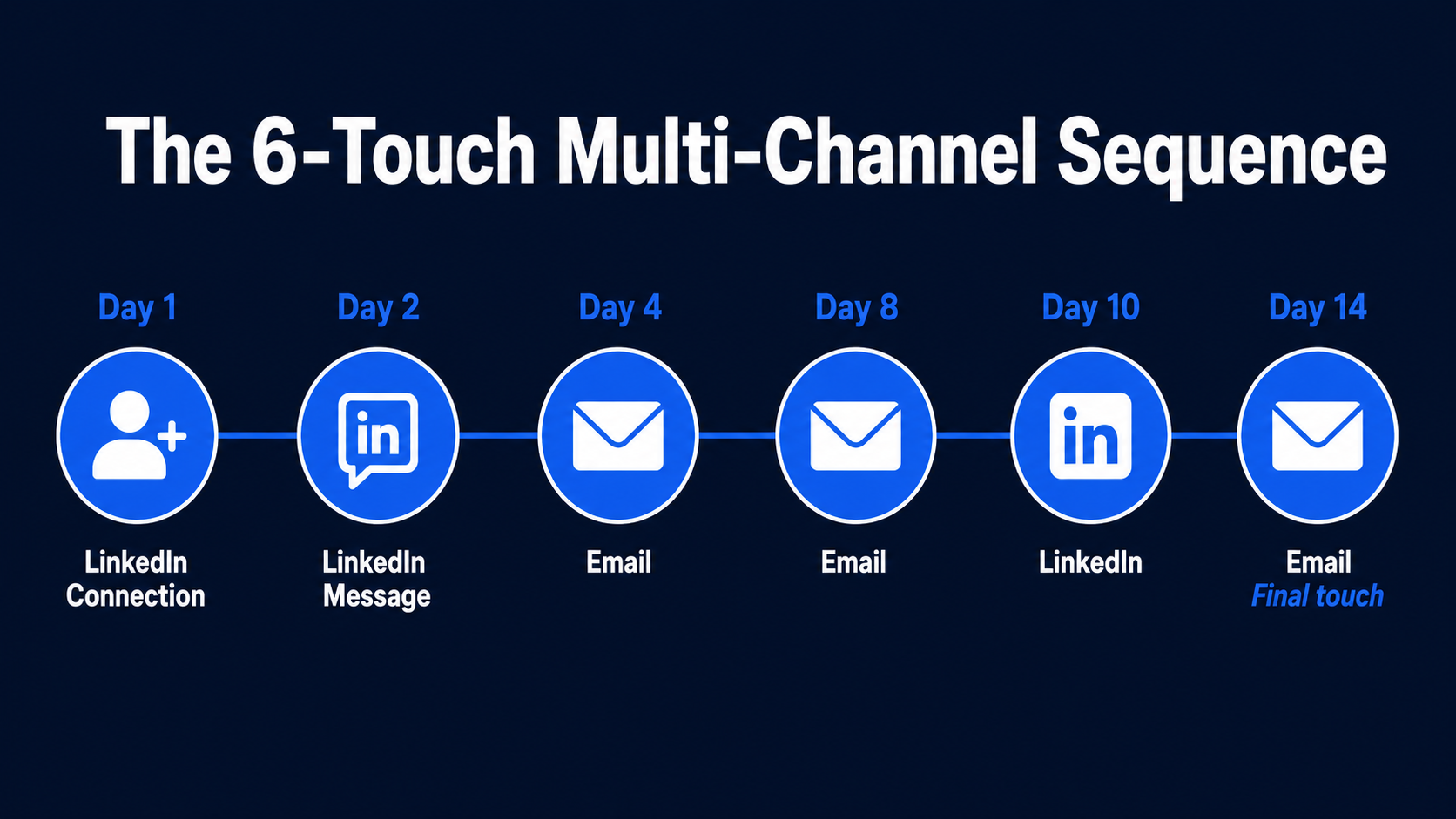
Multi-channel sequences combining both outperform either channel alone by 30–50% on qualified reply rates. The standard integrated sequence:- LinkedIn connection request (Day 1)
- LinkedIn message post-connection (Day 2–3)
- Cold email, touch 1 (Day 4–5)
- Cold email, touch 2 — different angle (Day 8)
- LinkedIn follow-up (Day 10)
- Final cold email (Day 14)
Step 4: Write Messaging That Earns a Response
The most common cold outreach mistake is writing emails that explain what you do rather than why that matters to this specific prospect right now.
Effective outbound messaging has four components:
Relevance signal
The first line of your email or LinkedIn message must establish that this is not a generic broadcast. It should reference something specific to the prospect: their recent LinkedIn post, a company announcement, a challenge specific to their industry, or a trigger signal from your research.
The problem you solve (in their language)
Not "we provide [category] solutions." The specific pain your best customers had before they worked with you, described in the language they used — not vendor language.
Evidence that it works
One specific, credible proof point: a relevant client outcome, a metric, a well-known client name. Brief and specific. Not a case study — one sentence.
A low-friction CTA
The call to action should require minimal commitment: "Worth a 20-minute call?" or "Is this relevant to what you're working on this quarter?" not "Book a demo" or "Let's schedule a call to discuss your challenges."
Test multiple message variants. Open rate tests the subject line and first line. Reply rate tests the full message. Positive reply rate tests the relevance of your offer to this audience. For AI-assisted personalisation at scale, see our guide to AI sales outreach.
Step 5: Build a Sequence, Not a Single Touch
Most responses to outbound come after the second, third, or fourth touch. A single-touch strategy produces 20–30% of the results of a well-executed sequence.
The principles for effective B2B outbound sequences:
- 6–10 touches over 10–14 days for most B2B ICPs. Beyond 14 days, response rates drop sharply and the frequency starts feeling harassing rather than persistent.
- Different angle at each touch. The second email is not a "just following up" — it adds a new angle (a case study, a question, a market observation).
- Plain text for follow-ups. Formatted HTML emails with images and branding feel like marketing. Plain text follow-ups feel personal.
- Shorter as you go further. Touch 1 might be 4–5 sentences. Touch 5 might be 2.
- Give them an easy out. The final touch should offer a clear exit: "If now isn't the right time, happy to reconnect in Q3 — just say the word and I'll follow up then."
Step 6: Qualify What Comes Back
Not every positive reply is a qualified opportunity. The goal of the qualification phase is to determine, as quickly as possible, whether there is a real opportunity — and to route dead-end conversations out of the active pipeline before they consume sales time.
The first conversation with a positive reply should establish:
- Is there a genuine problem that your offering solves?
- Does this person have the authority or influence to make a decision?
- Is there a budget and timeline that makes this a realistic near-term opportunity?
- Is there a reason to act now, or is this a "sounds interesting, maybe someday" conversation?
Positive replies that fail qualification should be moved to a long-term nurture rather than discarded. A prospect who has no budget today may have one in 12 months. Maintaining a light touchpoint cadence (a relevant piece of content every 6–8 weeks) keeps the relationship warm without consuming active pipeline resources. See our full lead qualification guide for frameworks and scoring approaches.
Measuring Outbound Strategy Performance
The metrics that matter, at each stage:
| Stage | Metric | Good Benchmark |
|---|---|---|
| List quality | Email bounce rate | <2% |
| Email delivery | Inbox placement rate | >85% |
| First touch | Open rate | 40–55% |
| Engagement | Reply rate | 3–8% |
| Intent | Positive reply rate | 1–3% |
| Pipeline | Meeting booked rate | 0.5–2% of contacts |
| Quality | Meeting-to-SAO rate | 30–50% |
Track these weekly. A drop in any one metric points to a specific problem: falling open rates indicate subject line or deliverability issues; falling reply rates despite good open rates indicate messaging problems; falling meeting-to-SAO rates indicate ICP or list quality problems.
The Most Common Outbound Strategy Mistakes
Starting without an ICP. This is the root cause of most outbound failures. Volume without targeting is expensive and demoralising. Single-touch campaigns. One email and no follow-up is not an outbound strategy — it's a missed opportunity. Pitching too early. The goal of outbound is to start a conversation, not to sell on the first touch. Opening with a two-paragraph product pitch trains prospects to ignore you. Not testing. Running the same message to the same list for three months without A/B testing subject lines, message angles, and CTAs means accepting whatever results you get without learning how to improve them. Ignoring deliverability. Outbound at any meaningful volume requires dedicated sending domains, inbox warming, and regular deliverability monitoring. Skipping this produces campaigns that look like they're running but aren't reaching anyone's inbox.How VirtuWise Builds Outbound Sales Strategies
VirtuWise operates as an outsourced outbound sales function — building and running the outbound strategy so B2B companies don't have to hire, train, and manage a full SDR team in-house.
We handle ICP definition, account research, list building, message testing, sequence management, and reply qualification. Our clients focus on running the meetings; we focus on booking them.
We've run outbound programmes for clients in fintech, iGaming, SaaS, IT services, and AI — markets where the buyer trust threshold is high and generic volume outreach consistently underperforms.
Our pricing:- Lead Generation: €3,000/month — ICP research, personalised outreach, meeting booking and scheduling, weekly reporting
- Lead Generation Plus: €5,000/month — everything in Lead Generation, plus multi-channel outreach (LinkedIn + email + messengers), A/B testing, higher volume
- Business Development: €7,000/month — full-cycle business development, dedicated senior sales manager, online and offline representation, custom strategy
- Inbound (SEO & AEO): €3,500/month — SEO and AEO run as one service: keyword strategy, content, technical fixes, and AI-crawler visibility (structured data, llms.txt)
- Fractional Growth Partner: Custom — a revenue engine audit, then optional ongoing Advisory or hands-on Implementation
Full details at virtuwise.io/pricing. Or explore our business development service to see how we structure full-cycle engagements.
Frequently Asked Questions
How many contacts should I target per month in an outbound programme?For quality-first outbound, 200–400 highly targeted contacts per month per sender typically outperforms 1,000+ contacts from a broader list. The ceiling is determined by your list quality and personalisation capability, not by how many emails your sequencer can send.
How do I avoid being marked as spam?Use dedicated sending domains (not your primary domain), warm inboxes before any campaign volume, verify all email addresses, keep bounce rates below 2%, maintain send volumes within safe limits (50–150 emails/day/inbox depending on domain age), and monitor inbox placement rates weekly.
Should I use a CRM for outbound tracking?Yes. A CRM (HubSpot, Salesforce, Pipedrive) is essential for tracking contact history, sequence state, and pipeline stage. Without it, reply management becomes chaotic and you lose pipeline to poor follow-up hygiene. Most outbound sequencers (Apollo, Outreach, Salesloft) integrate directly with CRMs.
How quickly should I expect results from a new outbound programme?First replies typically appear within the first two weeks. First meetings within 3–5 weeks. Consistent pipeline from a well-built programme typically stabilises at 2–3 months. Initial sequence results are always lower than mature programme results — it takes 2–3 iteration cycles to optimise messaging and list quality.
What's the difference between outbound sales strategy and a sales playbook?An outbound sales strategy covers who to target, through which channels, with what messaging, and how to qualify what comes back. A sales playbook covers what happens after qualification — the full sales process from first meeting to close. Both are necessary; the outbound strategy feeds the playbook.