
Cybersecurity Lead Generation: How to Build B2B Pipeline in 2026
Cybersecurity lead generation requires navigating technical buyers, long procurement cycles, and high trust requirements. Here's how security companies build consistent B2B pipeline.
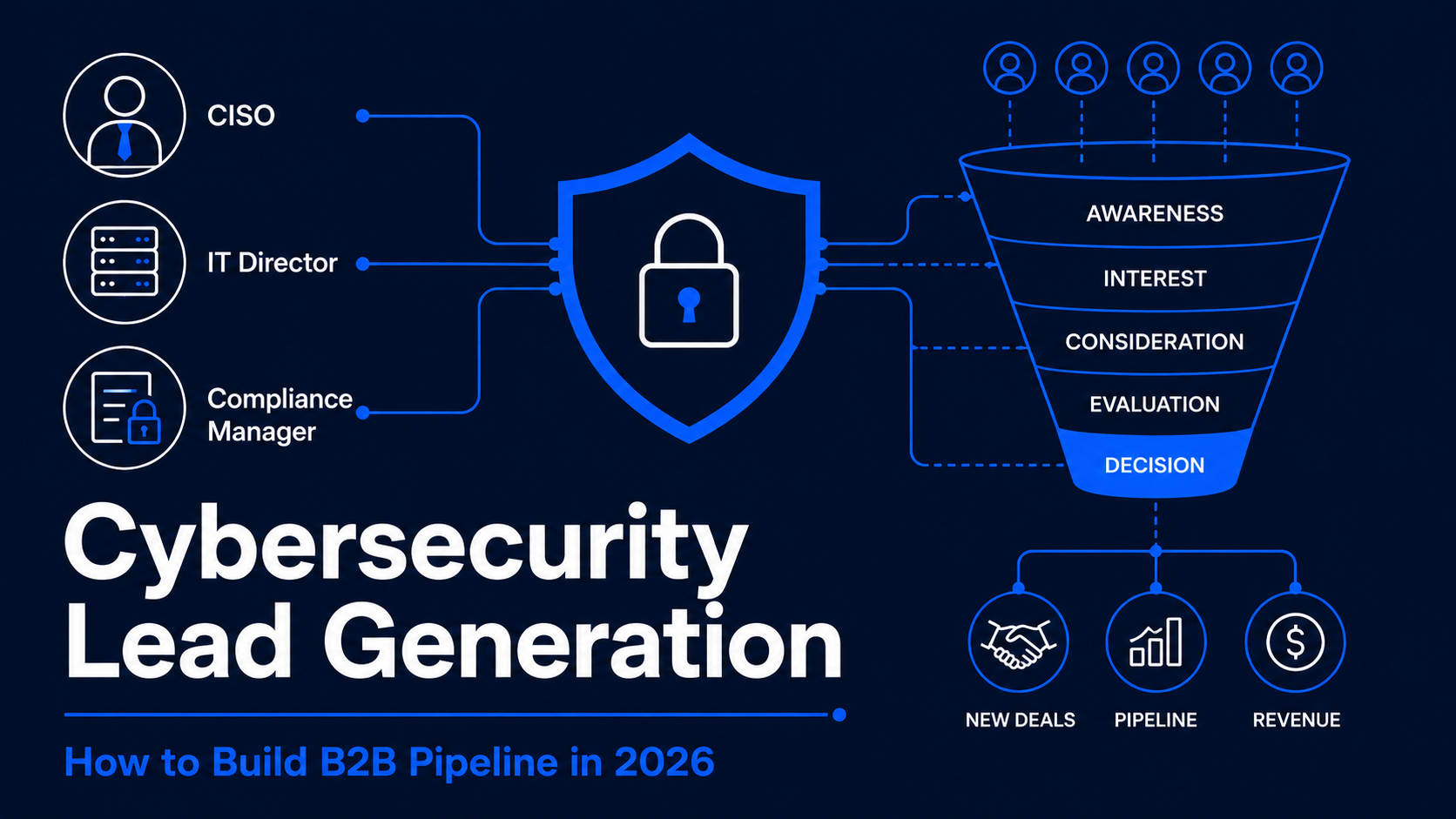
Cybersecurity is one of the fastest-growing B2B markets globally, but it is also one of the most challenging for lead generation. Buyers are technically sophisticated and deeply skeptical of vendor marketing. The consequences of a wrong purchase decision are significant — both financially and in terms of the risk posture they're responsible for. And the market is flooded with vendors, all claiming to have the best solution for the same set of threats.
For cybersecurity companies — whether you're selling MDR, endpoint security, IAM, penetration testing services, compliance software, or cloud security — building a consistent pipeline requires a fundamentally different approach than standard B2B lead generation. This guide covers what works, what doesn't, and how to build a lead generation operation that matches the cybersecurity market's specific dynamics.
Why Cybersecurity Lead Generation Is Hard
Three factors make cybersecurity lead generation structurally more difficult than most B2B categories:
Technical buyer skepticism.CISOs, security architects, and security operations leads are trained to be skeptical of claims. They've seen every vendor promise. Generic marketing language ("industry-leading", "best-in-class", "zero-trust ready") produces eye-rolls, not inquiries. They respond to technical specificity, credible evidence, and honest acknowledgment of limitations.
Fear, uncertainty, and doubt (FUD) fatigue.The cybersecurity industry has historically relied on FUD-based marketing — emphasising threats and scary consequences to drive urgency. Buyers have become immune to this. Outreach built on "hackers are targeting companies like yours" triggers the same mental filter as Nigerian prince emails.
Complex procurement and multi-stakeholder decisions.Security purchases typically involve the CISO, IT Director, Procurement, and often Legal and Compliance. A security platform purchase at an enterprise company may involve 8–12 stakeholders and a 12–18 month procurement process. Outreach that targets only the CISO misses the broader buying committee.
Defining Your ICP for Cybersecurity Outreach
The cybersecurity market is highly fragmented. ICP definition must be specific to your category, not just to "cybersecurity companies" as buyers.
By buyer role:- CISO: strategic decisions, vendor selection for significant platforms, budget authority above certain thresholds
- Security Operations Manager / SOC Lead: operational tooling, SIEM, MDR, incident response
- IT Director / CTO: infrastructure security, endpoint, cloud security
- Compliance / Risk Officer: GRC platforms, audit tooling, regulatory compliance
- DevOps / Engineering Lead: AppSec, SAST/DAST tooling, secrets management
Your ICP persona depends on your product category. Many cybersecurity vendors target the CISO when their product is actually selected and championed by a more operational role.
By company segment:- Enterprise (1,000+ employees): formal procurement, long cycles, multiple stakeholders
- Mid-market (100–1,000 employees): often an IT Director or CISO-equivalent with significant buying authority, faster cycles than enterprise
- SMB: MSP-driven in most cases; direct outreach to owners or IT-responsible roles
Cybersecurity needs are highly vertical-specific. Financial services, healthcare, and critical infrastructure have regulatory mandates (PCI-DSS, HIPAA, NIS2) that create specific, time-bounded buying events. Retail and e-commerce have specific card data compliance requirements. Mid-market technology companies prioritise cloud security and developer-facing tooling.
By trigger:- Regulatory deadline or new compliance requirement
- Recent breach or incident (publicly disclosed or internally experienced)
- Cloud migration or digital transformation project
- M&A activity (integrations create security gaps)
- New CISO hire (typically conducts a full stack review within 90 days)
- Specific certification pursuit (SOC 2, ISO 27001)
Outbound for Cybersecurity Companies
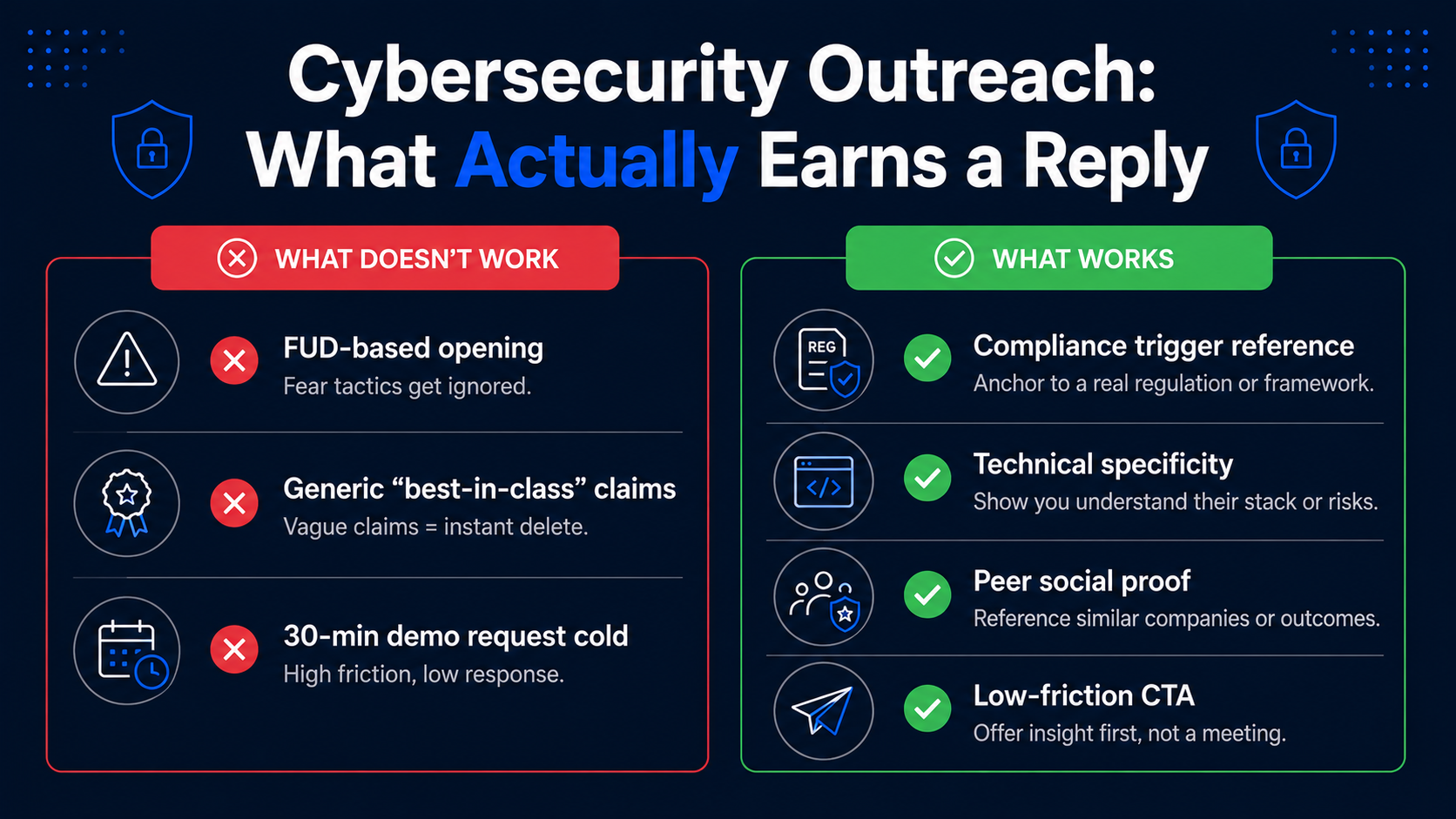
Outbound works in cybersecurity, but requires calibration for the buyer's skepticism level.
What to avoid in cybersecurity outreach
- Opening with threat statistics or fear-based framing
- Generic "we help companies like yours improve their security posture" messaging
- Claiming to be the "best" or "leader" in any category without evidence
- Asking for a 30-minute security assessment cold (implies you'll be selling at them for 30 minutes)
What works in cybersecurity outreach
Specificity over breadth.A first email that references a specific compliance framework relevant to their industry (PCI-DSS for payments, NIS2 for critical infrastructure, HIPAA for healthcare) demonstrates that you understand their specific context and don't need to be educated.
Technical credibility signals.References to specific CVEs, real breach case studies (public information), or technical details of how your product addresses a specific attack vector signal to technical buyers that you're worth 10 minutes.
Relevance to their current situation.Trigger-based outreach dramatically outperforms static list outreach in cybersecurity. A company that just announced a cloud migration, hired a new CISO, or is in the process of achieving ISO 27001 certification has a specific, timely need. Outreach that references this context converts at 3–5x the rate of generic outreach.
Peer references and social proof.CISO networks are tight. A reference to a named customer in a comparable vertical (with permission) or a mention of an analyst who has reviewed your product (Gartner, Forrester, IDC) builds immediate credibility that marketing claims cannot.
Sequence structure for cybersecurity
Given the buyer skepticism, a softer, more patient outbound sequence works better than aggressive follow-up:
- LinkedIn connection with a specific, relevant note (no pitch)
- LinkedIn post engagement (comment on their content if they're active)
- First email — specific trigger or context, no product pitch
- Second email — a relevant technical resource (not a sales deck)
- Third email — a relevant peer case study or reference
- Final touch — clear close with an easy opt-out
Total span: 14–21 days. Longer spacing between touches than standard B2B outbound. Cybersecurity buyers respond poorly to rapid-fire follow-up that feels like a data breach incident itself.
Content and Thought Leadership for Cybersecurity
The content that generates leads and builds credibility in cybersecurity:
Technical writing that demonstrates expertise.A vendor who publishes original threat research, detailed technical analyses of recent vulnerabilities, or honest assessments of industry tools is seen as a peer rather than a vendor. This is the highest-value content investment for cybersecurity companies.
Compliance and regulatory guidance.Detailed, practical guides to NIS2 implementation, DORA compliance timelines, PCI-DSS v4.0 changes, or HIPAA updates attract buyers who have specific, near-term compliance obligations. These buyers have genuine urgency and are often in active evaluation mode.
Case studies with technical specificity.A case study that describes the specific attack vector, the detection mechanism, and the response process in concrete terms is more credible than a case study that reports "reduced risk by 40%." Specificity signals authenticity.
Distribution channels: LinkedIn (for CISOs and security leaders), Hacker News and security community forums (for technical practitioners), industry publications (CyberSecurity Insiders, SC Media, Dark Reading), and security-focused podcast appearances.
Events and Community for Cybersecurity Pipeline
The cybersecurity community is conference-driven. RSA Conference, Black Hat, DEF CON, Infosecurity Europe, and sector-specific events (FS-ISAC for financial services, HIMSS for healthcare IT) are the primary venues where relationships are built and vendor selection decisions influenced.
Conference strategy for cybersecurity companies:
- Speaking and CFP submissions: security conferences have highly competitive CFP processes, but an accepted talk dramatically increases your credibility and visibility with the exact audience you're selling to
- Side events and roundtables: private dinners, CISO roundtables, and practitioner workshops at major conferences often produce higher-quality relationships than booth traffic
- Community presence: participating authentically in CISO forums, ISACs, and peer groups builds trust over time — but requires genuine contribution, not vendor promotion
Metrics for Cybersecurity Lead Generation
Given longer cycles and higher trust requirements, benchmarks adjust:
| Metric | Benchmark | Why It's Different |
|---|---|---|
| Cold email open rate | 35–45% | On par with other B2B; subject line and sender reputation still matter |
| Cold email positive reply rate | 1–2.5% | Lower than SaaS — FUD fatigue and high vendor skepticism |
| LinkedIn connection acceptance | 25–35% | Requires specific, technically credible notes |
| Meeting-to-qualified-opportunity | 40–55% | Higher than average — security buyers rarely take meetings without genuine intent |
| Sales cycle — mid-market | 3–6 months | CISO or IT Director decision, moderate procurement process |
| Sales cycle — enterprise | 12–18 months | 8–12 stakeholders, formal RFP, security review, legal sign-off |
The higher meeting-to-SAO rate partially compensates for the lower outreach conversion rate. Cybersecurity buyers are cautious about giving their time, but when they do take a meeting, they're typically in genuine evaluation mode.
How VirtuWise Supports Cybersecurity Companies
VirtuWise works with cybersecurity vendors and service providers building B2B pipeline through outbound. Our team has experience with the cybersecurity buyer's mindset, the compliance triggers that create urgency, and the personalisation approaches that work with technical decision-makers.
We don't run generic outbound for cybersecurity clients. We research specific triggers (regulatory timelines, new CISO hires, cloud migration announcements), build ICP-matched lists at the right company and persona level, and write messaging that speaks to the buyer's specific situation — not generic security fear.
Our pricing:- Lead Generation: €3,000/month — ICP research, personalised outreach, meeting booking and scheduling, weekly reporting
- Lead Generation Plus: €5,000/month — everything in Lead Generation, plus multi-channel outreach (LinkedIn + email + messengers), A/B testing, higher volume
- Business Development: €7,000/month — full-cycle business development, dedicated senior sales manager, online and offline representation, custom strategy
- Inbound (SEO & AEO): €3,500/month — SEO and AEO run as one service: keyword strategy, content, technical fixes, and AI-crawler visibility (structured data, llms.txt)
- Fractional Growth Partner: Custom — a revenue engine audit, then optional ongoing Advisory or hands-on Implementation
Full details at virtuwise.io/pricing.
Frequently Asked Questions
Does cold email work for cybersecurity companies?Yes, with calibration. Security buyers have high skepticism for generic vendor outreach, but specific, technically credible messaging from a vendor who demonstrates understanding of their regulatory context and current situation produces positive reply rates of 1.5–3%. The approach matters significantly more than the channel.
How do you reach CISOs at large enterprises?Large enterprise CISOs are heavily protected and receive enormous vendor outreach volume. Direct cold email to a Fortune 500 CISO rarely works. More effective approaches: warm introductions through CISO network communities, speaking at events where CISOs gather, relevant published research that CISOs cite and share, and LinkedIn engagement over time before any outreach.
How important is compliance knowledge for cybersecurity outreach?Very. Buyers in regulated industries (financial services, healthcare, critical infrastructure) have specific regulatory obligations that create time-bounded buying events. Outreach that demonstrates understanding of their specific compliance requirement (NIS2 deadline, DORA implementation, PCI-DSS v4.0) is immediately more relevant than generic security posture messaging.
What's the best channel for reaching security practitioners vs. CISOs?Technical practitioners (security engineers, SOC analysts, DevSecOps leads) are more reachable through technical community channels — LinkedIn technical discussions, security forums, GitHub, and practitioner-focused events like DEF CON. CISOs are more reachable through peer networks, industry events, and LinkedIn — but require a more strategic, relationship-oriented approach rather than outreach volume.