
IT Services Lead Generation: How to Build B2B Pipeline in 2026
IT services lead generation requires a different approach than most B2B markets. Here's how MSPs, IT consultancies, and tech service firms generate consistent B2B pipeline.
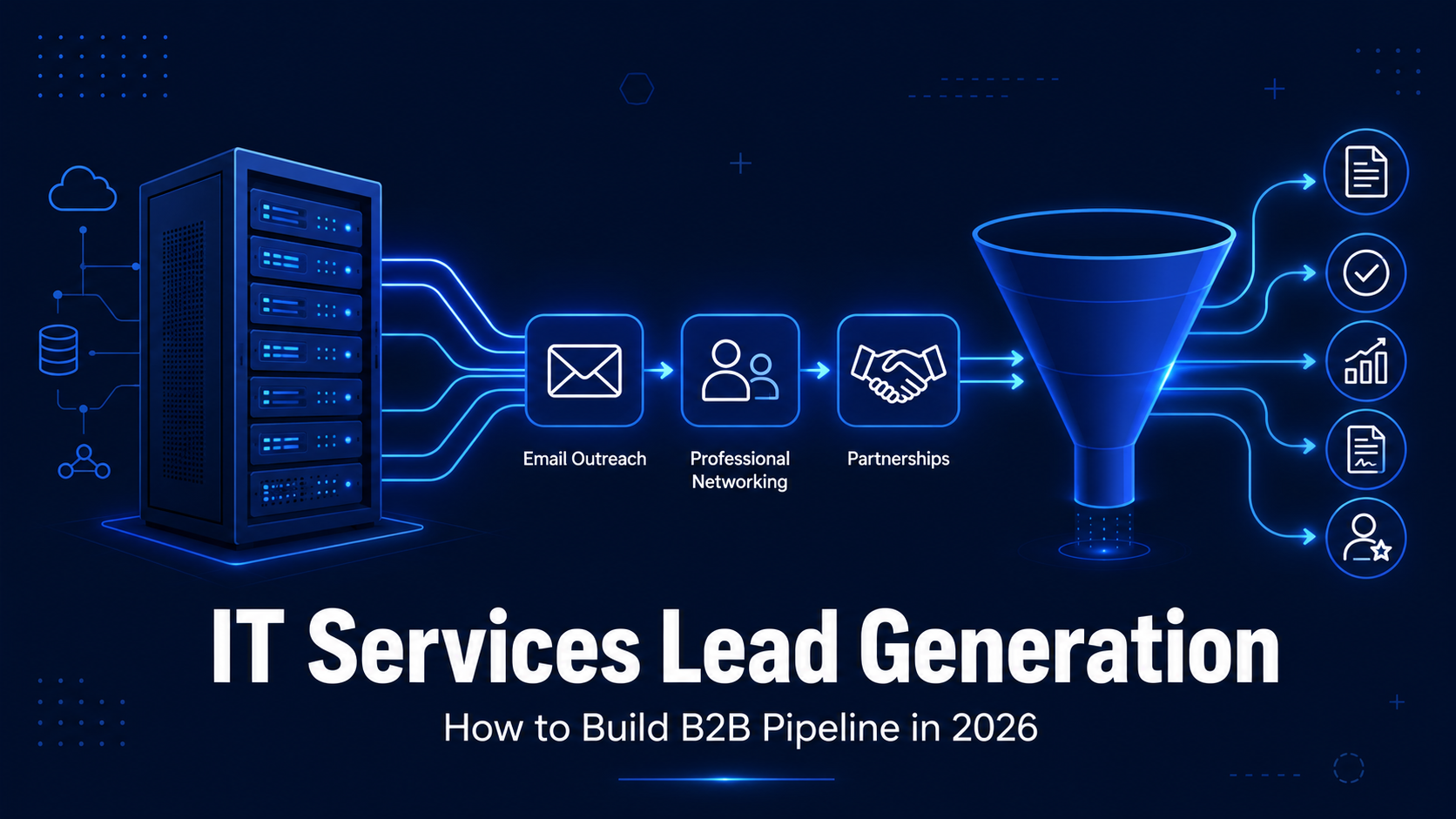
IT services companies face a distinct lead generation challenge. The market is crowded, services are often difficult to differentiate, procurement processes are long and relationship-driven, and the buyers most worth targeting — IT directors, CTOs, procurement leads — are heavily solicited and difficult to reach cold.
At the same time, IT services is a market with reliable demand and strong retention economics. Companies that get lead generation working consistently can build predictable, compounding revenue over years.
This guide covers how IT services and managed services companies generate qualified pipeline in 2026 — including the channels that work, the ones that don't, and how to build a lead generation operation that fits the market's specific dynamics.
Why IT Services Lead Generation Is Different
Most B2B lead generation frameworks assume relatively short sales cycles, clear pain signals, and buyers who are actively searching for solutions. IT services procurement often looks different:
- Long evaluation cycles. IT service contracts — especially managed services, outsourced infrastructure, and consultancy retainers — involve security reviews, compliance checks, reference calls, and budget approval chains. Six to twelve-month cycles are common for enterprise accounts.
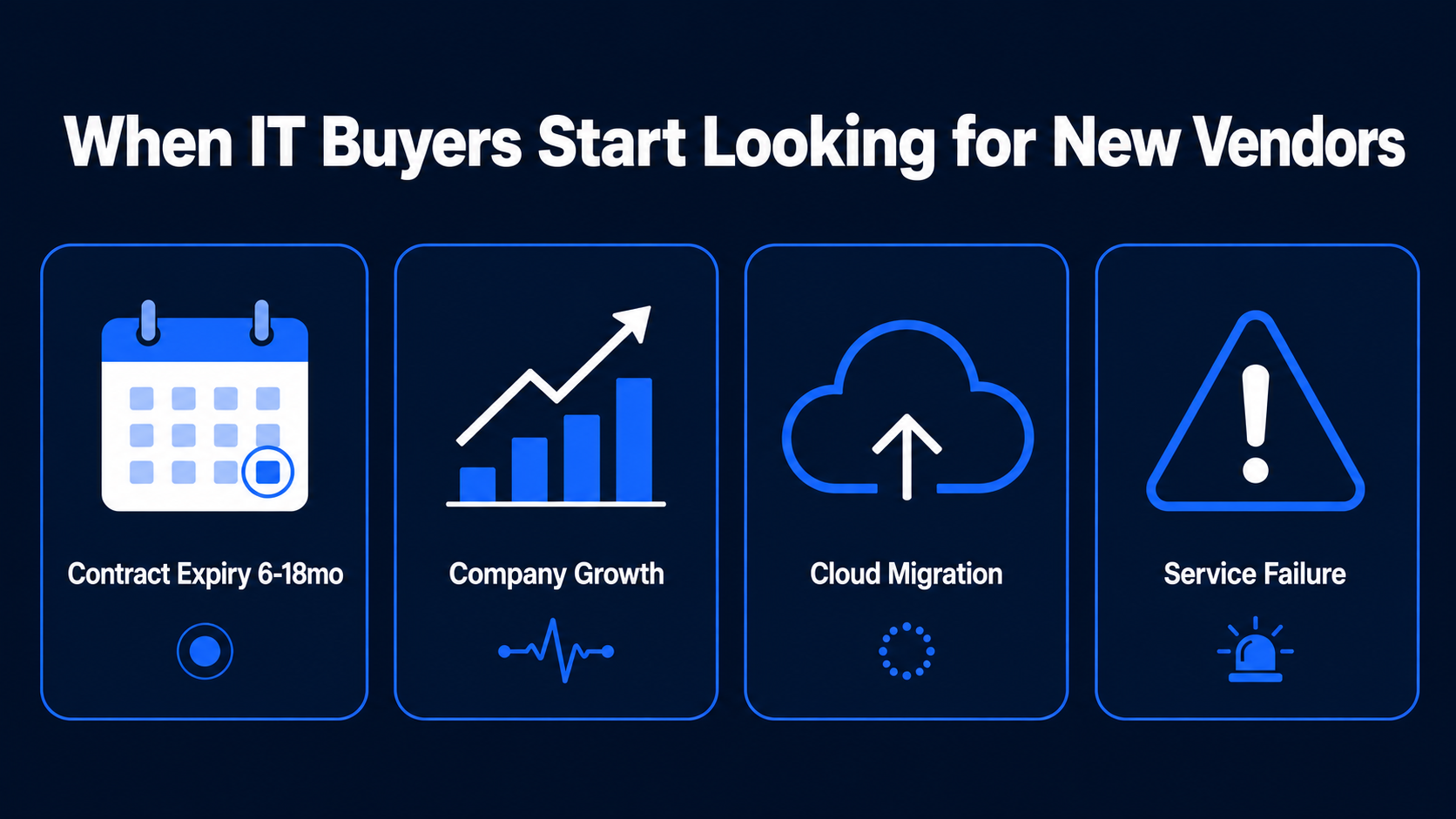
- High switching costs. Buyers in IT services are cautious about change. The cost and disruption of switching providers is significant, which means prospects are rarely looking for a new vendor unless something is pushing them to change — contract expiry, service failure, company growth, or a technology transition.
- Trust-heavy decisions. IT buyers are accountable for infrastructure that can't fail. They prioritise vendor credibility, references, and stability over price in most cases. Cold outreach from an unknown vendor faces a higher trust barrier than in less risk-sensitive categories.
- Limited search volume. "IT services lead generation" gets 140 monthly searches globally. Your buyers aren't googling for you. Inbound from SEO exists, but the organic pipeline opportunity is limited relative to outbound.
These dynamics mean that IT services lead generation works best through relationship-building and outbound, not inbound content funnels — at least in the short to medium term.
Define Your ICP Before Anything Else
IT services is not one market. It includes:
- Managed service providers (MSPs) targeting SMB and mid-market
- IT consultancies serving enterprise clients on transformation projects
- Cloud migration and infrastructure specialists
- Cybersecurity service firms
- Software development and staffing firms
- Niche vertical IT specialists (healthcare IT, fintech infrastructure, etc.)
Each has a different ICP, different buyer persona, different competitive dynamics, and different sales cycle. A marketing approach designed for an MSP targeting 50-person professional services firms will not work for a boutique AWS consulting firm targeting €500M enterprise clients.
Before building any lead generation programme, define:
- Account size and type (SMB, mid-market, enterprise; specific verticals)
- The specific service category you're positioning against
- The persona who initiates the evaluation (IT Director, CTO, COO, Procurement)
- The trigger that typically prompts a buyer to look for a new provider
The most consistent IT services ICP trigger: contract expiry (typically 6–18 months out), infrastructure failure or near-miss, company growth crossing a headcount or complexity threshold, or technology migration (moving to cloud, adopting a new ERP, post-acquisition integration).
Outbound: The Primary Channel for IT Services Pipeline
For most IT services companies, outbound is where reliable pipeline comes from. Here's how to make it work:
Account list quality determines everything
Build your target account list from ICP criteria, not from purchased databases. The difference in conversion rates between a well-researched ICP-matched list and a generic vertical list is 3–5x.
For IT services, useful account research signals include:
- Company headcount range (correlates with IT complexity and budget)
- Tech stack signals — specific tools they use indicate infrastructure maturity and potential pain
- Job postings — IT Director or Head of Infrastructure postings can signal an evaluation period
- LinkedIn activity — a CTO posting about cloud migration challenges is a warm signal
- Contract timing — public sector and larger enterprises often publish procurement information
Personalised outreach beats volume
IT buyers receive high volumes of vendor outreach. Generic "we provide managed IT services" emails are filtered without being read. The outreach that generates responses is specific to the prospect's situation:
- Reference a specific technology challenge relevant to their industry
- Mention a relevant client case study (without naming the client if confidential)
- Reference something specific to their business (recent funding, new office, LinkedIn post)
This level of personalisation at scale requires a combination of good list research and AI-assisted first-line generation — not template blasting.
Multi-channel is more effective than single-channel
For IT services outreach, email + LinkedIn + phone (where appropriate) outperforms any single channel. The sequence that works for most IT services ICPs:
- LinkedIn connection with a short, relevant note
- LinkedIn message after connection acceptance (value-add, not a pitch)
- Cold email to work email address
- Email follow-up #2 (different angle, shorter)
- LinkedIn follow-up message
- Final email with a clear close or alternative CTA
Total contact span: 10–14 days. Beyond that, responses drop sharply and you risk damaging the relationship with over-contact.
Referrals and Partner Networks
In IT services, referrals convert at significantly higher rates than cold outreach. A warm introduction from a trusted advisor, peer company, or mutual connection is often the most efficient pipeline source available — particularly for enterprise accounts.
Building a referral network requires intentional investment:
- Technology partner relationships: most technology vendors (Microsoft, AWS, Salesforce) have partner programmes with referral mechanisms. Active participation in these programmes generates both credibility and warm leads.
- Complementary service firms: an IT infrastructure firm and a cybersecurity consultancy serve similar buyers without directly competing. Cross-referral relationships between non-competing service firms are a reliable pipeline source for both parties.
- Existing client network: happy clients in IT services have long tenures and strong relationships. A structured approach to requesting and rewarding referrals from existing clients is often the highest-ROI activity available.
Content and Thought Leadership
IT services content marketing is a long-term play. The buyers who matter — IT directors at mid-market companies, CTOs at scale-ups — don't typically search for "managed IT services" with purchasing intent. They search for answers to specific technical and operational problems.
Content that works for IT services lead generation:
- Technical guides that demonstrate domain expertise (e.g. "How to approach cloud migration for a 200-person financial services firm")
- Vendor comparison content (e.g. "AWS vs Azure vs Google Cloud for regulated industries")
- Case studies that walk through a specific challenge, approach, and outcome — without being promotional
- Regulatory and compliance analysis relevant to the verticals you serve
This content rarely drives direct inbound pipeline in the short term. Its primary value is in warming up prospects who are already in your outbound sequence — a prospect who has read your cloud migration guide is more receptive to a follow-up conversation about their infrastructure than one who hasn't.
Events and Community Engagement
IT services buyers — particularly at the mid-market and enterprise level — engage with their peer community through industry associations, technology vendor events, and professional networks. Presence in these communities builds the brand recognition and trust that makes outreach more effective.
Relevant channels:
- Technology vendor ecosystem events (Microsoft Inspire, AWS re:Invent partner tracks, Salesforce World Tour)
- Vertical industry events where IT is on the agenda (sector-specific conferences where IT directors gather)
- LinkedIn thought leadership from senior technical staff
The goal is not direct lead generation from events (though it happens) — it's building the brand awareness and trust that shortens sales cycles for accounts already in your outbound pipeline.
Metrics for IT Services Lead Generation
Standard B2B metrics apply, with IT-services-specific benchmarks:
| Metric | Benchmark | Notes |
|---|---|---|
| Cold email open rate | 35–50% | Achievable with well-targeted, personalised lists |
| Cold email reply rate | 2–5% | Lower than SaaS due to high trust barrier |
| LinkedIn acceptance rate | 25–35% | Requires specific, relevant connection notes |
| Meeting-to-qualified-opportunity | 30–50% | IT buyers who commit to a meeting typically have genuine intent |
| Sales cycle — SMB MSP | 3–6 months | Shorter cycles, relationship still matters |
| Sales cycle — enterprise IT consultancy | 6–18 months | Security review, compliance checks, multi-stakeholder approval |
The most important metric is cost per qualified opportunity — not cost per lead. A well-run IT services outbound programme at €2,500/month that generates 4 qualified opportunities of average ACV €80K is an excellent ROI even if the lead count looks modest.
How VirtuWise Supports IT Services Companies
VirtuWise works with IT services companies, MSPs, and IT consultancies that need to build B2B pipeline without hiring and managing a full in-house SDR team.
We handle the outbound operation — ICP definition, account research, personalised outreach across email and LinkedIn, and qualified meeting delivery — with deep understanding of the IT services buyer's trust requirements and evaluation process.
Our pricing:- Lead Generation: €3,000/month — ICP research, personalised outreach, meeting booking and scheduling, weekly reporting
- Lead Generation Plus: €5,000/month — everything in Lead Generation, plus multi-channel outreach (LinkedIn + email + messengers), A/B testing, higher volume
- Business Development: €7,000/month — full-cycle business development, dedicated senior sales manager, online and offline representation, custom strategy
- Inbound (SEO & AEO): €3,500/month — SEO and AEO run as one service: keyword strategy, content, technical fixes, and AI-crawler visibility (structured data, llms.txt)
- Fractional Growth Partner: Custom — a revenue engine audit, then optional ongoing Advisory or hands-on Implementation
Details at virtuwise.io/pricing.
Frequently Asked Questions
Does cold outreach work for IT services companies?Yes, but with important caveats. IT buyers receive a lot of vendor outreach and have high filters. Cold outreach that is highly targeted (ICP-specific), genuinely personalised to the prospect's situation, and demonstrates real understanding of their context works significantly better than generic volume outreach. The approach matters more than the channel.
How important are certifications and partnerships for IT services lead generation?Very important for enterprise and mid-market deals. Microsoft Gold/Solutions Partner, AWS Advanced Tier, Google Cloud Partner, and similar certifications signal credibility and reduce the trust barrier for cold outreach. Prospects who are evaluating a new IT provider will check your technology partnerships — they're a filter, not just a badge.
What's the best way to find IT services prospects who are ready to switch providers?Contract timing signals are the most valuable: companies whose existing contracts are approaching renewal (12–18 months out) are in evaluation mode. Sources for timing signals include public procurement databases, LinkedIn job postings (IT Director positions often signal a re-evaluation period), and technology installation data that suggests infrastructure age.
How do you compete on something other than price in IT services?Vertical expertise is the most defensible differentiator. An IT services firm that has deep knowledge of financial services compliance requirements, healthcare IT infrastructure, or iGaming platform architecture is inherently harder to compare on price than a generalist provider. Specialisation also dramatically improves outbound conversion — buyers recognise that you understand their specific context.