
iGaming Payment Solutions: What Casino Operators Actually Look For
iGaming payment solutions are the make-or-break infrastructure for online casinos. Here's what operators evaluate — and how payment providers can win their business.
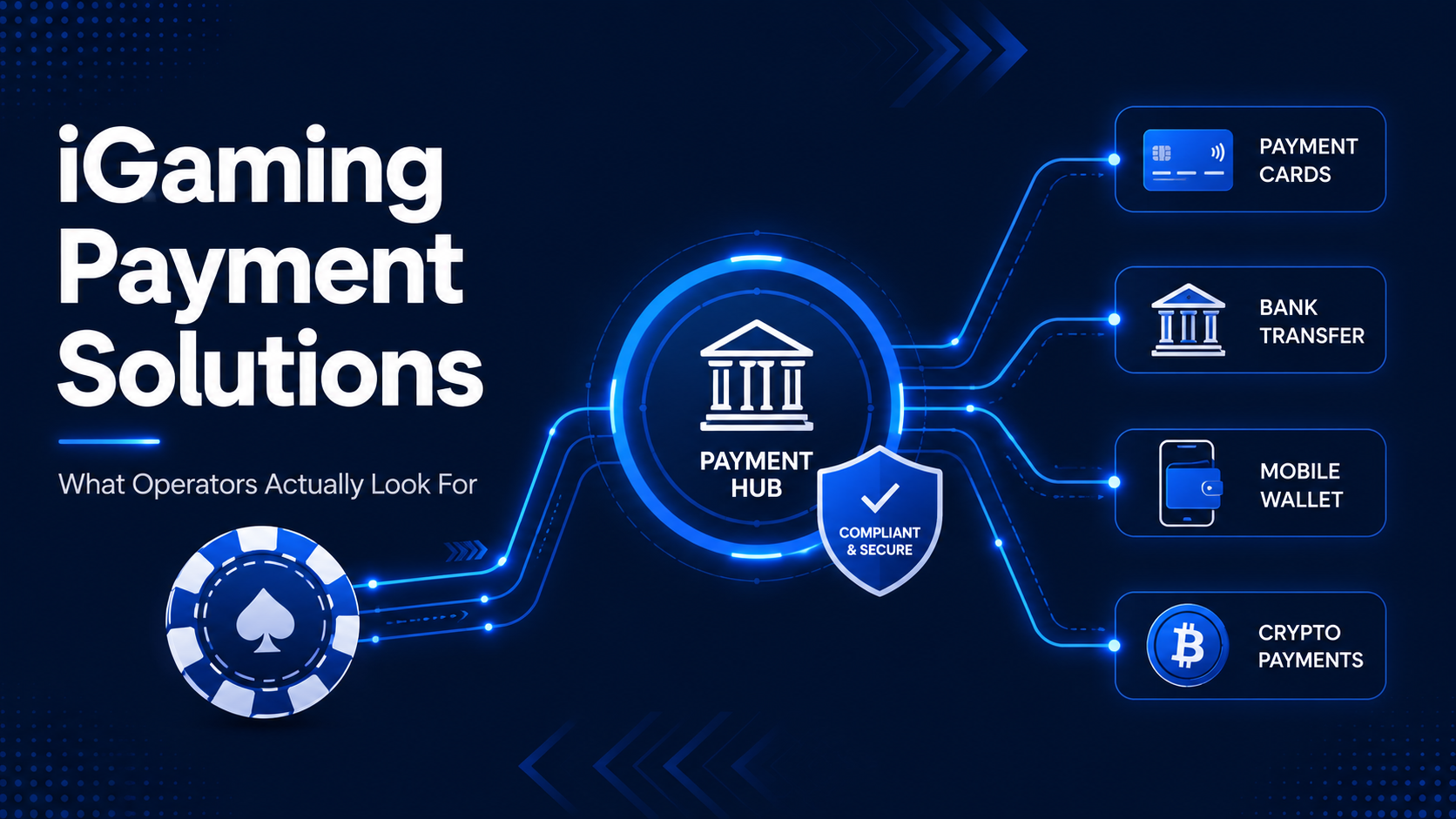
iGaming payment solutions are one of the most contested categories in the B2B gambling supply chain. Every licensed online casino needs a payment infrastructure that converts depositors, passes regulatory scrutiny, and keeps chargebacks low — and there are hundreds of providers claiming to deliver exactly that.
For casino operators, choosing the wrong payment partner creates real damage: declined transactions, delayed payouts, lost players, and compliance exposure. For payment providers, the challenge is different but equally acute: how do you differentiate in a market where every competitor claims "99.9% uptime" and "local payment method coverage"?
This guide explains what casino operators actually evaluate when selecting an iGaming payment solution — and what payment providers need to do to win operator relationships in a market that runs on trust and conference introductions.
Why Payment Infrastructure Defines the Player Experience
In iGaming, the payment layer touches every high-stakes moment in the player lifecycle: the first deposit that converts a registered user to an active player, the withdrawal request that determines whether a player returns, and the dispute resolution that either loses or retains a customer permanently.
Deposit conversion is the primary KPI
An operator running a slot-focused product might see 35–55% of registered users attempt a first deposit. The percentage of those attempts that actually complete — conversion rate — is directly controlled by the payment solution. A 5-percentage-point improvement in deposit conversion at significant volume translates to millions in annual GGR.
Payout speed drives player retention
Studies across European and LatAm markets consistently show that players who receive withdrawals within 24 hours have significantly higher 90-day retention rates than those who wait 3–5 business days. This makes payment processing speed a retention tool, not just an operational metric.
Regulatory compliance is non-negotiable
AML/KYC verification, transaction monitoring, responsible gambling payment controls, and jurisdiction-specific restrictions mean that iGaming payment solutions need dedicated compliance infrastructure — not a bolted-on module from a generic payment gateway.
What Casino Operators Evaluate When Selecting a Payment Provider
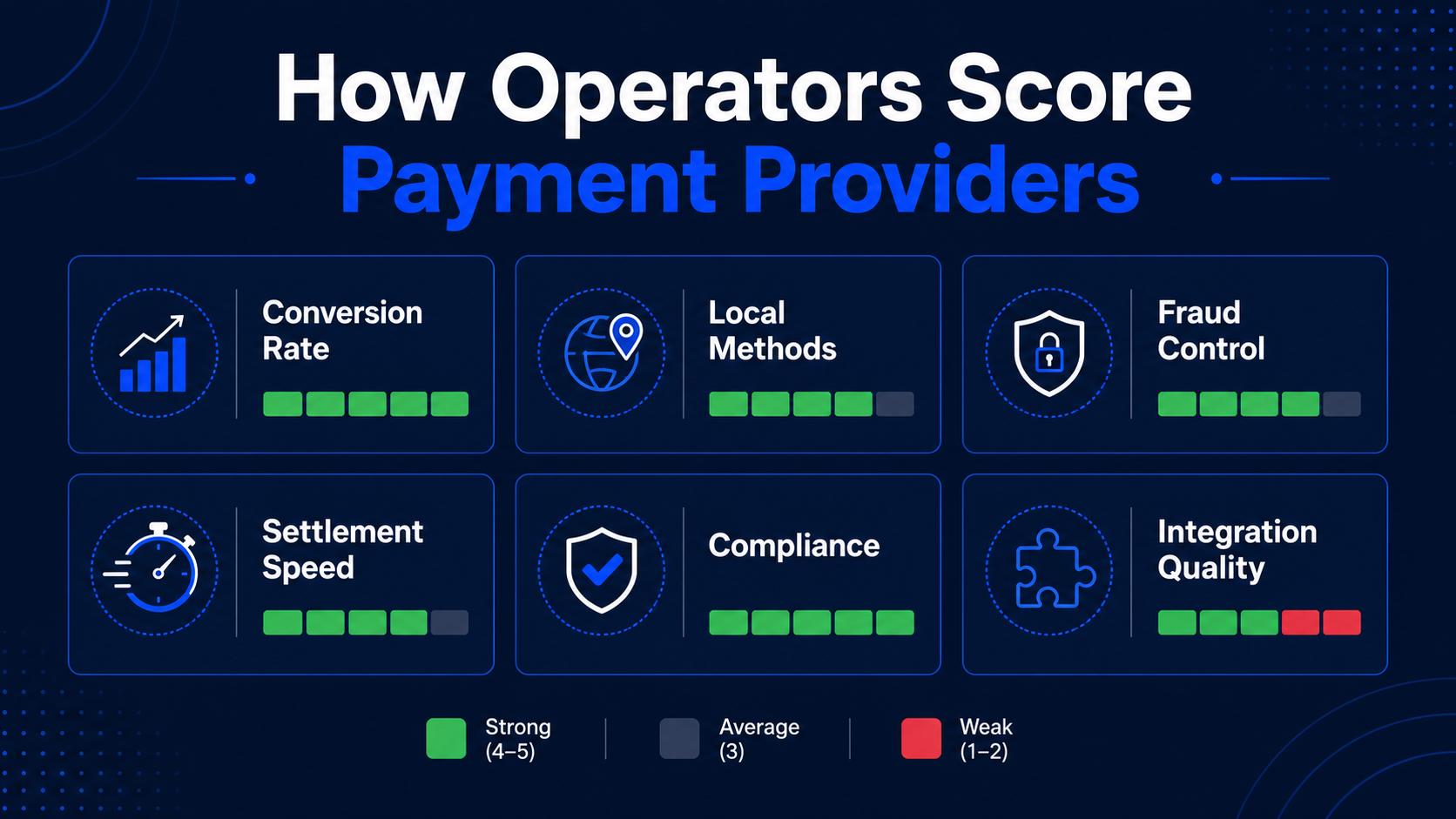
The operator evaluation process for iGaming payment solutions is more rigorous than most payment providers expect. Here are the criteria that dominate shortlists:
Geographic Coverage and Local Payment Methods
No single payment provider covers every market well. Operators evaluate providers on coverage of their specific target markets — not global claims, but actual conversion rates in the jurisdictions they operate.
For European operators, this typically means coverage of SEPA transfers, local credit cards, and increasingly iDEAL (Netherlands), MBWay (Portugal), BLIK (Poland), and similar local methods. For LatAm expansion, PIX (Brazil) and SPEI (Mexico) have become essential. For emerging markets, mobile money methods (M-Pesa in East Africa, bKash in Bangladesh) matter more than card rails.
An iGaming payment solution that claims "140+ payment methods" but delivers 30% conversion on Brazilian PIX is not a competitive option for a LatAm-focused operator.
Risk and Fraud Management
iGaming is a high-risk merchant category. Payment providers working in this space need fraud prevention and chargeback management systems calibrated specifically for gambling transaction patterns — which look nothing like e-commerce patterns.
Key fraud signals in iGaming (velocity of deposits before withdrawal, bonus abuse patterns, multi-accounting indicators) require iGaming-specific machine learning models. Generic fraud tools miss these signals and either block legitimate players or allow systematic abuse.
Licensing and Compliance Infrastructure
Regulatory requirements vary dramatically by jurisdiction. UKGC-licensed operators face specific deposit limits, responsible gambling payment blocks, and enhanced AML requirements. MGA, Curaçao, and emerging markets like Ontario each have their own compliance layers.
Operators evaluate whether a payment provider's compliance team understands their specific regulatory context — or whether compliance is a checklist rather than an operational capability.
Integration Quality and Technical Documentation
Bad API documentation is a leading cause of operator churn from payment providers. Operators building new integrations or migrating to new providers evaluate the quality of sandbox environments, webhook reliability, error handling documentation, and the availability of technical support during integration.
Settlement Speed and Currency Management
How quickly the provider settles funds to the operator — and in what currencies — directly impacts operator cash flow. Multi-currency settlement with competitive FX rates matters particularly for operators with cross-border player bases.
iGaming Payment Solution Comparison: What Operators Weigh
| Evaluation Criterion | Why It Matters | Green Flags | Red Flags |
|---|---|---|---|
| Local payment method conversion | Directly drives deposit conversion | Proven conversion data for target markets | Global coverage claims without market-specific data |
| Fraud & chargeback management | Protects operator margins | iGaming-specific ML models | Generic e-commerce fraud tools |
| Regulatory compliance | Licence protection | In-house compliance team per jurisdiction | Outsourced or checkbox compliance |
| API quality | Integration speed and stability | Sandbox, clear docs, webhook logs | Incomplete documentation, slow support |
| Settlement speed | Operator cash flow | T+1 or faster settlement | 5–7 day settlement cycles |
| Account management | Escalation and optimisation | Dedicated iGaming account manager | Shared support queue |
| References | Trust and track record | Named operator references | Vague "major operator" claims |
How iGaming Payment Providers Win New Operator Clients
The iGaming payment market is relationship-driven. The largest operator relationships — Tier 1 brands processing hundreds of millions annually — are not won through inbound marketing. They are built over years at ICE London, SiGMA Malta, and G2E Las Vegas, and through warm introductions from shared contacts.
But the mid-market — regional operators, emerging market entrants, new licensees — is more accessible and represents significant volume. Here is how payment providers win at this level:
Conferences are table stakes, not differentiators
Every payment provider is at ICE. Showing up is necessary but not sufficient. The providers winning mid-market operator relationships are running structured outreach before and after each event — identifying which operators are attending, scheduling meetings in advance, and following up with specific data on conversion performance in the operator's target markets.
Proof data trumps feature lists
Operators evaluate payment providers on evidence, not claims. A provider that can say "for an operator with your profile in your target market, our conversion rate over the last 12 months was X%" will outperform one presenting a feature comparison table.
Direct outreach to the right contacts matters more than advertising
The payment decision-maker at an iGaming operator is typically the Head of Payments, CFO, or CMO. These people do not respond to banner advertising. They respond to personalised outreach that demonstrates knowledge of their specific operation and market context.
Integration support quality is a selling point
Operators fear integration projects. A payment provider that offers dedicated technical onboarding, realistic timelines, and a clear escalation path for integration issues differentiates meaningfully from those who hand over API docs and wait.
Red Flags That Cost iGaming Payment Providers Operator Deals
Vague market coverage claims
"We support 100+ countries" without conversion data for the operator's specific markets is a red flag for experienced operators.
No iGaming-specific compliance team
Operators regulated by UKGC, MGA, or emerging frameworks need compliance support that understands gambling-specific requirements, not generic payment compliance.
Poor sandbox quality
Operators evaluating integrations that discover the sandbox is unreliable or undocumented will deprioritise or drop the integration before it launches.
Account manager churn
The iGaming payment relationship depends on people. An account manager who leaves takes institutional knowledge and relationship equity with them. Operators evaluate provider stability as a proxy for this risk.
Slow response to fraud events
When a chargeback spike or fraud pattern emerges, operators need same-day response. Providers without a dedicated iGaming risk team are structurally unable to provide this.
How VirtuWise Helps iGaming Payment Providers Build Operator Pipeline
VirtuWise is a B2B lead generation and business development agency that works specifically with iGaming technology and service providers — including payment solutions — to build and scale their operator pipelines.
For payment providers, our work typically involves:
- ICP definition and operator targeting: mapping the operator segments most likely to convert given the provider's actual coverage and capabilities
- Pre-conference outreach: identifying attending operators and scheduling qualified meetings before each major event
- Direct outbound to payment decision-makers: personalised email and LinkedIn outreach to Heads of Payments, CFOs, and relevant operations leads
- Pipeline management: tracking warm contacts through the long sales cycles typical in iGaming B2B deals
- Lead Generation: €3,000/month — ICP research, personalised outreach, meeting booking and scheduling, weekly reporting
- Lead Generation Plus: €5,000/month — everything in Lead Generation, plus multi-channel outreach (LinkedIn + email + messengers), A/B testing, higher volume
- Business Development: €7,000/month — full-cycle business development, dedicated senior sales manager, online and offline representation, custom strategy
- Inbound (SEO & AEO): €3,500/month — SEO and AEO run as one service: keyword strategy, content, technical fixes, and AI-crawler visibility (structured data, llms.txt)
- Fractional Growth Partner: Custom — a revenue engine audit, then optional ongoing Advisory or hands-on Implementation
Full details at virtuwise.io/pricing.
Related reading: iGaming Software Provider: How to Win B2B Clients · iGaming Marketing Agency: What Works in B2B · Outbound Lead Generation
Frequently Asked Questions
What is an iGaming payment solution?An iGaming payment solution is a specialised payment infrastructure designed for online gambling operators. It includes deposit and withdrawal processing, fraud prevention calibrated for gambling transaction patterns, AML/KYC compliance, local payment method integration, and chargeback management — all configured for the regulatory requirements of licensed gambling jurisdictions.
How do iGaming payment providers differ from standard payment gateways?Standard payment gateways are designed for e-commerce transaction patterns. iGaming payment solutions handle gambling-specific requirements including high-velocity deposit patterns, withdrawal-centric player behaviour, responsible gambling payment controls, and gambling-specific fraud signals that generic tools cannot detect.
What are the most important local payment methods in iGaming?It depends on the operator's target markets. For Europe: SEPA, iDEAL (Netherlands), BLIK (Poland), MBWay (Portugal). For LatAm: PIX (Brazil), SPEI (Mexico), PSE (Colombia). For Nordics: Trustly and BankID-linked methods. Operators consistently rank local payment method conversion above global coverage claims.
How long does it take to integrate a new iGaming payment provider?Integration timelines vary significantly by provider and operator technical stack. Simple integrations using well-documented APIs can complete in 2–4 weeks. Complex multi-market integrations with custom compliance requirements typically take 6–12 weeks. Integration support quality from the provider is a major factor.
How do iGaming payment providers typically find new operator clients?The primary channels are industry conferences (ICE London, SiGMA Malta, G2E), direct outreach to payment decision-makers, and referrals from shared technology partners (platform providers, game studios). Cold outbound to heads of payments and CFOs at target operators, with personalised messaging anchored in market-specific conversion data, is increasingly effective alongside conference coverage.