
B2B SaaS Lead Generation: Outbound Strategy Guide for 2026
B2B SaaS lead generation requires a different approach for outbound vs inbound, PLG vs sales-led, and early-stage vs growth-stage. Here's what works in 2026.
B2B SaaS has some of the most competitive lead generation dynamics in the market. Buyers are digitally sophisticated, research extensively before speaking to sales, and are targeted by more vendor outreach than almost any other category. At the same time, the economics of SaaS — recurring revenue, expansion potential, high LTV — make the upfront investment in qualified pipeline highly justified.
The challenge is that there is no single playbook. Early-stage B2B SaaS runs a different motion than growth-stage. Product-led growth companies approach pipeline differently than sales-led companies. And outbound for a $20K ACV product looks nothing like outbound for a $200K ACV product.
This guide covers the lead generation approaches that work in B2B SaaS in 2026 — with particular focus on outbound, the channel that generates predictable pipeline fastest and with the most control.
The B2B SaaS Lead Generation Landscape
B2B SaaS lead generation typically involves some combination of:
- Outbound SDR: proactive prospecting and outreach to ICP-matched accounts
- Inbound / content marketing: SEO, thought leadership, and product-led content that attracts buyers who are actively searching
- Paid acquisition: LinkedIn ads, Google Ads, review platforms (G2, Capterra) for in-market buyers
- Product-led growth (PLG): freemium or trial experiences that convert users to paying customers through product experience
- Partner and integration channels: co-marketing and referrals through complementary tools and platforms
The mix that makes sense depends on your ACV, sales cycle length, product complexity, and growth stage. Understanding which levers to pull first — and which to defer — prevents the common mistake of trying to do everything at once with limited resources.
Outbound vs Inbound for B2B SaaS
Both channels have distinct economic profiles:
| Outbound | Inbound | |
|---|---|---|
| Time to first leads | 4–8 weeks | 6–18 months |
| Control | High | Low |
| Cost per lead | Higher initially, decreases with optimisation | Lower at scale |
| Lead intent | Variable (cold to warm depending on trigger) | High (buyer-initiated) |
| Scalability | Scales with team and tooling | Scales with content and domain authority |
For most B2B SaaS companies, outbound generates pipeline faster and with more control in the near term. Inbound compounds over time and eventually produces lower-cost pipeline. The optimal strategy runs both in parallel — outbound to build pipeline today, inbound to reduce cost tomorrow.
PLG vs Sales-Led: How It Affects Outbound
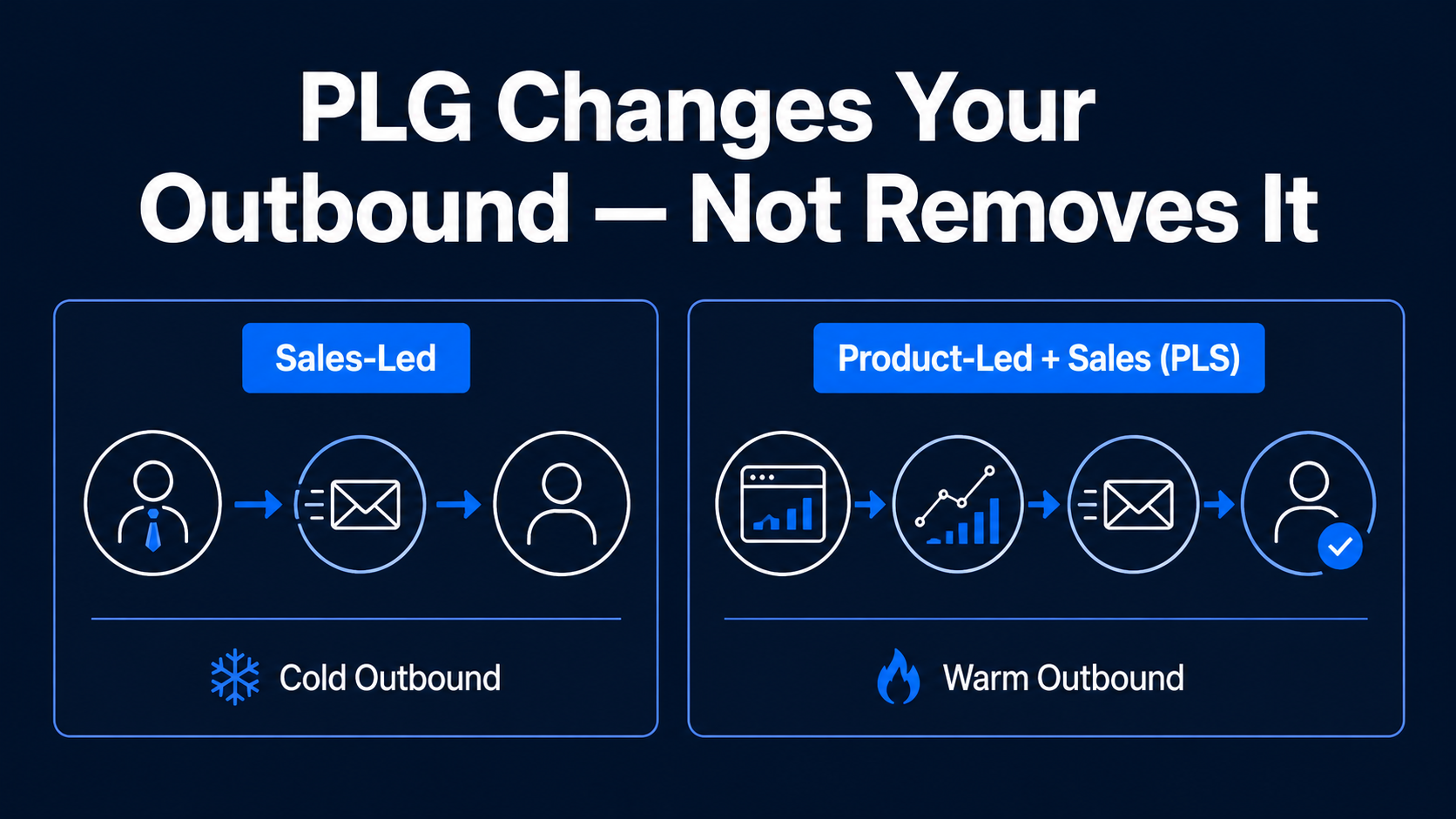
Product-led growth changes the outbound motion significantly.
Sales-led (no PLG): outbound is the primary mechanism for generating initial contact and interest. The ICP is defined by company characteristics; the trigger is anything that indicates they have the pain your product solves. PLG with sales overlay (Product-Led Sales / PLS): outbound supplements product data. Your highest-value outbound targets are existing free users or trial users who show strong product engagement signals — high usage, key feature adoption, team invitation. This creates a "warm outbound" motion where you're reaching out to people who have already experienced your product's value.PLG companies running a pure inbound-to-upgrade motion leave significant revenue on the table from high-intent users who never convert without a human touch. Sales outreach to engaged free users converts at 3–5x the rate of cold outbound to non-users.
Building Your B2B SaaS ICP for Outbound
SaaS ICP for outbound differs from generic B2B ICP in useful ways:
Tech stack signals are high-value. What tools your ICP uses indicates their workflows, tech maturity, and where your product fits. A company using Salesforce + Outreach + Gong is a fundamentally different prospect than one using spreadsheets. Tools like Clay and Clearbit can surface tech stack data at scale. Funding stage predicts buying behavior. Series A companies are typically building their first sales stack and are open to new tools. Series B–C companies are scaling and looking for tools that work at volume. Enterprise and post-IPO companies have procurement processes that require different outreach and longer cycles. Job posting signals are actionable. A SaaS company posting for a VP of Revenue Operations is likely to be evaluating or buying rev ops tooling. A company posting for 5 SDRs is probably in the market for outreach tooling, CRM, and enablement software. Monitoring job postings as a trigger signal is underused by most SaaS outbound teams. Competitor displacement. Companies using a direct competitor are warm prospects if the competitor has specific weaknesses you can address. Identifying accounts using competitor tools (from tech stack data or through free trial sign-ups) and running targeted displacement sequences is one of the highest-conversion outbound motions in SaaS.For a complete guide to building your ICP, see Ideal Customer Profile: How to Build One That Works.
The Outbound Process for B2B SaaS
List building
Start with a tier-1 list of 200–400 accounts that meet your tightest ICP criteria — matching on industry, company size, growth stage, and tech stack signal. These get your most personalised outreach.
Build a tier-2 list of 500–1,000 accounts that meet core ICP criteria but lack the additional trigger signals. These get a well-crafted but less individually researched sequence.
Messaging for SaaS outreach
SaaS buyers are sophisticated about vendor outreach. They can smell a generic sequence from the subject line. What works:
- First-line personalisation based on specific, researched context (not "I saw you work in SaaS")
- Pain described in product-and-workflow terms they recognise, not category terms
- Evidence from a comparable company — ideally one the prospect might have heard of
- A question about their current workflow, not a pitch
What doesn't work:
- Long emails explaining your product's feature set
- "Congrats on your recent funding" as a cold opener (every SaaS vendor sends this)
- Pitching the product in the first touch
- Asking for 30-minute demos as the CTA
Sequence structure
For SaaS with ACV above €10K, a 6-touch multi-channel sequence (email + LinkedIn) over 12–14 days is appropriate. Below €5K ACV where self-serve conversion is possible, a 4-touch email sequence with a CTA to a free trial or demo booking is more efficient.
For high-ACV enterprise SaaS (above €50K), the sequence is the start of a relationship, not a close attempt. The CTA should be a conversation, not a demo — and the sequence should flow naturally into the AE's discovery process.
For a broader framework, see Outbound Sales Strategy: Build Your B2B Engine.
Inbound Lead Generation for B2B SaaS
Inbound compounds over time. The content that generates qualified inbound for B2B SaaS in 2026:
Bottom-of-funnel comparison content. Articles like "[Your product] vs [Competitor]", "Best [category] tools for [use case]", and "[Category] software reviews" attract buyers who are actively evaluating solutions. High intent, high conversion. Problem-aware content. Articles that address the specific pain your product solves without directly promoting it. Buyers in early research mode consume this content. The CTA is a more relevant resource or a demo — presented as a natural next step, not a hard sell. Integration and workflow content. How-to content around the specific tools and workflows your ICP uses ("How to connect Salesforce with [category] tools") attracts buyers who are already using those tools and are potentially in-market for yours.Review platform presence (G2, Capterra, Trustpilot) is an inbound channel that most B2B SaaS companies underinvest in. A strong G2 presence generates warm inbound from buyers conducting vendor comparisons — one of the highest-converting inbound sources for SaaS.
For a broader demand generation strategy, see Demand Generation Agency: What They Do and When You Need One.
Metrics for B2B SaaS Lead Generation
The KPIs that matter at each stage:
- Outbound: positive reply rate (target 1–3%), meeting booked rate (target 0.5–2%), meeting-to-qualified-opportunity rate (target 30–50%)
- Inbound: organic traffic growth, trial/demo request rate per visitor, MQL-to-SQL conversion
- PLG: free-to-paid conversion rate, time-to-first-value, expansion revenue from PLG-sourced accounts
- Overall: CAC by channel, LTV:CAC ratio, payback period
For early-stage SaaS, focus on meeting-to-close rate and LTV:CAC before scaling any channel. Scaling a channel with a broken qualification or closing motion produces expensive growth with poor unit economics.
How VirtuWise Supports B2B SaaS Companies
VirtuWise works with B2B SaaS companies building or scaling their outbound sales motion — including early-stage teams building their first SDR function and growth-stage companies that need outbound capacity without expanding headcount.
We specialise in outbound for SaaS companies targeting European markets (UK, DACH, Nordics, Benelux) and for SaaS companies entering new verticals with existing products. Our team understands the SaaS buyer persona, the competitive dynamics, and the compliance requirements (GDPR) that affect European outbound.
Our pricing:- Lead Generation: €3,000/month — ICP research, personalised outreach, meeting booking and scheduling, weekly reporting
- Lead Generation Plus: €5,000/month — everything in Lead Generation, plus multi-channel outreach (LinkedIn + email + messengers), A/B testing, higher volume
- Business Development: €7,000/month — full-cycle business development, dedicated senior sales manager, online and offline representation, custom strategy
- Inbound (SEO & AEO): €3,500/month — SEO and AEO run as one service: keyword strategy, content, technical fixes, and AI-crawler visibility (structured data, llms.txt)
- Fractional Growth Partner: Custom — a revenue engine audit, then optional ongoing Advisory or hands-on Implementation
Full details at virtuwise.io/pricing.
Frequently Asked Questions
What's a realistic CAC for B2B SaaS outbound?Outbound CAC for B2B SaaS varies widely by ACV and sales cycle. For mid-market SaaS (ACV €15K–€60K) with a 3–4 month sales cycle, a well-run outbound programme typically produces a blended CAC (including SDR cost) of €3,000–€8,000. The relevant metric is LTV:CAC — a ratio above 3:1 indicates a sustainable channel.
How does GDPR affect B2B SaaS outbound in Europe?B2B email outreach to corporate email addresses in the EU/UK has a legitimate interest basis under GDPR for companies with a genuine business relationship or B2B context. The requirements include: a clear opt-out mechanism in every email, no use of personal data for purposes beyond the outreach, and maintaining records of legitimate interest assessments. Most professional B2B outbound practice is GDPR-compliant; consumer-like mass email marketing is not.
Should I run outbound before or after achieving product-market fit?After. Outbound before PMF produces a lot of meetings with poor conversion, obscures which ICP actually buys, and wastes your initial sales capacity on exploration rather than validation. Once you have 10–20 paying customers who represent a clear pattern, outbound can systematically target that pattern.
How do I compete with SaaS companies that have much larger outbound teams?ICP specificity. A small outbound team targeting a tightly defined ICP with highly personalised outreach almost always outperforms a large team running generic volume outreach against a broad market. Being "the [vertical] SaaS company" rather than "a SaaS company" in your outreach dramatically increases the relevance and conversion rate of every touchpoint.