
Demand Generation Agency: Full Guide for B2B Teams in 2026
A demand generation agency builds pipeline through multi-channel strategy, not just lead lists. Here's what they actually do, how to evaluate one, and when it makes sense to hire.
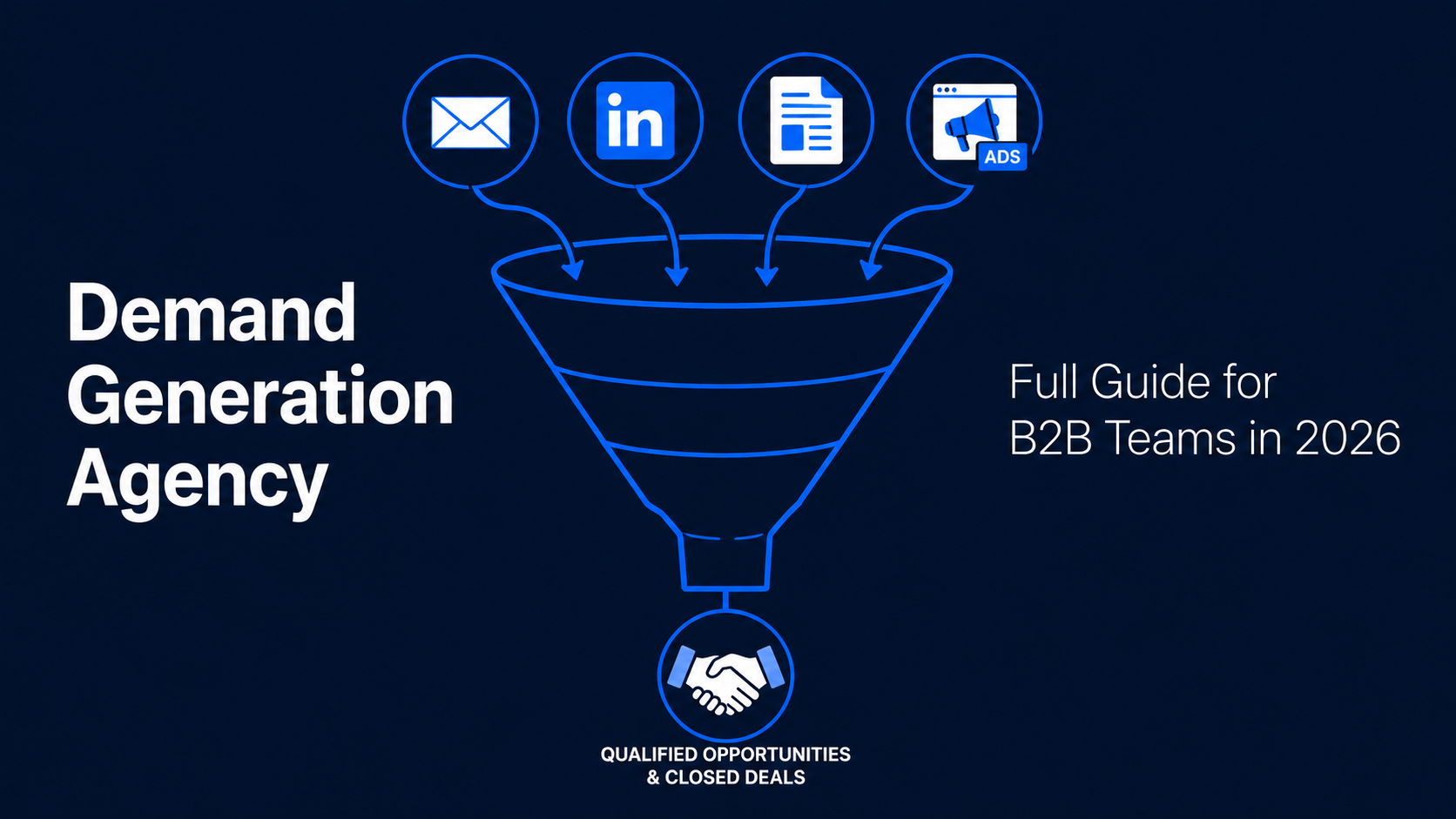
"Demand generation" has become one of the most overloaded terms in B2B marketing. Every agency offers it. Most mean different things by it. And a lot of companies end up paying for campaigns that generate activity — content downloads, webinar signups, contact form fills — without generating the thing that actually matters: qualified pipeline.
This guide cuts through the noise. It covers what a real demand generation agency does, how it differs from a lead generation agency, what to look for when evaluating one, and how to decide whether hiring externally makes sense for your business.
If you're a B2B company trying to build predictable revenue and considering agency support, this is where to start.
What Is a Demand Generation Agency?
A demand generation agency builds and executes multi-channel programmes designed to create awareness, interest, and intent among your target accounts — and convert that intent into qualified pipeline for your sales team.
The key distinction from a lead generation agency is scope and intent. A lead generation agency typically focuses on producing contact lists, filling inboxes, or generating form fills. Demand generation agencies take a broader view: they aim to create and capture demand across the full buyer journey, from first awareness through to sales-qualified opportunity.
In practice, a B2B demand gen agency typically combines:
- Outbound prospecting and SDR function (creating demand with cold audiences)
- Content strategy and thought leadership (attracting inbound interest)
- Paid media management (capturing intent from buyers already searching)
- ABM and account-based programmes (concentrating effort on high-value targets)
- Marketing automation and lead nurturing (converting engaged contacts over time)
- Analytics and attribution (measuring what's actually driving pipeline)
The breadth varies significantly by agency. Some specialise in one or two of these channels; others claim to cover all of them. Understanding which channels matter most for your market is essential before evaluating any provider.
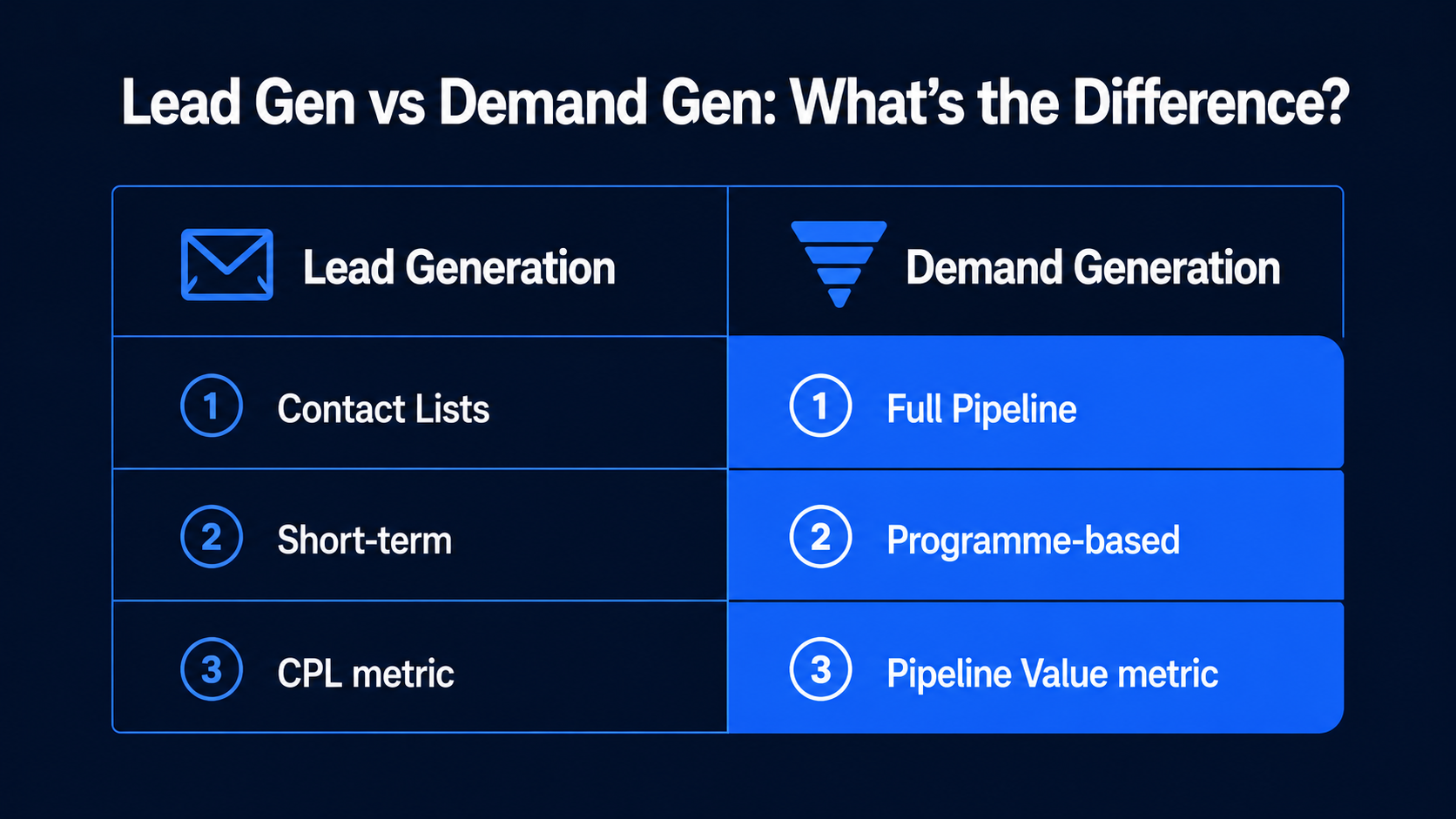
Demand Generation vs Lead Generation: What's the Difference?
The terms are often used interchangeably, but the distinction is meaningful when choosing a partner.
| Lead Generation | Demand Generation | |
|---|---|---|
| Focus | Producing contact names and details | Building pipeline across the full buyer journey |
| Output | Contact lists, form fills, inbound requests | Qualified opportunities, pipeline value |
| Time horizon | Short-term, campaign-based | Medium to long-term, programme-based |
| Channels | Typically one or two (email, PPC) | Multi-channel (outbound, content, paid, ABM) |
| Measurement | Lead volume, CPL | Pipeline value, CAC, revenue influence |
For most B2B companies with complex sales cycles, demand generation is the more appropriate frame. A contact list does nothing for pipeline if the contacts have no context for your company and no intent to buy.
The confusion matters because many agencies sell "demand generation" but deliver lead generation — contact data with a lower conversion rate than you'd achieve through a more integrated approach.
What a B2B Demand Generation Agency Actually Does
A good B2B demand generation agency operates as an extension of your commercial team. The work divides broadly into three phases:
1. Strategy and positioning
Before running any programme, an agency should help you answer:
- Who is your ICP at the account and persona level?
- What problem are you solving, and how does your buyer describe that problem?
- What does the competitive landscape look like, and how do you differentiate?
- Which channels does your ICP actually use, and in what sequence?
Skipping this phase produces technically competent execution against the wrong targets with the wrong message. Most demand generation failures trace back here.
2. Programme execution
With strategy defined, execution covers the channels most relevant to your ICP. For B2B companies in sales-led markets, this typically means:
- Outbound SDR programme: targeted prospecting, personalised outreach, multi-channel sequencing across email and LinkedIn
- Content and SEO: articles, guides, and resources that attract buyers searching for solutions your product addresses
- Paid search and social: capturing intent from buyers actively searching for your category, and building awareness on LinkedIn with your target audience
- Email nurturing: maintaining engagement with prospects not yet ready to buy
For enterprise-focused or high-ACV businesses, ABM overlays the above: concentrating resources on a defined list of target accounts with bespoke content, outreach, and advertising.
3. Measurement and optimisation
Demand generation results don't appear in week one. A serious agency establishes leading indicators (outreach reply rates, content engagement, qualified meeting rates) alongside lagging indicators (pipeline value, CAC, closed revenue) and reports against both.
The most common failing in agency-managed demand gen is optimising for the wrong metric: reporting on MQL volume when what matters is SAO (Sales Accepted Opportunity) rate. Make sure your agency's success metrics match your commercial reality.
How to Evaluate a Demand Generation Agency
Choosing a demand generation partner is a consequential decision. The wrong agency costs 6–12 months and a significant budget. The right evaluation process reduces that risk.
Questions to ask in the sales process
- What does your typical client engagement look like in the first 90 days?
- How do you define and measure pipeline contribution vs. lead volume?
- What does your reporting structure look like, and how often do we review?
- What channels do you have genuine in-house expertise vs. what do you subcontract?
- Can you share specific pipeline results from clients in a similar market?
Red flags to watch for
- Agencies that lead with reach metrics (impressions, clicks, downloads) without discussing pipeline
- Proposals that promise guaranteed lead volumes without discussing qualification criteria
- One-size-fits-all programmes that don't account for your ICP or market
- Reluctance to discuss attribution and how they measure revenue impact
- No named team members assigned to your account
The proof is in client references
Ask specifically for references from clients in a similar market or with a similar ICP. A demand generation agency that performs well in SaaS may not understand the relationship dynamics of iGaming or the compliance constraints of fintech. Vertical expertise matters.
Key Demand Generation Channels for B2B
The right channel mix depends on your market, ICP, ACV, and sales cycle length. Here's how the major channels stack up for B2B:
Outbound (email + LinkedIn)
The fastest way to generate pipeline from a cold audience. Works best when ICP is well-defined and target account lists are built from quality data. Reply rates of 3–8% are achievable for well-executed campaigns; 1–2% is the norm for average execution.
Best for: companies with a defined ICP, ACV above €5K, and a need to generate pipeline quickly.
Content and SEO
Builds inbound pipeline over 6–18 months. High ROI once rankings are established. Best for educational content that addresses the questions your ICP types into search engines.
Best for: companies with patience for a 6–12 month build, and markets where buyers actively search for solutions.
Paid search and LinkedIn ads
Captures intent from buyers already in-market. High CPL but high purchase intent. LinkedIn ads are expensive but highly targetable by job title, company, and intent signals.
Best for: companies with budget to invest in paid, particularly for high-ACV offers where a single conversion justifies significant cost per lead.
Account-based marketing (ABM)
Concentrates resources on a defined set of high-value target accounts. Requires significant coordination between marketing and sales. Most effective for enterprise deals with ACV above €50K.
Best for: enterprise-focused companies with a short, well-defined target account list.
When to Hire a Demand Generation Agency
External demand generation support makes sense in specific situations:
- Entering a new market or vertical where you don't have existing relationships, brand awareness, or distribution channels
- Scaling faster than your internal team can support without the fixed cost of additional full-time hires
- Lacking internal expertise in specific channels (paid media, ABM, SEO)
- Testing demand generation before building internal capability — using an agency to validate channels and messaging before hiring
The in-house route makes more sense when:
- You have a repeatable playbook and need execution bandwidth, not strategic input
- Your market requires deep institutional knowledge that an agency can't acquire in 3–6 months
- You have the budget for senior internal hires and the time to build
For most B2B companies in the €2M–€15M revenue range, a hybrid model works best: an internal commercial leader setting strategy and managing the relationship, with an agency executing specific channels (often outbound SDR, content, or paid).
Demand Generation for B2B Manufacturers and Industrial Companies
B2B manufacturers face a distinct demand generation challenge. Unlike SaaS or professional services, manufacturing companies often sell highly technical products with long evaluation cycles, small buyer universes, and relationship-driven procurement that resists digital-first approaches.
What demand generation for B2B manufacturers typically looks like in practice:
Outbound is the primary channel.The target account list for a mid-market manufacturer might be 200–500 companies globally. With audiences this small, inbound-only demand generation is too slow and too unpredictable. Direct outreach to procurement leads, engineering decision-makers, and VPs of Operations is usually the most efficient path to qualified pipeline.
Trade shows and conferences are essential, not optional.Manufacturing buyers still rely heavily on in-person evaluation. Pre-conference outreach — reaching attendees of Hannover Messe, trade sector events, or industry summits in advance to book meetings — converts at significantly higher rates than floor networking.
Content supports outreach, not the other way around.A well-written technical guide or case study makes cold outreach more credible and improves reply rates. But content rarely generates pipeline independently in manufacturing B2B — it reinforces a relationship already being built through outreach.
Sales cycles are long.A manufacturing procurement cycle often runs 9–18 months from first contact to purchase order. Demand generation for B2B manufacturers requires sustained nurture programmes that maintain contact with prospects across that cycle without creating noise.
For manufacturing companies evaluating a demand generation agency, the relevant question is: do they have experience reaching procurement and operations decision-makers in your specific industrial sub-sector? Generic B2B demand gen expertise does not transfer automatically to industrial buyers with technical evaluation requirements.
How to Structure an Agency Engagement
A well-structured demand generation agency engagement has clear terms on both sides:
- Scope of work: which channels are covered, at what volume, with what deliverables per month
- Success metrics: how pipeline contribution is measured, reported, and attributed
- Ramp period: realistic 60–90 day period before expecting full pipeline output
- Communication cadence: weekly operational updates, monthly strategy reviews
- Ownership of assets: who retains creative assets, data, and learnings at contract end
Avoid engagements with no defined ramp period (results don't appear instantly), no clear attribution methodology, or where the agency controls your ad accounts or CRM data without giving you access.
How VirtuWise Works as a B2B Demand Generation Partner
VirtuWise functions as an outsourced demand generation function for B2B companies that need pipeline without the cost and time of building a full internal team.
Our focus is the outbound side of demand generation — ICP definition, account research, personalised multi-channel outreach, and qualified meeting delivery — combined with content that supports and amplifies outbound efforts over time.
We work primarily with companies in fintech, iGaming, IT services, SaaS, and AI — markets where buyer trust thresholds are high and generic outreach doesn't work.
Our pricing:- Lead Generation: €3,000/month — ICP research, personalised outreach, meeting booking and scheduling, weekly reporting
- Lead Generation Plus: €5,000/month — everything in Lead Generation, plus multi-channel outreach (LinkedIn + email + messengers), A/B testing, higher volume
- Business Development: €7,000/month — full-cycle business development, dedicated senior sales manager, online and offline representation, custom strategy
- Inbound (SEO & AEO): €3,500/month — SEO and AEO run as one service: keyword strategy, content, technical fixes, and AI-crawler visibility (structured data, llms.txt)
- Fractional Growth Partner: Custom — a revenue engine audit, then optional ongoing Advisory or hands-on Implementation
Full details at virtuwise.io/pricing.
Frequently Asked Questions
What's the difference between a demand generation agency and a performance marketing agency?Performance marketing agencies focus on paid channels (PPC, social ads) and optimise for measurable response metrics like CPL and ROAS. Demand generation agencies take a broader view, covering the full buyer journey including outbound, content, email nurturing, and ABM — not just paid response. The two can complement each other but have different cost structures and time horizons.
How long does it take to see results from a demand generation agency?Outbound programmes typically show early results within 6–10 weeks. Content and SEO take 6–12 months to show meaningful organic traffic. Paid campaigns can generate leads within days but require ongoing budget. A realistic expectation for a new agency engagement: first qualified meetings within 8 weeks, meaningful pipeline within 3–4 months.
How much does a demand generation agency cost?B2B demand generation agency pricing varies widely. Specialist outbound SDR agencies typically start at €1,500–€3,000/month for an active programme. Full-service agencies covering paid, content, and ABM can run €10,000–€30,000/month. The relevant metric is cost per qualified meeting and cost per pipeline euro, not the monthly retainer itself.
Can a demand generation agency replace our sales team?No. A demand generation agency creates and qualifies pipeline — it gets you to the conversation. Closing that conversation requires your sales team's product knowledge, relationship capability, and commercial judgment. The most effective setups have the agency generating meetings and your salespeople running them.
What should a demand generation agency report on?At minimum: meetings booked, meeting-to-opportunity conversion rate, pipeline value generated, and attribution by channel. Leading indicators (outreach reply rates, content engagement, ad CTR) help diagnose what's working. The output metric that matters is pipeline, not just activity.