
Growth Marketing Agency: What They Do, What They Cost, and How to Pick the Right Fit
Growth marketing agencies run rapid, cross-channel experiments instead of a fixed campaign plan. Here's what that actually looks like, what it costs, and how to evaluate one.
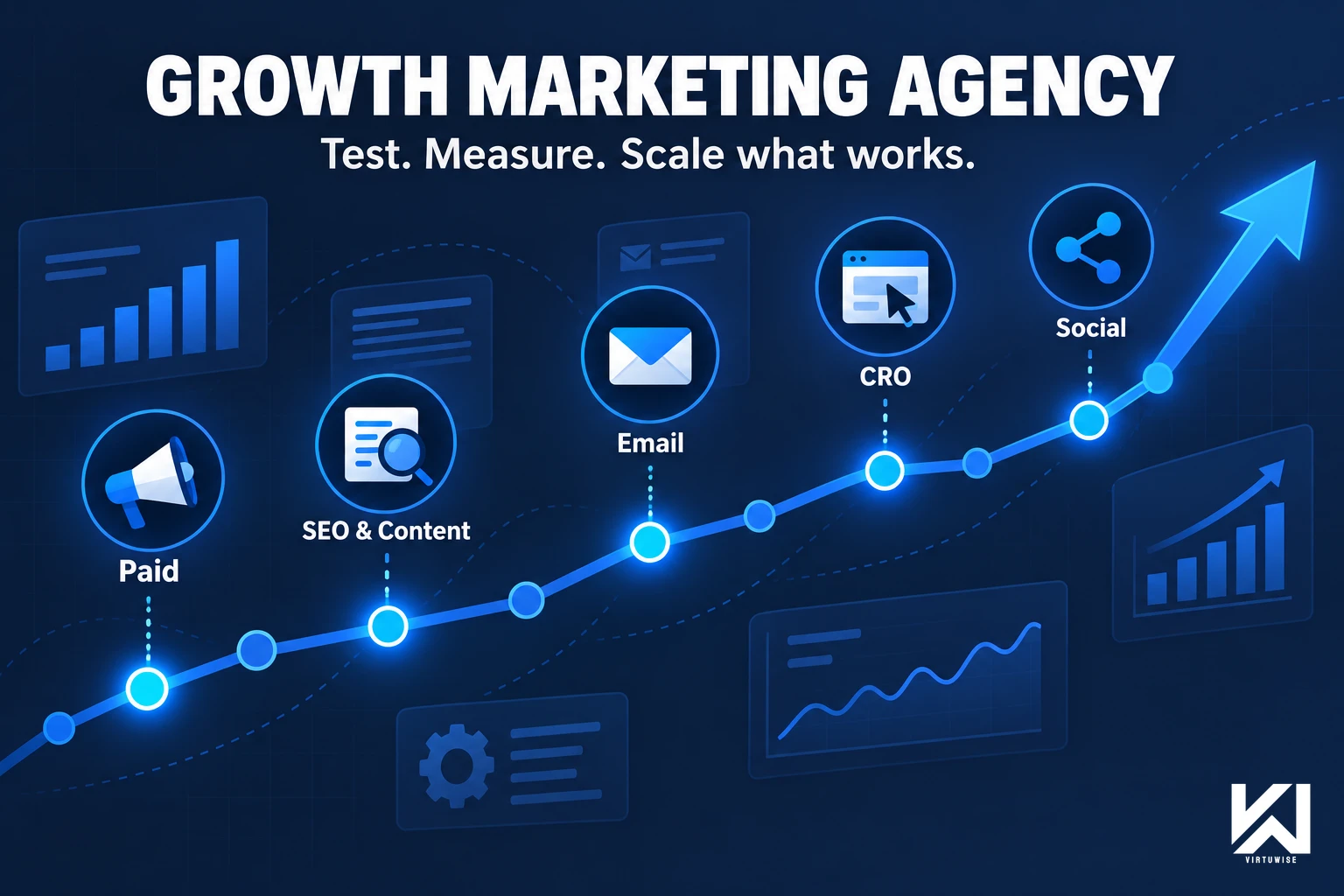
"Growth marketing agency" gets used loosely enough that it's worth being precise about what actually separates one from a traditional marketing agency, because the difference isn't the channels — most agencies of either kind run paid ads, SEO, and email. The difference is the operating model: a growth marketing agency treats every channel and message as a hypothesis to test and iterate on quickly, rather than a fixed annual plan executed on schedule.
This guide covers what a growth marketing agency actually does day to day, how pricing typically works, how to evaluate one before signing, why B2B growth marketing runs differently than B2C, and where an outsourced-CMO-style growth partner fits as a different kind of engagement entirely.
What a Growth Marketing Agency Actually Does
The defining trait of growth marketing is experimentation cadence, not any particular channel. A growth marketing agency typically runs a continuous test-measure-iterate loop across whichever channels are actually converting for a given business — paid acquisition, SEO and content, conversion rate optimization (CRO), email/lifecycle, and increasingly organic social — rather than committing a fixed budget to one or two channels for a full quarter and reviewing results at the end.
In practice, that looks like:
- Rapid experiment cycles — testing messaging, landing pages, audience segments, and channel mix on short cycles (often weekly or biweekly), killing what isn't working and reallocating budget toward what is
- Cross-channel measurement — tracking a shared set of funnel metrics across channels rather than reporting each channel's performance in isolation, since growth agencies are typically optimizing for a business outcome (qualified pipeline, signups, revenue) rather than a channel-specific vanity metric
- CRO as a core discipline, not an afterthought — a meaningful share of growth marketing work happens on-site (landing pages, signup flows, pricing pages) rather than purely in ad platforms, since fixing conversion rate often has a faster payback than buying more traffic
- Full-funnel ownership — growth marketing agencies more often own the funnel from first touch through activation or signup, rather than stopping at lead handoff the way a traditional lead-gen-focused agency sometimes does
A traditional marketing agency isn't doing anything wrong by comparison — it's optimized for consistent execution against a known plan, which is the right model for some businesses. Growth marketing is the right model when the business doesn't yet know which channel or message will work best and needs to find out quickly, or when it's past that stage and needs continuous optimization rather than a "set it and review quarterly" cadence.
Traditional Marketing Agency vs. Growth Marketing Agency
| Traditional Marketing Agency | Growth Marketing Agency | |
|---|---|---|
| Focus | Executing an agreed campaign plan | Continuous experimentation to find and scale what works |
| Cadence | Quarterly or campaign-based planning cycles | Weekly/biweekly test cycles, faster iteration |
| Reporting | Channel-specific metrics (impressions, clicks, rankings) | Funnel and business-outcome metrics (CAC, activation, pipeline) |
| Typical engagement | Fixed-scope retainer against a defined plan | Ongoing, with scope shifting as experiments surface what to double down on |
| Best fit | Known channel mix, consistent execution needed | Unclear channel/message-market fit, or a plateaued growth curve |
How Growth Marketing Agency Pricing Typically Works
Growth marketing agencies generally price in one of three structures, sometimes blended:
- Monthly retainer — the most common structure, covering a defined scope of channels and experimentation capacity. Exact ranges vary widely by agency tier, team seniority, and scope, so treat any specific number you see quoted elsewhere with some skepticism unless it comes with a clear scope attached — this is genuinely one of the harder things to pin down with a single figure across the market. [needs source: independent benchmark data on typical growth marketing agency retainer ranges]
- Project-based — a fixed-scope engagement (a CRO audit and redesign, a specific channel launch) with a defined deliverable and end date, common for narrower, well-defined asks
- Performance-based — pricing tied partly to outcomes (cost-per-lead, revenue share), less common as a sole model since it usually requires a mature attribution setup both sides trust, but sometimes layered on top of a base retainer
Whatever the structure, the more useful question during evaluation isn't "what's the retainer" — it's what's actually included in that number: how many experiments run per cycle, who's doing the analysis, and whether CRO and on-site work are in scope or billed separately.
How to Evaluate a Growth Marketing Agency
Test velocity and process transparency
Ask directly: how many experiments does a typical client run per month, and what does the reporting on a "failed" test actually look like? An agency confident in its process will show you a real example, including tests that didn't work — that's a normal part of experimentation, not something to hide.
Channel breadth vs. specialization
Some growth agencies run broad, cross-channel experimentation; others specialize deeply in one or two channels (paid social, SEO, lifecycle email) and call it growth marketing because of the testing cadence, not the channel count. Neither is wrong, but it needs to match what the business actually needs — broad discovery work if channel-fit is still unclear, deeper specialization once it's known.
Reporting rigor
Growth marketing reporting should tie back to a real business metric, not just channel-level activity. If a proposed reporting cadence stops at impressions and click-through rate without connecting to pipeline, signups, or revenue, that's traditional-agency reporting wearing growth-marketing language.
Red flags
- Vague "growth hacking" language with no concrete description of an actual testing process
- No willingness to show past experiment results, including unsuccessful ones
- Case studies citing only top-of-funnel metrics (traffic, impressions) with no connection to a business outcome
- A single fixed campaign plan presented as "growth strategy" with no built-in mechanism for iteration
B2B Growth Marketing Agency: Why It's a Different Discipline
Most public "growth marketing" case studies and playbooks are written from a B2C, consumer-app playbook — fast signup funnels, viral loops, short sales cycles measured in minutes. A B2B growth marketing agency needs a genuinely different model, not just the same tactics applied to a different logo:
- Longer, multi-stakeholder cycles — B2B buying decisions often involve several people and weeks or months, not a single-session conversion, so "growth" has to be measured across a longer funnel with meaningful mid-funnel stages, not just a signup event
- Account-based motion alongside broad testing — for B2B, growth marketing frequently blends account-based marketing (ABM) — targeting specific companies and buying committees — with broader channel experimentation, rather than optimizing purely for volume
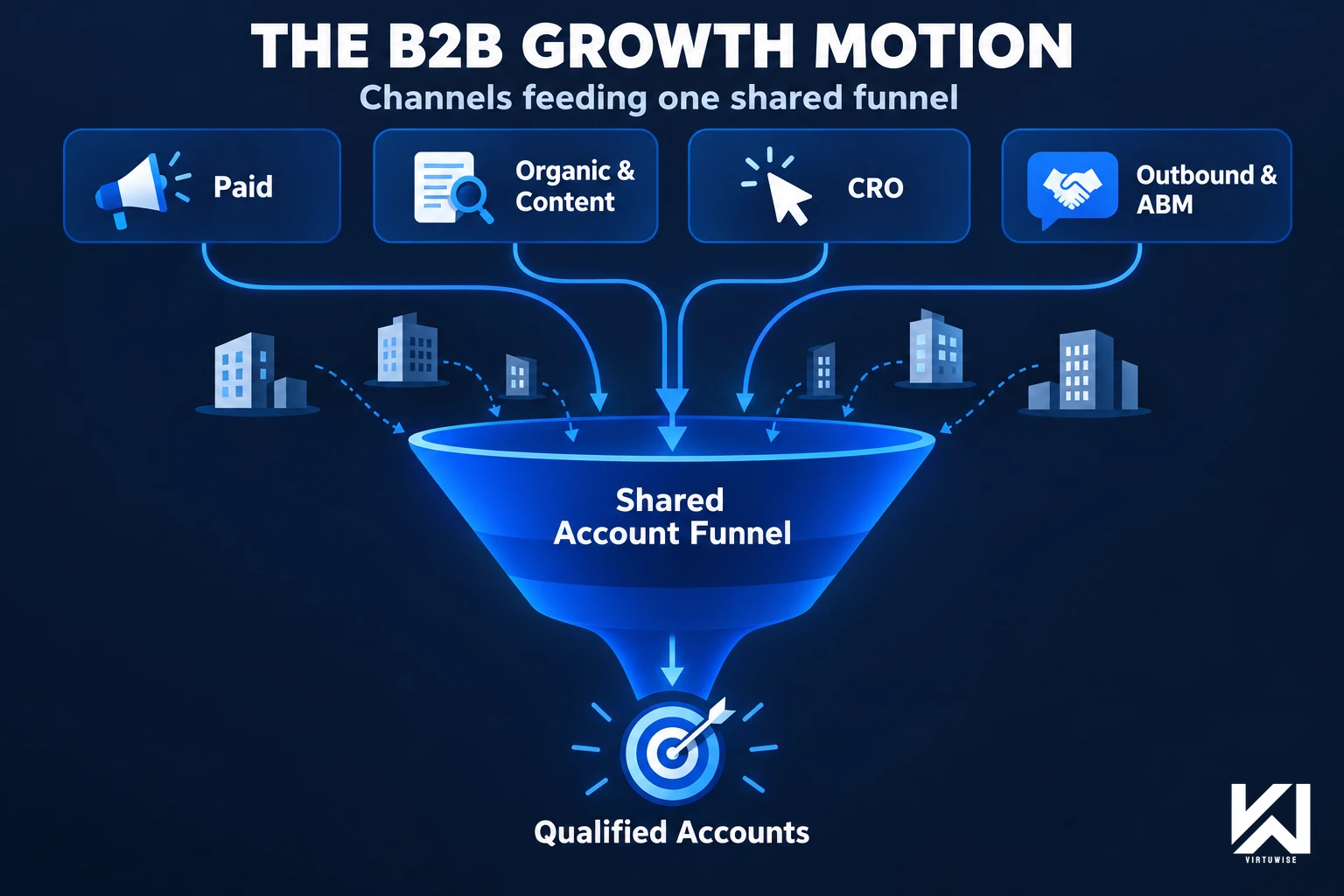
- Content and outbound working as one motion, not two — in B2B, organic content and direct outbound frequently target the same accounts at different funnel stages, so a B2B growth marketing agency needs both disciplines coordinated, not siloed into separate teams reporting separately
Put together, this is what a properly coordinated B2B growth motion looks like end to end — channels feeding a shared account list rather than running in isolation:
When to Look Past a Growth Marketing Agency Entirely
A growth marketing agency is built to execute experimentation across channels. That's a different job from deciding, at a strategic level, which parts of the whole revenue engine — not just marketing channels, but positioning, ICP, and the balance between Outbound, Inbound, and product-led motion — actually need investment in the first place.
VirtuWise's Fractional Growth Partner engagement is built for that earlier, more strategic question. It's an outsourced-CMO-style audit of the whole revenue engine, delivered as a standalone engagement:
- ICP and positioning assessment — whether the business is targeting the right accounts with the right message before any channel spend is evaluated
- Full-funnel mapping across Outbound, Inbound, and product-led motion — not one channel's experimentation queue, the whole system
- A prioritized, written growth roadmap — a concrete deliverable, not an ongoing retainer commitment
- Optional Advisory or hands-on Implementation, scoped separately after the audit, only if the findings warrant it
It's Custom-priced and scoped on an initial call, with no obligation to continue past the audit itself. Full details at virtuwise.io/services/fractional-growth-partner and virtuwise.io/pricing.
Frequently Asked Questions
What does a growth marketing agency do differently from a regular marketing agency?A growth marketing agency runs continuous, rapid experimentation across channels — testing messaging, audiences, and channel mix on short cycles and reallocating toward what works — rather than executing a fixed campaign plan reviewed quarterly. The channels used (paid, SEO, email, CRO) often overlap with a traditional agency; the operating cadence and measurement approach are what's actually different.
How much does a growth marketing agency cost?Pricing varies widely by structure (monthly retainer, project-based, or performance-based) and scope, and there isn't a single reliable industry-wide figure worth quoting without a defined scope attached. The more useful evaluation question is what's included in a quoted number — experiment volume per cycle, whether CRO and on-site work are in scope, and who's doing the analysis — rather than the headline number alone.
Is a growth marketing agency the same as a "growth hacking" agency?"Growth hacking" is an older, narrower term that originally referred to scrappy, low-cost acquisition tactics for early-stage startups. "Growth marketing agency" is the broader, more mature evolution of that idea, applied at more channels and company stages, with real measurement infrastructure behind it rather than one-off tactics.
What's different about a B2B growth marketing agency specifically?B2B growth marketing has to account for longer, multi-stakeholder buying cycles, often blends account-based marketing with broader channel testing, and typically needs content and direct outbound coordinated as one motion rather than run separately — the consumer-app growth playbook (fast signup funnels, viral loops) doesn't transfer directly.
How is a Fractional Growth Partner different from a growth marketing agency?A growth marketing agency executes channel-level experimentation on an ongoing basis. A Fractional Growth Partner engagement is a strategic, outsourced-CMO-style audit of the entire revenue engine — ICP, positioning, and full-funnel strategy across Outbound, Inbound, and product-led motion — delivered as a standalone engagement with a written roadmap, before any decision about ongoing execution gets made.