
Inside Sales Outsourcing: What It Is, When It Works, and How to Do It Right (2026)
Inside sales outsourcing lets you skip the 6-month ramp and get qualified pipeline in weeks. Here's what it includes, what it costs, and when it makes sense.
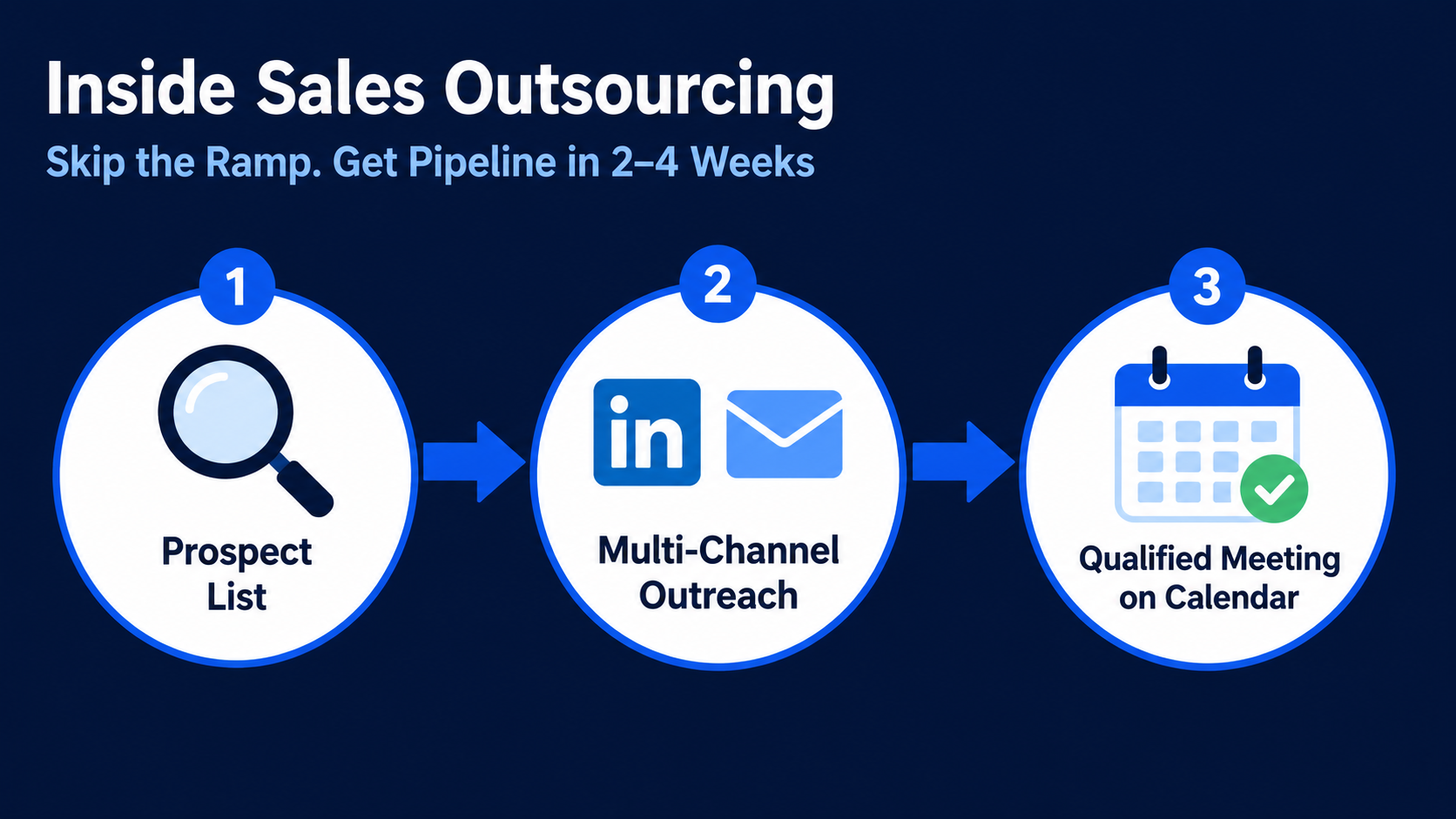
Building an inside sales team from scratch is slow, expensive, and risky — especially before you've validated what actually works.
Inside sales outsourcing is the alternative: you hand over the prospecting, outreach, and pipeline generation function to an external team who already have the infrastructure, the skills, and the market knowledge in place. You get results in weeks instead of months. You pay a fraction of what an in-house team costs. And you don't gamble a six-figure salary on a hire before you know what "good" looks like for your specific ICP.
This guide explains what inside sales outsourcing actually involves, who it's for, what to expect, and how to evaluate providers.
What Is Inside Sales Outsourcing?
Inside sales outsourcing means delegating your sales development function — prospecting, outreach, lead qualification, and meeting booking — to an external team rather than building it internally.
The term "inside sales" refers to sales done remotely, without in-person meetings: phone, email, LinkedIn, and digital channels. It contrasts with field sales, where reps travel to client sites. Most B2B sales at the SMB and mid-market level happen through inside sales.
When you outsource this function, you're not handing over your closing motion. You're outsourcing the pipeline generation work that feeds your closers: finding qualified prospects, reaching them, generating interest, and getting them onto a discovery call.
Your Account Executives still run the sales conversations. An outsourced inside sales team gives them a full calendar of qualified prospects to work with.
What an Outsourced Sales Team Actually Does
A full-service outsourced inside sales engagement covers:
ICP definition and list buildingDefining exactly who to target — company size, industry, geography, tech stack, funding stage — and building verified prospect lists of decision-makers who match those criteria. This is more work than it sounds: a well-built list for the EU market requires GDPR-compliant sourcing, local market knowledge, and manual verification that generic data vendors don't provide.
Multi-channel outreachRunning coordinated sequences across LinkedIn, email, and messaging channels. A typical sequence hits the same decision-maker across 6–8 touchpoints over 2–3 weeks. Multi-channel outreach consistently outperforms single-channel: reply rates are 2–3× higher when LinkedIn and email are coordinated rather than used independently.
Lead qualificationFiltering responses to identify genuine interest. Not every reply is an opportunity — some are polite rejections, some are wrong timing, some are wrong person. A good outsourced team qualifies before booking, so your AEs only spend time on real conversations.
Meeting booking and coordinationHandling scheduling, confirmations, reminders, and rescheduling. This is a real operational load that most companies don't account for until it's falling on an AE.
Reporting and iterationWeekly pipeline reporting with outreach metrics, reply rates, meeting rates, and quality signals. A good outsourced team doesn't just execute — they bring data that lets you improve targeting and messaging each week.
In-House Inside Sales Team vs Outsourced: The Real Comparison
The most common objection to outsourcing inside sales is that an internal team will know your product better. That's true by month six. It's irrelevant in the first four months while the hire is ramping.
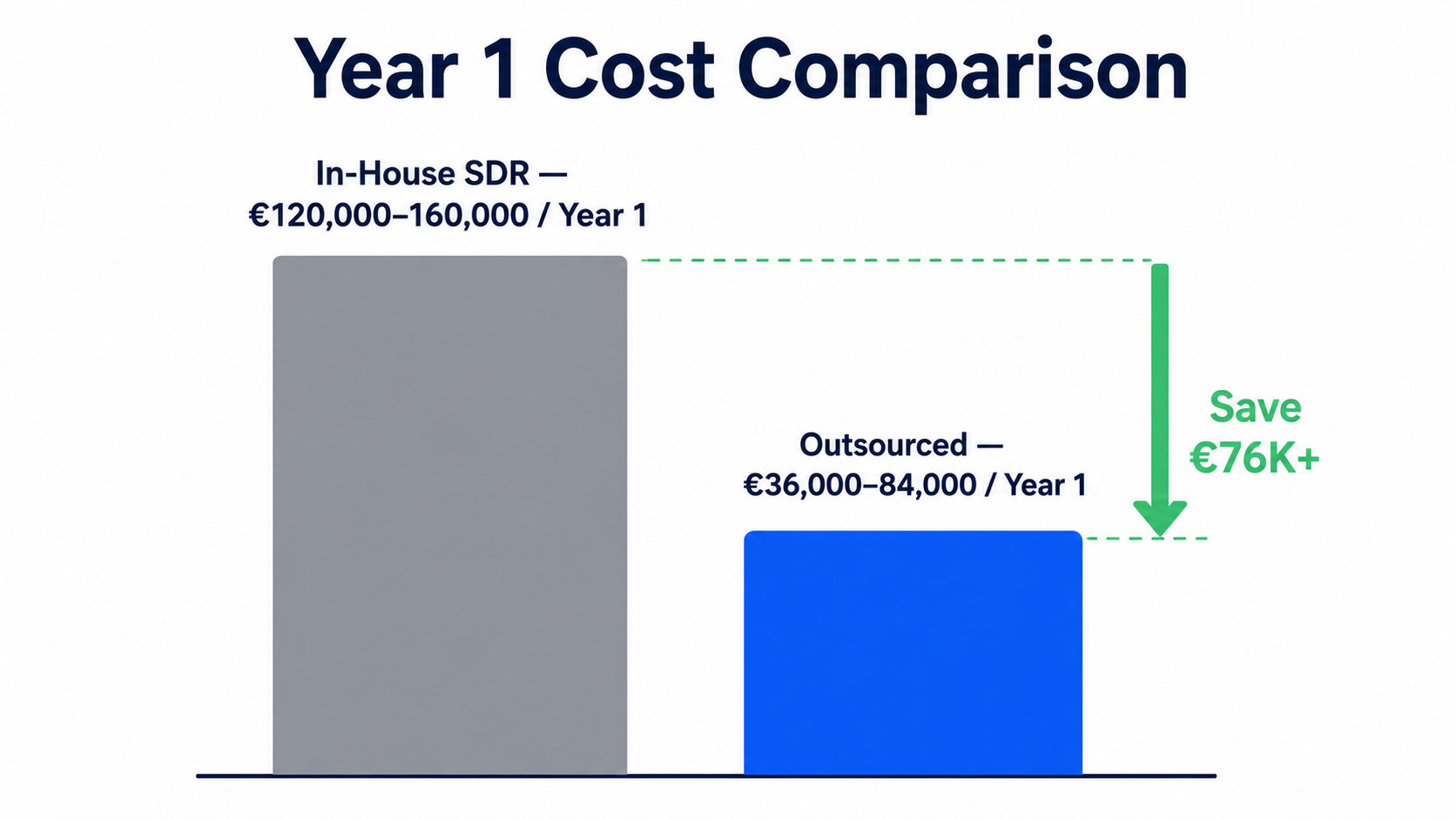
Here's the full Year 1 picture:
| Factor | Outsourced Inside Sales | In-House SDR |
|---|---|---|
| Time to first meetings | 2–4 weeks | 4–6 months |
| Year 1 cost | €36,000–€84,000 | €120,000–€160,000 |
| Recruitment cost | None | €15,000–€25,000 |
| Infrastructure (tools) | Included | €6,000–€13,000/year |
| Market expertise | Immediate | Built over 6–12 months |
| Ramp risk | None | High (35% SDR annual turnover) |
| Contract flexibility | Monthly | 12–24 month employment |
| ICP validation data | Available from week 3 | Available from month 5–6 |
The outsourced model wins on every dimension in Year 1. By Year 2–3, if you've validated your ICP and messaging, a hybrid model (outsourced for new markets and volume, in-house for proven playbook) often makes sense.
Full cost breakdown with exact numbers →When Inside Sales Outsourcing Makes Sense
You need pipeline faster than a ramp allowsHiring and ramping an SDR takes 4–6 months before they reach full productivity. If you have a pipeline gap today, an outsourced team can be generating qualified meetings in 2–4 weeks. The speed differential alone justifies the decision for most growth-stage companies.
You're entering a new market or geographyBreaking into Germany, the Nordics, UK, or any market where you don't have established relationships requires starting from zero: building lists, learning buying behaviour, testing messaging, mapping the right decision-makers. An outsourced team with existing market knowledge does this in weeks. Building that internally takes quarters.
You don't have a validated playbook yetHiring an SDR before you know your ICP, your messaging, and your conversion benchmarks means paying full salary while they figure out what works. Outsourcing lets you generate that learning at lower cost — then use the data to hire the right person with a proven playbook in hand.
You don't have bandwidth to manage an SDRA junior SDR needs 3–5 hours of management per week to be effective: call reviews, sequence coaching, ICP refinement, pipeline inspection. If your sales leader is also the primary closer, that bandwidth usually isn't there. An outsourced team brings their own management layer.
You're testing a new vertical or ICPBefore committing headcount to a new vertical, an outsourced pilot runs the market test at low risk. Three months of outsourced outbound into a new segment gives you real data on whether it's worth the internal investment.
When Inside Sales Outsourcing Doesn't Make Sense
You have a highly technical product that requires deep domain expertise to sellSome products — deeply technical enterprise software, complex financial infrastructure, niche industrial equipment — require months of product immersion before anyone can have a credible discovery conversation. If the first 15 minutes of any sales call require genuine technical depth, an outsourced team will struggle to qualify effectively.
You're already at scale with a proven playbookAt €20M+ ARR with validated sequences, strong AE-to-SDR ratios, and a full enablement function, building out in-house is the right move. Outsourcing is highest-value when there's still something to figure out.
Your deal flow is primarily inboundIf your pipeline is already being fed by strong inbound (product-led growth, heavy content, referrals), adding outbound may not be the priority. Outsourced inside sales generates outbound pipeline — it doesn't replace an inbound motion.
What to Expect: Realistic Results
Outbound inside sales is a numbers game at the top of the funnel. Realistic benchmarks for a well-targeted B2B campaign with quality messaging:
| Metric | Typical Range | What Drives It |
|---|---|---|
| Email open rate | 35–55% | Subject line + sender domain reputation |
| LinkedIn acceptance rate | 20–40% | Profile quality + personalisation |
| Reply rate (email) | 5–15% | ICP targeting + messaging relevance |
| Meeting booking rate | 1.5–5% | Qualification threshold + offer clarity |
| Qualified meetings/month | 8–20 | Market size + ICP specificity + campaign age |
Campaigns improve over time. Month 1 generates learning. Month 2 is where volume starts. Month 3 is often where the real results appear as messaging and targeting are optimised based on actual data.
How to Choose an Outsourced Inside Sales Provider
Match their market knowledge to yours
EU outreach is different from US outreach. Data sourcing, GDPR compliance, decision-maker mapping, channel preferences (LinkedIn over cold calling in most EU markets), and messaging tone all differ significantly. An agency that has run 50 campaigns targeting US SaaS companies and claims EU capability has not actually done EU outreach. Ask for specific EU campaign results.
Ask how they define a qualified meeting
The industry standard for "qualified" varies enormously. Some providers count any booked call — including no-shows and wrong-persona contacts — as a delivery. A genuine qualification standard means the meeting contact has: (1) confirmed a relevant business challenge, (2) indicated budget authority or a path to it, and (3) agreed to a specific meeting time with intent. Define this in your contract.
Check what's included in the retainer
Costs look similar on paper until you discover that prospect lists, sending infrastructure, or copy are billed separately. Ask for a full list of what's included: list building, copywriting, email infrastructure, LinkedIn accounts, reporting, and management. Surprises in invoicing are a sign of a transactional vendor, not a partner.
Start with a test engagement
Three months is the right test duration — enough to see meaningful results, optimise messaging, and evaluate meeting quality. Avoid providers pushing 12-month commitments before results are proven. The best outsourced sales teams are confident enough in their results to offer short initial engagements.
VirtuWise: Outsourced Inside Sales for B2B Companies in EU, UK, and US
VirtuWise runs multi-channel inside sales outsourcing for B2B companies in fintech, gaming, iGaming, AI, and IT services — with a specific focus on EU and UK market outreach.
What's included:- Full ICP definition and prospect list building (GDPR-compliant EU data)
- Coordinated LinkedIn + email + messenger sequences
- Decision-maker mapping across DE, NL, UK, Malta, Nordics, and US markets
- Qualified meeting booking with confirmed interest and timing
- Weekly reporting and campaign optimisation
- Single channel: €3,000/month
- Multi-channel (LinkedIn + email): €5,000/month
- Full-cycle with dedicated BDR: €7,000/month
- Inbound (SEO & AEO): €3,500/month
- Fractional Growth Partner: custom, scoped on a call
Frequently Asked Questions
What is inside sales outsourcing?Inside sales outsourcing means delegating your remote sales development function — prospecting, outreach, qualification, and meeting booking — to an external team. You keep control of the closing motion; the outsourced team generates the qualified pipeline that feeds your AEs.
How much does outsourcing inside sales cost?Quality outsourced inside sales runs €3,000–€8,000/month depending on channels, market, and scope. This compares to €120,000–€160,000 in Year 1 for an equivalent in-house SDR when you include recruitment, ramp, tooling, and employer costs.
What's the difference between inside sales outsourcing and appointment setting?They describe the same function from different angles. "Inside sales outsourcing" emphasises replacing or augmenting an internal sales development team. "Appointment setting" emphasises the output — booked meetings. In practice, a full-service engagement covers both: team function and meeting delivery.
How quickly do results come from outsourced inside sales?Quality providers deliver first qualified meetings within 2–4 weeks of launch. Full campaign velocity — consistent monthly meeting volume — typically develops by month 2–3 as messaging and targeting are optimised.
Should I outsource inside sales or hire an SDR?For most companies under €10M ARR, outsourcing delivers better Year 1 ROI: faster time to pipeline, lower cost, no ramp risk, and immediate market expertise. Once you have a validated playbook and consistent pipeline demand, adding an in-house SDR to own the proven motion makes sense alongside the outsourced function.
Can outsourced inside sales work for EU markets?Yes — but only with providers who have genuine EU market experience. EU outreach requires GDPR-compliant data, LinkedIn-first channel approach (not cold calling), and market-specific decision-maker knowledge that generic US-focused agencies don't have. More on outsourced SDR companies →
Fractional SDR and SDR as a Service: Are They the Same Thing?
Three terms you'll encounter when evaluating inside sales outsourcing — fractional SDR, SDR as a service, and outsourced inside sales — describe essentially the same model with different marketing labels. Understanding the distinctions helps you evaluate providers more accurately.
Fractional SDR refers to a sales development representative who works on your account part-time — typically alongside other client accounts. The "fractional" framing comes from the finance world (fractional CFO) and emphasises that you're getting SDR capacity without a full-time hire. Most outsourced inside sales engagements are fractional in practice: your account gets a portion of a senior SDR's time, supported by a team. SDR as a service is a SaaS-influenced framing of the same model. It emphasises the subscription structure (monthly retainer, clear deliverables, no employment costs) over the staffing model. Companies that use this term often have more standardised packages and technology-led reporting. Outsource inside sales and inside sales outsourcing are the most descriptive terms — they accurately describe what the engagement does: moving the inside sales function outside the company.In practice, when you're evaluating an inside sales outsourcing company, the label matters less than these specifics:
- How many accounts does each SDR manage, and what's the effective time allocation to yours?
- Is there a dedicated account manager or strategic lead above the SDR level?
- What does the transition look like if you decide to bring the function in-house?
A fractional SDR who manages eight accounts and allocates four hours per week to yours is a fundamentally different engagement than a dedicated outsourced team treating your programme as a primary account.
The Bottom Line
Inside sales outsourcing solves the ramp problem. Instead of waiting 4–6 months for a hire to reach productivity, you have qualified meetings on the calendar in 2–4 weeks — at roughly half the annual cost.
The model works best when you're between €2M and €15M ARR, entering a new market, running a new ICP hypothesis, or facing a pipeline gap that you can't afford to wait 6 months to solve.
The decision criteria are straightforward: does the provider have genuine expertise in your market and vertical? Do they define "qualified" the way you do? Can you start with a test engagement before committing?
If the answer to all three is yes, outsourcing beats hiring in almost every Year 1 scenario.
Want to see what outsourced inside sales looks like for your specific market and ICP? VirtuWise runs multi-channel outbound for B2B companies in fintech, gaming, iGaming, AI, and IT services across EU, UK, and US — with transparent pricing and no 12-month lock-in. View our services, see our pricing, or book a 30-minute strategy call.
Related reading: - In-House SDR vs Outsourced Sales: Full Cost and ROI Comparison (2026) - Best Outsourced SDR Companies in 2026: A Buyer's Comparison - SDR vs BDR: Roles, Differences, and Who to Hire First (2026) - B2B Lead Generation Channels That Actually Work in 2026