
What Does an Appointment Setting Agency Do — And Do You Need One? (2026)
B2B appointment setting agencies book qualified meetings onto your calendar. Here's how they work, what they cost, and how to choose the right one for your market.
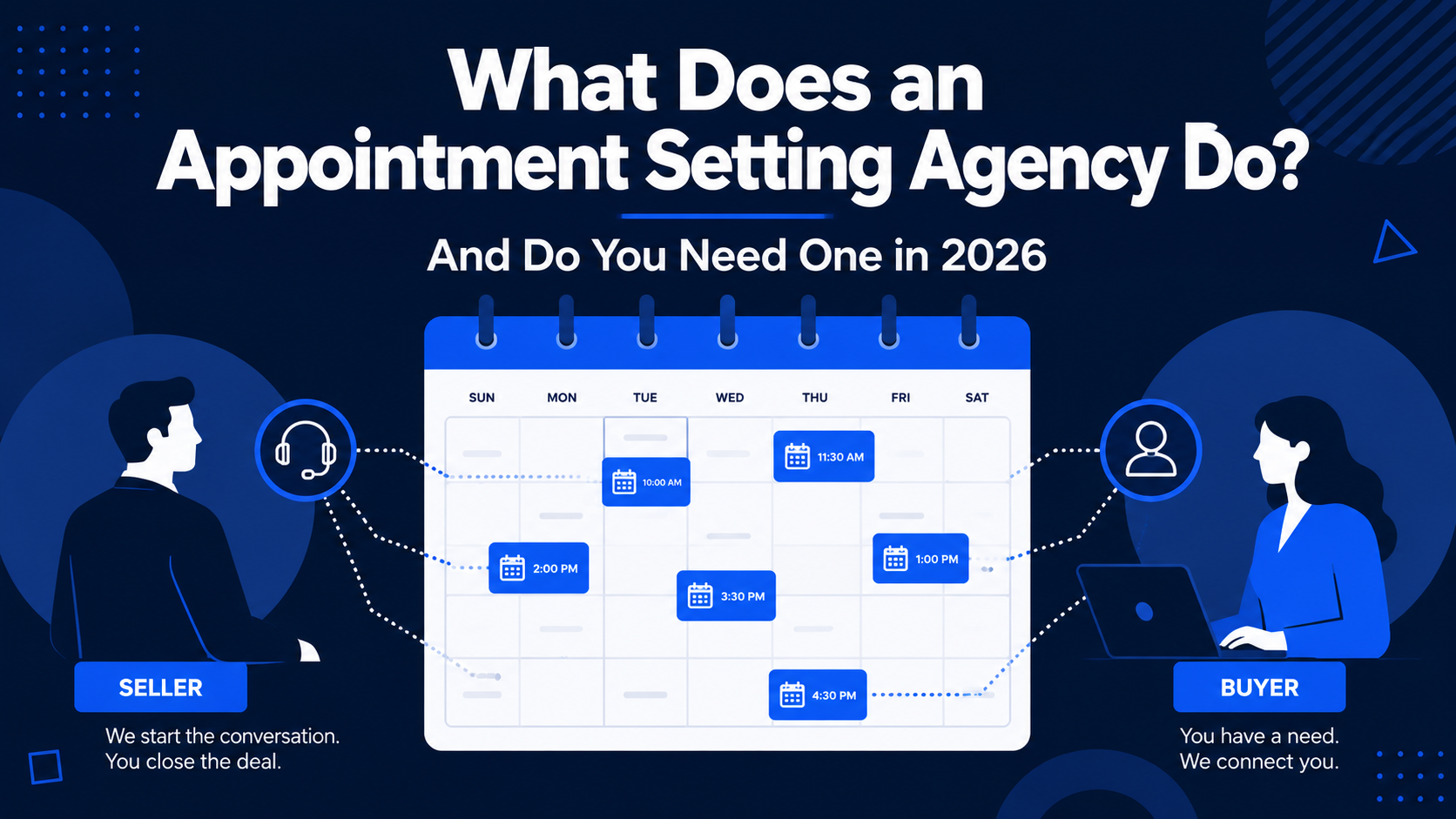
Your product is solid. Your pricing is competitive. Your close rate on demos is strong. The problem is getting enough of those demos on the calendar in the first place.
That's the exact gap a B2B appointment setting agency fills.
This guide explains what appointment setting agencies actually do, how they differ from broader lead generation services, what they cost, and how to evaluate whether one is right for your stage and market.
What Is a B2B Appointment Setting Agency?
A B2B appointment setting agency handles the top-of-funnel portion of your sales process: identifying prospects who match your ICP, running multi-channel outreach, qualifying interest, and booking meetings directly onto your sales team's calendars.
What you get at the end: a calendar with qualified conversations. What you don't get: closed deals — that's still your job.
The clearest way to understand the role is by what it replaces. Without an appointment setting function, your Account Executives are spending time on:
- Building and sourcing prospect lists
- Writing and sending outreach sequences
- Following up on replies
- Qualifying whether a prospect is worth a meeting
- Scheduling calls across time zones
All of that is pipeline generation work. An appointment setting agency takes that entirely off your AEs' plates so they can focus on the only thing they should be doing: running sales conversations and closing.
Appointment Setting vs Lead Generation: What's the Difference?
The terms are often used interchangeably, but the distinction matters when you're buying a service.
Lead generation delivers a list — a set of companies and contacts who match your ICP. Some lead gen services go further and run outreach, but many stop at the data layer. Appointment setting delivers a booked meeting — a qualified prospect who has confirmed interest and a scheduled time to speak with your team. It goes all the way through to calendar confirmation.Think of it this way: lead generation finds the door; appointment setting gets you through it.
When evaluating any provider, ask explicitly: do you deliver data, outreach, or booked meetings? The answer tells you where their service ends and where your work begins.
What B2B Appointment Setting Services Include
A full-service appointment setting engagement typically covers:
Prospecting and list buildingBuilding targeted lists of companies and decision-makers that match your ICP — filtered by industry, company size, geography, funding stage, technology stack, or other signals relevant to your market.
Multi-channel outreachRunning coordinated sequences across email, LinkedIn, and direct messaging. The channel mix matters: LinkedIn-only limits you to prospects who are active there; email-only misses the relationship layer. Multi-channel outreach — the same decision-maker reached through multiple touchpoints — significantly outperforms single-channel approaches.
Lead qualificationConfirming that a prospect has genuine interest, relevant budget authority, and appropriate timing before booking the meeting. A meeting that wasn't qualified is a wasted AE hour. The best appointment setting agencies define qualification criteria with you before launch and don't count a booked call as success unless those criteria are met.
Calendar managementHandling the back-and-forth of scheduling across time zones, sending reminders, and managing reschedules. This is a real time cost that most teams underestimate.
ReportingWeekly or biweekly reports showing outreach volume, reply rates, meeting conversion rates, and quality signals from the meetings booked.
How B2B Appointment Setting Works in Practice
A standard engagement looks like this:
Week 1–2: OnboardingICP definition, messaging alignment, list building, infrastructure setup (sending domains, LinkedIn accounts, CRM integration). Quality agencies do this in two weeks. Slower agencies take a month — which is a red flag.
Week 3–4: LaunchFirst sequences go live. Initial data on open rates, reply rates, and objections starts coming in. Expect iteration on messaging in this phase — what works on paper doesn't always work in market.
Week 4–6: First qualified meetingsFor well-targeted campaigns with good messaging, first qualified meetings appear within 2–4 weeks of launch. If you're at week 6 and the calendar is empty, something is wrong with ICP, messaging, or both.
Month 2–3: OptimisationBased on reply data and meeting outcomes, the agency adjusts targeting, sequences, and channel mix. Month 2 is typically where volume stabilises and quality improves.
How Much Does B2B Appointment Setting Cost?
Pricing varies significantly by channel, volume, and market:
| Model | Price Range | What You Get |
|---|---|---|
| Single channel (email or LinkedIn) | €2,500–€4,000/month | One outreach channel, moderate volume |
| Multi-channel (LinkedIn + email) | €4,000–€6,000/month | Coordinated multi-touch sequences |
| Full-cycle (multi-channel + dedicated BDR) | €6,000–€8,000/month | End-to-end with strategic layer |
| Enterprise / account-based | €8,000–€15,000+/month | Complex multi-stakeholder programmes |
- Under €2,000/month almost always means offshore execution with low-quality lists
- "Pay per meeting" models incentivise volume over quality — agencies optimise toward any booked call, not qualified ones
- Long lock-in contracts (12 months) before you've validated the model
- EU market outreach (GDPR compliance, multi-language, more complex data sourcing)
- Multi-stakeholder enterprise accounts
- Highly technical verticals requiring specialised knowledge
VirtuWise: B2B Appointment Setting for EU, UK, and US Markets
VirtuWise specialises in multi-channel appointment setting for B2B companies in fintech, gaming, iGaming, AI, and IT services — with specific expertise in EU and UK market outreach.
What the engagement includes:- ICP definition and decision-maker mapping for your target market
- Coordinated LinkedIn + email + messenger outreach sequences
- GDPR-compliant EU data sourcing and sender infrastructure
- Qualified meeting booking with confirmed budget authority and timing
- Weekly reporting with full pipeline visibility
- Lead Generation (single channel): €3,000/month
- Lead Generation Plus (multi-channel): €5,000/month
- Business Development (full-cycle with dedicated BDR): €7,000/month
- Inbound (SEO & AEO): €3,500/month
- Fractional Growth Partner: custom, scoped on a call
How to Evaluate a B2B Appointment Setting Agency
1. Ask for vertical-specific proof
Anyone can claim "we work across all industries." Ask for specific results in your sector: how many campaigns, what meeting volumes, which job titles they've reached. An agency that has run 20 campaigns in fintech knows that compliance teams hold budget in different ways than product teams. That knowledge doesn't come from a generic playbook.
2. Define "qualified meeting" before signing
Every agency promises qualified meetings. The definition of "qualified" differs dramatically. Some count any booked call regardless of whether the prospect showed up or had any genuine interest. A real qualification standard means the prospect has confirmed: (1) they have a relevant business need, (2) they have some form of budget authority, and (3) the timing is appropriate. Get this definition in writing before the engagement starts.
3. Check their channel mix
Phone-heavy appointment setting models work in North American markets where cold calling is culturally normalised. In EU markets — especially Germany, Nordics, Netherlands, and UK — phone outreach is significantly less effective and raises GDPR concerns. Ask specifically: what percentage of your booked meetings come from LinkedIn vs email vs phone, in EU markets?
4. Ask what market they actually know
EU outreach is not US outreach with a different dialling code. Decision-maker mapping, data sources, GDPR compliance, sender domain reputation, and messaging tone all differ meaningfully. If you're targeting German mid-market or iGaming operators in Malta, your agency should have specific campaign history there — not just a general claim of "international experience."
5. Test before committing
Three months is the standard initial engagement for appointment setting. That's enough time to validate whether the model works for your ICP, see actual meeting quality, and judge whether the relationship works. Any agency pushing 12-month contracts before results are proven is optimising for their contract, not your pipeline.
Appointment Setting vs Hiring an SDR
The most common alternative to hiring an appointment setting agency is hiring an internal SDR. Here's how the comparison plays out in Year 1:
| Factor | Outsourced Appointment Setting | In-House SDR |
|---|---|---|
| Time to first meetings | 2–4 weeks | 4–6 months (ramp) |
| Year 1 cost | €36,000–€84,000 | €120,000–€160,000 |
| Infrastructure included | Yes | No (€6,000–€13,000/year tooling) |
| Market expertise | Immediate (vertical-specific) | Built slowly |
| Flexibility | Month-to-month | 12-month+ commitment |
| Risk | Low (cancel if no results) | High (recruitment + ramp cost) |
For most companies at the €2M–€15M ARR stage, outsourced appointment setting delivers better ROI in Year 1 because it eliminates the ramp problem. You get results in weeks, not months, while spending significantly less.
Full cost comparison →Frequently Asked Questions
What does an appointment setting agency do?An appointment setting agency handles prospecting, multi-channel outreach, lead qualification, and meeting booking on behalf of your sales team. They deliver booked meetings with qualified prospects directly onto your AEs' calendars — your team handles the conversations and closing.
How much does B2B appointment setting cost?Quality B2B appointment setting services run €3,000–€8,000/month depending on channels (single vs multi-channel), market (EU vs US), and engagement scope. Below €2,000/month typically signals offshore execution and low-quality lists.
Is appointment setting the same as lead generation?No. Lead generation identifies and delivers prospect data. Appointment setting goes further — running outreach, qualifying prospects, and booking confirmed meetings. Appointment setting is the next step after lead generation, or replaces it entirely in a full-service model.
How long does it take to get results from appointment setting?Quality agencies deliver first qualified meetings within 2–4 weeks of launch. This compares to 4–6 months for an in-house SDR hire to reach full productivity after ramp.
What makes a good appointment setting agency?Vertical-specific experience in your sector, a clear definition of "qualified meeting" agreed upfront, EU market capability if you're targeting Europe, multi-channel outreach (not just phone), and transparent pricing without long lock-in.
Do appointment setting agencies work for EU markets?Yes — but not all of them. EU outreach requires GDPR-compliant data sourcing, different channel mix (LinkedIn and email over cold calling), and decision-maker knowledge that is market-specific. Ask explicitly about EU campaign history before engaging.
The Bottom Line
Appointment setting is a solved problem — if you pick the right agency for your market and define success clearly before you start.
The criteria that matter: vertical experience, EU vs US capability, channel mix, how they define "qualified," and whether they offer a reasonable test period before lock-in.
For B2B companies targeting European markets in fintech, gaming, iGaming, AI, or IT services, the fastest path to qualified pipeline is an agency that already knows your buyers and has the infrastructure running.
Ready to see what appointment setting looks like for your specific market? VirtuWise runs multi-channel outbound for B2B companies across EU, UK, and US — with 1,000+ meetings booked and transparent pricing from €3,000/month. View our services, see our pricing, or book a 30-minute strategy call.
Related reading: - Best Outsourced SDR Companies in 2026: A Buyer's Comparison - In-House SDR vs Outsourced Sales: Full Cost and ROI Comparison (2026) - B2B Lead Generation Channels That Actually Work in 2026 - SDR vs BDR: Roles, Differences, and Who to Hire First (2026)