
SDR vs BDR: Roles, Differences, and Who to Hire First (2026)
SDR vs BDR — what's the actual difference? We break down roles, responsibilities, salaries, and which hire makes sense at each stage of B2B growth.
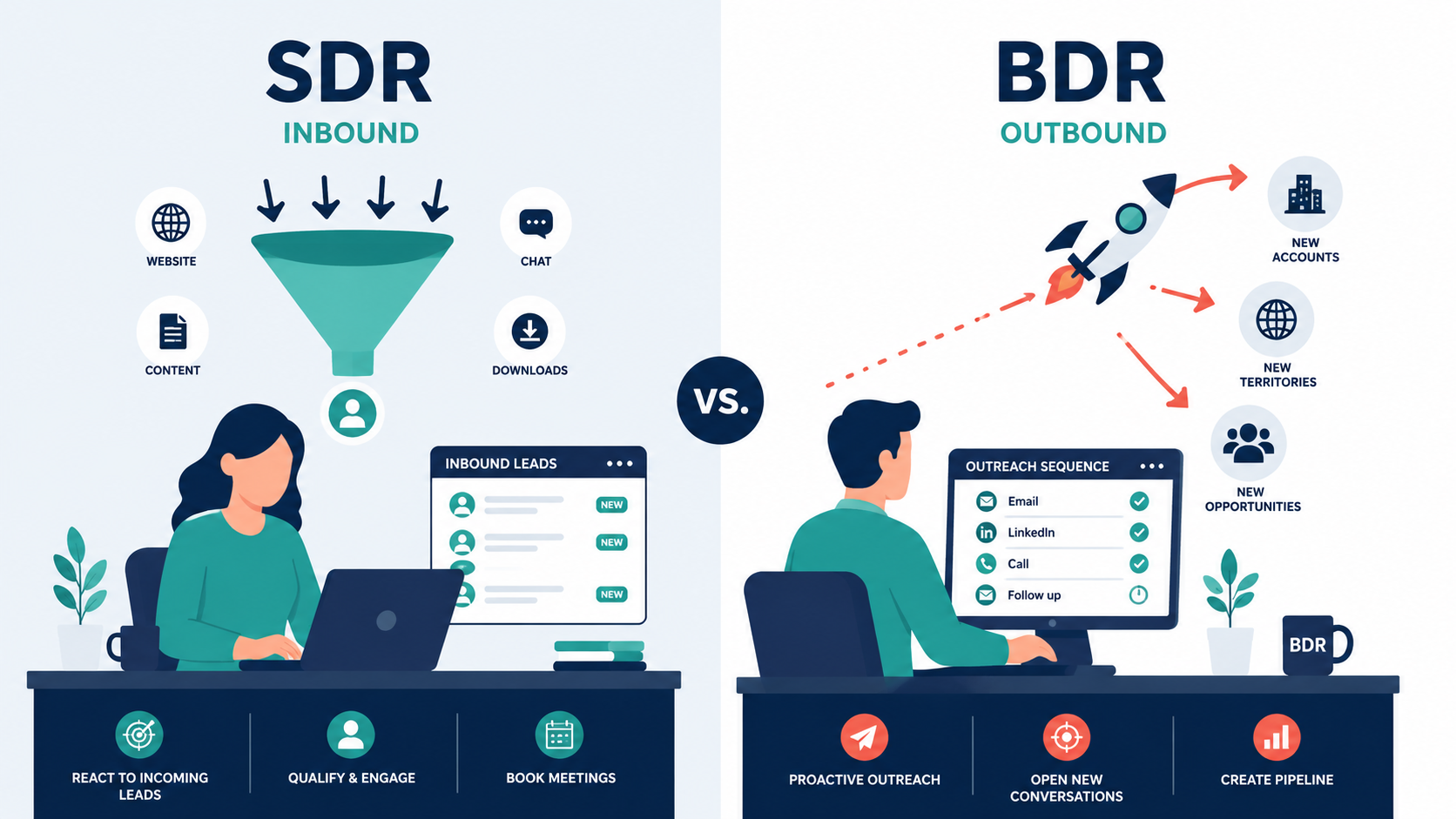
Two job titles. Similar-sounding abbreviations. Completely different functions — and real consequences for which one you hire first.
The SDR vs BDR question comes up at almost every B2B company that's scaling its sales function. Most founders get the answer wrong not because they don't understand the roles, but because they haven't mapped the roles clearly to their current growth stage.
This guide defines both roles precisely, shows where they overlap and where they diverge, and gives you a clear framework for deciding which hire — if either — makes sense right now.
What Is an SDR in Sales?
An SDR — Sales Development Representative — is a role focused on pipeline creation through early-stage prospect qualification and outreach.
In most B2B organisations, the SDR's job is to move prospects from initial contact to a qualified conversation. Their output is not closed deals. It's booked meetings for Account Executives.
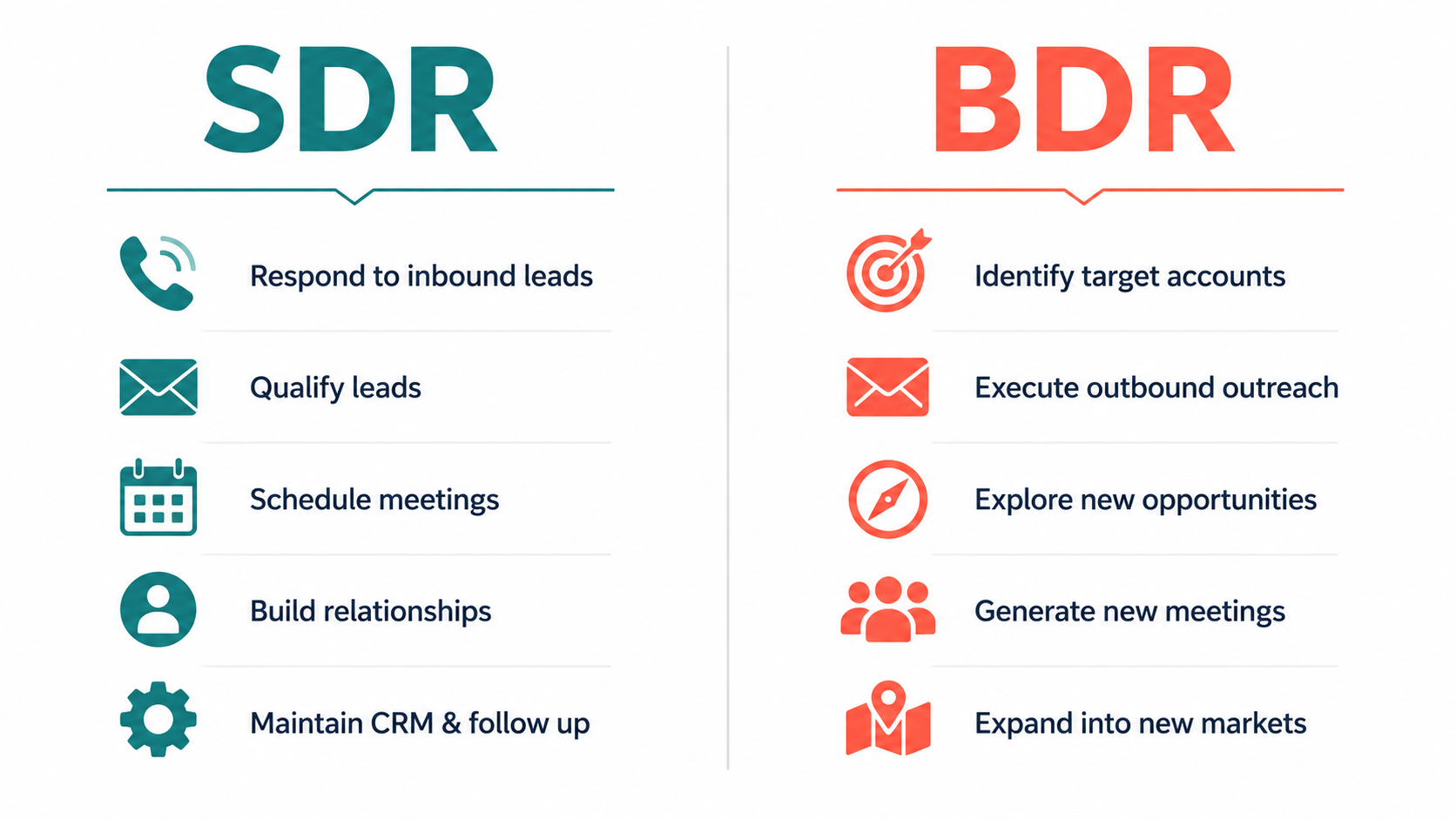
What SDRs typically do:- Respond to and qualify inbound leads (MQLs from marketing)
- Run outbound prospecting within established, validated markets
- Execute email and phone sequences to target prospect lists
- Qualify leads against ICP criteria (budget, authority, need, timing)
- Schedule discovery calls or demos for AEs
- Maintain CRM accuracy (contact records, activity logs, deal stages)
- Closers — they hand off to AEs
- Strategists — they execute playbooks, not build them
- Generalists — they focus on one part of the funnel (top)
The SDR role emerged from Aaron Ross's predictable revenue model (Salesforce, early 2010s): the idea that separating prospecting from closing made both more effective. That model has become standard in B2B SaaS and is now spreading across industries.
Typical SDR metrics:- Number of qualified meetings booked per month
- Show rate (what % of booked meetings actually happen)
- Conversion rate from outreach to meeting
- Sequence reply rate
- Pipeline generated (€ value of deals they fed into)
What Is a BDR?
A BDR — Business Development Representative — is a role focused on generating pipeline from net-new market segments, partnerships, or channels that don't yet have an established playbook.
While the names are often used interchangeably (and many companies assign both titles to the same function), a true BDR role is distinct from an SDR in scope and strategic weight.
What BDRs typically do:- Build outbound pipeline in new markets, verticals, or geographies
- Identify and engage with potential channel or integration partners
- Research new ICPs and validate product-market fit in untested segments
- Create outreach sequences from scratch for new target audiences
- Often work more closely with leadership or product on strategic market exploration
- Inbound processors — their work is purely outbound and exploratory
- Order-takers — they need more autonomy and judgment than SDRs
- Junior roles by default — BDR work often requires more commercial experience
In practice, many B2B companies use SDR and BDR as titles for the same outbound role. But at companies where the distinction matters, BDR = new frontier; SDR = proven territory.
SDR vs BDR: Side-by-Side Comparison
| Factor | SDR | BDR |
|---|---|---|
| Primary focus | Pipeline from known ICP | Pipeline from new markets/channels |
| Lead source | Inbound (MQLs) + outbound | Purely outbound + new segments |
| Playbook | Executes established sequences | Builds and tests new sequences |
| Seniority required | Junior–mid | Mid–senior |
| Output metric | Qualified meetings booked | New pipeline segments opened |
| Works closest with | Marketing + AEs | Leadership + Product |
| Autonomy level | Lower | Higher |
| Risk of hire | Lower | Higher (pioneering role) |
| Common in | SaaS, fintech, IT services | Expansion-stage companies |
Where the Confusion Comes From
Most of the SDR vs BDR debate is caused by companies using the titles inconsistently.
At Salesforce and most US SaaS companies, both titles mean essentially the same thing: an outbound prospector who books meetings for AEs. The BDR title is sometimes used to signal slightly more seniority or a higher-value target market.
At European B2B companies and agencies, the BDR title more often implies a genuine business development function — building partnerships, entering new markets, pursuing enterprise-level strategic outreach that goes beyond a sequence-driven SDR model.
Before hiring either, define the role by its actual responsibilities — not by the title. What are the specific daily activities? What's the output metric? Who do they report to and hand off to?
Salaries: SDR vs BDR in 2026 (EU Market)
| Role | Base Salary | OTE | Total Comp |
|---|---|---|---|
| Junior SDR (0–2 years) | €30,000–€45,000 | €5,000–€10,000 | €35,000–€55,000 |
| Mid SDR (2–4 years) | €45,000–€60,000 | €8,000–€15,000 | €53,000–€75,000 |
| Senior SDR / Team Lead | €55,000–€75,000 | €12,000–€20,000 | €67,000–€95,000 |
| Junior BDR | €40,000–€55,000 | €8,000–€15,000 | €48,000–€70,000 |
| Mid–Senior BDR | €55,000–€80,000 | €15,000–€25,000 | €70,000–€105,000 |
BDR roles command a 10–20% salary premium over equivalent SDR seniority levels — reflecting the higher autonomy and strategic expectation.
Add employer costs (social contributions, health, benefits) of 20–30% on top of base in most EU markets.
When to Hire an SDR
The SDR hire makes sense when:
You have inbound lead volume that isn't being followed up fast enough.Marketing is generating MQLs — demo requests, content downloads, trial sign-ups — but your AEs are spending time qualifying leads that shouldn't reach them. An SDR inserts a filter.
You've validated your ICP and messaging.Outbound SDRs can only execute what already works. If you know your target persona, understand their pain points, and have sequences that generate replies — an SDR can scale that. If you don't have a validated playbook, an SDR will be unproductive for months.
You're in a defined market with addressable prospect lists.SDRs run volume-based outreach against known segments. If you can define your ICP clearly (industry, size, title, geography) and build a list, an SDR can work it.
You have an AE ready to close meetings.There's no point booking meetings that nobody closes. The SDR-to-AE ratio in most B2B companies is 1:2 to 1:4 — for every SDR, there are two to four AEs converting their pipeline.
When to Hire a BDR
The BDR hire makes sense when:
You're entering a new market or geography.Breaking into fintech in Germany, gaming in Malta, or IT services in the Nordics requires prospecting from scratch — building a new ICP definition, testing messaging, mapping decision-makers. That's BDR work, not SDR work.
You're building partnerships or ecosystem channels.If part of your growth strategy involves integrations, resellers, or co-selling relationships, a BDR with a business development mandate is the right hire — not someone executing email sequences.
You've exhausted your current ICP and need to find the next one.When your established market is saturated or slowing, you need someone to identify and qualify the next segment. SDRs execute; BDRs explore.
You need senior outbound with strategic judgment.Some deals require a different approach than a sequence — relationship building over months, multi-stakeholder navigation, longer cycles. A BDR with the autonomy and experience to run those processes independently is the right hire.
The Honest Answer: Which Should You Hire First?
For most B2B companies at the early-to-growth stage, the sequencing looks like this:
Stage 1 (€0–€2M ARR): Neither. Founders should run outbound themselves. This is where you learn your ICP, test your messaging, and find what converts. Hiring before this is validated wastes money on a ramp that teaches you nothing. Stage 2 (€2M–€5M ARR): One senior SDR or a fractional outsourced team. Once you have something that works, you need someone to scale it — not explore. Hire to execute a proven playbook. Stage 3 (€5M–€15M ARR): SDR team + consider BDR for new verticals. At this stage you likely have one defined ICP working well and are starting to explore adjacent markets. The SDR team covers your core pipeline; the BDR explores what's next. Stage 4 (€15M+ ARR): Both, separated by function. At scale, the SDR/BDR distinction becomes operationally important — you need different talent, different metrics, and different management for each.SDR vs BDR vs Outsourced: The Third Option
Before committing to either hire, it's worth stress-testing the assumption that an internal hire is the right vehicle.
Both SDRs and BDRs have meaningful costs beyond salary: recruitment (15–20% of first-year salary), ramp time (4–6 months to full productivity), tooling (€6,000–€13,000/year per seat), and management overhead (3–5 hours/week for a senior person).
For companies that:
- Need pipeline faster than a ramp allows
- Aren't yet sure which ICP or channel to focus on
- Don't have the management bandwidth to coach an SDR weekly
- Are entering a new market without established relationships
...an outsourced outbound function often delivers better ROI in Year 1. Time to first qualified meetings: 2–4 weeks vs 4–6 months for an in-house hire. Year 1 cost: ~€60,000–€70,000 vs ~€146,500 for a single in-house SDR.
Full SDR vs outsourced cost breakdown →Many B2B companies at the €5M–€30M ARR range run both: outsourced outbound for pipeline velocity and new market testing, with one or two in-house SDRs owning the proven playbook. The combination is faster and cheaper than building a full in-house team from scratch.
Frequently Asked Questions
What is the difference between an SDR and a BDR?An SDR (Sales Development Representative) focuses on qualifying inbound leads and running outbound prospecting in established markets to book meetings for AEs. A BDR (Business Development Representative) focuses on developing pipeline in new markets, geographies, or channels — often with more strategic autonomy. In practice, many companies use both titles for the same outbound prospecting function.
What does SDR stand for in sales?SDR stands for Sales Development Representative. The role focuses on early-stage pipeline creation — qualifying prospects and booking qualified meetings for Account Executives who close deals.
What does BDR stand for?BDR stands for Business Development Representative. The role typically focuses on outbound prospecting in new or untested markets, often with more seniority and autonomy than a standard SDR position.
Should I hire an SDR or a BDR first?Hire an SDR once you have a validated playbook and ICP — they'll execute what works. Hire a BDR when you need to break into a new market or segment without an established approach. For most early-stage B2B companies, neither is the right first hire — outsourced outbound delivers faster pipeline at lower cost before a playbook is proven.
What is the SDR turnover rate?SDR annual turnover averages 35%. Each departure restarts the full recruitment and ramp cycle — typically €80,000–€120,000 in total cost. High turnover makes the true cost of in-house SDR teams significantly higher than base salary suggests.
How much does an SDR earn in Europe?A mid-level SDR in the EU earns €45,000–€60,000 base plus €8,000–€15,000 OTE commission — total €53,000–€75,000. Add 20–30% employer costs and the true company cost is €65,000–€100,000 per SDR per year.
The Bottom Line
SDR and BDR are often used interchangeably, but when the distinction matters, it comes down to this:
SDR = execute a proven playbook in known markets. BDR = build new pipeline in unproven territory.Neither hire is a shortcut. Both require a validated ICP, management bandwidth, proper tooling, and ramp time before they generate meaningful output. For most companies under €5M ARR, the faster and cheaper path to pipeline is outsourced outbound — which gives you the data to justify the right internal hire when the time comes.
Building your sales development function and unsure which model fits your stage? VirtuWise runs multi-channel outbound for B2B companies in fintech, gaming, IT services, and SaaS — acting as your outsourced SDR/BDR function while you build internal capability. View our services, see our pricing, or book a 30-minute strategy call.
Related reading: