
iGaming Platform Provider: How to Differentiate and Win Operator Clients at Scale
iGaming platform providers compete in a crowded market where every vendor claims the same features. Here's how to differentiate and build a scalable operator pipeline.
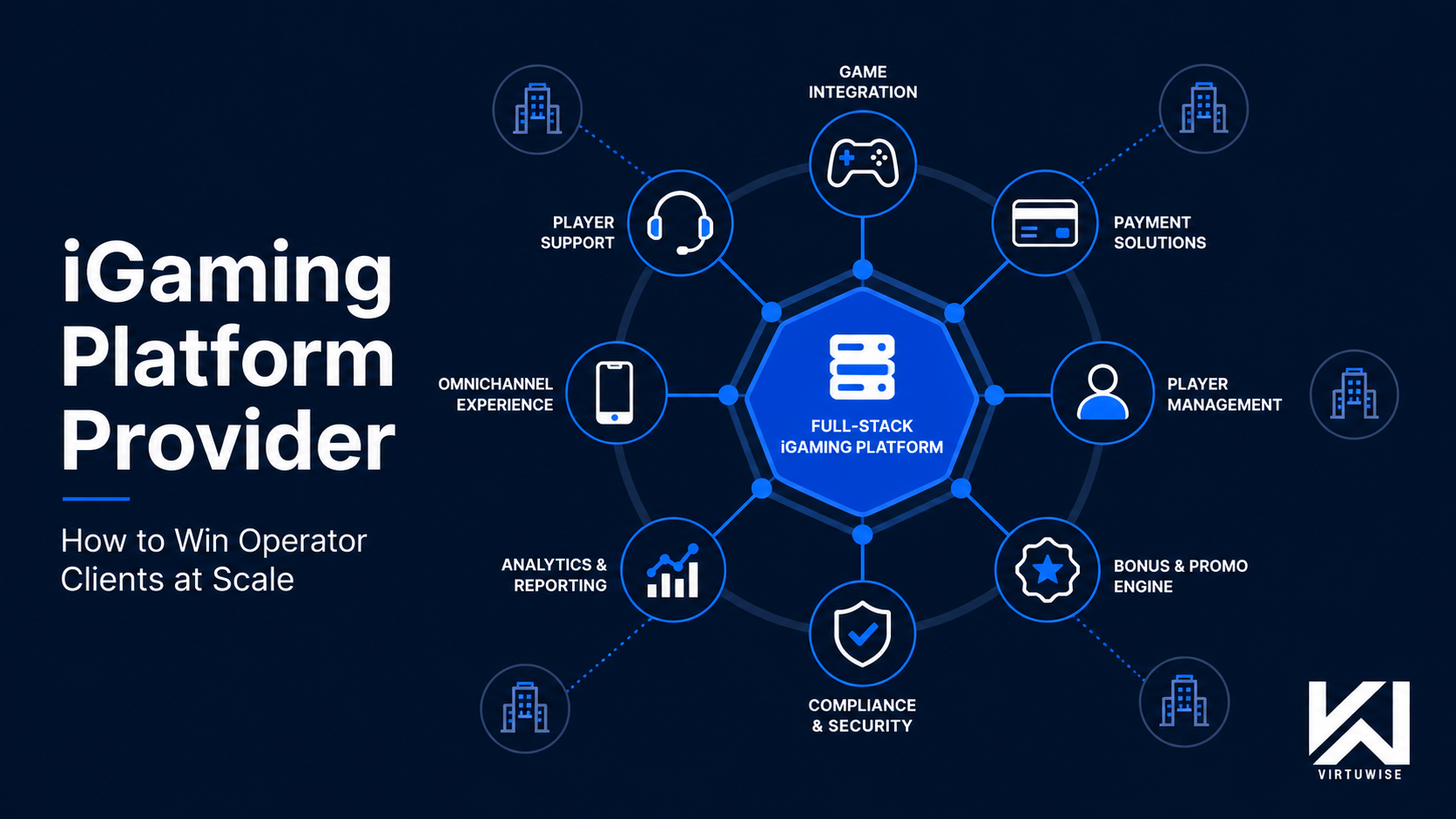
iGaming platform providers occupy the most complex position in the B2B gambling supply chain. A full-stack iGaming platform is the operational core of an online casino — the layer that connects games, payments, player management, bonuses, regulatory controls, and reporting into a single deployable infrastructure. And it is, by definition, the hardest thing for an operator to change once deployed.
The challenge for platform providers is not building a competitive product. Most of the established players have genuinely capable platforms. The challenge is differentiating in a market where every vendor claims the same capabilities: "turnkey platform," "seamless integrations," "rapid time-to-market," "fully compliant across 50+ jurisdictions."
When the claims are identical, operators default to evaluating on relationship quality, reference strength, and their confidence in the vendor's ability to deliver. Winning in the iGaming platform market is therefore as much a sales and relationship problem as a product problem.
The iGaming Platform Market Structure
Understanding the competitive landscape helps platform providers position more precisely.
Full-stack platform providers
offer the complete infrastructure: game aggregation, payment gateway integration, player management (PAM), CRM, bonus engine, responsible gambling tools, and regulatory reporting. They serve operators who want a complete infrastructure from a single vendor. Key players include SoftSwiss, Softgamings, EveryMatrix, BetConstruct, and others.
Modular/API-first providers
offer core platform infrastructure with open APIs for third-party integration, serving operators who want control over specific components (their own payment stack, specific CRM tools). This appeals to more sophisticated operators building differentiated products.
White-label platforms
offer pre-built operator configurations that dramatically reduce time-to-market, primarily serving new or smaller operators who prioritise speed of launch over customisation.
The buyer universe
Platform buyers include new market entrants (start-up operators seeking a launch platform), existing operators switching platforms (driven by performance issues, new market entry, or contract renewal), and aggregators building white-label operations on top of existing platforms.
Why iGaming Platform Differentiation Is Difficult
The core differentiation problem: almost every platform provider claims the same things.
- "500+ integrated game providers"
- "Compliant in 50+ jurisdictions"
- "Rapid deployment — live in 60 days"
- "Dedicated account management"
- "Flexible API architecture"
Operators hear these claims repeatedly. Without specific, verifiable evidence behind each claim, they function as white noise rather than differentiators.
The differentiation that actually moves operators comes from three places: evidence over claims, market specialisation, and integration ecosystem strength.
How iGaming Platform Providers Differentiate Effectively
Evidence Over Claims
The most effective differentiation is replacing claims with verifiable evidence.
"500+ game providers" → "We have 487 integrated game providers; here's the full list filterable by category, jurisdiction, and certification status."
"Compliant in 50+ jurisdictions" → "Here are our active licence holders by market, and here's our compliance team's background in the jurisdictions you're targeting."
"Rapid deployment" → "Our last 10 deployments had an average go-live time of 47 days; here are three operators willing to confirm their experience."
Evidence-anchored claims require more preparation but create a completely different conversation than feature lists.
Market Specialisation
Platform providers who specialise in specific operator types or geographic markets are more credible to operators within those segments than generalists claiming to serve everyone.
A platform provider who can say "we have 12 active operator clients in the Nordics, and we understand the specific responsible gambling requirements, payment methods, and player behaviour characteristics of that market" is significantly more convincing to a Nordic market entrant than a generalist claiming Nordic compliance.
Specialisations that work as differentiators: specific geographic markets, specific operator size brackets, specific product verticals (sports betting vs casino vs poker), or specific technology approaches (headless/API-first architecture).
Integration Ecosystem Depth
Platform providers that have deep, certified integrations with the specific payment providers, game studios, and third-party tools an operator is already using — or planning to use — remove integration risk from the buyer's calculation.
An operator already running a specific PSP who discovers that a platform provider has a pre-built, certified integration with that PSP has a lower perceived switching cost. The platform's integration ecosystem becomes a sales tool.
iGaming Platform Differentiation: What Actually Works
| Differentiation Approach | What Operators Respond To | What Falls Flat |
|---|---|---|
| Evidence-anchored capability claims | Specific data, customer-confirmed timelines, verifiable lists | Unverified "500+" or "50+ jurisdictions" claims |
| Market specialisation | Named clients and outcomes in target market | "We serve all markets globally" |
| Reference operators | Named, contactable references in comparable segment | "We work with major operators" |
| Integration ecosystem | Pre-built integrations with operator's existing stack | Generic "open API" claims |
| Compliance depth | In-house compliance team with jurisdiction-specific expertise | Checkbox compliance documentation |
| Deployment track record | Actual go-live timelines for comparable deployments | Projected "60-day" promises |
| Support model | Dedicated team, named account managers, escalation paths | Generic SLA commitments |
The iGaming Platform Sales Process
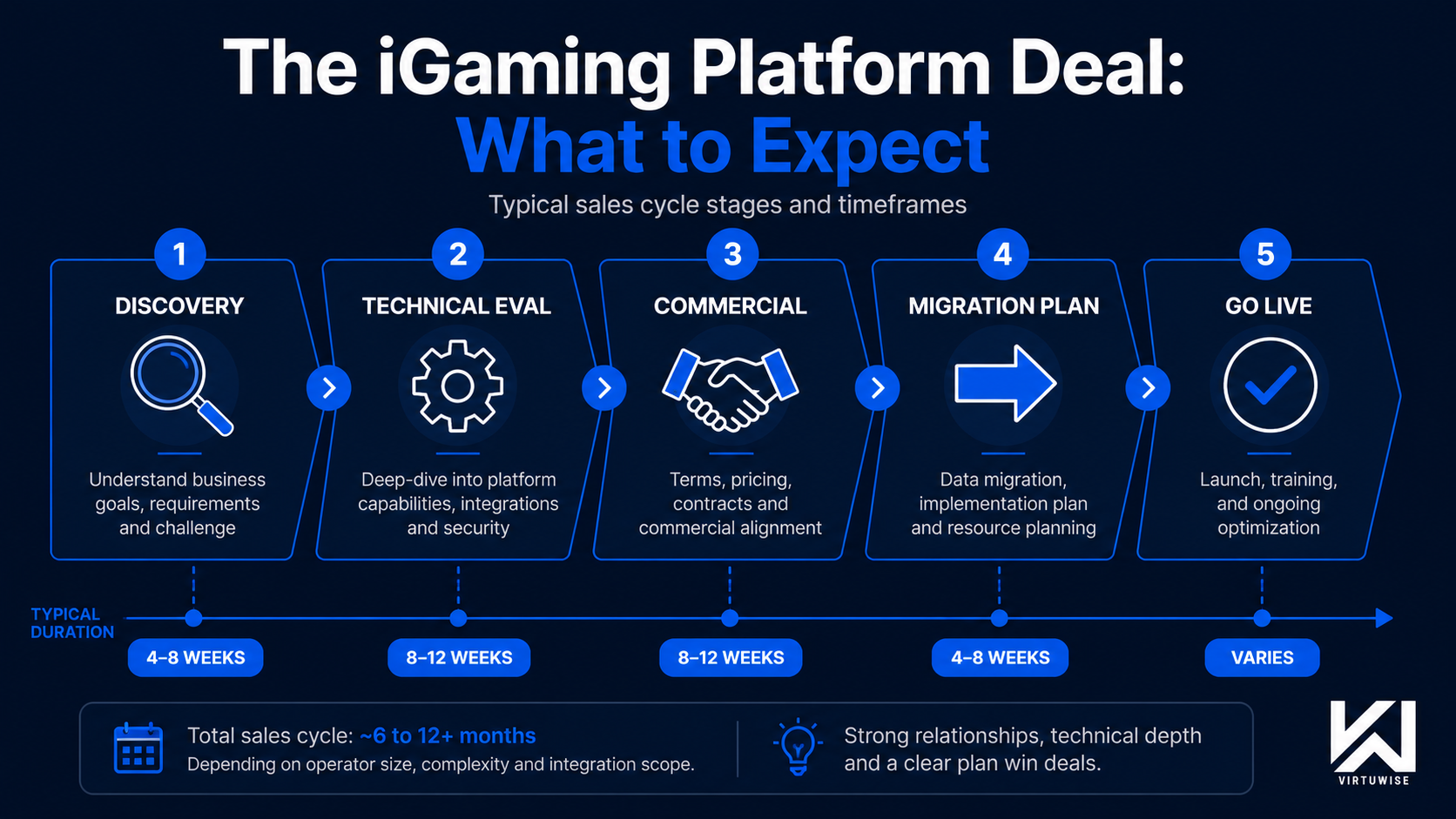
Platform deals are among the longest and most complex in iGaming B2B. The typical cycle:
Stage 1: Discovery (weeks 1–8).Initial meetings with commercial and technical contacts to assess fit. The platform provider is being evaluated alongside 2–4 competitors. This stage is about establishing credibility and advancing to a technical evaluation.
Stage 2: Technical evaluation (weeks 6–20).Sandbox access, integration tests, architecture review. Technical decision-makers have significant influence at this stage. Providers who make sandbox access easy and provide responsive technical support during evaluation have a measurable advantage.
Stage 3: Commercial negotiation (weeks 16–30).Pricing, revenue share structure, SLAs, and contract terms. CFO and legal involvement. Platform providers with standardised commercial structures close faster than those negotiating every term from scratch.
Stage 4: Migration planning (concurrent with Stage 3).For operators switching platforms, migration complexity is the primary risk. Platform providers with a documented migration methodology and named migration project managers significantly reduce perceived risk at this stage.
The total cycle from first contact to go-live regularly exceeds 12 months for complex deployments.
How iGaming Platform Providers Build Pipeline
Given the long sales cycle and relationship-dependent market, iGaming platform providers face a specific pipeline challenge: they need to be in front of operators who are in an active evaluation phase — not just building brand awareness for future consideration.
Trigger-event monitoring
is the most efficient pipeline prioritisation tool. Operators are most receptive to platform conversations when:
- They are approaching a current platform contract renewal
- They are expanding into new regulated markets requiring platform compliance
- They have recently received investment or acquisition that signals growth plans
- They have posted job listings for technical platform roles (suggesting evaluation or migration planning)
- They have experienced documented performance issues with a current platform
Platform providers that monitor for these signals and initiate outreach at the right moment reach operators in the window of highest receptivity.
Pre-conference outreach
remains essential. ICE London and SiGMA are where platform evaluation conversations begin. Providers who have pre-scheduled meetings with 10+ target operators at ICE, versus those who rely on floor traffic, are in fundamentally different competitive positions.
Reference-first outreach
Approaching a new prospect with "I'd like to introduce you to the Head of Technology at [named operator in your market] who recently went through a deployment with us" is categorically more effective than a product introduction. References that speak to similar operators create peer trust.
How VirtuWise Supports iGaming Platform Providers
VirtuWise builds B2B pipeline for iGaming technology providers, including platform companies competing for operator clients in a long-cycle, relationship-driven market.
For platform providers, our work typically includes:
- Trigger-event identification: monitoring for operator signals that indicate active platform evaluation — contract renewals, market expansion, investment rounds, hiring patterns
- Decision-maker outreach: direct LinkedIn and email outreach to CTOs, Heads of Technology, and commercial leads at target operators
- Pre-conference pipeline building: scheduling qualified meetings with attending operators before ICE, SiGMA, and other key events
- Long-cycle relationship management: maintaining contact with operators in early-stage evaluation over the months before they're ready for a formal process
- Lead Generation: €3,000/month — ICP research, personalised outreach, meeting booking and scheduling, weekly reporting
- Lead Generation Plus: €5,000/month — everything in Lead Generation, plus multi-channel outreach (LinkedIn + email + messengers), A/B testing, higher volume
- Business Development: €7,000/month — full-cycle business development, dedicated senior sales manager, online and offline representation, custom strategy
- Inbound (SEO & AEO): €3,500/month — SEO and AEO run as one service: keyword strategy, content, technical fixes, and AI-crawler visibility (structured data, llms.txt)
- Fractional Growth Partner: Custom — a revenue engine audit, then optional ongoing Advisory or hands-on Implementation
Full details at virtuwise.io/pricing.
Related reading:- iGaming Industry — B2B Sales and Lead Generation
- iGaming Software Provider: How to Build a B2B Sales Pipeline
- iGaming Marketing Agency: B2C vs B2B
- iGaming Payment Solutions: What Operators Actually Look For
- iGaming CRM Software: What Operators Actually Look For
- Pricing
- Business Development Services
- LinkedIn Lead Generation
- Outbound Lead Generation