
iGaming Software Provider: How to Build a B2B Sales Pipeline in a Relationship-Driven Market
iGaming software providers compete in one of the most relationship-dependent B2B markets. Here's how to build a scalable operator pipeline when conferences aren't enough.
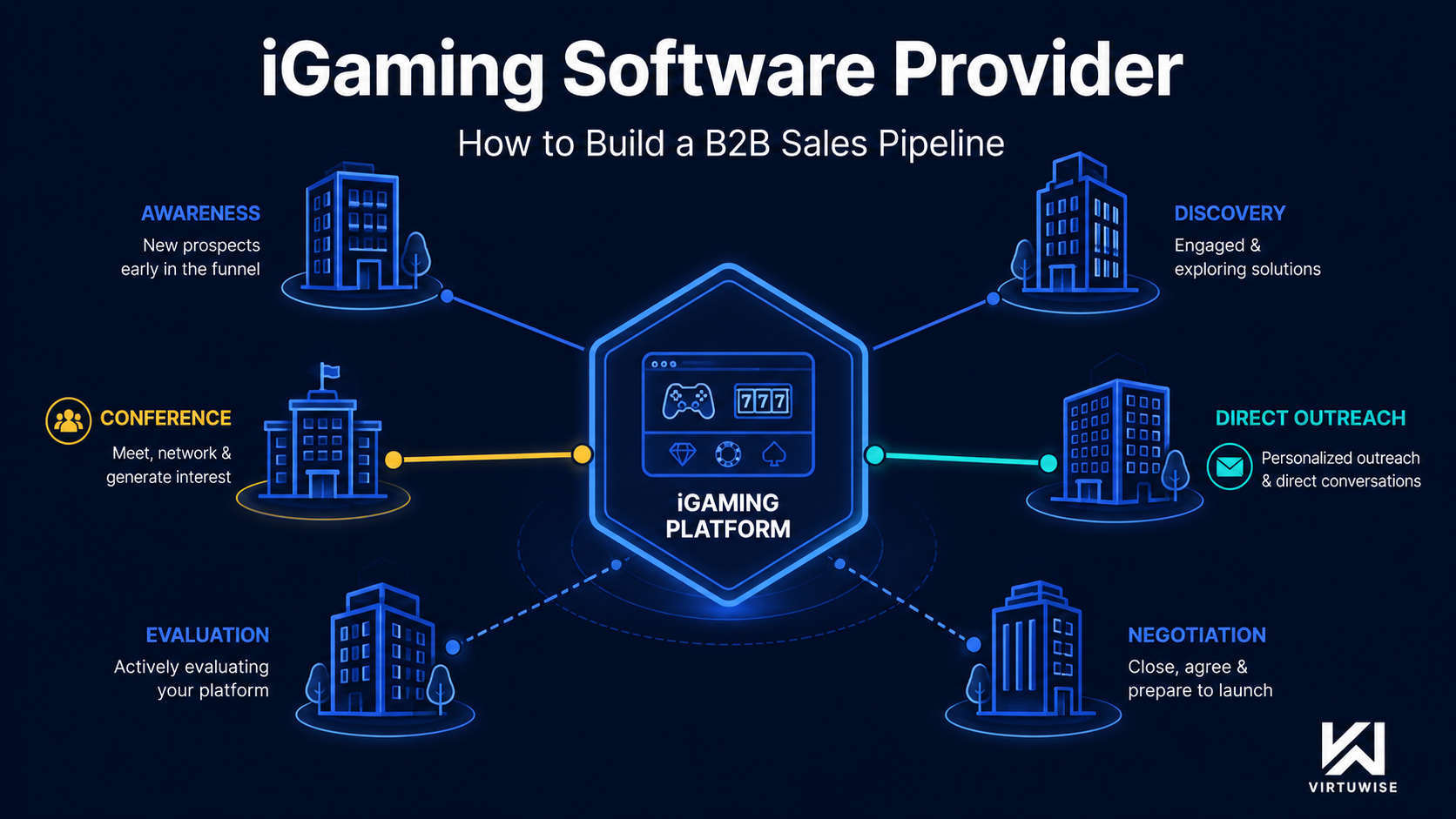
iGaming software providers operate in one of the most relationship-driven B2B markets that exists. Operators choose technology partners based on reputation, track record, and trust built over years — not on landing pages or inbound forms. The sales cycle from first conversation to signed contract regularly runs 6–18 months. And the total addressable market, while valuable, is finite: there are perhaps 2,000–5,000 licensed operators globally who represent real commercial opportunities for most B2B software providers.
In this environment, "build a great product and wait for operators to find you" is not a growth strategy. It's a plateau. iGaming software providers who grow predictably are running structured, consistent outreach to the right operator contacts — not waiting for the next conference or hoping for referrals to compound.
This guide covers the B2B sales dynamics specific to iGaming software, the channels that actually generate qualified pipeline, and how providers can build a scalable outreach function without hiring a full enterprise sales team.
The iGaming B2B Market Structure
Understanding the buyer landscape is the starting point for any iGaming software provider building a sales pipeline.
Who the buyers are
Licensed casino operators (both online and land-based) are the primary buyers for most iGaming software categories — platform software, game engines, payment solutions, CRM, bonus management, responsible gambling tools, and affiliate management systems. Aggregators and white-label operators represent a secondary buyer segment for platform-level infrastructure.
Who the decision-makers are
The software buying decision typically involves the CEO or COO (strategic sign-off), the Head of Technology or CTO (technical evaluation), and a category-specific operational lead — Head of Payments for payment solutions, Head of CRM for retention platforms, CMO for marketing technology. Outreach that misses this stakeholder map creates bottlenecks that kill deals before they start.
How buyers discover vendors
The primary discovery channels in iGaming B2B are: industry conferences (ICE London, SiGMA Malta, G2E Las Vegas, EiG), peer referrals from operator networks, platform partnership ecosystems, and trade press. Direct outreach is underutilised — which makes it disproportionately effective when done well.
Why Conference-Only Pipeline Is a Structural Problem
Most iGaming software providers rely heavily on conferences for lead generation. This creates predictable problems:
Pipeline is lumpy
All deals start in January (post-ICE) and November (post-SiGMA), creating seasonal revenue cycles that are difficult to manage operationally.
Competition is highest at conferences
Every competitor is at ICE. Operator attention is divided across hundreds of vendor meetings. The provider who reaches an operator before the show — and has already established value before the floor meeting — converts at a fundamentally different rate.
Conference meetings go cold
The typical ICE experience: 40 business card exchanges, 20 follow-up emails sent, 5 responses, 2 meetings, 1 deal — and that deal closes 9 months later when everyone has forgotten the original conversation.
The operators worth winning aren't always on the floor
Senior decision-makers at Tier 1 operators often skip the exhibition floor. The Head of Technology at a major European operator is not standing at your booth on Tuesday afternoon.
Sales Channels That Actually Build iGaming Software Pipeline
Direct Outbound to Decision-Makers
Direct outreach via LinkedIn and email to the specific decision-makers at target operators is underutilised in iGaming B2B relative to its effectiveness. The reason it's underutilised: most providers either don't do it at all, or do it poorly — sending generic product introductions to generic contacts.
Effective iGaming outbound is specific. It references the operator's specific market, recent developments (new market entry, licence acquisition, platform migration signals), and the particular challenge the software addresses for that operator profile. The message is 4–6 sentences, not a brochure.
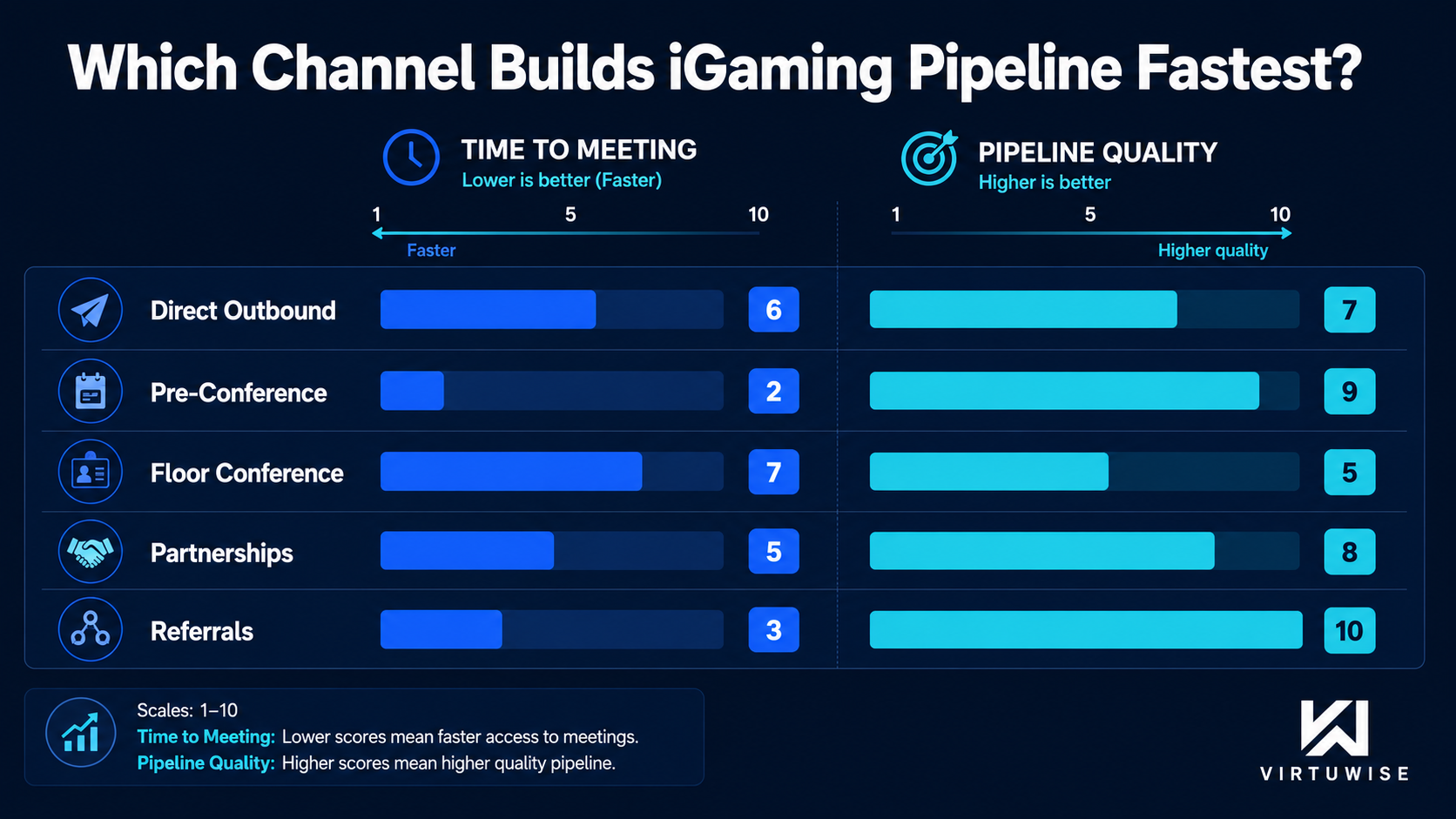
The conversion from well-executed outbound to first meeting in iGaming B2B is typically 2–5%, versus 0.5–1% for generic cold outreach. At that rate, a programme reaching 200 decision-makers per month generates 4–10 qualified first meetings.
Pre-Conference Outreach
The most efficient use of conference attendance is converting it from a lead generation event to a pipeline acceleration event. This requires outreach to attending operators 3–6 weeks before the conference — before their calendars fill.
Pre-conference outreach that secures 8–12 pre-scheduled meetings converts those meetings to qualified pipeline at roughly double the rate of unscheduled booth conversations. The provider who arrives at ICE with a full calendar is in a structurally different position from one who relies on walk-up traffic.
Platform and Partnership Ecosystems
Platform providers (full-stack iGaming platforms) often have partner ecosystems that allow game studios, payment providers, and other vendors to reach their operator client base through official partnership channels. For software providers in complementary categories, formal platform partnerships can generate warm introductions at scale.
The trade-off: partnership channels are slow to build and typically involve revenue sharing or integration investment. They complement direct outreach rather than replace it.
Content and Industry Authority
iGaming operators consume trade press, attend conference panels, and follow industry analysts. Providers who publish credible technical content — conversion data, compliance guides, market analysis — build name recognition in the operator community over time. This doesn't generate immediate pipeline, but it shortens the credibility-building phase when direct outreach happens.
iGaming B2B Sales Channel Comparison
| Channel | Time to First Meeting | Pipeline Quality | Scalability | Cost |
|---|---|---|---|---|
| Direct outbound (email + LinkedIn) | 2–8 weeks | High (targeted) | High | Medium |
| Conference (pre-scheduled meetings) | Event-dependent | Very high | Low (event cycle) | High |
| Conference (floor traffic) | Same day | Variable | Low | High |
| Platform partnerships | 3–12 months | High (warm intro) | Medium | Medium-High |
| Referrals | Variable | Very high | Low (volume-limited) | Low |
| Inbound (content/SEO) | 6–18 months | Medium | Medium | Medium |
What iGaming Software Providers Get Wrong in Their Sales Approach
Targeting too broadly
With a finite market of viable operators, effective iGaming providers build a precise ICP — not "any licensed online casino" but a specific profile defined by GGR size, market focus, technology stack, and current contract status. A pipeline of 50 well-qualified operators outperforms one of 500 poorly qualified ones.
No trigger-event monitoring
The best time to approach an operator about platform or software migration is when they are already considering a change. Trigger events include: new market licence acquisition, known contract renewals, platform migration announcements, new investment rounds, and hiring signals (Head of Technology job posts suggest platform evaluation). Providers who monitor for these events and reach out promptly hit operators in the window of highest receptivity.
Mismatched stakeholder outreach
Reaching out to CEOs about technical integration details, or reaching out to technical leads about commercial terms, creates friction that slows deals. The right contact depends on the sales stage.
Weak or absent reference stories
In iGaming B2B, every operator will ask "who else are you working with?" Providers without a named reference list are asking operators to take a trust leap that experienced buyers resist. Building a reference base — even with 3–5 named clients willing to take a call — transforms the sales conversation.
Building a Systematic Outreach Function
The alternative to conference dependency is a structured, year-round outreach programme. The elements:
ICP definition
Who are the 200–500 operators globally that represent real commercial opportunities given your specific capabilities, markets, and deal size requirements?
Contact database
For each target operator, who are the 2–3 specific people with buying authority? Building and maintaining this database is ongoing work.
Messaging framework
What are the 3–5 specific problems your software solves? What evidence (conversion data, case studies, compliance outcomes) supports each claim? Messaging that maps specific capabilities to specific operator problems, with evidence, outperforms product introductions.
Outreach cadence
How many target contacts does the programme reach per month? What is the sequence of touches (LinkedIn connection, LinkedIn message, email, follow-up)? What is the cadence across the 6–8 week sequence?
Conference integration
How does the programme identify which target contacts are attending each major conference, and how does it shift to pre-conference meeting booking 4–6 weeks before each event?
How VirtuWise Builds Pipeline for iGaming Software Providers
VirtuWise is a B2B lead generation and business development agency working specifically with iGaming technology and service providers. Our work for software providers typically involves building the systematic outreach function described above — the ICP definition, contact sourcing, messaging, and outreach execution that generates qualified meetings with operator decision-makers year-round.
For iGaming software providers, this means:
- Building a target operator list matched to your specific ICP and capabilities
- Identifying the right decision-maker contacts at each operator
- Executing LinkedIn and email outreach with messaging anchored in your proof points
- Managing pre-conference outreach for ICE, SiGMA, and other key events
- Tracking pipeline from first touch through qualified meeting
- Lead Generation: €3,000/month — ICP research, personalised outreach, meeting booking and scheduling, weekly reporting
- Lead Generation Plus: €5,000/month — everything in Lead Generation, plus multi-channel outreach (LinkedIn + email + messengers), A/B testing, higher volume
- Business Development: €7,000/month — full-cycle business development, dedicated senior sales manager, online and offline representation, custom strategy
- Inbound (SEO & AEO): €3,500/month — SEO and AEO run as one service: keyword strategy, content, technical fixes, and AI-crawler visibility (structured data, llms.txt)
- Fractional Growth Partner: Custom — a revenue engine audit, then optional ongoing Advisory or hands-on Implementation
Full details at virtuwise.io/pricing.
Frequently Asked Questions
What is an iGaming software provider?An iGaming software provider is a B2B technology company supplying licensed casino operators with the software infrastructure needed to operate: platform software, game engines, CRM and retention tools, payment processing, affiliate management, responsible gambling tools, and regulatory compliance systems. The iGaming software market is highly specialised and relationship-dependent.
How do iGaming software providers find new operator clients?The primary channels are industry conferences (ICE London, SiGMA Malta, G2E Las Vegas), direct outreach to decision-makers at target operators, platform partnership ecosystems, and referrals from shared contacts. Direct outbound — LinkedIn and email outreach to the specific people with buying authority — is underutilised relative to its effectiveness.
How long is the iGaming B2B sales cycle?The sales cycle for iGaming software ranges from 3 months for straightforward integrations to 18+ months for core platform contracts. The length depends on deal size, the number of stakeholders involved, and whether the operator is actively evaluating options or in a passive research phase.
What makes a strong iGaming software sales pitch?Specificity and evidence. Operators respond to outreach that demonstrates knowledge of their specific market, current challenges, and technology context — and supports capability claims with conversion data, case studies, or named references. Generic product pitches without operator-specific hooks consistently underperform.
How many operators should an iGaming software provider target?The right number depends on deal size and sales capacity. Providers targeting €100K+ annual contracts can build viable businesses on 20–50 active operator relationships. A programme reaching 200–500 qualified ICP contacts per year — with effective messaging and consistent follow-up — typically generates 15–30 qualified first meetings annually from outbound alone.