
Game Art Outsourcing: What Publishers Evaluate and How Studios Win Contracts
Game art outsourcing drives player acquisition for mobile and PC titles. Here's what Art Directors evaluate in an outsourcing studio — and how studios build a consistent client pipeline.
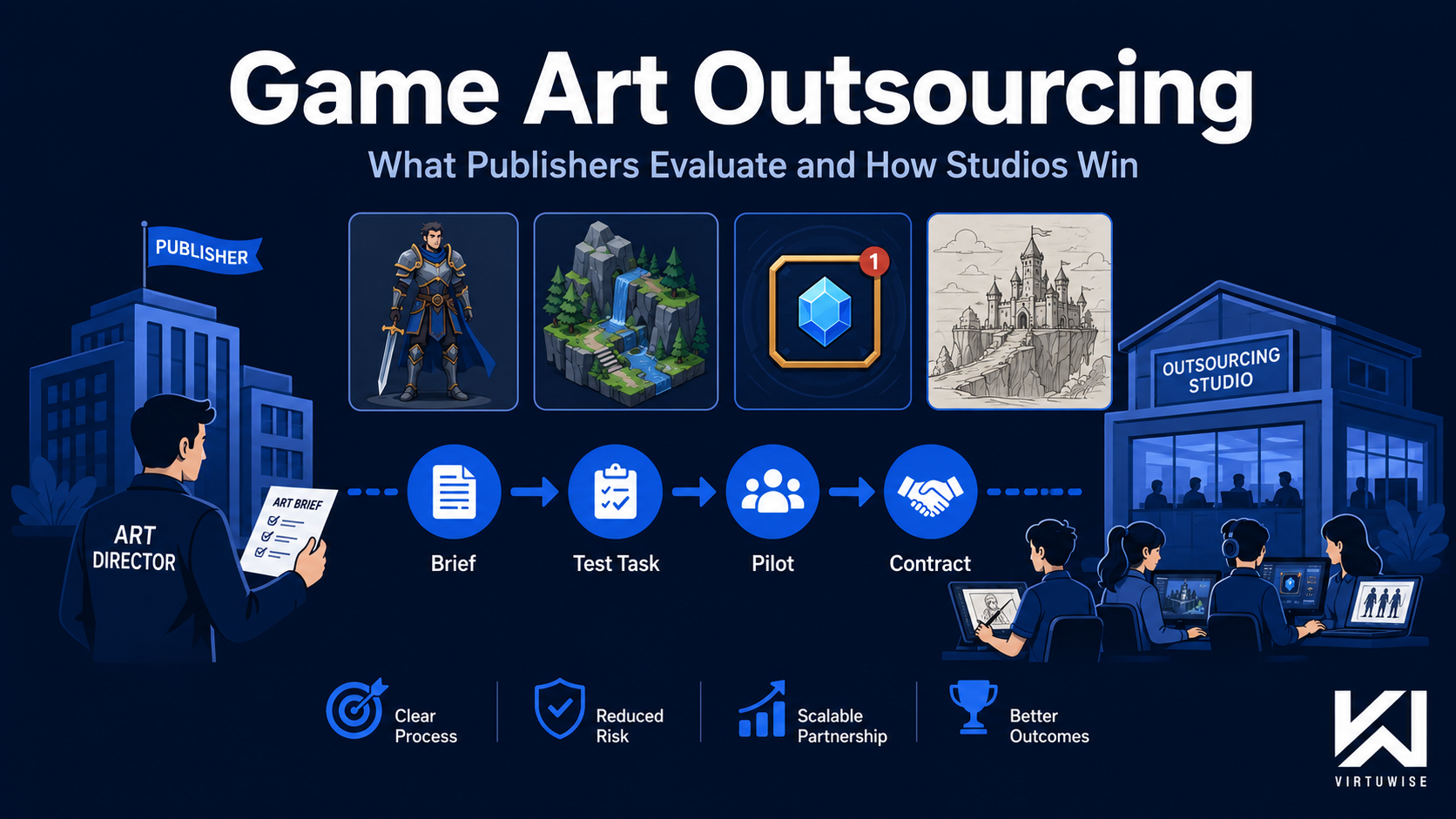
Art production is the largest category of outsourcing in the game industry. For most mid-sized and large publishers, producing all game art in-house is not economically viable — the scope of art required across concept, environment, character, UI, VFX, and cinematics for a modern title exceeds what permanent internal teams can absorb at the volume and variety the production schedule demands. External game art studios fill that gap, handling specific art functions at scale under the direction of the publisher's Art Director and production team.
For game art outsourcing studios, the market opportunity is real and durable. But it is intensely competitive. Dozens of qualified studios compete for the same publisher relationships. The studios that win consistent work are not always the most technically skilled — they are the ones who build relationships with the right decision-makers before project briefs are written and who demonstrate relevance to specific project requirements before they're ever invited to bid.
This guide covers what Art Directors actually evaluate when choosing a game art outsourcing studio, how the sales process works in practice, and what studios need to do to build a reliable client pipeline in a relationship-driven market.
What Game Art Outsourcing Covers
Game art outsourcing spans a broad range of production disciplines. Studios that specialise in one or two categories and communicate that specialisation clearly outperform generalists who claim capability across every art function.
Concept art
Early-stage concept work — character concepting, environment mood boards, visual development, style exploration — is outsourced both to access specific conceptual styles and to supplement internal concept capacity during high-intensity development phases. Concept art outsourcing decisions are made by Art Directors and Creative Directors who evaluate on style range, ideation capability, and collaboration quality during the brief development process.
2D game art and UI
2D illustration, sprite production, user interface design, icon sets, and marketing art for mobile games is a high-volume outsourcing category — particularly in mobile gaming where production cycles are fast and visual asset volumes are large. Publishers evaluate 2D studios on throughput (assets per week), style consistency across a large asset library, and technical adherence to specifications (resolution, format, animation requirements).
3D modelling and animation
Character modelling, environment modelling, prop production, rigging, and animation are consistently outsourced for both mobile and PC/console projects. 3D outsourcing is technically demanding — polygon budgets, LOD requirements, UV unwrapping standards, and engine compatibility (Unreal, Unity, Godot) vary significantly by platform and project. Studios that demonstrate specific engine expertise and platform-appropriate technical standards convert better than those who claim broad 3D capability without specifics.
Environment art
Full environment outsourcing — modular asset production, level art dressing, lighting bakes, and environment optimisation — is one of the larger-scope outsourcing relationships publishers form. Environment art outsourcing studios are evaluated heavily on their ability to match the visual language of the publisher's existing internal art direction and to work within established pipelines and asset management systems.
VFX and technical art
Particle systems, shader development, post-processing effects, and technical art integration are increasingly outsourced as visual quality expectations rise and specialist technical art skills become harder to maintain in-house. VFX studios are evaluated on engine integration depth (Blueprint, Niagara in Unreal; Shader Graph in Unity) and on their ability to match the look-development established by the internal team.
What Art Directors Look For in a Game Art Outsourcing Studio
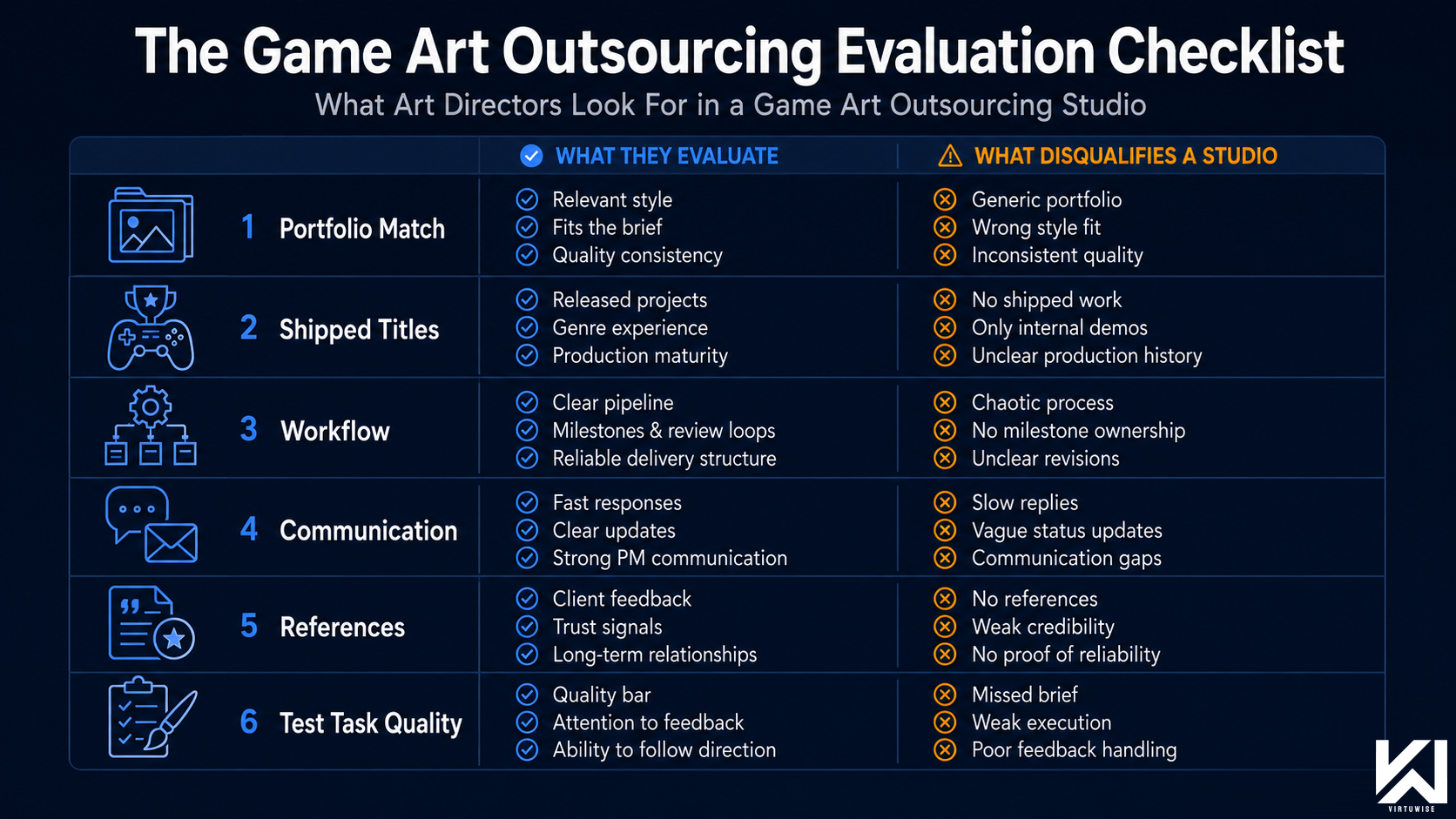
Art Directors at publishers evaluate game art outsourcing studios on a combination of creative quality, technical fit, and operational reliability. The creative quality question is answered by the portfolio. The technical fit question is answered by samples and test tasks. The operational reliability question is answered by references and how the studio behaves during the evaluation process.
Style and technical match, not portfolio breadth
An Art Director evaluating outsourcing partners for a stylised mobile RPG is not interested in a studio's ability to do photorealistic 3D environments for console. They need to see evidence — specific samples, ideally from shipped titles — that the studio can execute the visual language of their specific project. Portfolio depth within a relevant style consistently outperforms breadth across many styles.
The implication for studios: segment your portfolio by genre, visual style, and platform. Lead every client conversation with the most relevant 8–12 samples, not a full portfolio tour.
Process compatibility
Art production outsourcing is a deeply collaborative workflow. The publisher's Art Director provides direction; the studio executes, receives feedback, revises, and delivers. How that cycle works — the feedback format, the revision turnaround, the file organisation, the communication tool — matters enormously because Art Directors spend a significant fraction of their time managing external studios.
Studios that can demonstrate structured production processes — documented revision workflows, consistent file naming conventions, daily or twice-weekly check-ins during active production — reduce the perceived management overhead for Art Directors and become easier partners to work with than those who produce good work but require heavy client-side management.
Shipped title credits
There is a meaningful quality signal difference between a studio that has shipped games and one that has not. Publishers weight shipped-title experience because it correlates with the ability to deliver to spec under deadline pressure — the conditions that actually exist in game production. A portfolio of polished pre-production samples from unshipped projects carries less weight than credits on released games, even if the samples are technically superior.
Response quality during evaluation
How a studio behaves before they're hired is the best available predictor of how they'll behave during production. Studios that provide fast, precise responses to briefs, ask clarifying questions that demonstrate understanding of the project, and deliver test samples on time and to spec convert at significantly higher rates than those who deliver equivalent quality late or with poor communication.
The Game Art Outsourcing Sales Process
The path from first contact to signed contract in game art outsourcing follows a consistent sequence:
First contact → Portfolio introduction → Style brief → Test task → Pilot contract → Ongoing relationshipThe first contact is almost always relational: a referral, a conference encounter, a LinkedIn connection that leads to a portfolio introduction. Cold approaches without a portfolio anchor or contextual relevance rarely progress past the first message.
The style brief stage is where Art Directors define what they're looking for — visual references, technical specifications, scope parameters. Studios that respond to briefs with questions that demonstrate genuine understanding of the project (rather than immediate portfolio links) score better in evaluation.
The test task is the critical conversion point. Most publishers require a paid or unpaid test task — typically 2–4 assets produced to a specific brief — before awarding any contract. Studios that treat the test task as a production engagement (documenting the process, asking questions at the right stages, delivering with technical documentation) convert at higher rates than those who treat it as a portfolio exercise.
How Game Art Outsourcing Studios Build Client Pipeline
Identify the right contacts within publisher studios
The decision-maker for game art outsourcing is typically the Art Director, Lead Artist, or (for larger studios) a dedicated outsourcing manager or vendor manager. These contacts are identifiable on LinkedIn, in game credits databases, and through industry conference speaker lists. The challenge is reaching them before they've already allocated their outsourcing budget for the current title.
Conference presence with pre-event outreach
GDC, Gamescom, Game Connection, and regional developer conferences are where game art outsourcing relationships are initiated. Art Directors and producers at attending publishers typically fill their meeting schedules 3–5 weeks before the event. Studios that reach out in advance with a specific portfolio angle — "we make stylised 2D character art for mobile RPGs and noticed you're attending GDC" — book more meetings than studios who approach cold on the show floor.
LinkedIn as a year-round channel
Between conferences, LinkedIn is the highest-leverage channel for game art studios to maintain relationships with Art Directors and production contacts at target publishers. Portfolio shares (specific samples relevant to a contact's current project), congratulatory messages on shipped titles, and direct outreach tied to specific project announcements all generate warm conversations outside the conference calendar.
Referral development from existing clients
A satisfied Art Director who moves from one publisher to another takes their preferred vendor relationships with them. A studio that consistently delivers quality work and maintains proactive relationships with past clients generates a compound referral network over time. This is the most durable source of game art outsourcing business — and the most underinvested by studios who treat completed projects as closed relationships.
How VirtuWise Supports Game Art Outsourcing Studios
VirtuWise builds client pipelines for game art outsourcing studios targeting publishers and developers in mobile, PC, and console markets — handling the business development work that most studios have never systematised.
For game art studios, our work typically includes:
- Decision-maker mapping: identifying Art Directors, Lead Artists, and Production contacts at target publishers with current role data and project context
- Pre-conference outreach: scheduling portfolio reviews and meetings with attending Art Directors before GDC, Gamescom, Game Connection, and key regional events
- LinkedIn outreach: personalised connection campaigns targeting art and production decision-makers with messaging anchored in portfolio relevance and specific project signals
- Pipeline reporting: weekly outreach volume, response rates, meeting rates, and test task conversion tracking
- Lead Generation: €3,000/month — ICP research, personalised outreach, meeting booking and scheduling, weekly reporting
- Lead Generation Plus: €5,000/month — everything in Lead Generation, plus multi-channel outreach (LinkedIn + email + messengers), A/B testing, higher volume
- Business Development: €7,000/month — full-cycle business development, dedicated senior sales manager, online and offline representation, custom strategy
- Inbound (SEO & AEO): €3,500/month — SEO and AEO run as one service: keyword strategy, content, technical fixes, and AI-crawler visibility (structured data, llms.txt)
- Fractional Growth Partner: Custom — a revenue engine audit, then optional ongoing Advisory or hands-on Implementation
Full details at virtuwise.io/pricing.
Frequently Asked Questions
What is game art outsourcing?Game art outsourcing is the practice of game publishers and developers contracting external art studios to produce specific visual assets — concept art, 2D game art, 3D models, environment art, UI, VFX — rather than producing everything with internal teams. Publishers outsource art to access specialist visual styles, scale production capacity for large projects, and manage the project-based workload variability of game development without permanent headcount overhead.
What types of game art are most commonly outsourced?The most commonly outsourced art categories are 2D illustration and sprite production (particularly for mobile games), 3D character and environment modelling, concept art, UI design, and VFX. Environment art is one of the larger-scope outsourcing categories, often involving ongoing relationships rather than single-project contracts.
How do publishers find game art outsourcing studios?Publishers primarily discover game art studios through referrals from Art Directors and production contacts in their professional network, through encounters at industry conferences (GDC, Gamescom, Game Connection), and through direct outreach from studios who approach them with relevant portfolio samples. Cold outreach without a portfolio anchor or contextual relevance converts poorly — relationship context or portfolio specificity is required for the first conversation to progress.
What do Art Directors look for when evaluating a game art outsourcing studio?Art Directors evaluate studios on: visual style match to their specific project requirements (not general portfolio breadth), evidence of shipped titles on relevant platforms, production workflow transparency and process compatibility, communication reliability during the evaluation process, and live references from other Art Directors who have worked with the studio in production conditions.
How do game art outsourcing studios win their first publisher clients?First publisher clients typically come from the studio founder's or lead artist's existing professional network. Studios without established publisher relationships build initial business through conference attendance and pre-event outreach, LinkedIn engagement with Art Directors at target publishers, offering test tasks at reduced scope and cost to reduce evaluation risk, and producing portfolio samples that directly match the visual requirements of target publishers' current titles.
Related reading:
- Gaming Industry Lead Generation: How to Win B2B Clients in iGaming and Game Development
- Game Development Outsourcing: How to Build a B2B Client Pipeline
- B2B Appointment Setting Companies: How to Choose the Right Partner
- Conference Lead Generation for B2B: How to Turn Events into Pipeline
- Gaming & iGaming Industry
- Business Development Services
- LinkedIn Lead Generation