
SEO for SaaS Companies: What's Different and How to Choose a SaaS SEO Agency
SEO for SaaS companies isn't generic SEO with a different logo. Here's what's actually different, what a SaaS SEO agency should deliver, and what it should cost.
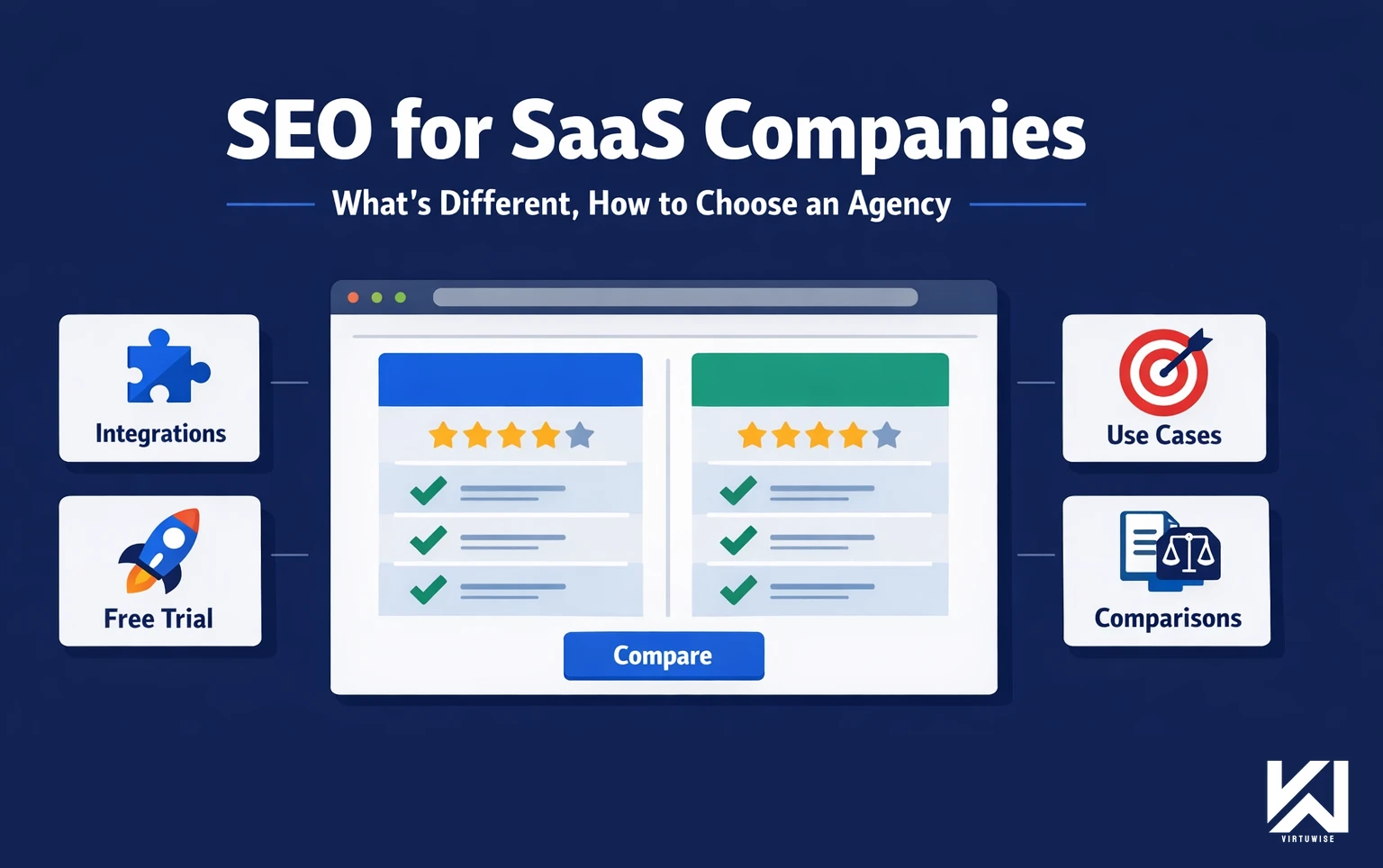
SEO for SaaS companies gets marketed like a distinct discipline, and mostly, it should be. The core mechanics — technical health, content quality, link building — don't change. What changes is the keyword universe: SaaS buyers search "[product] vs [competitor]" and "[tool] + [integration]" in ways a typical B2B services business's buyers never do, and a generic SEO agency without SaaS experience routinely misses that traffic entirely.
This guide covers what's actually different about SEO for SaaS companies, what a SaaS SEO agency should deliver that a generalist agency often doesn't, what it should cost, and how to evaluate one.
What's Actually Different About SEO for SaaS Companies
Comparison and alternative pages
SaaS buyers routinely search "[your product] vs [competitor]" and "[competitor] alternatives" before they ever search a generic category term. These pages, done well, capture buyers at a genuinely late decision stage — closer to a trial signup than almost any other content type. Most non-SaaS-specialist agencies either skip this entirely or write shallow, obviously-biased comparison pages that buyers distrust on sight.
Integration pages
"[Your product] + [complementary tool]" searches come from buyers already evaluating your product alongside their existing stack — an extremely high-intent, underused keyword category. Every real integration your product supports is a page opportunity most SaaS companies never build out systematically.
Signup and trial-intent keywords
Queries like "free [category] tool" or "[category] free trial" carry direct product intent that a generic informational content strategy doesn't target deliberately. Mapping content to this intent layer specifically — not just general category education — is SaaS-specific keyword strategy.
Product-led, self-serve funnel awareness
Where many B2B SEO strategies optimize toward a form-fill and a sales conversation, SaaS SEO — especially for product-led or self-serve products — often optimizes toward a direct trial or freemium signup. That changes what a strong call-to-action looks like on organic-landing content, and what "conversion" even means for reporting purposes.
Use-case and persona pages
SaaS products often serve multiple distinct buyer personas or use cases from one product. Dedicated pages for "[product] for [persona/use case]" capture more specific search intent than a single generic product page can, and they compound: each new use case is a new page opportunity.
SaaS SEO Strategy: How the Pieces Fit Together
A coherent SaaS SEO strategy typically layers three content types against the funnel:
- Top-of-funnel: educational content building topical authority and category awareness — necessary for long-term authority, lower individual conversion rate
- Mid-funnel: use-case and persona pages, "how to" content solving a problem your product happens to solve
- Bottom-of-funnel: comparison pages, integration pages, and signup-intent content — lower volume individually, but the highest-converting traffic in most SaaS SEO programs
Agencies that only build top-of-funnel educational content are leaving the highest-converting layer of SaaS SEO untouched. Agencies that only chase comparison and integration pages build a program with no durable topical authority underneath it. A real strategy runs all three, weighted by where the company actually needs volume versus conversion right now.
B2B SaaS SEO: Why the B2B Buying Committee Matters
B2B SaaS SEO carries an added layer most consumer or SMB SaaS SEO doesn't: the buying committee. A single organic visit rarely represents the entire purchase decision — a champion researching the category, a technical evaluator comparing integrations, and an economic buyer checking pricing may all interact with your content separately before a deal closes.
This means B2B SaaS SEO content needs to serve multiple roles simultaneously: category-education content for the champion, integration and technical-depth content for the evaluator, and pricing/ROI-clear content for the economic buyer. Content built for a single generic "buyer" persona underperforms against this reality.
SaaS SEO Services: What to Expect
A complete SaaS SEO services engagement covers:
- Keyword research mapped to the SaaS funnel — informational, comparison, integration, and signup-intent terms, not just category volume
- Comparison and integration page strategy — identifying and building the highest-intent page types systematically, not ad hoc
- Technical SEO for SaaS marketing sites, which are frequently JavaScript-heavy and prone to crawlability issues that generic technical audits miss
- Content built by writers who understand the product category — SaaS content written by someone with no category context reads generically and converts poorly
- Reporting tied to trial signups or pipeline, not just organic traffic and rankings
How to Evaluate a SaaS SEO Agency
Ask for SaaS-specific case studies, not general SEO case studies
A case study from a local services business or an e-commerce brand doesn't tell you whether an agency understands comparison pages, integration content, or product-led growth dynamics. Ask specifically for SaaS clients and SaaS-specific results.
Ask how they handle comparison pages
This is the single clearest signal of real SaaS SEO experience. Ask for an example comparison page they've built, and how they handle the credibility problem (buyers distrust obviously one-sided comparisons). Agencies without a real answer here are likely generalists.
Ask about technical SEO experience with SaaS site architectures
SaaS marketing sites often sit on modern JavaScript frameworks that create indexation and rendering issues generic technical audits miss. Ask specifically about experience with your site's stack.
Evaluate whether reporting ties to trial signups, not just traffic
Ask to see a sample report. Does it connect organic content to trial signups or pipeline, or does it stop at sessions and rankings? For product-led SaaS specifically, signup attribution is the metric that actually matters.
What SaaS SEO Should Cost
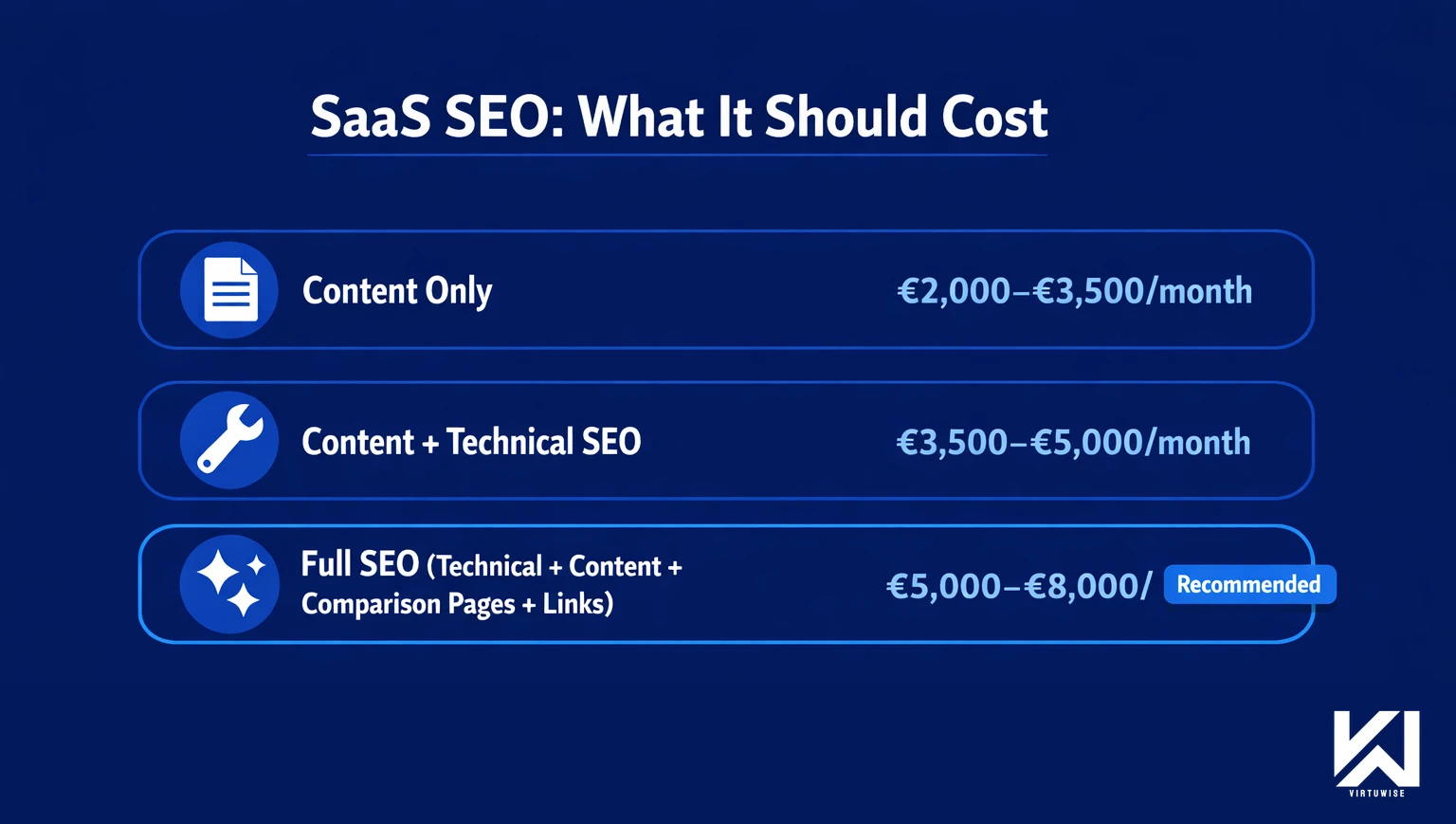
| Scope | Typical Monthly Cost |
|---|---|
| Content only | €2,000–€3,500/month |
| Content + technical SEO | €3,500–€5,000/month |
| Full SEO (technical + content + comparison/integration pages + links) | €5,000–€8,000/month |
Below €1,500/month typically means generic content production with no comparison or integration page strategy — the highest-converting layer of SaaS SEO left untouched entirely:
How VirtuWise Runs SEO for SaaS Companies
VirtuWise's Inbound engagement covers the SaaS-specific layers described above — comparison and integration page strategy, use-case content, and technical SEO — as part of the same SEO and AEO engagement, not a separate SaaS add-on.
Inbound (SEO & AEO) starts at €3,500/month. Full details at virtuwise.io/pricing or on the SEO & AEO services page.Frequently Asked Questions
How is SEO for SaaS companies different from regular SEO?SaaS SEO targets a different set of intents than typical business SEO: free-trial and signup-intent keywords, integration and comparison pages ("[product] vs [competitor]", "[product] + [tool] integration"), and use-case content mapped to specific buyer personas rather than broad informational topics. It also has to account for a self-serve or product-led funnel, where organic traffic often converts directly into a trial signup rather than a form fill.
What should a SaaS SEO agency deliver?A SaaS SEO agency should deliver: keyword research mapped to the SaaS buying funnel (informational, comparison, and signup-intent terms), comparison and integration page strategy, technical SEO for typically JavaScript-heavy SaaS marketing sites and app-adjacent pages, content built by writers who understand the product category (not generic freelancers), and reporting that ties organic traffic to trial signups or pipeline, not just rankings.
How much does SaaS SEO cost?SaaS SEO services typically range from €2,000/month for narrow content-only engagements to €5,000-€8,000/month for full-scope SEO covering technical, content, comparison pages, and link building. Below €1,500/month usually means generic content with no SaaS-specific comparison or integration page strategy.
Do SaaS companies need a specialized SEO agency, or does generic SEO work?SaaS companies benefit meaningfully from agencies with actual SaaS experience because the keyword universe (comparison, integration, signup-intent terms) and content requirements (product understanding, category positioning) differ from typical B2B service businesses. A generalist agency can execute SEO mechanics competently but often misses the comparison/integration page opportunity entirely, which is frequently where SaaS SEO's highest-converting traffic comes from.
What SEO content works best for SaaS companies?The highest-converting SaaS SEO content is usually comparison pages ("[product] vs [competitor]"), integration pages ("[product] + [tool]"), and use-case pages targeting a specific persona or job-to-be-done — these capture buyers close to a decision. Top-of-funnel educational content still matters for building topical authority and top-of-funnel volume, but comparison and integration pages typically convert at a materially higher rate.