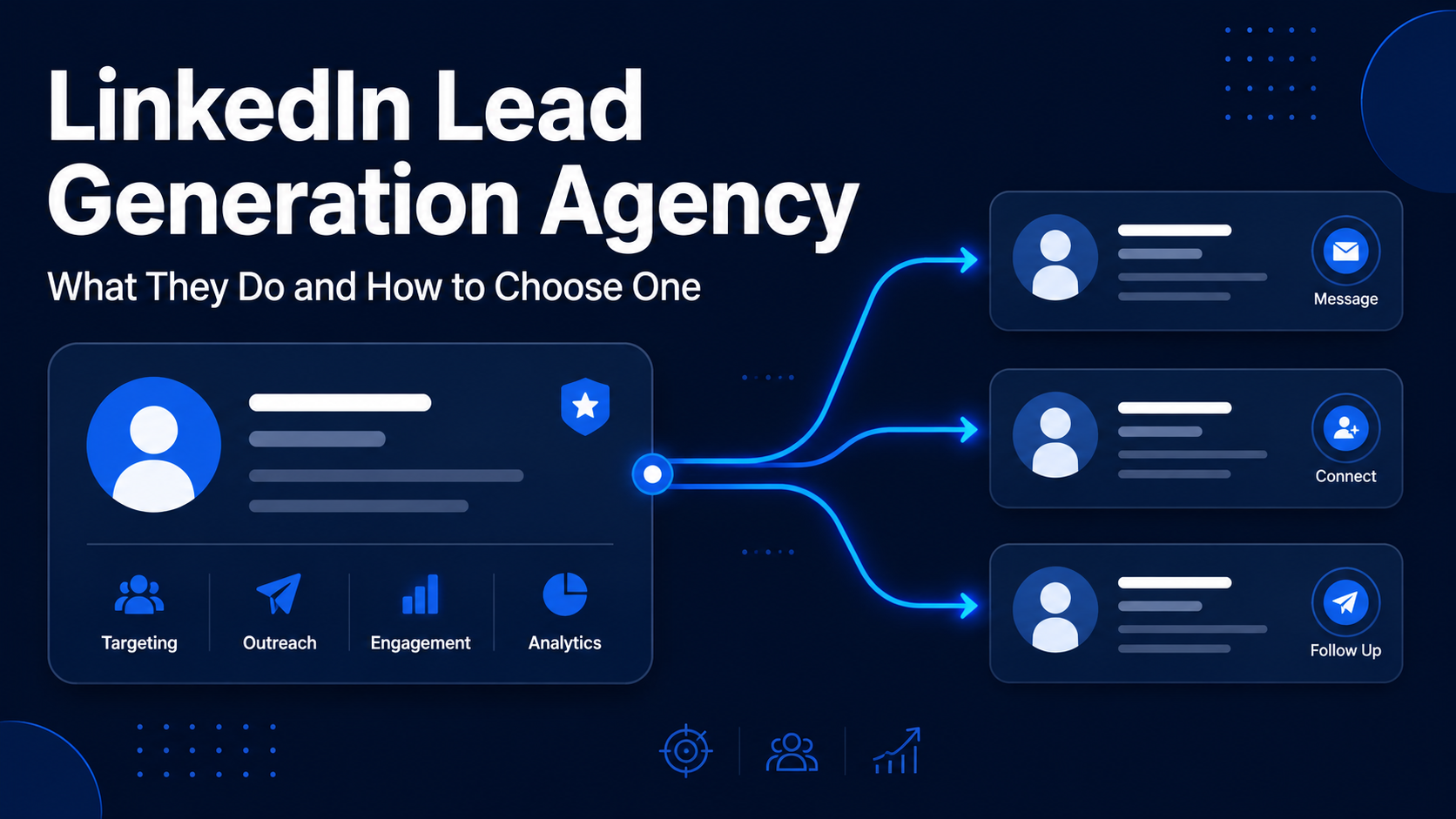
LinkedIn Lead Generation Agency: What They Do and How to Choose One
A LinkedIn lead generation agency handles profile optimisation, outreach, and content to build B2B pipeline from LinkedIn. Here's what they do and how to evaluate them.
LinkedIn is the most effective digital channel for B2B prospecting in most markets. Decision-makers are reachable. Targeting is precise. And unlike cold email, a LinkedIn connection request doesn't land in a spam folder.
The challenge is execution. Running a LinkedIn outreach programme that consistently generates qualified meetings requires time, discipline, and enough knowledge to avoid the mistakes that get accounts restricted or permanently damage your brand with key prospects.
This is why LinkedIn lead generation agencies exist. They manage the operational side of LinkedIn outreach so your sales or marketing team can focus on the conversations and deals.
This guide covers what LinkedIn lead generation agencies actually do, how to evaluate them, what to watch for in terms of risk, and how to decide between an agency and handling it in-house.
What Is a LinkedIn Lead Generation Agency?
A LinkedIn lead generation agency manages LinkedIn-based prospecting and outreach on behalf of a client, with the goal of generating qualified sales conversations or meetings.
The services they provide typically include:
- Profile optimisation (your personal profile or your team's profiles as outreach assets)
- ICP and target account definition
- Prospect list building using LinkedIn Sales Navigator or third-party tools
- Connection request sending and message sequencing
- Follow-up management and reply handling
- Reporting on connection rates, reply rates, and meetings booked
Some agencies also provide LinkedIn content creation and thought leadership management — the strategy of building your personal or company brand on LinkedIn to warm up outreach audiences over time.
The range of capabilities matters when evaluating agencies. Some operate purely as outreach execution services. Others offer a more strategic function that integrates outreach with content, positioning, and long-term brand building.
What LinkedIn Lead Generation Actually Involves
To evaluate agencies meaningfully, it helps to understand the operational components of LinkedIn lead generation:
Profile preparation
An effective LinkedIn outreach profile reads as credible, specific about who you help and how, and gives prospects a reason to accept the connection. A profile that reads as a generic salesperson generates lower acceptance rates and lower response rates regardless of outreach quality.
Most agencies start with a profile audit and recommendations. The best ones help you implement changes that produce measurable improvements in connection acceptance rates.
ICP and list building
LinkedIn Sales Navigator allows filtering by job title, seniority, industry, company size, geography, and a growing set of intent and activity signals. A well-built prospect list using these filters produces connection acceptance rates of 30–40%. A poorly targeted list produces 10–15%.
Agencies differ significantly in how they build lists. The best ones cross-reference Sales Navigator filters with additional data sources (Apollo, Clearbit, company news) to target not just ICP-fit but ICP-fit with trigger signals.
Connection and outreach sequencing
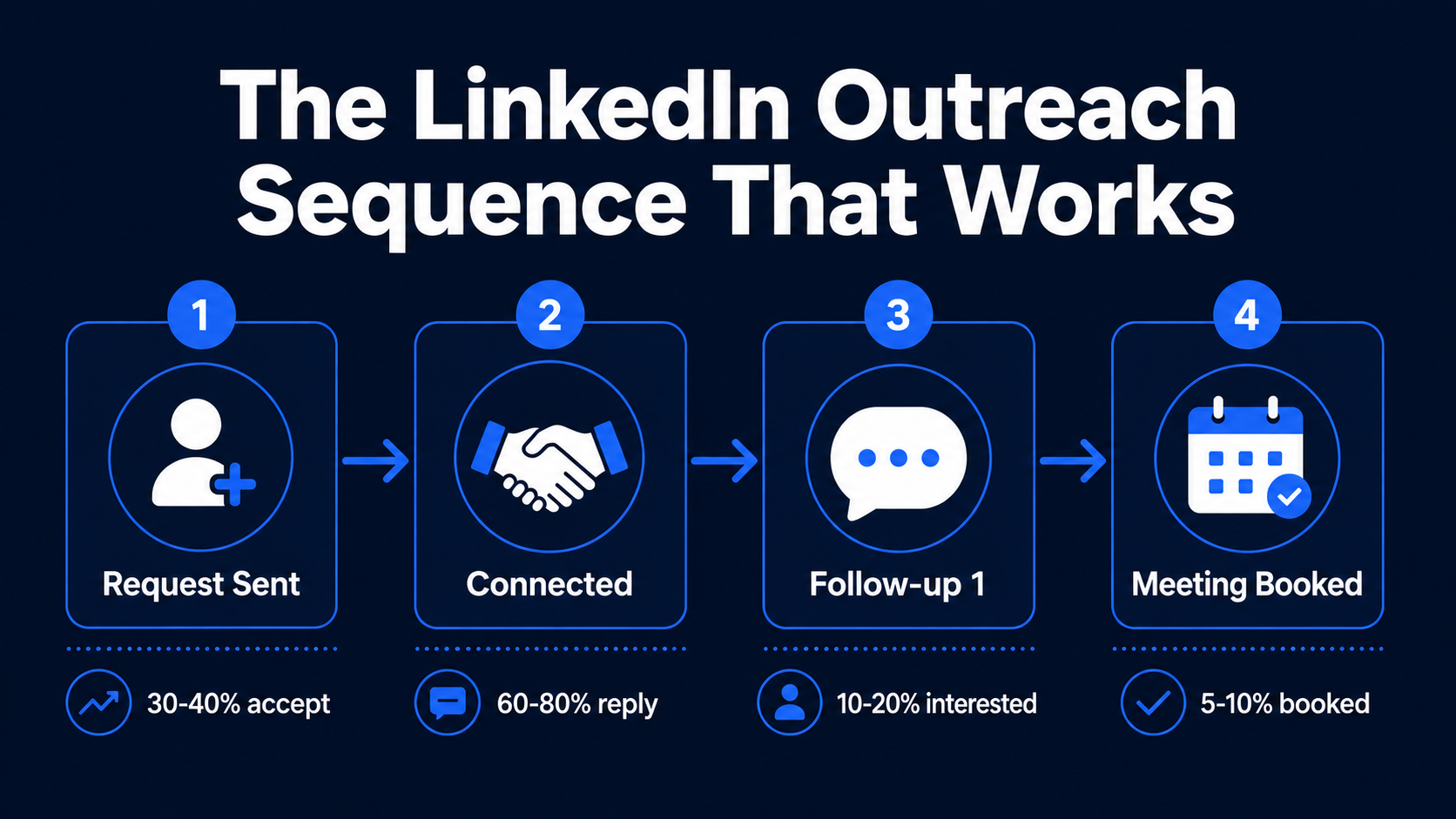
A LinkedIn outreach sequence typically looks like:
- Connection request with a short, relevant note (or no note — testing both is worthwhile)
- Follow-up message within 24–48 hours of acceptance
- Second follow-up 5–7 days later if no reply
- Optional: LinkedIn content engagement before the sequence (liking, commenting on their posts)
The art is in the messaging: relevant, specific, low-pressure, with a clear value proposition and a call to action that requires minimal commitment from the prospect.
Reply handling
Replies require rapid, thoughtful responses. A positive reply that waits 48 hours for a human response often loses momentum. A neutral or unclear reply handled poorly turns a potential opportunity into a disengaged contact.
Agencies typically handle reply routing — directing positive replies to you or your sales team — but vary significantly in whether they draft responses or leave them entirely to the client.
How to Evaluate a LinkedIn Lead Generation Agency
The market is crowded with providers ranging from excellent to actively harmful. Here's what to look for:
Connection acceptance rate
Ask for benchmarks from comparable clients. A well-run LinkedIn outreach programme targeting B2B decision-makers should achieve 25–40% connection acceptance rates. Below 20% suggests poor list quality, poorly optimised profiles, or aggressive approaches that prospects are declining.
Reply rate and positive reply rate
Of connected prospects, reply rates for well-executed sequences are 5–15%. Positive reply rates (expressing interest or agreeing to a call) should be 2–5% of connections sent. Agencies that report total reply rates without separating positive, neutral, and negative replies are obscuring poor performance.
Meeting-to-qualified-opportunity rate
The metric that matters for your pipeline. Not just meetings booked — but meetings that lead to an active sales conversation. Ask agencies for this data from comparable clients. If they don't track it, that tells you something about how they define success.
Compliance and platform safety approach
LinkedIn actively restricts accounts that exhibit automation signals. An agency running high-volume outreach from your personal LinkedIn profile without safety controls risks a permanent profile restriction. Ask specifically:
- What tools do you use for connection automation?
- How do you stay within LinkedIn's daily limits?
- Have any client profiles been restricted? How was it resolved?
Legitimate agencies use tools with built-in safety limits (Expandi, Waalaxy, Dripify with proper configurations) and stay well within LinkedIn's threshold of 100–150 connection requests per week per account.
Content and thought leadership integration
LinkedIn outreach cold, without any brand presence, produces lower conversion rates than outreach from a profile that has been active, posting relevant content. Agencies that understand this and integrate content into their outreach strategy produce better results than those running purely automated connection campaigns.
Red Flags to Avoid
Agencies that use your primary LinkedIn profile for mass automation without safety controls.This is the fastest way to get a permanent restriction on a profile you've built over years.
Agencies that promise guaranteed meeting numbers.Reputable agencies provide performance benchmarks; they don't guarantee outcomes for a channel they don't control.
No clear ICP process.An agency that asks for your target industries and company size without going deeper into firmographics, trigger signals, or persona-level criteria will produce low-quality lists and poor conversion.
No reply handling capability.Agencies that generate connections and send messages but leave all replies entirely to you create operational overhead and pipeline leakage. At minimum, they should categorise replies and flag positives for rapid follow-up.
Cookie-cutter messaging.If the agency uses the same outreach templates across all their clients with only minor personalisation, your messages will be recognisably generic. This is particularly damaging in small, interconnected verticals where prospects know they're receiving the same message as their colleagues.
LinkedIn Agency vs In-House: How to Decide
The decision depends on your volume, expertise, and how central LinkedIn is to your go-to-market.
| Factor | Agency | In-House |
|---|---|---|
| Time to first pipeline | 2–4 weeks | 3–5 months (hire + ramp) |
| Cost | €3,000–€7,000/month | €60,000–€90,000/year fully loaded |
| LinkedIn expertise | Immediate | Developed over time |
| Multi-profile outreach | Included | Requires additional hires |
| Market knowledge | Transferable from other clients | Deep over time |
| Best stage | Testing channel, entering new market, scaling fast | Proven playbook, high volume, long-term channel commitment |
A middle path that works well for many B2B companies: agency for execution while internal team focuses on content and relationship quality. The agency handles the mechanics; the sales team handles the conversations.
How VirtuWise Approaches LinkedIn Outreach
LinkedIn is one of the core channels in VirtuWise's outbound operation. We run LinkedIn prospecting alongside cold email as part of integrated outreach programmes — not as a standalone automated connection campaign.
Our approach:
- Profile optimisation recommendations before any outreach begins
- ICP-matched prospect lists built from Sales Navigator + data enrichment
- Personalised connection requests and follow-up sequences calibrated to your market
- All positive replies routed to your sales team within 4 hours
- Safety-first automation: all campaigns run within LinkedIn's platform limits
We work across fintech, iGaming, SaaS, IT services, and AI — verticals where buyer trust is high and generic outreach produces poor results.
Our pricing:- Lead Generation: €3,000/month — ICP research, personalised outreach, meeting booking and scheduling, weekly reporting
- Lead Generation Plus: €5,000/month — everything in Lead Generation, plus multi-channel outreach (LinkedIn + email + messengers), A/B testing, higher volume
- Business Development: €7,000/month — full-cycle business development, dedicated senior sales manager, online and offline representation, custom strategy
- Inbound (SEO & AEO): €3,500/month — SEO and AEO run as one service: keyword strategy, content, technical fixes, and AI-crawler visibility (structured data, llms.txt)
- Fractional Growth Partner: Custom — a revenue engine audit, then optional ongoing Advisory or hands-on Implementation
Full details at virtuwise.io/pricing.
Frequently Asked Questions
How many LinkedIn connection requests can you safely send per week?LinkedIn's safe threshold for most accounts is 100–150 connection requests per week, sent gradually across the week rather than in bulk. New accounts or those with low engagement histories should start lower (30–50/week) and build over time. Exceeding these thresholds consistently increases restriction risk.
What connection acceptance rate should I expect?For well-targeted B2B outreach to decision-makers, 25–40% is achievable. Highly personalised connection requests with relevant context can reach 40–50%. Generic or pitch-heavy notes bring this down to 10–15%. The baseline connection acceptance rate before any outreach message is sent is a strong indicator of profile quality and targeting quality.
Does LinkedIn lead generation work for all B2B markets?LinkedIn works best for B2B markets where decision-makers are active users — typically technology, financial services, professional services, SaaS, and knowledge-intensive industries. It works less well for very small businesses (where decision-makers may not be on LinkedIn), industrial sectors, and markets where WhatsApp or industry-specific platforms are the primary communication channel.
How long before LinkedIn outreach generates pipeline?A well-run LinkedIn programme typically generates first positive replies within 2–4 weeks and first meetings within 4–6 weeks. Building to a consistent pipeline contribution takes 2–3 months as the connection base grows and the sequence is optimised. LinkedIn compounds over time — a larger network generates more organic inbound than a new one.
Can LinkedIn outreach replace cold email?For most B2B use cases, LinkedIn and cold email are more effective in combination than either alone. LinkedIn connections warm up email outreach; email provides an additional touchpoint for LinkedIn connections that haven't replied. Multi-channel sequences using both typically produce 30–50% higher qualified reply rates than single-channel.