
SaaS Lead Generation: Channels, Strategies, and How to Scale Pipeline in 2026
SaaS lead generation requires a different approach than traditional B2B. Here's what channels work, when to outsource vs build in-house, and realistic benchmarks.
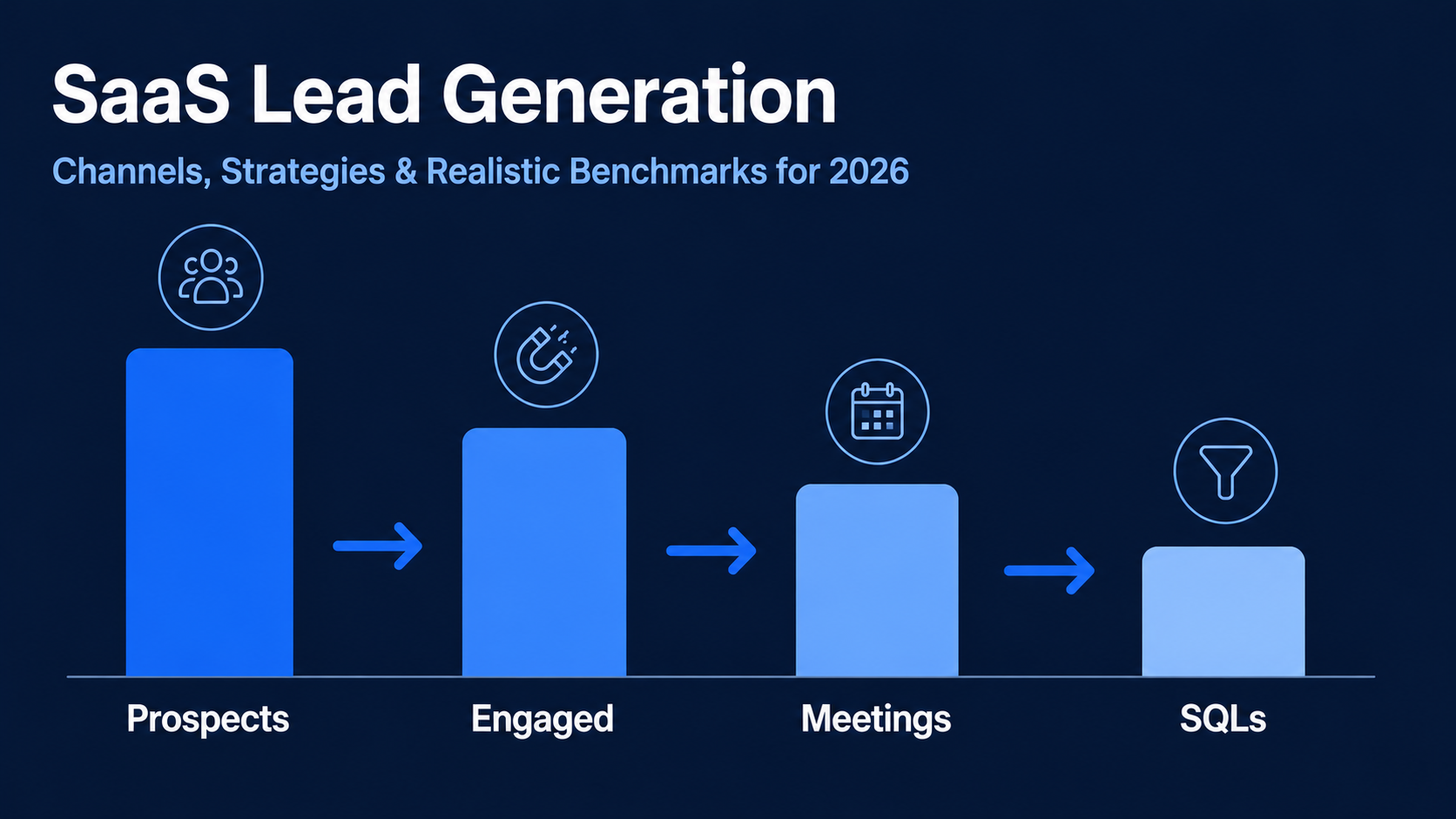
SaaS companies face a specific pipeline problem: the buying journey is long, the ICP is precise, and most channels that work for product-led growth don't translate directly to enterprise or mid-market sales.
Building consistent SaaS lead generation requires choosing the right channels for your stage, structuring outreach around the way SaaS buyers actually evaluate software, and knowing when to build internally versus outsource to a team that already has the infrastructure in place.
This guide covers what actually works for SaaS lead generation in 2026, how to structure outbound for B2B SaaS, what realistic results look like, and how to evaluate whether an outsourced model makes sense for your current stage.
Why SaaS Lead Generation Is Different
SaaS pipeline generation has a set of characteristics that distinguish it from standard B2B outreach:
Multi-stakeholder dealsSaaS purchases at mid-market and enterprise involve multiple buyers: the champion (often a VP of Sales, RevOps, Marketing, or Engineering), the economic buyer (CFO or CEO), and sometimes IT or legal. Outreach that only targets one stakeholder misses the others who influence or block the decision.
Longer evaluation cyclesEnterprise SaaS deals take 3–9 months from first conversation to close. This means outbound-generated leads need to be nurtured through a longer pipeline, and pipeline volume metrics need to account for multi-month lag between meeting booked and revenue closed.
Technical complexity in messagingGeneric "we help you increase revenue" pitches don't land with SaaS buyers. Decision-makers in product, engineering, or RevOps functions respond to specific pain points, integration context, and outcomes relevant to their stack — not vague efficiency claims.
ICP specificitySaaS companies targeting, for example, Series B fintech companies with 50–500 employees using Salesforce and HubSpot have a precise ICP that requires accurate data sourcing. Buying a generic list and blasting it produces poor results for precise ICPs.
Product-led vs sales-led tensionMany SaaS companies built on PLG (product-led growth) eventually need to add a sales-led motion for enterprise accounts. Outbound for PLG-native companies requires building sales capabilities from scratch — often alongside an existing inbound motion.
SaaS Lead Generation Channels That Work in 2026
1. LinkedIn Outbound
LinkedIn is the highest-performing outbound channel for SaaS in EU and US markets. Decision-makers at SaaS target companies — VPs, CTOs, RevOps leads, Sales Directors — are more consistently active on LinkedIn than their counterparts in other industries.
LinkedIn outbound for SaaS works when:
- Profile is optimised (not a recruitment page, but a clear value proposition)
- Connection requests are personalised with a relevant hook
- Post-connection messages reference a specific pain or trigger
- Sequences are 3–5 touchpoints, not a single cold pitch
Realistic LinkedIn acceptance rate for well-targeted SaaS outreach: 25–40%.
2. Cold Email
Email remains highly effective for SaaS when targeting mid-market and enterprise accounts. Technical buyers check email; they don't always respond to InMail. The combination of LinkedIn + email in a coordinated sequence produces reply rates 2–3× higher than either channel alone.
For SaaS specifically: email sequences that lead with a specific problem the prospect is likely experiencing (based on their tech stack, company stage, or recent signal) significantly outperform generic value-prop pitches.
3. Content and SEO
Long-form content targeting commercial-intent keywords ("best [category] software", "[problem] solutions for [industry]") generates inbound pipeline for SaaS companies — but with a 6–18 month lag before meaningful traffic builds. Content is a high-value long-term channel, not a short-term pipeline fix.
For early-stage SaaS, outbound delivers faster results. Content compounds over time.
4. Partner and Integration Channels
SaaS companies with integration partnerships (appearing in Salesforce AppExchange, HubSpot Marketplace, or similar) generate qualified referral traffic from users actively looking for complementary tools. Partner channels are underutilised for SaaS lead generation relative to their conversion quality.
5. Community and Events
LinkedIn groups, Slack communities, and vertical events (fintech conferences, SaaS Summit, RevOps meetups) provide access to highly targeted audiences. Community-sourced leads convert at higher rates because trust is established before the first conversation. This channel requires consistent time investment.
Outbound Lead Generation for B2B SaaS: A Practical Approach
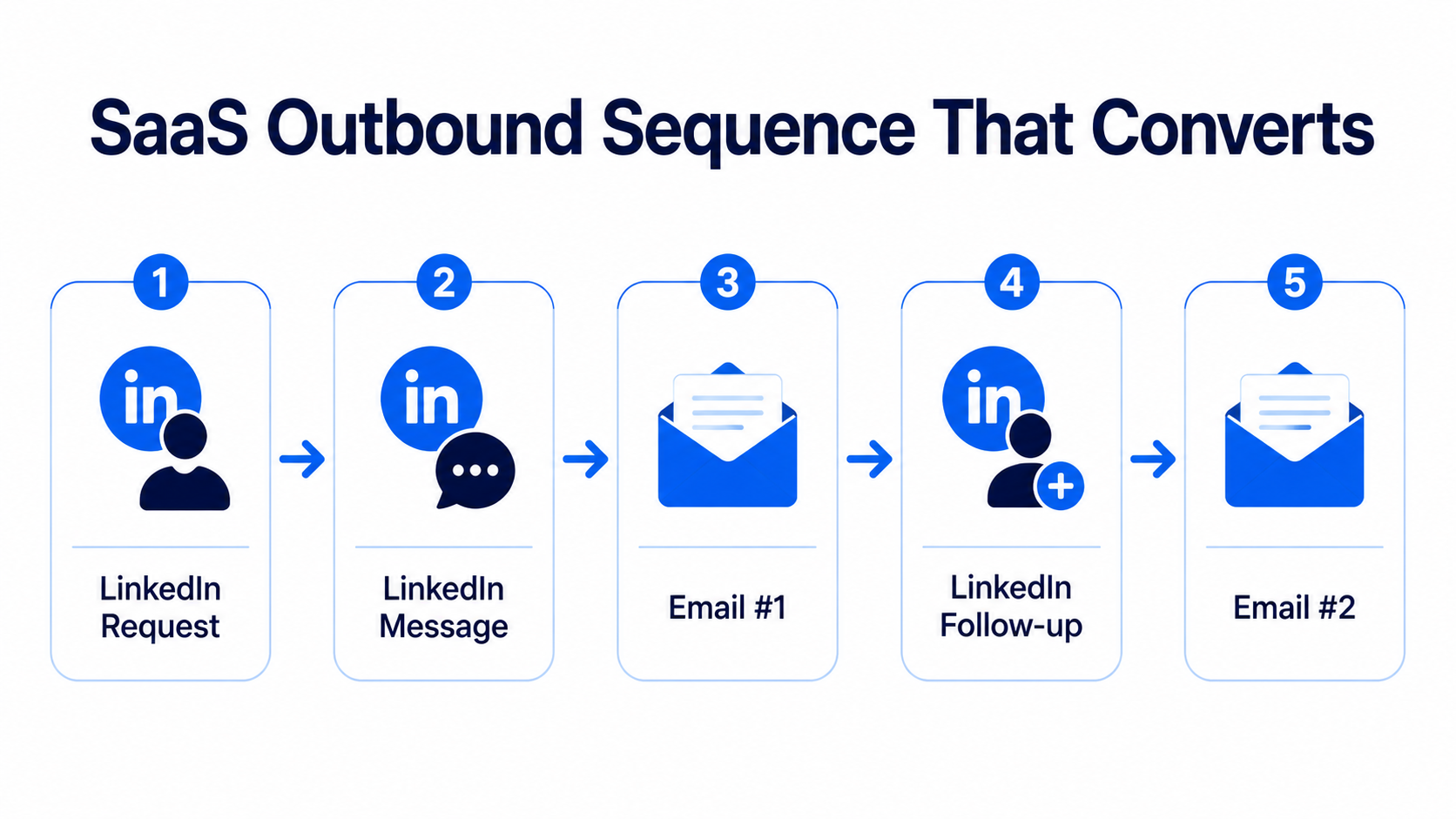
For SaaS companies adding or scaling outbound, the high-performing approach follows this structure:
ICP definition at the account level, not just the persona levelDefine not just who you're targeting (job title, seniority) but which companies specifically: size, vertical, growth stage, funding, tech stack, geography. The more specific the account criteria, the higher the reply rates and the better the meeting quality.
Multi-stakeholder mappingFor deals above €20K ACV, identify 2–3 stakeholders per target account: the champion, the economic buyer, and a relevant influencer (e.g., the RevOps lead who will manage the implementation). Coordinated outreach to multiple contacts at the same account is standard ABM practice and significantly increases conversion.
Trigger-based personalisationCold outreach to SaaS buyers converts significantly better when it references a relevant trigger: company funding announcement, a new product launch, a job posting signalling growth, a conference they're speaking at, or a technology change. Generic "I help companies like yours" copy lands in the delete folder.
Sequence structure: LinkedIn-first, email to closeFor EU and US SaaS markets, the highest-performing sequence is:
1. LinkedIn connection with a specific hook
2. LinkedIn message post-connection (short, relevant)
3. Email follow-up with more context
4. LinkedIn follow-up or email #2
5. Final email with a direct call to action
Realistic SaaS Lead Generation Benchmarks
For well-targeted B2B SaaS campaigns with quality infrastructure and messaging:
| Metric | Realistic Range | Notes |
|---|---|---|
| LinkedIn acceptance rate | 25–40% | Profile quality and personalisation matter |
| Email open rate | 35–55% | Subject line + sender domain reputation |
| Reply rate (multi-channel) | 5–15% | ICP quality + message relevance |
| Meeting booking rate | 2–5% | Qualification threshold + offer clarity |
| Qualified meetings/month | 8–20 | Depends on market size and campaign age |
| SQL conversion (from meeting) | 30–60% | Depends on qualification criteria |
Month 1 of any new campaign generates learning. Month 2 stabilises volume. Month 3 is typically when consistent meeting flow develops as targeting and messaging are refined.
When to Outsource SaaS Lead Generation
You're pre-PMF or in early growth (under €3M ARR)
Before product-market fit is confirmed, outbound generates signals about ICP fit, message resonance, and market demand — not just pipeline. An outsourced team runs this validation faster and cheaper than an in-house SDR hire.
You're adding a sales-led motion to a PLG product
SaaS companies with strong inbound or self-serve models often lack outbound infrastructure entirely. Adding an enterprise or mid-market motion means building something from scratch. Outsourcing the first phase of that build — before committing to internal headcount — reduces risk significantly.
You're entering a new market or vertical
Breaking into a new geography (EU markets, DACH, Nordics, UK) or a new vertical (fintech, gaming, iGaming) requires starting from zero on data, messaging, and decision-maker knowledge. An agency with existing campaign history in that market does this in weeks.
You need pipeline faster than a ramp allows
A SaaS SDR hire takes 4–6 months to reach full productivity. An outsourced SaaS lead generation agency delivers qualified meetings in 2–4 weeks.
When to Build SaaS Lead Generation In-House
You're above €15M ARR with a validated playbook
Once you know exactly what works — which ICPs convert, which messages land, which channels produce the highest-quality pipeline — hiring in-house to own the proven motion makes sense. At this stage, the focus shifts from discovery to scale.
You have strong product-led growth and need minimal outbound volume
If inbound and PLG are producing sufficient pipeline, a small in-house SDR function for enterprise expansion can handle the volume without the overhead of a full agency engagement.
Your product requires deep technical immersion to sell
SaaS products where a 15-minute discovery call requires genuine deep technical knowledge are harder to outsource. In those cases, an outsourced team handling top-of-funnel (interest generation, qualification) with an in-house technical pre-sales resource handling discovery is a workable hybrid.
VirtuWise: Lead Generation for B2B SaaS Companies
VirtuWise runs multi-channel outbound for B2B SaaS and IT services companies targeting EU, UK, and US markets — with vertical-specific experience in fintech, gaming, iGaming, and AI tools.
What's included:- ICP definition and account-level targeting for SaaS buyers (C-suite, VPs, RevOps, technical leads)
- GDPR-compliant EU data sourcing and sending infrastructure
- Multi-stakeholder sequencing for mid-market and enterprise SaaS accounts
- LinkedIn + email coordinated sequences with trigger-based personalisation
- Qualified meeting booking with confirmed interest, budget authority, and timing
- Weekly reporting with SQL-level tracking and campaign optimisation
- Lead Generation (single channel): €3,000/month
- Lead Generation Plus (multi-channel): €5,000/month
- Business Development (full-cycle with dedicated BDR): €7,000/month
- Inbound (SEO & AEO): €3,500/month
- Fractional Growth Partner: custom, scoped on a call
Frequently Asked Questions
What is SaaS lead generation?SaaS lead generation is the process of identifying and engaging potential customers (other businesses) for a SaaS product — through outbound outreach, content and SEO, paid channels, partnerships, and events. The goal is to generate qualified pipeline: prospects with genuine need, budget authority, and appropriate timing for a sales conversation.
What's the best lead generation channel for SaaS?For mid-market and enterprise SaaS, multi-channel outbound (LinkedIn + email) delivers the fastest results. Content/SEO is the best long-term channel but takes 6–18 months to build meaningful volume. Most high-growth SaaS companies run outbound for near-term pipeline while content compounds in the background.
How long does it take to see results from SaaS outbound?For a well-targeted campaign with quality infrastructure, first qualified meetings appear within 2–4 weeks of launch. Consistent monthly volume — 8–20 meetings per month — typically develops by month 2–3 as messaging and targeting are optimised.
Should I hire an SDR or outsource SaaS lead generation?For most SaaS companies under €10M ARR, outsourcing delivers better Year 1 ROI: faster time to pipeline, lower cost, no ramp risk, and immediate market expertise. Once ICP and messaging are validated and pipeline demand is consistent, adding an in-house SDR to own the proven motion makes sense alongside the outsourced function.
What makes SaaS lead generation different from standard B2B outreach?SaaS deals involve multiple stakeholders, longer evaluation cycles, and technically sophisticated buyers who respond to specific product-relevant pain rather than generic efficiency claims. Effective SaaS outreach targets multiple contacts at each account, references relevant signals (funding, job postings, tech stack), and maps to how the buying committee actually makes decisions.
How much does SaaS lead generation cost?Outsourced SaaS lead generation runs €3,000–€8,000/month for a full-service agency engagement, compared to €120,000–€160,000 in Year 1 for an equivalent in-house SDR. The outsourced model is significantly lower-cost in Year 1 and eliminates ramp risk.
The Bottom Line
SaaS lead generation is more precise than standard B2B outreach — which makes the ICP definition, account selection, and messaging more important, not less. Generic outbound at SaaS buyers produces poor results. Account-level targeting with trigger-based personalisation and multi-channel sequencing produces strong ones.
For SaaS companies between €1M and €15M ARR, the fastest path to consistent pipeline is an outsourced outbound function that already knows SaaS buying behaviour, has EU and US market infrastructure in place, and can deliver qualified meetings in weeks rather than months.
The criteria for choosing the right partner: experience with SaaS or IT services buyers, multi-channel capability, and a clear definition of "qualified" that goes beyond any booked call.
Want to see what SaaS lead generation looks like for your ICP and target market? VirtuWise runs multi-channel outbound for B2B SaaS and IT services companies across EU, UK, and US — with transparent pricing and no 12-month lock-in. View our services, see our pricing, or book a 30-minute strategy call.
Related reading: - Inside Sales Outsourcing: What It Is, When It Works, and How to Do It Right (2026) - What Does an Appointment Setting Agency Do — And Do You Need One? (2026) - B2B Cold Email Templates That Work in 2026: 12 Examples by Vertical - In-House SDR vs Outsourced Sales: Full Cost and ROI Comparison (2026)