
B2B Cold Email Templates That Actually Get Replies (2026)
12 B2B cold email templates with real examples — structured by vertical, use case, and sequence stage. Includes subject lines, follow-ups, and what to avoid.
Most cold email templates fail before the prospect finishes reading the subject line.
Not because the product is wrong. Not because the market is wrong. Because the email was written from the sender's perspective — what they want to say — instead of what the prospect needs to hear to care.
This guide gives you 12 B2B cold email templates built for actual outbound: fintech, SaaS, IT services, and iGaming verticals, across first-touch, follow-up, and multi-channel sequences. Each template includes the logic behind it — why the structure works and what to change for your specific ICP.
What Makes a B2B Cold Email Template Actually Work
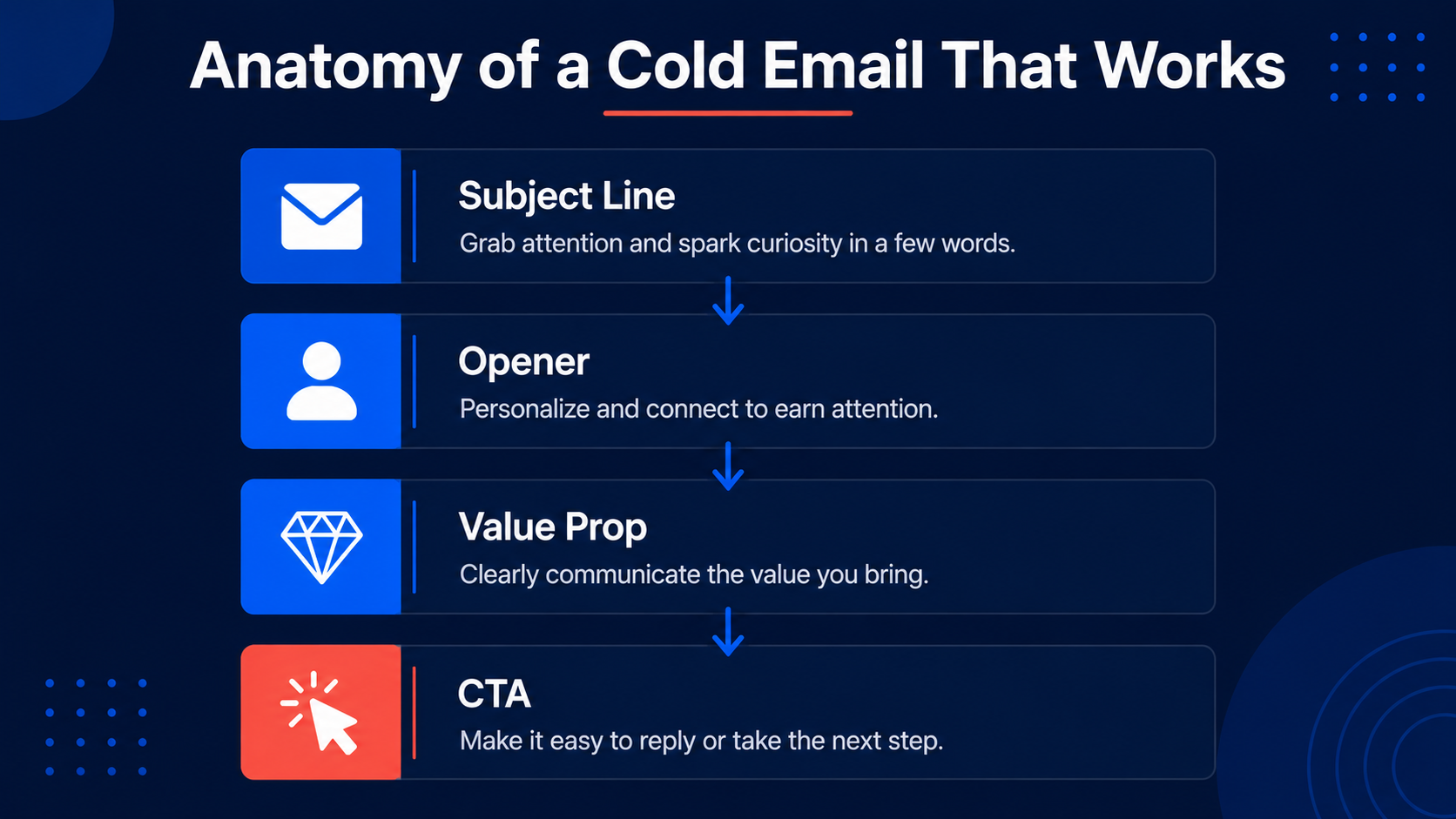
Before the templates, the framework. Every high-performing cold email shares four structural elements:
1. A subject line that creates curiosity without being misleadingThe job of the subject line is one thing: get the email opened. It should be short (4–7 words), specific enough to feel relevant, and avoid spam triggers ("FREE", "URGENT", all caps). Personalisation — company name, role, or recent trigger — increases open rates meaningfully.
2. An opener that proves you did your researchThe first sentence is not about you. It's about them. Reference something specific: a recent funding round, a market they're expanding into, a challenge common to their role. Generic openers ("I hope this finds you well", "My name is X and I work at Y") get deleted.
3. A value proposition in one or two sentencesWhat do you do and why should they care? Not features — outcomes. Not "we offer LinkedIn outreach" — "we book 8–12 qualified meetings per month for B2B companies expanding into EU markets." The more specific, the more credible.
4. A single, low-friction CTAAsk for one thing. Not a demo, not a proposal, not a commitment. Ask if they're open to a 15-minute call. Ask if this is relevant. Ask if they want to see a case study. One ask, easy to say yes to.
Cold Email Length: How Long Should It Be?
For a first-touch cold email: 75–150 words.
That's it. If you can't articulate your value proposition in 150 words, you haven't clarified your ICP. Long cold emails get skimmed, not read. Every sentence that doesn't earn its place pushes the CTA further down — and reduces the chance the prospect gets there.
Follow-up emails: even shorter. 40–80 words. One new angle, one CTA.
12 B2B Cold Email Templates for 2026
Template 1: Pain-Based First Touch (Any Vertical)
When to use: First outreach to a cold prospect where you've identified a specific pain point relevant to their role. Subject: [First name], question about [specific challenge]Hi [First name],
Most [job title]s I talk to at [company size/type] are dealing with [specific pain point] — especially when trying to [relevant goal].
We help [ICP description] [specific outcome]. One example: [Company X] went from [starting point] to [result] in [timeframe].
Would it make sense to connect for 15 minutes to see if we could do something similar for [Company]?
[Your name]
Why it works: Opens with them, not you. Pain-first framing creates immediate relevance. Social proof in one sentence. Low-friction CTA. Customise: Replace [specific pain point] with something you've actually researched — a challenge common to their role, industry signal, or company context.
Template 2: Relevance-Based First Touch (Trigger Event)
When to use: A trigger event makes outreach timely — funding round, new hire, expansion announcement, industry news. Subject: Congrats on [event] — quick questionHi [First name],
Saw that [Company] [recently raised / expanded into / launched] — congrats on that.
Companies in that position often find [relevant challenge] comes up fast. We've helped several [similar companies] navigate that, typically getting them to [specific outcome] within [timeframe].
Worth a quick call to see if there's a fit?
[Your name]
Why it works: Trigger events make outreach feel earned rather than random. The prospect knows why you're reaching out now. Conversion rates on trigger-based emails run 2–3× higher than generic templates. Customise: Use a LinkedIn alert, funding database, or job posting signal as your trigger. Don't fabricate relevance — prospects can tell.
Template 3: Fintech / Payments Vertical
When to use: Targeting payments, neo-banks, BaaS, or regtech companies in EU or UK. Subject: [Company] + B2B pipeline in [target market]Hi [First name],
Growing B2B pipeline in [market] is slower than it looks on paper — especially when decision-making sits across compliance, product, and commercial teams simultaneously.
We specialise in outbound for fintech companies expanding into EU markets — building targeted decision-maker lists, running multi-channel sequences, and booking qualified conversations with the right stakeholders.
For context: we've helped similar fintech teams book 60–200 qualified opportunities per engagement across DE, NL, UK, and Nordics markets.
Open to a 15-minute call this week?
[Your name]
Why it works: Acknowledges a genuine complexity in fintech selling (multi-stakeholder decisions). Vertical-specific proof point. Market-specific geography builds credibility.
Template 4: SaaS / IT Services Vertical
When to use: Targeting B2B SaaS or IT services companies that need to scale pipeline without adding headcount. Subject: Scaling [Company]'s outbound without another SDR hireHi [First name],
Hiring and ramping an SDR takes 4–6 months and costs €100K+ in year one before you see qualified pipeline. A lot of SaaS teams at [Company's stage] are finding outsourced outbound faster to test.
We run multi-channel outbound (LinkedIn + email) for SaaS and IT services companies targeting EU markets — qualifying leads and booking meetings directly onto your AEs' calendars.
Would a short case study from a similar company be worth your time?
[Your name]
Why it works: Leads with the economic case (SDR cost), relevant to the VP Sales persona. Positions VirtuWise against the hire-first reflex. Offers a case study as low-friction next step.
Template 5: iGaming / Gaming Vertical
When to use: Targeting iGaming operators, B2B gaming suppliers, platform providers, or payment processors in the gaming space. Subject: B2B pipeline in gaming — quick question for [First name]Hi [First name],
Breaking into gaming accounts — whether operators, aggregators, or platform partners — is a different process than standard B2B outreach. Relationships matter more, and the decision-making is faster but harder to reach.
We've run outbound for B2B gaming suppliers and payment providers targeting EU/Malta/UK markets, booking qualified meetings with heads of gaming, procurement, and commercial teams.
Worth 15 minutes to talk through what that looks like for [Company]?
[Your name]
Why it works: Shows vertical fluency — mentioning operators, aggregators, Malta, and the relationship-driven nature of gaming B2B signals genuine market knowledge, not generic outreach.
Template 6: Breaking Into a New Market
When to use: Company is entering a new geography (common for US-to-EU or UK-to-EU expansion). Subject: [Company]'s EU expansion — pipeline questionHi [First name],
Expanding into [EU market] from [origin market] is faster when your first conversations are already scheduled. The bottleneck is usually market-specific data and outreach infrastructure, not product.
We help B2B companies entering EU markets build targeted prospect lists and run multi-channel outreach from day one — typically booking first qualified meetings within 2–4 weeks of launch.
Would it be useful to see how we've approached this for similar companies in [vertical]?
[Your name]
Why it works: Identifies the exact phase the prospect is in and the specific bottleneck they face. The "2–4 weeks to first meetings" metric is a concrete proof point that answers the implicit question ("how fast?").
Template 7: Follow-Up #1 (3–4 Days After First Touch)
When to use: No reply to Template 1 or 2 after 3–4 business days. Subject: Re: [original subject]Hi [First name],
Following up in case this got buried.
One thing I didn't mention: we handle the full outbound setup — lists, infrastructure, copy, sequences — so there's no ramp time on your side.
Still worth a quick call?
[Your name]
Why it works: Short. Adds one new piece of value (no ramp). Doesn't apologise for following up. No guilt, no urgency pressure.
Template 8: Follow-Up #2 (7–8 Days After First Touch)
When to use: No reply after Follow-Up #1. Subject: [First name] — last one from meHi [First name],
I'll keep this short — last email from me on this topic.
If building qualified pipeline in [target market] becomes relevant in the next quarter, happy to connect then. I'll leave it with you.
[Your name]
Why it works: "Last email" framing paradoxically increases reply rates — it removes pressure and triggers reciprocity. The open-ended future reference keeps the door open without being pushy. Often gets replies simply because people don't want to leave things unresolved.
Template 9: LinkedIn → Email Bridge
When to use: Prospect accepted a LinkedIn connection request but didn't reply to your message. Transitioning to email. Subject: Connected on LinkedIn — [Company] pipelineHi [First name],
We connected on LinkedIn last week — wanted to reach out here as well since email tends to be easier for scheduling.
[One-sentence value proposition relevant to their role/company].
Worth a 15-minute call to see if there's a fit?
[Your name]
Why it works: References the prior touchpoint, creating continuity rather than a second cold outreach. The reason for switching channels is stated honestly, which builds trust.
Template 10: The "No BS" Direct Template
When to use: Senior buyers (VP Sales, CRO, CEO) who have seen every template and respond to directness. Subject: Pipeline for [Company] in [market][First name],
We help [ICP] book qualified meetings in [market] without hiring and ramping an SDR.
It costs €[X]/month. It takes 2–4 weeks to first meetings. 40+ B2B clients, 1,000+ meetings booked.
Interested?
[Your name]
Why it works: Senior buyers value their time. This email is 35 words. It answers who, what, how much, and how fast. No fluff. The question at the end is disarmingly direct — it either gets a yes, a no, or a "tell me more."
Template 11: Re-Engagement (Cold Lead)
When to use: A lead went cold 3+ months ago after initial interest or a call that didn't convert. Subject: [First name] — checking back inHi [First name],
We spoke [X months] ago about [context]. Things didn't move forward at the time — totally understand.
Reaching out because [new thing: updated offering, new case study, relevant market change]. Thought it might change the conversation.
Still open to connecting?
[Your name]
Why it works: Acknowledges the history rather than pretending it didn't happen. The "new thing" justifies why you're reaching out now rather than just re-sending the same pitch. Respects their time and their previous decision.
Template 12: Referral / Warm Introduction Request
When to use: You have a connection at the company but need to reach the right decision-maker. Subject: Quick introduction requestHi [First name],
I've been working with [Company's partner / investor / shared connection] — [Name] suggested you might be the right person to talk to about [topic].
[One-sentence value proposition].
Would you be open to a brief call?
[Your name]
Why it works: Social proof from a shared connection is the strongest opener in B2B outreach. The referral reduces cold-outreach friction to near zero — open rates on warm introductions run 60–80% vs 30–50% for cold.
Cold Email Subject Lines That Work in 2026
Based on patterns across B2B outbound campaigns in EU and US markets:
| Type | Example | Why It Works |
|---|---|---|
| Name + question | "[Name], question about [topic]" | Personal + open-loop |
| Congrats + relevance | "Congrats on [event] — quick question" | Trigger-based, earned |
| Company + market | "[Company] + EU expansion" | Specific, relevant |
| Direct value | "Scaling pipeline without another SDR hire" | Outcome-focused |
| Last touchpoint | "Re: [original thread]" | Thread continuity |
| Short + intriguing | "Quick thought on [pain]" | Curiosity gap |
What to Avoid in B2B Cold Email
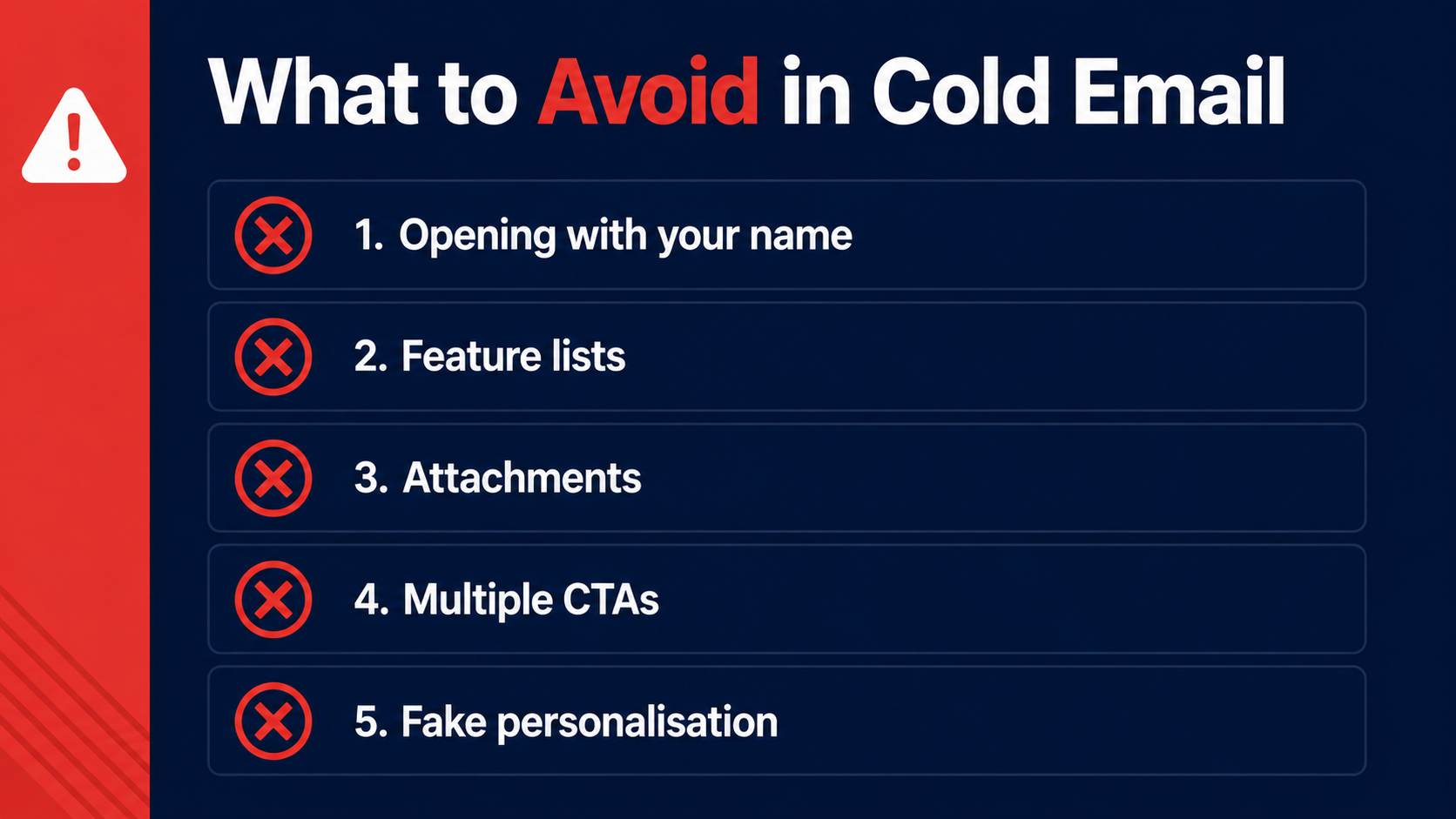 1. Opening with your company name
"Hi, I'm [Name] from [Company]" is the fastest path to delete. No one cares yet. Earn their attention before asking for it.
2. Feature lists instead of outcomes"We offer LinkedIn outreach, email sequences, and CRM integration" says nothing about why this matters. "We book 8–12 qualified meetings per month for companies entering EU markets" says everything.
3. Attachments in first touchAttachments trigger spam filters and signal distrust. Save the deck for after you've established interest.
4. Multiple CTAs"Let me know if you'd like a call, or I can send over a case study, or if you prefer I can share a one-pager" = decision paralysis. One ask.
5. Over-personalisation that feels fakeReferencing someone's LinkedIn post from 18 months ago as "personalisation" reads as scripted. Use signals that are current and genuinely relevant.
Cold Email and Multi-Channel: The Real Sequence
Cold email in isolation converts at 1–3% (meetings booked / contacts reached). Cold email as part of a multi-channel sequence — LinkedIn connection, email, LinkedIn message, follow-up email — converts at 3–8%.
A standard 3-week B2B outreach sequence:
- Day 1: LinkedIn connection request (personalised note)
- Day 3: Email — Template 1 or 2 (first touch)
- Day 5: LinkedIn message (if accepted) referencing the email
- Day 7: Email Follow-Up #1 — Template 7
- Day 10: LinkedIn InMail (if not connected)
- Day 14: Email Follow-Up #2 — Template 8 ("last one from me")
The email channel does the heavy lifting on information. The LinkedIn channel builds the relationship layer. Combined, each touchpoint reinforces the others rather than competing.
Frequently Asked Questions
How do I write a cold email that gets a response?Start with a specific opener about the prospect (not yourself), deliver value in two sentences, and ask for one small thing — a 15-minute call or permission to send a case study. Keep it under 150 words. The most common mistake is writing about your company rather than their problem.
How long should a B2B cold email be?75–150 words for first touch. 40–80 words for follow-ups. Shorter is almost always better — prospects scan, not read. Every sentence must earn its place.
What is cold email outreach?Cold email outreach is proactive email contact with prospects who haven't opted in or expressed prior interest. In B2B, it's a primary pipeline generation channel when done with proper targeting, personalisation, and a multi-touch sequence.
Does cold emailing work in 2026?Yes — but differently than in 2019. Inboxes are more competitive, spam filters are more sophisticated, and buyers are more sceptical of generic templates. What works: hyper-specific ICP targeting, first-sentence personalisation, short copy, and multi-channel follow-up. What doesn't work: mass blast, long pitch emails, fake personalisation.
What cold email response rate should I expect?For well-targeted B2B cold email with proper personalisation: 5–15% reply rate, 1–4% meeting booking rate. Rates vary significantly by industry, ICP quality, and copy quality. Full benchmark data →
Should I use cold email or LinkedIn for B2B outreach?Both — in sequence. LinkedIn builds the relationship layer; email carries the detail. LinkedIn acceptance rates of 20–40% create a warm layer that significantly improves email open and reply rates when used together. LinkedIn outreach templates →
The Bottom Line
The templates above are starting points, not final copies. Every strong cold email sequence starts with a specific ICP, a genuine understanding of that buyer's problems, and a value proposition that maps to outcomes they care about.
Copy-pasting templates without that foundation produces mediocre results — because the prospect can feel the difference between an email written for them and one written for a list.
If the targeting and personalisation layer is in place, the templates work. If it isn't, no template will fix it.
Running outbound at scale requires more than good templates — it requires infrastructure, sequencing, data, and constant iteration. VirtuWise runs multi-channel outbound campaigns for B2B companies in fintech, gaming, iGaming, AI, and IT services across EU, UK, and US markets. View our services, see our pricing, or book a 30-minute strategy call.
Related reading: - Cold Email Response Rates: 2026 Benchmarks and How to Beat Them - LinkedIn Connection Request Message Templates That Get Accepted (2026) - Best Outsourced SDR Companies in 2026: A Buyer's Comparison - B2B Lead Generation Channels That Actually Work in 2026