
iGaming CRM Software: What Casino Operators Look For (and How Vendors Win Their Business)
iGaming CRM software drives player retention, bonus management, and lifecycle campaigns. Here's what operators evaluate — and how CRM vendors win in a relationship-driven market.
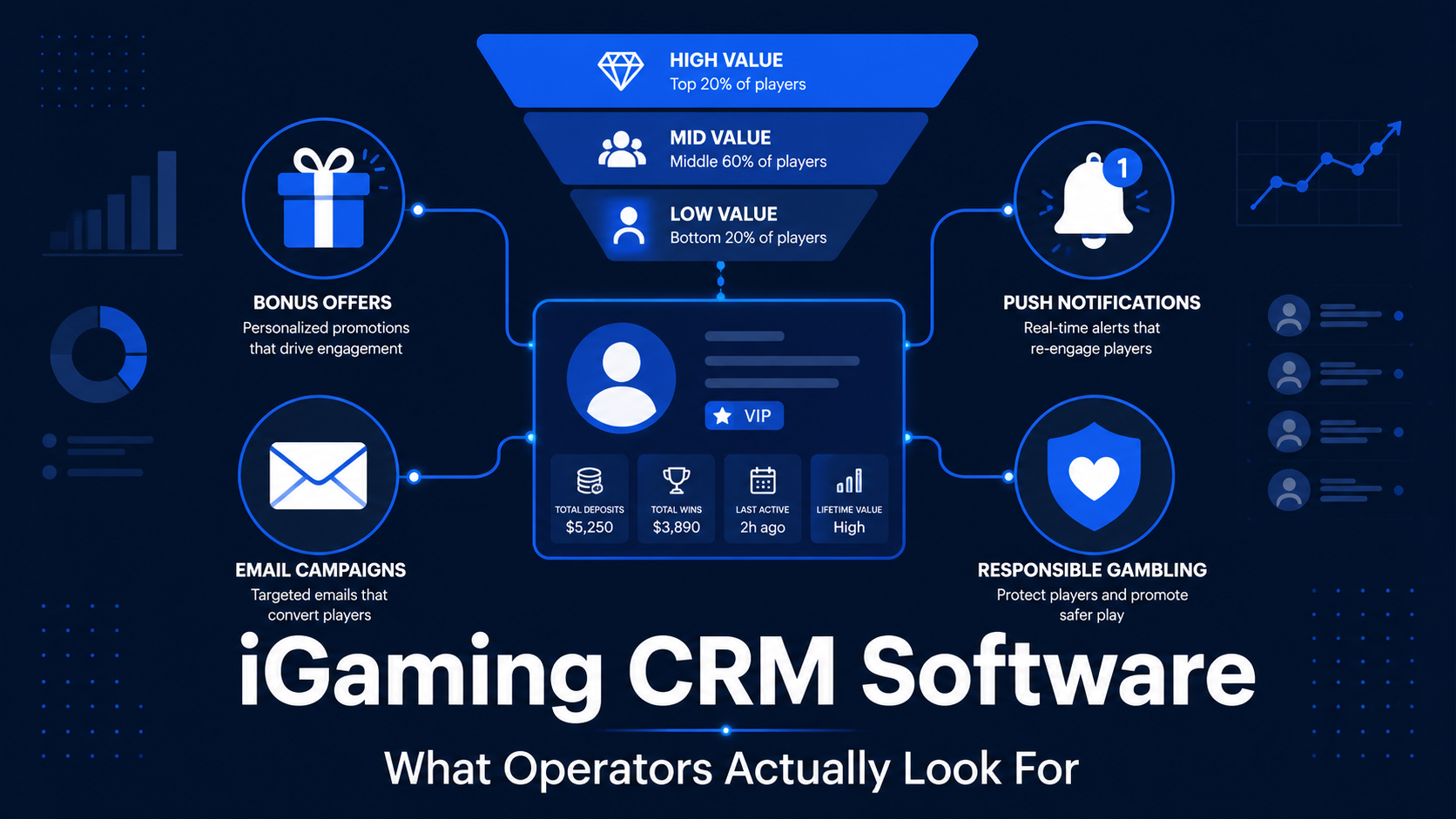
iGaming CRM software sits at the intersection of player retention, personalisation, and regulatory compliance — and for online casino operators, it is one of the most consequential technology decisions they make. The wrong CRM costs operators both money and players. The right one drives measurable improvements in lifetime value, bonus ROI, and chargeback-sensitive reactivation campaigns.
For CRM vendors in the iGaming space, the challenge is differentiation. Every platform claims to offer segmentation, automated campaigns, and responsible gambling controls. The question operators are actually asking is: does this vendor understand how iGaming players behave, and can they prove it works at scale?
This guide covers what casino operators actually evaluate when selecting a CRM platform — and the sales and outreach strategies that help iGaming CRM vendors win in a market built on relationships and proven outcomes.
Why iGaming CRM Is a Different Category
General-purpose CRM platforms — Salesforce, HubSpot, Klaviyo — were built for e-commerce and SaaS buyer journeys. iGaming player behaviour is structurally different in ways that matter for CRM design:
Player value is nonlinear
In e-commerce, customer lifetime value builds through repeat purchases at roughly predictable intervals. In iGaming, a player's value can peak and collapse within a single session, or expand dramatically following a promotional trigger. CRM logic that assumes linear value accumulation mismanages iGaming players.
Bonus management is a core CRM function
Free spins, deposit match bonuses, cashback, and loyalty tier management are not marketing nice-to-haves in iGaming — they are the primary lever for activation, retention, and reactivation. A CRM that handles bonuses poorly creates accounting exposure and player trust issues simultaneously.
Responsible gambling controls are embedded in operations
UKGC-licensed operators must offer deposit limits, self-exclusion, reality checks, and cooling-off periods as CRM-level features. These requirements are not add-ons to a standard CRM — they require purpose-built logic and audit trails that generic platforms cannot provide.
Real-time personalisation at gambling transaction speed
A player who just completed a winning session represents a reactivation opportunity within minutes, not hours. iGaming CRM systems need to trigger personalised outreach in near-real-time, at the moment of highest engagement probability.
What Casino Operators Evaluate When Selecting CRM Software
Player Segmentation Capabilities
The foundational CRM function in iGaming is segmenting players by value, behaviour, risk, and lifecycle stage. Operators evaluate whether the platform supports dynamic segmentation — segments that update in real time as player behaviour changes — and whether segment logic can incorporate game-specific data (slot preference, live casino activity, sports betting patterns).
Static segments built weekly from database exports are a decade behind the current standard.
Bonus Engine Depth
The iGaming CRM bonus engine needs to handle concurrent offers, wagering requirements, time restrictions, game-specific bonus validity, and bonus abuse controls — and it needs to integrate with the platform's game engine for real-time wagering tracking.
Operators ask vendors to walk through their bonus logic during demos, and providers who cannot answer specific questions about concurrent offer stacking or wagering calculation methodology lose credibility fast.
Responsible Gambling Integration
For UKGC, MGA, and other regulated market operators, responsible gambling controls must be embedded at the CRM level — not just at the platform level. This means CRM-triggered intervention messages, automated limits on bonus offers for players showing risk signals, and audit-ready reporting for regulatory submissions.
Operators in regulated markets view this as a licence protection requirement, not a feature decision.
Multi-Channel Campaign Execution
Player engagement in iGaming runs across email, SMS, push notification, in-app messaging, and live chat. Operators evaluate whether the CRM can coordinate campaigns across all channels from a single workflow, or whether multi-channel execution requires stitching together separate tools.
Analytics and Attribution
CRM investment is justified by measurable outcomes — reduced churn, improved bonus ROI, higher reactivation rates. Operators evaluate whether the vendor's analytics allow attribution of CRM interventions to player behaviour changes, and whether the reporting is granular enough to optimise by campaign, segment, and channel.
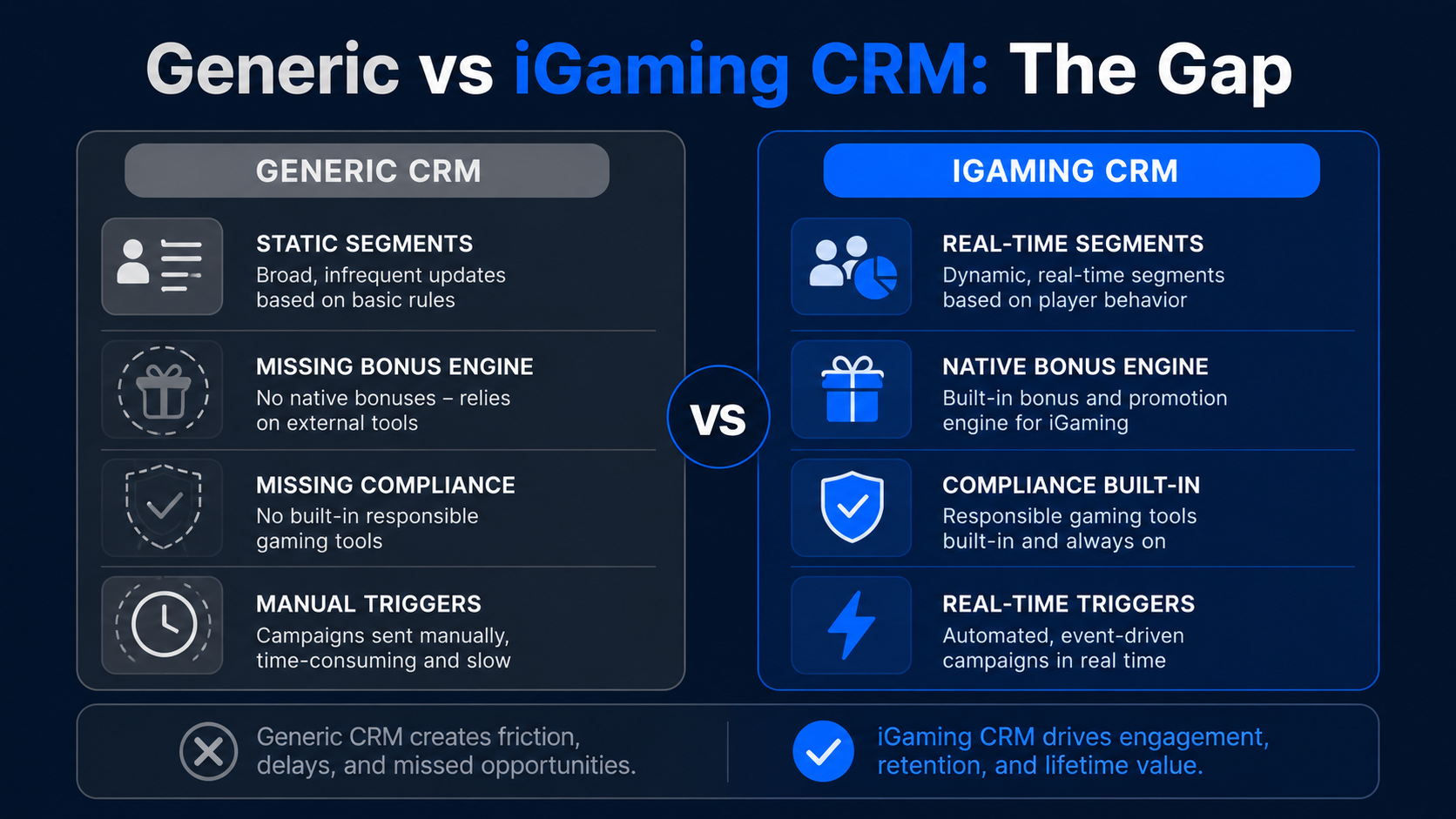
iGaming CRM vs Generic CRM: What the Gap Actually Looks Like
| Capability | iGaming CRM | Generic CRM |
|---|---|---|
| Player segmentation | Real-time, behaviour-driven, game-specific | Static or batch-updated |
| Bonus management | Native bonus engine with wagering logic | Not available or basic |
| Responsible gambling | Built-in controls and audit trails | Add-on or not available |
| Campaign triggers | Real-time event-based (session end, deposit, loss) | Time-based or manual |
| Integration | Native platform/game engine integration | Custom API work required |
| Regulatory reporting | UKGC/MGA-ready reporting | Manual extraction required |
| Compliance overhead | Designed for gambling compliance | Significant customisation needed |
How iGaming CRM Vendors Win Casino Operator Clients
The iGaming B2B sales cycle for CRM platforms is long — typically 3–9 months from first conversation to signed contract. Operators evaluating a CRM change are making a decision that will affect every player-facing team in the organisation, so the sales process involves product, marketing, compliance, and finance stakeholders.
Starting with the right contact matters
The CRM buying decision is typically owned by the Head of CRM, VP of Marketing, or Chief Marketing Officer — not IT. CRM vendors that route their outreach through technical contacts waste months on conversations that can't close.
Proof of outcomes closes deals
Operators evaluating CRM platforms want to see evidence of outcomes with comparable operators — not feature demos. A case study showing "retained X% of churned players in 90 days through automated reactivation" for an operator with a similar profile is more persuasive than a product tour.
Conference presence builds pipeline, but doesn't close it
SiGMA, ICE, and EiG are where iGaming CRM relationships start. But the deal closes in structured follow-up conversations, not on the show floor. Vendors with a disciplined post-conference follow-up process convert conference contacts into qualified pipeline at a meaningfully higher rate.
The demo is a make-or-break moment
Operators come to demos with specific, technical scenarios. A vendor that cannot walk through a specific bonus engine use case, responsible gambling trigger logic, or real-time segmentation update in the demo environment loses the deal at that stage regardless of everything else.
References from named, comparable operators are essential
"We work with major operators" is not a reference. "Speak with the Head of CRM at [named operator in your market]" is. CRM vendors without referenceable clients have a structural barrier to closing deals with risk-averse operators.
What iGaming CRM Vendors Get Wrong in Their Sales Process
Targeting operators who aren't ready to switch
Operators on a long-term CRM contract with significant historical data are not viable near-term opportunities regardless of product quality. CRM vendors who identify operators approaching contract renewal or launching in new markets focus their sales effort where there is actual buying intent.
Leading with product, not outcomes
Operators don't buy CRM features — they buy reduced churn, improved bonus ROI, and regulatory compliance confidence. CRM vendors whose pitch leads with product capabilities before establishing the operator's specific retention and compliance challenges are leading from the wrong place.
Underestimating integration complexity
CRM migration in iGaming involves player data, historical transaction data, existing segmentation logic, and bonus history. Vendors who underestimate integration complexity lose deals after contracts are signed — which damages their reference base. Experienced operators ask about migration support before they ask about product features.
How VirtuWise Supports iGaming CRM Vendors
VirtuWise works with iGaming B2B technology providers — including CRM platforms — to build the outbound pipeline and direct operator relationships that drive enterprise growth.
For CRM vendors, our typical engagement covers:
- Decision-maker mapping: identifying Head of CRM, VP Marketing, and CMO contacts at target operators, with relationship signals and trigger events
- Pre-conference outreach: scheduling meetings at SiGMA, ICE, and EiG with qualified operator contacts before the event
- Multi-channel outreach campaigns: LinkedIn + email sequences targeting specific operator profiles with personalised messaging anchored in outcome evidence
- Pipeline tracking: managing the long iGaming B2B sales cycle from first contact to demo-qualified opportunity
- Lead Generation: €3,000/month — ICP research, personalised outreach, meeting booking and scheduling, weekly reporting
- Lead Generation Plus: €5,000/month — everything in Lead Generation, plus multi-channel outreach (LinkedIn + email + messengers), A/B testing, higher volume
- Business Development: €7,000/month — full-cycle business development, dedicated senior sales manager, online and offline representation, custom strategy
- Inbound (SEO & AEO): €3,500/month — SEO and AEO run as one service: keyword strategy, content, technical fixes, and AI-crawler visibility (structured data, llms.txt)
- Fractional Growth Partner: Custom — a revenue engine audit, then optional ongoing Advisory or hands-on Implementation
Full details at virtuwise.io/pricing.
Frequently Asked Questions
What is iGaming CRM software?iGaming CRM software is a player relationship management platform built specifically for online casino and betting operators. It handles player segmentation, bonus management, multi-channel campaign execution, responsible gambling controls, and retention analytics — functions that generic CRM platforms cannot support without significant customisation.
How is iGaming CRM different from standard CRM tools?Standard CRM tools are designed for B2B sales pipelines or e-commerce buyer journeys. iGaming CRM is built around gambling-specific requirements: real-time player behaviour triggers, bonus engine logic with wagering calculations, responsible gambling intervention controls, and regulatory audit trails for UKGC, MGA, and other licensing authorities.
What does it cost to implement an iGaming CRM?iGaming CRM platforms typically charge a monthly licence fee based on active player volumes, plus an implementation and integration fee. Total cost of ownership depends heavily on integration complexity with the operator's existing platform, game engine, and payment stack. Migration projects from existing CRM systems add significant one-time cost.
How long does an iGaming CRM implementation take?Implementation timelines vary from 8 weeks for straightforward integrations on standard platforms to 6+ months for operators with complex multi-brand setups, significant historical data migration requirements, or custom segmentation logic needs.
How do iGaming CRM vendors typically find new operator clients?The primary acquisition channels are industry conferences (SiGMA, ICE, EiG), direct outreach to CRM and marketing decision-makers at target operators, and referrals through platform and game provider partnerships. Structured pre-conference outreach — identifying attending operators and scheduling meetings before the event — significantly outperforms floor networking alone.