
Sportsbook Software Provider: What Operators Evaluate and How Vendors Win Their Business
Sportsbook software vendors compete on trading margin control and live-event reliability, not feature lists. Here's what operators actually evaluate and how vendors build a consistent pipeline.
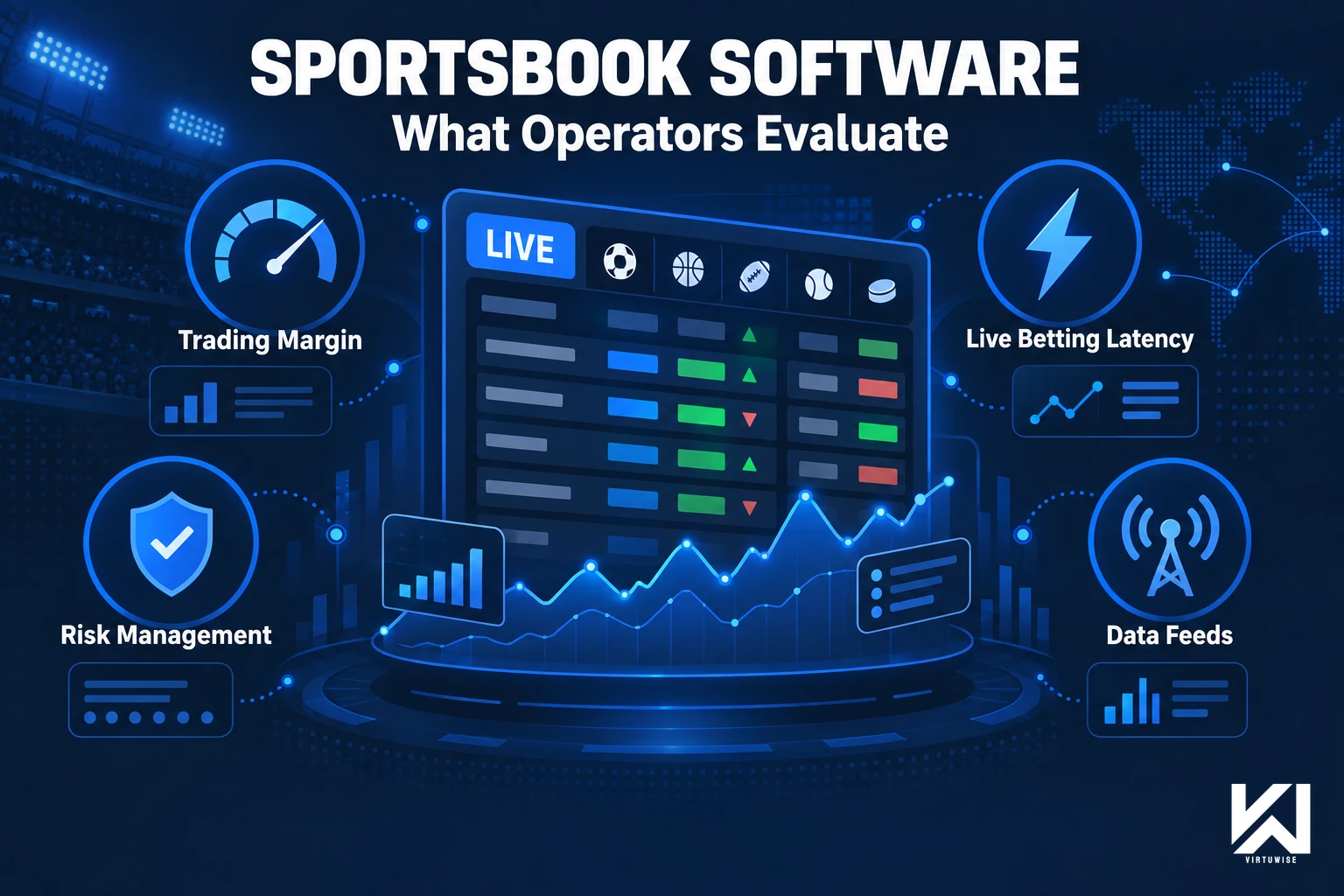
Sportsbook software is a narrower, more technically demanding category than iGaming platform software in general. A casino platform needs to run slots and table games reliably. A sportsbook platform needs to price thousands of live, moving markets correctly, absorb sudden betting volume the moment a goal goes in, and hold a trading margin that determines whether the operator's business is actually profitable — all at once, in real time, with real money on the line. Operators evaluate sportsbook software vendors accordingly: on trading discipline and uptime under load, not on how many sports the platform lists.
This guide covers what sportsbook software actually does, what licensed operators evaluate when choosing a provider, how vendors win operator business in a relationship-driven, long-cycle market, and how VirtuWise supports sportsbook software vendors building a B2B pipeline.
What Sportsbook Software Actually Does
Sportsbook software is the technology stack that prices sports betting markets, accepts and settles bets, and manages the operator's risk exposure — distinct from broader iGaming platform software (casino, slots, payments, CRM), even though the two are frequently bundled together commercially.
Odds compilation and trading margin
The core function: generating and continuously adjusting prices across pre-match and live markets, factoring in real-world data, market movement, and the operator's own risk appetite. Margin control here directly determines the operator's profitability — a sportsbook that consistently misprices markets bleeds money regardless of how much volume it takes.
Live and in-play betting
Real-time odds updates during a live event, with latency measured in milliseconds mattering — a stale price during a live match is a direct financial exposure, since sharp bettors will exploit the gap before it's corrected.
Risk management and trading tools
Dashboards and automated rules that let an operator's trading team monitor exposure by market, limit stakes on specific outcomes, and flag unusual betting patterns that might indicate insider information or coordinated attacks on a mispriced line.
Data feed integration
Sportsbook platforms depend on continuous, low-latency data feeds for scores, statistics, and odds benchmarking from third-party data providers — integration quality and feed redundancy (what happens if a primary feed drops mid-match) is a real technical evaluation point, not a checkbox.
Player account management and settlement
Bet acceptance, stake limits, automated settlement the moment an event concludes, and the audit trail regulators expect — all of it needs to hold up under the highest-volume moments (a World Cup final, not a quiet Tuesday), which is precisely when failure is most visible and most costly.
What Operators Evaluate in a Sportsbook Software Provider
Trading margin control
Operators want to know whether the platform's pricing engine and trading tools actually protect margin — real performance data from comparable operators matters more here than a demo on a quiet market.
Uptime and latency during live events
A platform that performs well on a Tuesday afternoon and buckles during a Champions League final isn't credible. Operators evaluate load-testing evidence and real incident history, not marketing claims about "enterprise-grade infrastructure."
Data feed quality and redundancy
Which data providers the platform integrates with, how it behaves when a feed degrades or drops, and whether there's a fallback — a sportsbook that goes dark mid-match because of a single feed dependency is a real, recurring failure mode operators have seen before.
Risk management tooling depth
Whether the trading team gets granular, real-time control — per-market limits, automated suspicious-pattern flags, exposure dashboards — or whether risk management is a bolt-on afterthought to a platform built primarily for casino products.
Scalability under volume spikes
Betting volume during major events can spike by an order of magnitude in minutes. Platforms need demonstrated, not theoretical, capacity to absorb that without degrading performance for every other market running simultaneously.
Regulatory and licensing coverage
Sports betting carries jurisdiction-specific regulatory requirements — responsible gambling controls, data residency, licensing certifications — on top of general iGaming compliance, and coverage gaps here can block an operator's market entry entirely.
Sportsbook Software Evaluation: What Matters Most
| Evaluation Criterion | What Operators Need | Common Shortfall |
|---|---|---|
| Trading margin control | Real performance data from comparable operators | Marketing claims with no comparable evidence |
| Live-event uptime | Proven capacity under real load spikes | Untested beyond synthetic benchmarks |
| Data feed redundancy | Fallback when a primary feed degrades | Single-provider dependency |
| Risk management depth | Granular, real-time trading controls | Generic tooling adapted from casino products |
| Scalability | Demonstrated performance at 10x normal volume | Pilot-scale performance only |
| Regulatory coverage | Sport-specific licensing across every target jurisdiction | Primary-market coverage only |
Sportsbook Software: Where the Broader Term Fits
Buyers searching simply for "sportsbook software" are often earlier in their evaluation — comparing platform categories or exploring whether to build, buy, or white-label before narrowing to specific vendors. For a sportsbook software provider, this broader search intent still matters commercially: it's the entry point for operators who haven't yet mapped out the trading-margin, latency, and risk-management criteria above, and content that helps them understand the category earns trust before the vendor-comparison stage begins. Positioning that leads with trading discipline and live-event reliability — not just a feature list — resonates whether the searcher is comparing categories or comparing named vendors.
How Sportsbook Software Vendors Win Operator Deals
Sportsbook software sales combine the same relationship-driven dynamics as the broader iGaming market with an additional layer of technical scrutiny specific to real-time trading risk.
The decision-making unit
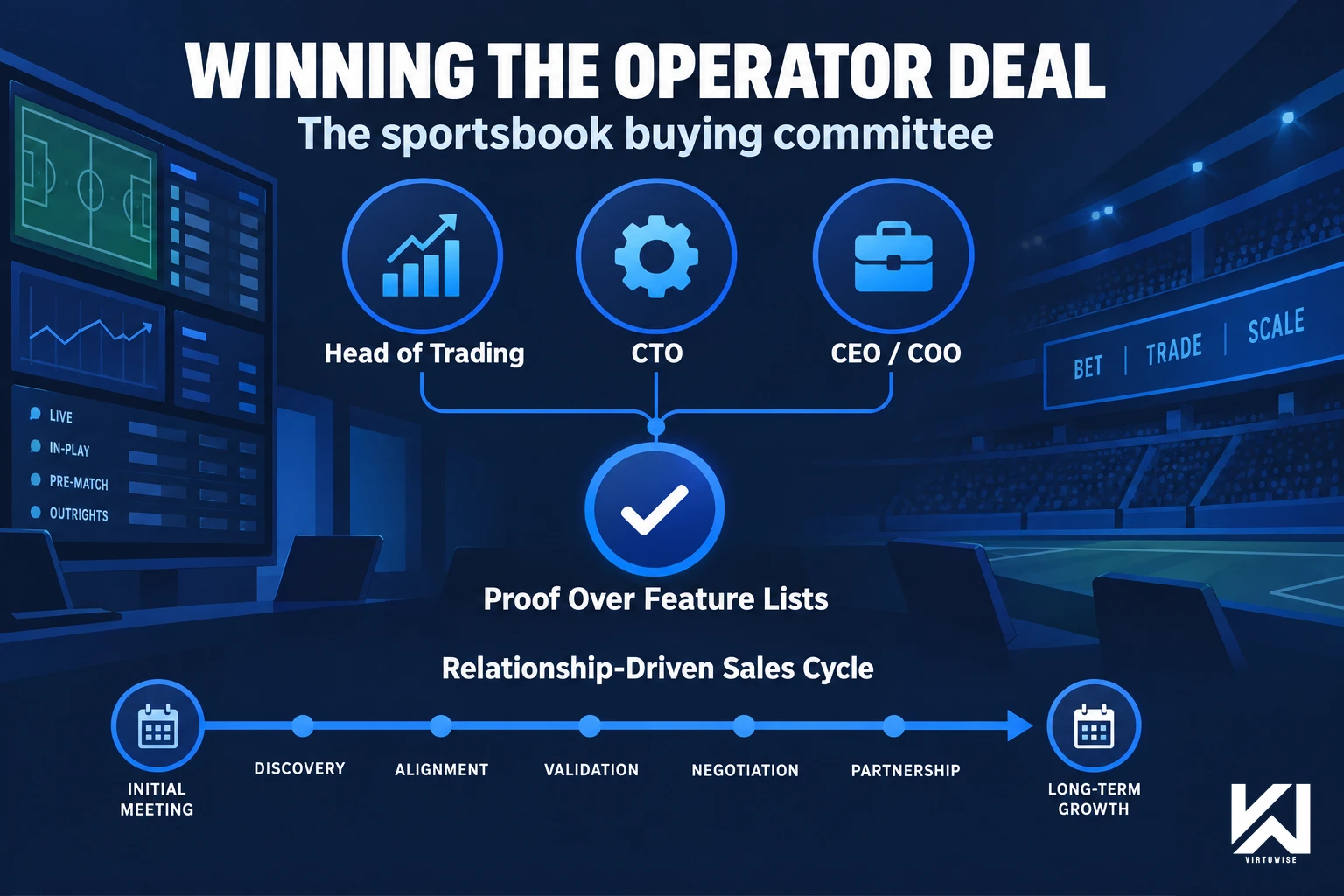
Sportsbook software procurement typically involves the Head of Trading or Risk (margin and pricing-engine evaluation), the CTO or Head of Technology (integration and infrastructure), and the CEO or COO (commercial sign-off and vendor relationship). Outreach that only reaches commercial contacts often stalls once trading-specific technical questions surface.
A long, relationship-driven sales cycle
As with iGaming software broadly, sportsbook vendor relationships form over months, often around industry events, peer referrals, and demonstrated track record rather than inbound interest alone — but the technical bar for a sportsbook specifically is higher, since a mispriced live market has an immediate, measurable financial cost in a way a casino game glitch usually doesn't.
Proof over feature lists
Vendors who progress in operator evaluations are the ones who can show real trading performance, real uptime history during major sporting events, and named operator references at comparable scale — not a feature comparison sheet.
Trigger-event timing
The strongest windows to approach an operator are specific pain events: visible platform instability during a major event, a data feed failure that caused an operator to eat exposure it shouldn't have, an operator expanding into a new regulated market that needs sport-specific licensing coverage, or dissatisfaction with an incumbent's margin performance.
Put together, this is the shape of an approach built for a technical, relationship-driven buying process rather than a single conference pitch:
How VirtuWise Supports Sportsbook Software Vendors
VirtuWise builds B2B pipeline for iGaming and sportsbook technology vendors competing for relationships with licensed operators across regulated markets.
For sportsbook software vendors, our work typically includes:
- Decision-maker mapping: identifying Heads of Trading/Risk, CTOs, and commercial leads at target operators, with current platform stack and expansion signals
- Multi-channel outreach: LinkedIn and email sequences targeting trading and technical stakeholders with messaging anchored in margin performance and uptime proof points
- Trigger-event monitoring: identifying operators showing signs of incumbent platform frustration, new-market licensing activity, or visible reliability issues
- Conference-complementary outreach: structured pipeline building around the industry event calendar rather than relying on the show floor alone
Outbound starts at €3,000/month, scoped across a few tiers depending on channel mix and depth — from focused single-channel outreach up to full-cycle business development with a dedicated senior sales manager. Full details at virtuwise.io/services/business-development and virtuwise.io/pricing.
Frequently Asked Questions
What is sportsbook software?Sportsbook software is the technology stack that prices sports betting markets, manages live/in-play odds, accepts and settles bets, and controls an operator's trading risk exposure. It's a distinct, more technically demanding category than general iGaming platform software (casino, slots, payments), even when the two are sold together.
What's the difference between sportsbook software and a general iGaming platform?An iGaming platform broadly covers casino games, slots, payments, and CRM. Sportsbook software specifically handles odds compilation, live-event pricing, and trading risk management — a narrower category with real-time financial exposure that general platform software doesn't carry.
What do operators look for in a sportsbook software provider?Trading margin control backed by real performance data, proven uptime and latency during live high-volume events, redundant data feed integration, granular risk management tooling, demonstrated scalability under volume spikes, and regulatory/licensing coverage across every target jurisdiction.
How long does a sportsbook software sales cycle take?Similar to the broader iGaming market, sportsbook vendor relationships typically develop over several months to over a year, shaped by trust, track record, and technical proof rather than a fast inbound-driven cycle. Vendors need outreach and nurture sequences built for that timeline.
How do sportsbook software vendors find new operator clients?Primary channels are industry conferences and trade shows, peer referrals through operator networks, and direct outreach to trading and technical decision-makers — the last of which is comparatively underused in this market, making it disproportionately effective for vendors who invest in it consistently rather than only around show season.