
iGaming Affiliate Software: What Operators Evaluate and How Vendors Win
iGaming affiliate software is a core revenue channel for online casinos — but operators evaluate it on depth, not features. Here's what matters and how vendors build operator relationships.
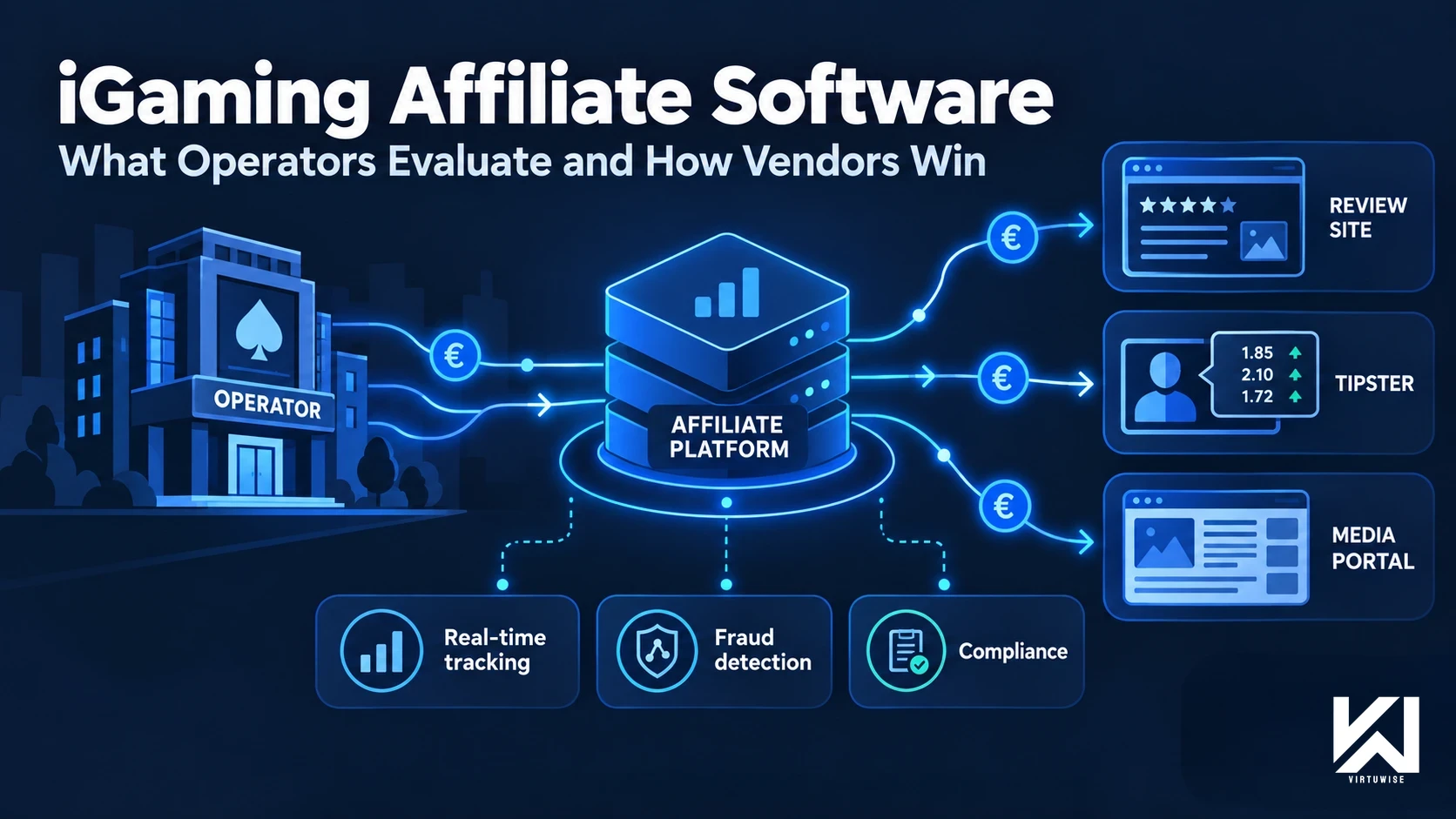
Affiliate marketing drives a significant share of player acquisition for most licensed online casino operators. In mature iGaming markets — UK, Germany, Nordics, Canada — affiliate-referred players often account for 30–50% of new depositing customers. The software managing those affiliate relationships is therefore not a peripheral tool: it is a revenue-critical infrastructure layer that sits between the operator and one of their most important acquisition channels.
For iGaming affiliate software vendors, this creates both an opportunity and a challenge. The opportunity is that operators genuinely need sophisticated affiliate management capability and will pay for it. The challenge is that the market is crowded, operators evaluate vendors carefully and slowly, and the sales process is relationship-dependent in the same way as all iGaming B2B.
This guide covers what casino operators actually look for when evaluating affiliate software, how the sales process works in practice, and what affiliate software vendors need to do to build a consistent operator pipeline.
What iGaming Affiliate Software Does
iGaming affiliate software manages the commercial relationship between an online casino operator and their affiliate partners — the media sites, review portals, tipster networks, and individual webmasters who drive player traffic in exchange for commission.
Core capabilities that any credible iGaming affiliate platform must provide:
Commission management and tracking
Affiliates are paid on performance — typically revenue share (a percentage of the net gaming revenue their referred players generate), CPA (a fixed payment per first-time depositor), or a hybrid of both. The affiliate software tracks every referred player from click through to deposit, calculates commissions correctly, and manages the reconciliation between affiliate earnings and operator accounting.
Multi-brand and multi-jurisdiction support
Enterprise iGaming operators run multiple casino brands across multiple regulated jurisdictions. The affiliate software must support brand-level commission structures, jurisdiction-specific compliance rules (e.g., UK Gambling Commission restrictions on certain affiliate marketing types), and consolidated reporting across the estate.
Fraud detection and traffic quality monitoring
Affiliate fraud — self-referral, fake registrations, bonus abuse by referred players — is a material cost for operators if undetected. iGaming affiliate platforms need automated fraud detection models calibrated for gambling behaviour patterns, real-time traffic quality monitoring, and the ability to quarantine suspicious affiliate activity before commission payments are processed.
Self-service affiliate portal
Affiliates manage dozens of operator relationships simultaneously. An affiliate portal that provides real-time statistics, creative asset downloads, link generation, and payment tracking reduces the operational overhead on the operator's affiliate management team — and makes the operator's programme more attractive to high-quality affiliates who prioritise ease of reporting.
API integration with the iGaming platform
Commission calculations depend on accurate player data from the gaming platform — deposits, withdrawals, net gaming revenue by player, bonus costs. The affiliate software's integration quality with the operator's platform (or with common platform providers like SoftSwiss, EveryMatrix, or BetConstruct) is a critical evaluation criterion.
What Casino Operators Evaluate in Affiliate Software
Tracking accuracy and real-time attribution
Affiliate payments depend entirely on the accuracy of the tracking layer. Operators evaluate whether the platform correctly attributes players across devices, handles cookie expiry correctly, and resolves attribution conflicts between affiliates who've had the same player at different stages. A tracking error that under-credits a high-performing affiliate or over-credits a low-performing one creates commercial disputes that damage affiliate relationships.
Commission model flexibility
Different affiliates work on different models — some prefer revenue share for recurring income, others prefer CPA for immediate cash flow. Sophisticated operators run complex commission structures: tiered revenue share based on player volume, hybrid models, deal-specific terms for top-performing affiliates, and negative carryover policies. The software's flexibility in handling these structures is evaluated in every serious procurement process.
Regulatory compliance tooling
UK Gambling Commission affiliates must adhere to specific advertising standards. MGA-licensed operators have their own compliance requirements for affiliate marketing. Some jurisdictions restrict certain affiliate models entirely. The affiliate software's ability to enforce compliance at the platform level — blocking non-compliant creatives, restricting affiliate access by jurisdiction, maintaining audit-ready records — is a requirement, not a feature.
Reporting depth and data export
Operators need affiliate-level reporting, player-level reporting (cohort quality by affiliate), marketing channel reporting, and finance-level reconciliation data. The ability to export granular data to the operator's BI tools is increasingly expected. Affiliate software that locks data inside its own reporting interface creates analytical friction that larger operators won't accept.
Affiliate onboarding and management UX
For operators running large affiliate programmes (50+ active affiliates), the efficiency of the management interface matters. How quickly can a new affiliate be onboarded? How easy is it to update commission terms across a group of affiliates? How clear is the dispute resolution workflow? These operational details often surface late in the evaluation process but can be decision-making factors.
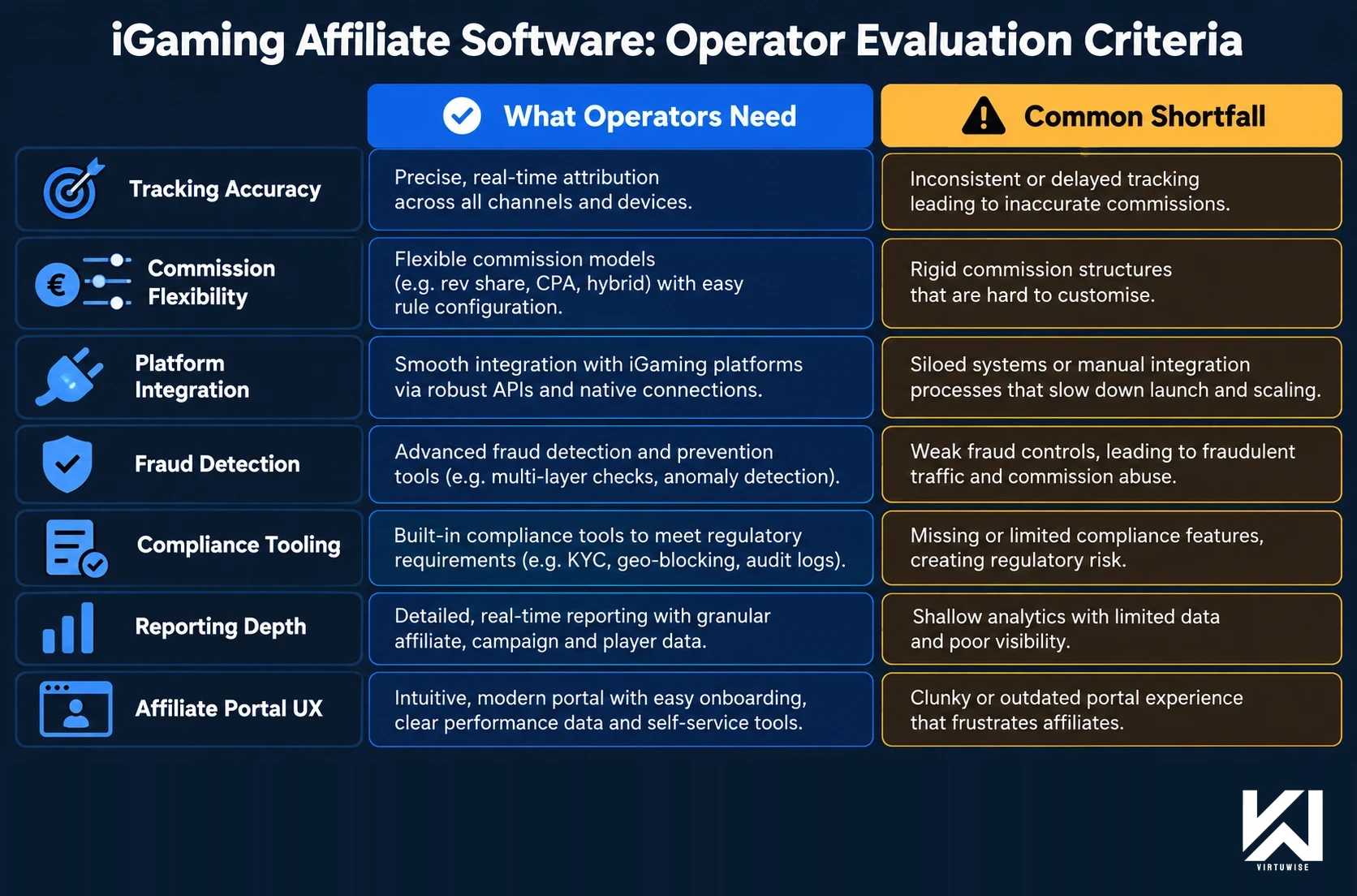
iGaming Affiliate Software Evaluation: What Matters Most
| Evaluation Criterion | What Operators Need | Common Shortfall |
|---|---|---|
| Tracking accuracy | Cross-device, real-time, conflict-resolution | Attribution gaps in multi-device journeys |
| Commission flexibility | Tiered, hybrid, deal-specific models | Rigid flat-rate or rev-share-only structures |
| Platform integration | Native integration with operator's platform | Generic API requiring custom development |
| Fraud detection | iGaming-specific models, real-time flagging | Generic fraud rules calibrated for e-commerce |
| Compliance tooling | Jurisdiction-specific controls, audit trails | Manual compliance processes |
| Reporting depth | Player-level cohort data, BI-ready exports | Summary-level reporting only |
| Affiliate portal UX | Self-service stats, assets, payment history | Operator-mediated data requests |
How iGaming Affiliate Software Vendors Win Operator Clients
The iGaming B2B market is relationship-driven. Affiliate software decisions — particularly for operators switching from an incumbent provider — are made slowly, involve multiple stakeholders, and depend heavily on references and proof of integration quality with the operator's existing tech stack.
The decision-making unit
Affiliate software procurement typically involves: the Head of Affiliates or Affiliate Manager (primary user and technical evaluator), CMO or Marketing Director (commercial sign-off), Head of Technology or CTO (integration evaluation), Finance (commission reconciliation and reporting alignment), and Legal/Compliance (regulatory requirements).
Outreach that reaches only the Head of Affiliates may generate a champion who can't close the deal internally. Effective outreach maps and engages multiple stakeholders — particularly the commercial and technical layers.
Proof over claims
Every affiliate software vendor claims accurate tracking, flexible commission structures, and real-time reporting. Operators have heard all of it. The vendors who progress in evaluations are those who can demonstrate:
- Named operator references who will take a call about their tracking accuracy experience
- A demo environment that actually handles the specific commission structure the operator uses
- Integration documentation and a named technical contact at the operator's platform provider
Pre-conference outreach is essential
ICE London, SiGMA Malta, and EiG are where iGaming affiliate software relationships begin. Operators and affiliate software vendors are at these events — but the operators worth meeting have their schedules filled before the show floor opens. Vendors who run structured pre-conference outreach (identifying attending operators, reaching out 4–6 weeks in advance) secure meetings at 2–3× the rate of floor networking.
Trigger-event timing
The best time to approach an operator about affiliate software is when they are experiencing a specific pain: growing affiliate programme that their current platform is struggling to scale, market expansion into a new jurisdiction with specific compliance requirements, or a platform migration that opens a window for changing the affiliate stack alongside the core platform.
Put together, this is what separates vendors who consistently reach operator shortlists from ones who don't:
How VirtuWise Supports iGaming Affiliate Software Vendors
VirtuWise builds B2B pipeline for iGaming technology providers, including affiliate software companies competing for operator relationships in a relationship-driven, conference-dependent market.
For affiliate software vendors, our work typically includes:
- Decision-maker mapping: identifying Head of Affiliates, CMO, and technical contacts at target operators, with relationship signals and current platform data
- Pre-conference outreach: scheduling qualified meetings with attending operators before ICE, SiGMA, and EiG
- Multi-channel outreach: LinkedIn and email sequences targeting affiliate and commercial stakeholders with messaging anchored in tracking accuracy and integration proof points
- Trigger-event monitoring: identifying operators approaching platform migrations, market expansions, or affiliate programme scaling events that create a buying window
- Lead Generation: €3,000/month — ICP research, personalised outreach, meeting booking and scheduling, weekly reporting
- Lead Generation Plus: €5,000/month — everything in Lead Generation, plus multi-channel outreach (LinkedIn + email + messengers), A/B testing, higher volume
- Business Development: €7,000/month — full-cycle business development, dedicated senior sales manager, online and offline representation, custom strategy
Full details at virtuwise.io/pricing.
Frequently Asked Questions
What is iGaming affiliate software?iGaming affiliate software manages the commercial relationship between online casino operators and their affiliate partners — tracking player referrals, calculating commissions (revenue share, CPA, or hybrid), providing affiliate self-service portals, and giving operators compliance and fraud detection tooling specific to regulated gambling markets.
How is iGaming affiliate software different from standard affiliate platforms?Standard affiliate platforms are designed for e-commerce or SaaS referral models. iGaming affiliate software handles gambling-specific requirements: commission models based on net gaming revenue rather than purchase value, negative carryover policies, jurisdiction-specific compliance controls, fraud detection calibrated for gambling behaviour patterns, and integration with iGaming platforms rather than e-commerce systems.
What commission models do iGaming affiliate platforms support?Mature iGaming affiliate platforms support revenue share (typically 20–45% of net gaming revenue), CPA (fixed payment per first-time depositor, typically €30–€150 depending on market), hybrid models combining both, sub-affiliate structures, and deal-specific terms for high-volume affiliates. The flexibility of the commission engine is a primary evaluation criterion for operators with complex affiliate programme structures.
How do iGaming affiliate software vendors find new operator clients?The primary channels are industry conferences (ICE London, SiGMA Malta, EiG), direct outreach to affiliate managers and marketing directors at target operators, and referrals through shared platform providers. Pre-conference outreach — identifying attending operators and scheduling meetings 4–6 weeks in advance — significantly outperforms floor networking for generating qualified conversations.
How long does the iGaming affiliate software sales cycle take?Affiliate software procurement cycles typically run 3–9 months from first contact to signed contract. Operators switching from an incumbent provider require technical evaluation of integration compatibility, reference checks, and compliance review. New operators or those launching in new markets may move faster. Trigger events — platform migrations, market expansions, programme scaling challenges — create compressed evaluation windows.