
AML Software: What Financial Institutions Evaluate and How Vendors Win Enterprise Deals
AML software vendors compete on regulatory depth, not feature lists. Here's what financial institutions actually evaluate and how vendors build a consistent enterprise pipeline.
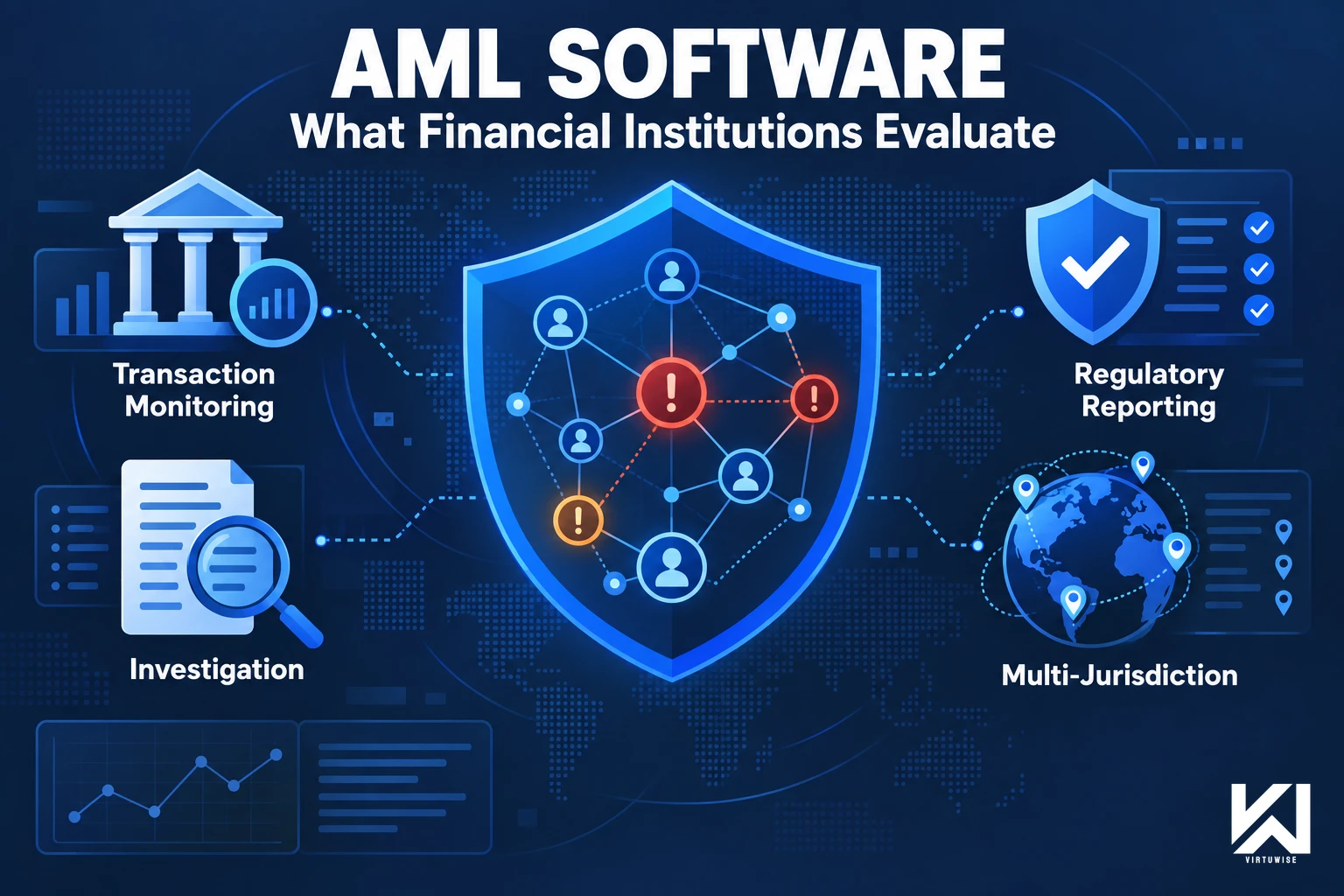
Anti-money laundering software sits at the center of a bank or fintech's regulatory exposure — a false negative can trigger regulatory penalties running into millions, and a poorly tuned system can bury a compliance team in false positives that erode trust in the whole platform. For AML software vendors, this creates a genuine opportunity: financial institutions need this capability and will invest in it seriously. It also creates a genuine sales challenge — procurement cycles are long, technical evaluation is rigorous, and buyers have been burned before by vendors overselling detection accuracy.
This guide covers what financial institutions actually evaluate in AML software, how the enterprise sales process works in practice, and what AML software vendors need to do to build a consistent pipeline of qualified opportunities.
What AML Software Does
AML software monitors financial transactions and customer behavior to detect, flag, and report activity that may indicate money laundering, terrorist financing, or other financial crime — a regulatory requirement for banks, payment providers, and most regulated financial institutions.
Core capabilities that any credible AML platform must provide:
Transaction monitoring and pattern detection
Real-time and batch analysis of transactions against rule-based and behavioral models designed to surface suspicious patterns — structuring, layering, unusual velocity — while minimizing noise from legitimate activity.
Customer due diligence and KYC integration
AML software typically integrates with or includes KYC (Know Your Customer) processes — identity verification, risk scoring, and ongoing customer due diligence — since effective AML depends on knowing who's actually transacting, not just what the transaction looks like.
Sanctions and watchlist screening
Screening customers and transactions against sanctions lists, PEP (politically exposed persons) databases, and adverse media — with the screening logic kept current as lists change, often multiple times a week.
Case management and SAR filing
Tools for compliance teams to investigate flagged activity, document findings, and file Suspicious Activity Reports (SARs) or equivalent regulatory filings — with a clear audit trail regulators can review.
False-positive reduction and model tuning
The single most common complaint about AML software is alert volume — systems tuned too broadly generate more flagged activity than compliance teams can realistically investigate. Vendors who can demonstrably reduce false positives without missing genuine risk have a real competitive edge.
Regulatory reporting and audit trails
Automated generation of regulatory reports and a complete, exportable audit trail of every decision the system made — required both for routine compliance and for defending decisions during a regulatory examination.
What Financial Institutions Evaluate in AML Software
Regulatory coverage and jurisdiction fit
Different jurisdictions carry different AML regulatory frameworks — FinCEN requirements in the US, the EU's AML directives, FCA expectations in the UK, and others. Institutions operating across multiple jurisdictions evaluate whether a platform's rule sets and reporting formats genuinely cover every market they operate in, not just a primary one.
False-positive rate, in practice not in the pitch
Every vendor claims low false positives. Institutions increasingly ask for real performance data from comparable clients — actual alert volumes, actual investigation time per alert — rather than accepting a marketing claim at face value.
Integration with core banking and payment systems
AML software needs accurate, timely transaction data from the institution's existing systems. Integration complexity and quality — how cleanly the platform connects to the institution's specific core banking or payment infrastructure — is a major technical evaluation criterion, and often the source of the longest part of a sales cycle.
Scalability under transaction volume growth
An institution evaluating AML software for a five-year horizon needs to know the platform performs at 10x current transaction volume, not just at pilot scale. Vendors who can't speak credibly to performance at scale lose enterprise deals to ones who can.
Explainability and audit defensibility
Increasingly, institutions want to understand why a model flagged (or didn't flag) specific activity — both for internal governance and because regulators are scrutinizing "black box" AI-driven AML models more closely. Vendors with explainable model logic have an advantage in regulated, risk-averse buying committees.
AML Software Evaluation: What Matters Most
| Evaluation Criterion | What Institutions Need | Common Shortfall |
|---|---|---|
| Regulatory coverage | Rule sets and reporting matched to every jurisdiction operated in | Primary-market coverage only, gaps in secondary markets |
| False-positive rate | Real client performance data | Marketing claims with no comparable evidence |
| Core system integration | Clean, low-friction connection to existing infrastructure | Custom integration work discovered late in the sales cycle |
| Scalability | Proven performance at multiples of current volume | Pilot-scale performance with no enterprise-scale proof |
| Explainability | Model logic defensible to internal governance and regulators | Black-box scoring with limited audit trail |
| Case management workflow | Efficient investigation tooling for compliance teams | Generic case management not built for AML-specific workflows |
KYC AML Software: Where the Two Overlap
Many buyers search for "KYC AML software" because the two functions are operationally inseparable — effective AML monitoring depends on accurate customer identity and risk data from KYC, and KYC processes increasingly feed directly into AML risk scoring rather than existing as a separate onboarding step.
For vendors, this means positioning matters: platforms that handle both functions natively, with a single shared customer risk profile, have a real advantage over point solutions that require institutions to stitch together separate KYC and AML systems with custom integration work. Buyers evaluating "AML software" frequently expect KYC capability to already be part of the conversation, not a separate procurement process.
How AML Software Vendors Win Enterprise Deals
AML software sales are relationship-dependent and technically rigorous at the same time — a combination that rewards vendors who can navigate both a long, multi-stakeholder buying process and a genuinely demanding technical evaluation.
The decision-making unit
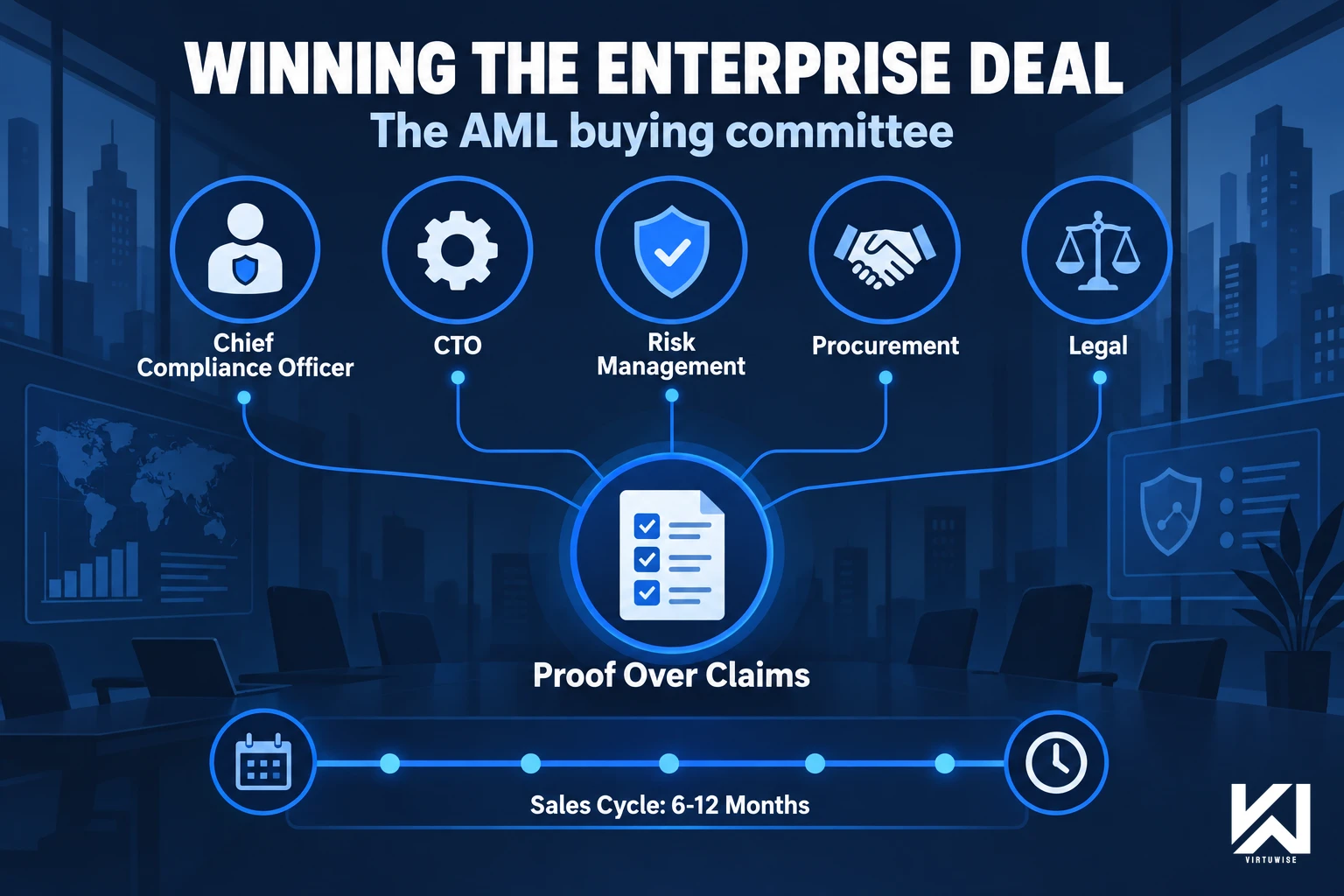
AML software procurement typically involves: the Head of Compliance or Chief Compliance Officer (primary evaluator and business owner), CTO or Head of Technology (integration and architecture evaluation), Risk Management (model performance and false-positive tolerance), Procurement (commercial terms), and Legal (regulatory and contractual review).
Outreach that reaches only the compliance function often stalls at the technical evaluation stage, when integration and architecture questions surface that the compliance champion can't answer alone.
Proof over claims
Every AML vendor claims accurate detection and low false positives. The vendors who progress in evaluations are those who can demonstrate:
- Named references from institutions of comparable size and regulatory complexity
- Real performance benchmarks, not just marketing-stated accuracy figures
- A technical evaluation environment that handles the institution's actual transaction patterns, not a generic demo dataset
Long, technically rigorous sales cycles
AML software procurement commonly runs 6–12 months from first contact to signed contract, given the regulatory stakes and the depth of technical evaluation involved. Vendors need outreach and nurture sequences built for this timeline, not campaigns designed around a 30-day sales cycle.
Trigger-event timing
The strongest openings to approach a financial institution about AML software are specific pain events: a recent regulatory finding or enforcement action, expansion into a new regulated jurisdiction, a core banking system migration that opens a window to reassess the AML stack, or visible frustration with an incumbent's false-positive volume.
Put together, this is the shape of an approach that actually reaches a technical, risk-averse buying committee instead of stalling at one contact:
How VirtuWise Supports AML Software Vendors
VirtuWise builds B2B pipeline for AML, KYC, and RegTech vendors competing for enterprise relationships with banks, fintechs, and other regulated financial institutions.
For AML software vendors, our work typically includes:
- Decision-maker mapping: identifying Chief Compliance Officers, CTOs, and Risk leaders at target institutions, with current AML stack and regulatory-pressure signals
- Multi-channel outreach: LinkedIn and email sequences targeting compliance and technical stakeholders with messaging anchored in regulatory coverage and integration proof points
- Trigger-event monitoring: identifying institutions approaching regulatory deadlines, core system migrations, or visible incumbent frustration that creates a buying window
- Long-cycle nurture sequencing: built for AML software's 6-12 month procurement timeline, not a generic 30-day cadence
Outbound starts at €3,000/month, scoped across a few tiers depending on channel mix and depth — from focused single-channel outreach up to full-cycle business development with a dedicated senior sales manager, which fits AML's longer, multi-stakeholder sales cycle well. Full details at virtuwise.io/services/business-development and virtuwise.io/pricing.
Frequently Asked Questions
What is AML software?AML (anti-money laundering) software monitors financial transactions and customer behavior to detect, flag, and report activity that may indicate money laundering or other financial crime — a regulatory requirement for banks, payment providers, and most regulated financial institutions. It typically includes transaction monitoring, KYC integration, sanctions screening, case management, and regulatory reporting.
What's the difference between AML software and KYC AML software?AML software specifically refers to transaction monitoring and financial-crime detection. "KYC AML software" describes platforms that combine that monitoring with Know Your Customer identity verification and risk scoring — an increasingly common combination, since accurate AML detection depends on accurate customer identity and risk data from KYC.
How long does an AML software sales cycle take?AML software procurement typically runs 6-12 months from first contact to signed contract, given the regulatory stakes involved and the depth of technical evaluation — integration testing, false-positive benchmarking, and compliance/legal review all add real time. Institutions switching from an incumbent vendor often move slower than new AML buyers due to migration risk.
How do AML software vendors find new enterprise clients?The primary channels are direct outreach to Chief Compliance Officers and Risk leaders at target institutions, industry conferences and RegTech events, and referrals through shared banking-infrastructure or core-system partners. Multi-stakeholder outreach — reaching compliance, technical, and risk functions rather than just one champion — significantly outperforms single-contact outreach for generating qualified opportunities.
What matters most to financial institutions evaluating AML software?Regulatory coverage across every jurisdiction operated in, real (not marketed) false-positive performance data, integration quality with existing core banking systems, proven scalability at enterprise transaction volume, and explainable model logic that holds up to internal governance and regulatory scrutiny.