
B2B Lead Generation Agency Pricing: Models, Costs, and What You Get in Europe
B2B lead generation agency pricing explained: retainer, per-lead, per-meeting and hybrid models, what drives cost across European markets, and how to compare quotes.
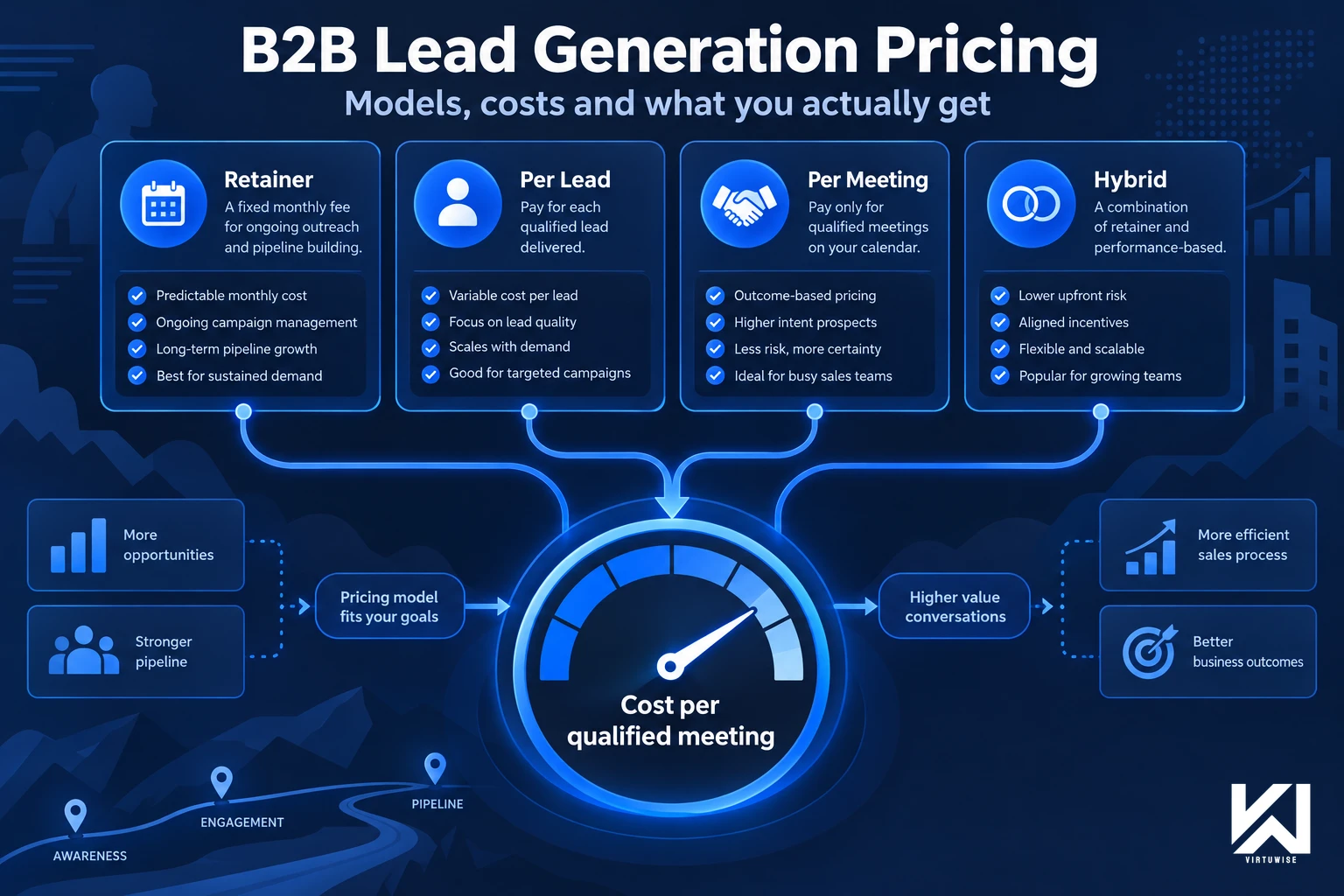
B2B lead generation agency pricing depends on the model you buy, not on a market rate. A lead generation company charges a monthly retainer, a fee per lead, a fee per meeting, or a mix of a retainer and a performance component, and the same number on a quote can mean very different things in each. The only fair way to compare offers is cost per qualified meeting, meaning what you pay for a conversation with the right buyer that your sales team accepts.
For reference, VirtuWise outbound lead generation for European, UK and CIS markets starts at €3,000 per month, with no long-term contracts. The rest of this guide explains how the four pricing models work, what drives the price up or down, how pricing changes when you sell across several countries, and how to compare quotes without being misled by the headline number.
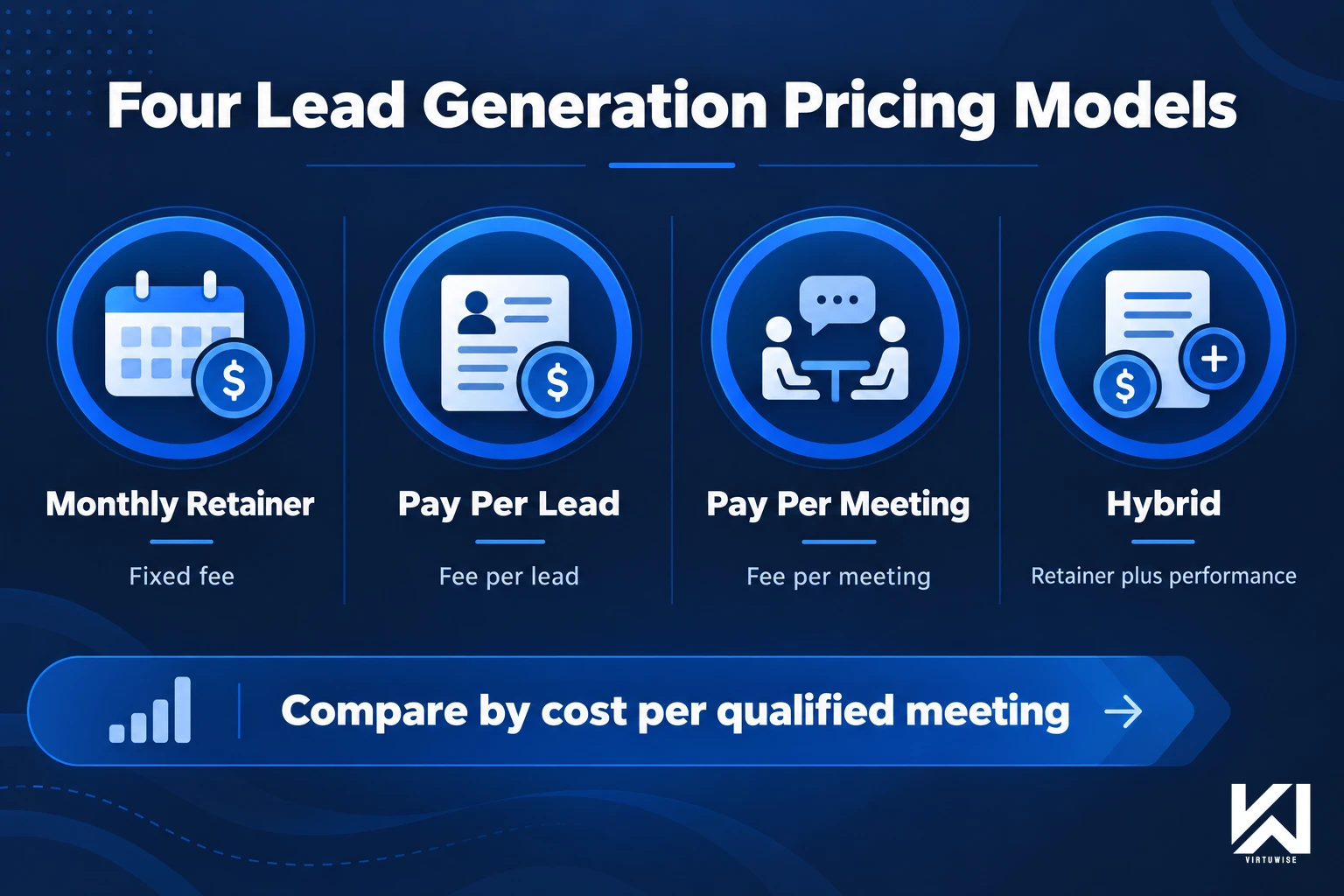
The Four Lead Generation Pricing Models
Monthly retainer
You pay a fixed monthly fee and the agency runs the programme: research, list building, outreach, reply handling and meeting booking. The fee covers the work and the team, not a guaranteed number of leads.
This is the most common model for B2B lead generation because outbound needs continuous calibration of targeting and messaging. It suits companies that want a stable, transparent cost and a team that improves the programme month by month.
Pay per lead
You pay a fixed amount for each lead delivered. It looks simple and low-risk, but everything depends on what counts as a lead. If a lead is a name and an email address, or anyone who replied, the price per lead will look cheap while the share that turns into real opportunities stays low.
Pay per meeting (pay per appointment)
You pay for each meeting booked. This is closer to the outcome you want, but the same question applies: booked, held or accepted by your team? A per-meeting price only makes sense with a written definition of a qualified meeting, a no-show policy and a way to reject meetings that miss your criteria.
Hybrid: retainer plus performance
A lower fixed retainer plus a variable fee tied to qualified meetings or opportunities. It aligns incentives on both sides, and it works best when both parties have already agreed on the definition of qualified and on how results are measured.
Comparison at a glance
| Model | How you pay | Who carries the risk | What to check |
|---|---|---|---|
| Monthly retainer | Fixed fee per month | Shared: you fund the work, the agency owns execution | Reporting, definition of qualified, notice period |
| Pay per lead | Fee per lead delivered | You: lead quality is hard to control | What counts as a lead, how leads are verified |
| Pay per meeting | Fee per booked meeting | Mostly the agency, until quality disputes start | Booked vs held vs accepted, no-show handling |
| Hybrid | Lower retainer plus a performance fee | Split between you and the agency | How the performance fee is triggered and capped |
Whichever model you choose, the common denominator is the same: what you pay for each meeting your sales team actually accepts.
What Drives Lead Generation Cost
Two agencies can quote very different prices for what sounds like the same service. These are the factors behind the difference:
- Channels. LinkedIn only, email only, or both. Multi-channel programmes need more setup, more sending infrastructure and more reply handling. See how we approach LinkedIn lead generation and cold email outreach.
- Volume and the number of target accounts. A broader programme means more research, more outreach and more replies to process.
- Seniority of the target buyer. C-level and regulated-industry buyers need more careful research and messaging than a broad mid-level list.
- Markets and languages. Outreach in several countries needs localised messaging, local rules awareness and time-zone planning. This is why a multi-country programme costs more than a single-market English campaign. More on this in the next section.
- Data sourcing. Verified contacts from reliable providers cost more than bulk exports, and they protect your sender reputation.
- Reply handling and qualification. If a person reads, qualifies and answers every reply, the programme costs more and produces better meetings.
- How far into the sales cycle the provider goes. Booking meetings is one scope. Carrying qualified conversations through to proposal and deal is another. We compare the two in Lead Generation Only or Full Cycle.
How Lead Generation Agency Pricing Changes Across European and CIS Markets
If your buyers sit in several countries, the number of markets matters as much as the number of channels. Each market adds its own work:
- UK and Ireland. English-language outreach, but with its own rules on business-to-business contact and a competitive market where senior buyers receive a lot of outreach. Messaging needs to stand out.
- DACH (Germany, Austria, Switzerland). Buyers expect a formal, precise tone, and messaging should be written in German rather than translated. Decision structures and titles differ from the UK.
- France, Italy, Spain and the Benelux. Native-language messaging often works better than English, which means separate copy, separate testing and native-language reply handling.
- Nordics, Baltics, Poland, Bulgaria and Cyprus. Smaller target pools per country, and English is commonly used in business, so outreach in English can work while local language adds reach. Programmes usually combine several of these markets to reach a workable volume.
- CIS. Outreach is typically in Russian or Ukrainian, with different channel habits and buyer expectations than Western Europe.
In practice, each additional language and market needs its own list, messaging and testing cycle. That is why a quote for one market cannot be extended to five markets by multiplying the price, and why you should ask any provider how they price extra markets and languages before you sign. For the regulatory side, see how we handle compliance in our B2B lead generation service.
How to Compare Quotes: Cost per Qualified Meeting
A monthly fee, a price per lead and a price per meeting cannot be compared directly. Convert every quote to the same unit:
Cost per qualified meeting = total monthly cost ÷ meetings your sales team accepted as qualifiedHere is an illustrative calculation. These are made-up numbers to show the logic, not benchmarks.
| Retainer | Pay per meeting | |
|---|---|---|
| Monthly cost | €3,000 | 10 meetings × €400 = €4,000 |
| Meetings booked | 8 | 10 |
| Meetings held | 7 | 6 |
| Meetings accepted as qualified | 6 | 3 |
| Cost per qualified meeting | €500 | about €1,333 |
The per-meeting offer looked cheaper per unit (€400) and produced more booked meetings, but it cost more per qualified conversation. This is why we report booked, held and accepted meetings separately every week.
A short checklist before you sign
- Get a written definition of a qualified meeting: role, company type, need and timing.
- Ask how meetings are verified: confirmation, reminders, no-show handling.
- Ask who owns the lists and the sender infrastructure if you stop the engagement.
- Ask what the weekly report shows: volume, reply rate, meetings booked, held and accepted.
- Check the notice period. Long lock-ins are a bad sign in a channel that needs to be calibrated.
For a longer buyer's checklist, see our guide to choosing a B2B appointment setting company.
Red Flags in Lead Generation Quotes
- A guaranteed number of leads with no definition of a lead. Guarantees on volume usually trade quality for quantity.
- Pricing that only mentions activity. Messages sent and connection requests are inputs, not results.
- No reporting detail. If you cannot see replies and meeting outcomes weekly, you cannot judge the price.
- Long minimum terms with no exit. Outbound needs adjustment in the first weeks, so lock-in works in the provider's favour.
- No clarity on data and compliance. European outreach needs a lawful basis, an opt-out in every campaign and verified contact sources.
- A price that is far below everyone else's. Low prices are usually reached by cutting research, reply handling or data quality.
Lead Generation Agency vs In-House: How the Costs Compare
The agency fee covers a ready team, tooling and data. An in-house programme adds salaries, recruiting, management time, sending infrastructure, data subscriptions and a ramp-up period before the first meetings. The decision is less about the monthly figure and more about speed and certainty: an agency gets you to pipeline faster, and many companies add in-house SDRs once the playbook is proven. We break the comparison down in In-House SDR vs Outsourced Sales.
What VirtuWise Lead Generation Costs
VirtuWise B2B lead generation for EU, UK and US markets starts at €3,000 per month. Pricing is scoped across a few tiers depending on channel mix and depth, from focused single-channel outreach to full-cycle business development with a dedicated senior sales manager. There are no long-term contracts.
The fee covers ICP and account research, verified list building, messaging, LinkedIn and email outreach, human reply handling, meeting booking and weekly reporting on meetings booked, held and accepted. Details are on the pricing page.
Frequently Asked Questions
How much does B2B lead generation cost?It depends on the pricing model and scope, so there is no single market rate. Providers charge a monthly retainer, a fee per lead, a fee per meeting, or a hybrid. VirtuWise outbound lead generation starts at €3,000 per month. Compare any quote by cost per qualified meeting, not by the headline price.
Is a retainer or pay per lead better?A retainer is usually better for B2B because outbound needs continuous testing of targeting and messaging, and the team gets better each month. Pay per lead can work when you have a precise definition of a lead and a way to verify it, but without that the lead count tends to grow faster than the number of real opportunities.
Does lead generation agency pricing differ by country?Yes. Each extra market usually adds its own list, native-language messaging, testing and reply handling, so pricing does not scale by simply multiplying a single-market quote. Ask any provider how they price additional markets and languages, and whether the rate you are quoted covers one market or several.
How do I calculate cost per qualified meeting?Divide your total monthly cost by the number of meetings your sales team accepted as qualified. Use accepted meetings, not booked ones, because booked meetings include no-shows and poor fits.
How long before lead generation starts producing meetings?The first meetings usually appear within a few weeks of launch. Treat the first weeks as calibration, and judge cost per qualified meeting once targeting and messaging have been tuned on real replies.
Do lead generation agencies require long contracts?Some do. Because outbound programmes need adjustment, long minimum terms are a warning sign. VirtuWise works without long-term contracts.
Related reading: