
B2B Appointment Setting Companies: How to Choose One That Delivers Qualified Meetings
B2B appointment setting companies vary wildly in quality. Here's how to evaluate them, what qualified actually means, and which models work for different sales motions.
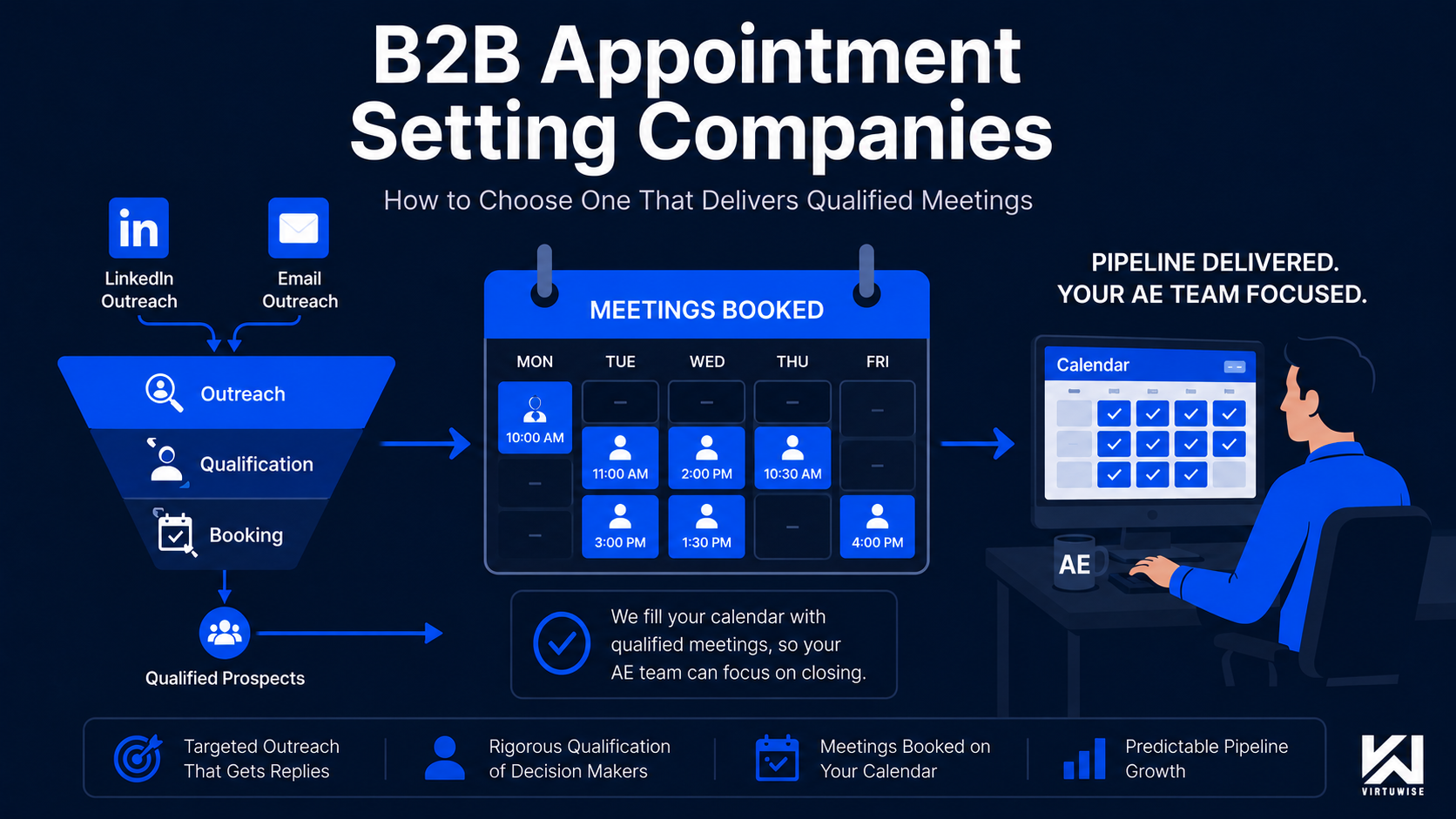
Every B2B appointment setting company promises the same thing: qualified meetings with decision-makers, booked directly onto your calendar, so your sales team can focus on closing rather than prospecting. The promise is consistent. The delivery is not.
The difference between a good appointment setting engagement and a bad one is not always visible until you're three months in and have spent €15,000–€25,000 on meetings that don't convert. Understanding how to evaluate appointment setting companies before you sign — not after — is the difference between a working pipeline and an expensive lesson.
This guide covers what B2B appointment setting companies actually do, why quality varies so dramatically, what "qualified" should actually mean in your contract, and how to evaluate providers before committing.
What B2B Appointment Setting Companies Do
B2B appointment setting is the process of generating and booking sales meetings between your team and qualified prospects — handling everything from initial outreach through to calendar confirmation so your Account Executives arrive at calls with genuine opportunities rather than courtesy conversations.
A full-service appointment setting engagement covers:
Prospect research and list building
Defining the ICP at company and contact level, building verified lists of decision-makers who match the criteria, and enriching those lists with relevant signals (company growth, tech stack, hiring activity, recent news). List quality is the single largest determinant of meeting quality — more than messaging, more than channel, more than volume.
Multi-channel outreach
Running coordinated sequences across LinkedIn, email, and direct messaging to reach prospects through the channels they actually respond to. B2B decision-makers at different seniority levels respond to different channels — C-suite often prefers email; VP and director level often engage first on LinkedIn. Multi-channel outreach consistently outperforms single-channel by 2–3× in meeting rate.
Qualification before booking
Filtering responses to distinguish genuine pipeline from polite rejections, wrong timing, or wrong persona. A qualified meeting — by any meaningful standard — has confirmed interest, relevant authority, and a specific time commitment. Booking any response as a meeting inflates volume and collapses conversion.
Scheduling and logistics
Managing calendar coordination, confirmation, reminders, and rescheduling. This is operational overhead that consumes more time than most companies expect before they outsource it.
Reporting and optimisation
Weekly reporting on outreach performance, reply rates, meeting rates, and quality signals. The best appointment setting companies use this data to refine targeting and messaging week over week — not just report static numbers.
Why Quality Varies So Much Between Appointment Setting Companies
The surface-level offer from B2B appointment setting companies looks identical: qualified meetings, proven process, transparent reporting. The variation is hidden in three places.
How they define "qualified"
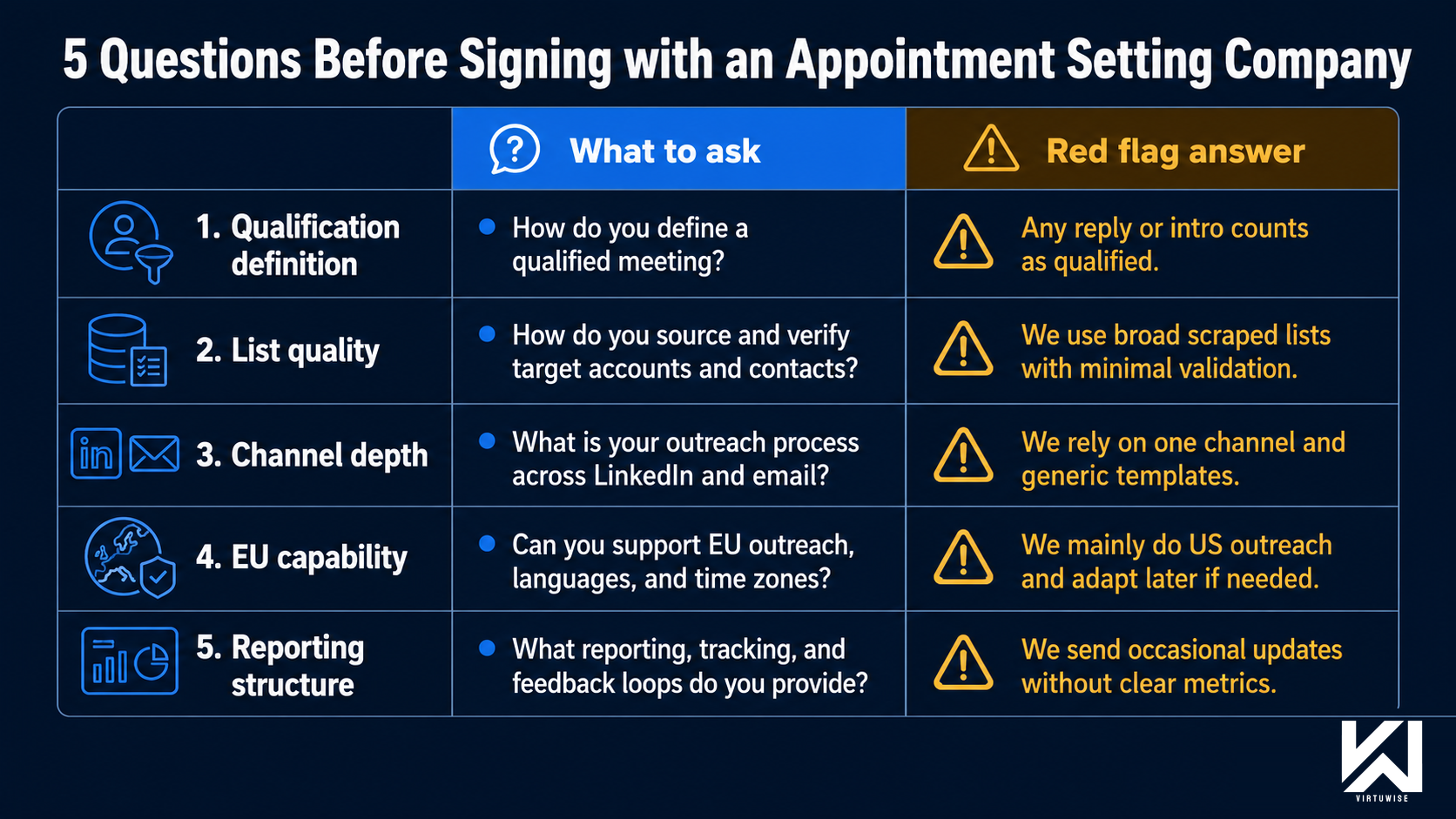
The word "qualified" has no standard definition in the appointment setting industry. Some providers count any accepted meeting — including no-shows, wrong-persona contacts, and polite "tell me more" responses that aren't genuine pipeline. Others apply a genuine qualification standard: confirmed business need, budget authority or path to it, and appropriate timing.
This matters enormously for your conversion rate downstream. Fifty meetings with 5% close rate is worse ROI than twenty meetings with 25% close rate — regardless of how impressive the meeting volume looks on the weekly report.
List quality and data sourcing
High-volume outreach on low-quality lists generates meetings with people who don't match your ICP, have no budget, or are in the wrong buying stage. The difference between a list built from a verified database with manual enrichment and a scraped list from LinkedIn is the difference between meeting a VP of Engineering at a Series B SaaS company and meeting a founder from a 5-person startup that has no budget for your product.
Channel depth versus channel breadth
Some appointment setting companies operate LinkedIn-only; others run email-only. Multi-channel providers vary enormously in how deeply they actually use each channel versus listing it as a feature. Ask specifically: what percentage of your booked meetings come from LinkedIn versus email, and how do you coordinate the two for the same prospect?
How to Evaluate B2B Appointment Setting Companies
Define "qualified" before you evaluate anyone
Before contacting a single provider, write down your internal definition of a qualified meeting:
- What job title or function must the contact hold?
- What company profile must they be from (size, industry, funding stage)?
- What must they have confirmed during the qualification exchange (budget, timeline, business challenge)?
- What counts as a disqualification (competitor employees, students, wrong geography)?
Every provider you evaluate should sign up to your definition — in writing, in the contract — not their internal default.
Ask for vertical references, not general testimonials
A case study from a cybersecurity company doesn't tell you how an appointment setting company performs for a fintech SaaS vendor. Ask specifically for references from clients whose ICP, market, and sales cycle are comparable to yours. If they can't provide any, that's the answer.
Test for EU versus US capability
EU appointment setting requires GDPR-compliant data sourcing, LinkedIn-first channel approach (cold calling converts poorly in most EU markets), and decision-maker maps that differ from US equivalents. Ask whether the provider has EU-specific infrastructure, local market knowledge, and active EU campaign history — not claimed EU capability.
Evaluate the reporting structure
Good appointment setting companies report on: outreach volume by channel, open/acceptance rates, reply rates, meetings booked, meetings held (versus no-shows), and meeting quality signals from your AE feedback. Providers that report only meetings booked are optimising their own metric, not yours.
Start with a test engagement
Three months is the right test duration for an appointment setting engagement. It's long enough to see meaningful results and evaluate meeting quality, short enough to exit without major sunk cost if the fit is wrong. Providers who push 12-month commitments before results are demonstrated are prioritising their own revenue security over your outcome.
B2B Appointment Setting Models: Which Fits Your Motion?
| Model | Best For | Risk |
|---|---|---|
| Dedicated appointment setter | Companies with well-defined ICP, high volume need | Single person dependency |
| Managed team model | Complex multi-market or multi-vertical programmes | Higher cost |
| LinkedIn-only | B2B markets where prospects are active on LinkedIn | Single-channel risk |
| Email-only | High-volume US campaigns, SMB targets | Deliverability challenges, lower EU conversion |
| Multi-channel (LinkedIn + email) | EU markets, senior buyers, complex ICPs | Requires coordination capability |
| Full-cycle (appt setting + BD) | Long-cycle enterprise with relationship-building requirement | Most expensive, highest output ceiling |
For EU B2B markets with mid-market or enterprise buyers, the multi-channel model consistently outperforms single-channel. For US-focused campaigns at high volume targeting SMB, email-led models can produce volume efficiently. The right model depends on your market, your buyer, and your ACV.
What B2B Appointment Setting Services Should Cost
Appointment setting services range from €1,000/month for offshore email-only execution to €10,000+/month for enterprise multi-channel programmes with dedicated teams. The relevant metric is not the monthly retainer — it's cost per qualified meeting and cost per pipeline opportunity generated.
Rough benchmarks for quality providers in the EU market:
- Single channel (LinkedIn or email only): €1,500–€3,000/month
- Multi-channel (LinkedIn + email): €3,000–€5,000/month
- Full-cycle with dedicated BDR: €5,000–€8,000/month
Below €1,500/month typically signals offshore execution with generic lists and minimal personalisation. Above €8,000/month for appointment setting alone (without full BD) requires justification in meeting volume and quality targets.
How VirtuWise Runs B2B Appointment Setting
VirtuWise provides B2B appointment setting services for companies in fintech, iGaming, IT services, SaaS, and AI — with a specific focus on EU and UK market outreach and multi-channel programmes that reach decision-makers across LinkedIn and email.
Our appointment setting engagements include:
- ICP definition and verified list building: company and contact level targeting with multi-dimensional ICP signals, not just firmographic filters
- Multi-channel outreach: coordinated LinkedIn and email sequences calibrated for your specific buyer profile and market
- Qualification before booking: every meeting confirmed on three criteria — relevant role, genuine need, appropriate timing
- Meeting logistics: scheduling, confirmation, reminders, rescheduling handled by the team
- Weekly pipeline reporting: outreach volume, reply rates, meeting rates, quality signals, and AE feedback loop
- Lead Generation: €3,000/month — ICP research, personalised outreach, meeting booking and scheduling, weekly reporting
- Lead Generation Plus: €5,000/month — everything in Lead Generation, plus multi-channel outreach (LinkedIn + email + messengers), A/B testing, higher volume
- Business Development: €7,000/month — full-cycle business development, dedicated senior sales manager, online and offline representation, custom strategy
- Inbound (SEO & AEO): €3,500/month — SEO and AEO run as one service: keyword strategy, content, technical fixes, and AI-crawler visibility (structured data, llms.txt)
- Fractional Growth Partner: Custom — a revenue engine audit, then optional ongoing Advisory or hands-on Implementation
Full details at virtuwise.io/pricing.
Frequently Asked Questions
What do B2B appointment setting companies do?B2B appointment setting companies handle the prospecting, outreach, and meeting booking function for your sales team — building targeted lists of decision-makers, running multi-channel outreach sequences, qualifying responses, and booking confirmed meetings onto your AEs' calendars. Your team focuses on running the meetings; the appointment setting company fills the calendar.
How much do B2B appointment setting services cost?Quality B2B appointment setting services typically range from €1,500/month for single-channel programmes to €5,000–€7,000/month for full multi-channel engagement with dedicated resources. Evaluate providers on cost per qualified meeting rather than monthly retainer — a higher retainer with better meeting quality almost always delivers better ROI than a cheaper service with high meeting volume and low conversion.
What should "qualified" mean in a B2B appointment setting contract?A qualified meeting should mean: (1) the contact holds a relevant role with buying authority or a clear path to the economic buyer; (2) the contact has confirmed a relevant business challenge; (3) the meeting is booked with genuine intent, not a polite "sure, put something in the calendar" response. Define this contractually before signing — not after your first month of meetings.
How long does it take B2B appointment setting to produce results?Quality providers book first meetings within 2–4 weeks of launch. Full velocity — consistent monthly meeting volume from an optimised campaign — typically develops by month 2–3 as targeting and messaging are refined on real response data.
Should I hire an in-house SDR or use a B2B appointment setting company?For most companies under €10M ARR, appointment setting outsourcing delivers faster time to pipeline, lower Year 1 cost, and immediate market expertise versus a 4–6 month SDR ramp. Once you have a validated playbook and a consistent pipeline volume that justifies dedicated headcount, hiring in-house alongside the outsourced function makes sense.
Related reading:
- Best Outsourced SDR Companies in 2026: A Buyer's Comparison
- Inside Sales Outsourcing: What It Is, When It Works, and How to Do It Right
- Outbound Lead Generation: Channels, Tactics, and What Works in 2026
- Demand Generation Agency: What They Do and How to Choose One
- B2B SaaS Lead Generation: How to Build a Repeatable Pipeline