
B2B Lead Generation Tools: The Stack That Produces Meetings (and What It Cannot Do)
B2B lead generation tools explained by layer: data, verification, outreach, CRM and reporting. What each does, a starter stack by company stage, and when an agency is the better option.
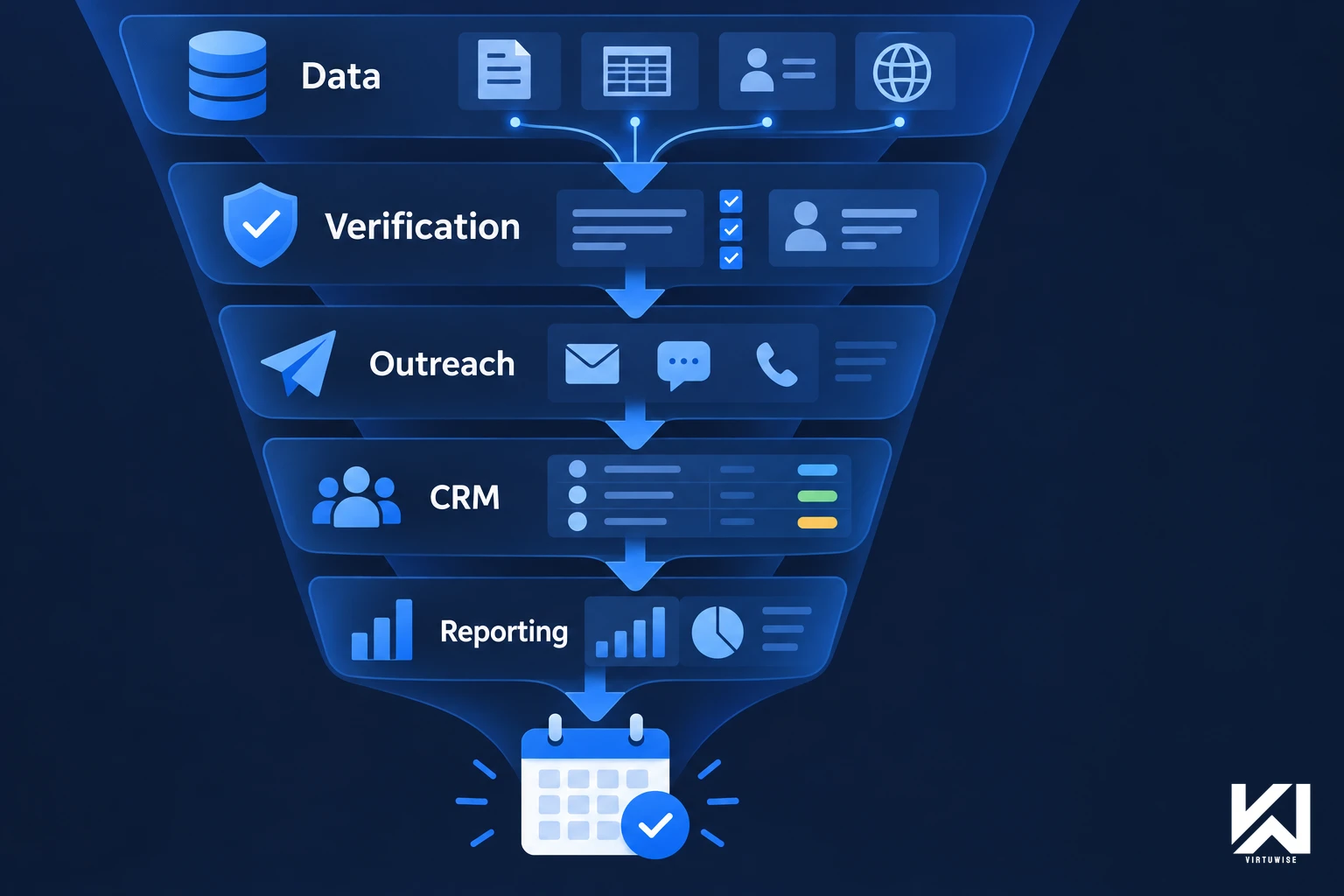
B2B lead generation tools are the software a team uses to find target buyers, verify their contact details, contact them and track the results. A working stack has five layers: data, verification, outreach, CRM and reporting. No tool on its own generates a qualified meeting. The meetings come from a clear ideal customer profile, a relevant message and a person who reads and answers replies. The tools make that process faster and cheaper to run.
This guide breaks the stack down by layer, shows what to look for in each, and gives a starter setup by company stage. Tool names are examples of each category, not endorsements, and pricing changes often, so check vendor pages before you decide.
What Counts as a B2B Lead Generation Tool?
A B2B lead generation tool is any software that supports one step between "we sell to these companies" and "a qualified buyer is on a call". Teams often use "lead generation software" for the whole category, but it covers very different jobs:
- Finding companies and decision-makers (prospecting databases, LinkedIn search)
- Checking that an email address is real and safe to send to (verification)
- Contacting people at scale without losing personalisation (outreach automation)
- Tracking conversations and deals (CRM)
- Measuring what works (reporting and analytics)
Buying a tool for one layer does not fix a weakness in another. A large database with no verification damages your sender reputation. An outreach platform with a weak list sends more bad messages, faster.
The Five Layers of a B2B Lead Generation Stack
| Layer | What it does | Example categories | What to check before buying |
|---|---|---|---|
| Data and prospecting | Finds companies and contacts that match your ICP | B2B contact databases, LinkedIn Sales Navigator, intent data | Coverage in your target countries, data freshness, how emails are sourced |
| Verification | Removes invalid and risky addresses | Email verification services | Catch-all handling, bounce guarantees, bulk limits |
| Outreach | Runs LinkedIn and email sequences | Email sequencers, LinkedIn automation | Sending limits, account-safety controls, reply detection, unsubscribe handling |
| CRM and pipeline | Stores contacts, tracks meetings and deals | Sales CRMs | Integration with outreach, ease of logging meetings, reporting |
| Reporting | Shows meetings, pipeline and cost per meeting | CRM dashboards, spreadsheets, BI tools | Whether it counts qualified meetings, not just sends and opens |
Data and Prospecting Tools
Data is the layer where most outbound programmes win or lose. The question is not how many contacts a database holds, but how many of them match your ICP, are current and can lawfully be contacted.
What to check:
- Regional coverage. Databases built around the US often have thinner data for Germany, the Nordics, Poland or Bulgaria. Test with 50 real target companies from your market before paying for a plan.
- Role accuracy. Titles change quickly. Check a sample against LinkedIn.
- Source and compliance. Under GDPR and UK GDPR, B2B outreach usually relies on legitimate interest, which needs documented reasoning and an easy opt-out. Ask how the provider sources emails.
- Export limits. Credits, daily caps and API access shape what you can do at scale.
A single database rarely covers every market well. Many teams combine one main database with LinkedIn search for the senior, harder-to-find roles.
Email Verification and Deliverability
Verification is the cheapest layer and the one most often skipped. Unverified lists produce bounces, and a high bounce rate hurts the domain you send from, which reduces how many messages reach the inbox, including to good prospects.
Basic rules that hold for most programmes:
- Verify every list before the first send, and again if it has aged.
- Send from separate outreach domains, not your main company domain.
- Warm new mailboxes gradually and keep daily volumes modest.
- Treat catch-all addresses as risky and handle them separately.
- Monitor bounce and spam-complaint rates weekly.
Infrastructure is part of the stack too: domains, mailboxes, SPF, DKIM and DMARC records. It is unglamorous work, and it decides whether your outreach is seen at all.
Outreach Automation: LinkedIn and Email
Outreach tools run the sequences: connection requests, messages, emails and follow-ups. They save hours, but they also carry the most risk.
Email sequencers schedule multi-step campaigns, rotate mailboxes and detect replies. Look for sending limits per mailbox, reply and bounce handling, and clear unsubscribe options. LinkedIn automation is more sensitive. LinkedIn restricts automated activity, and aggressive tools can get an account limited. Keep volumes conservative, personalise the first message and never use a team member's only LinkedIn account for experiments.For both channels, the tool should make it easy for a person to step in. Replies need a human answer within hours. Our guides to LinkedIn lead generation and cold email templates cover message design, which no tool can do for you.
CRM and Reporting
The CRM is where outreach turns into a measurable pipeline. The test is simple: can you see, for any campaign, how many qualified meetings were booked, how many were held, and how many became opportunities?
If the answer needs a manual spreadsheet every Friday, the stack is not finished. Define what counts as a qualified meeting before launch, log it the same way every time, and report cost per qualified meeting rather than messages sent or emails opened. Opens in particular are an unreliable signal because of how mail clients handle tracking.
Where AI Fits in the Stack
AI now appears in every layer: drafting first lines, summarising company research, scoring replies, even running "AI SDR" agents that send messages on their own. It is useful for research and drafting speed. It is not a substitute for judgement on who to contact and what to promise.
Use AI where a person can review the output quickly, and keep humans on targeting, offers and replies. For a closer look at autonomous agents, read our guide to AI SDRs.
A Starter Stack by Company Stage
| Stage | Typical setup | Watch out for |
|---|---|---|
| Founder-led, first outbound tests | One database or LinkedIn Sales Navigator, a verification service, one email sequencer, a simple CRM | Buying annual plans before the offer and ICP are proven |
| Small team with an SDR | Database plus verification, email and LinkedIn tools, a CRM with meeting tracking | Tool sprawl, and data that lives in three places |
| Scaling with several SDRs | Full stack with separate sending infrastructure, shared dashboards, defined handoffs to sales | Deliverability management and compliance records becoming a job of their own |
Start small. A tight list and a good message in a basic tool beat an expensive stack running a generic message.
Why Tools Alone Do Not Produce Meetings
Most disappointing results come from the same few causes:
- The ICP is vague. Better software scales a bad target faster.
- The message is generic. Buyers recognise templates at once.
- Replies are slow. A warm answer left for two days is often a lost meeting.
- Nobody owns the stack. Lists age, domains degrade and sequences run unchecked.
- Success is measured by activity. Sends, opens and connections feel productive and prove nothing.
If your tools are fine and the outcome is still weak, the gap is usually process or capacity, not software.
Tools vs an Agency
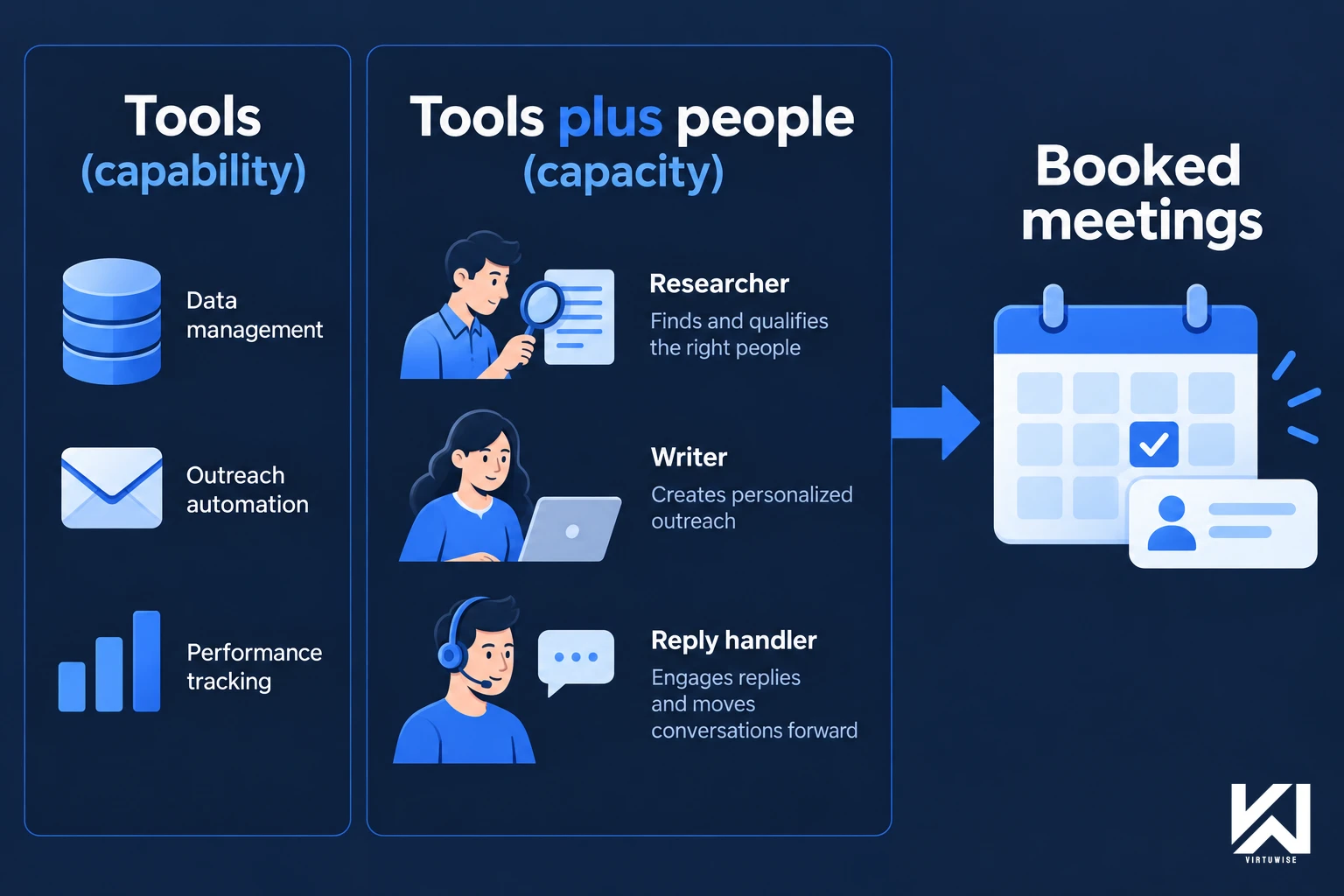
Buying tools gives you capability but not capacity: you still need people to research, write, send, answer and report. A lead generation agency brings the tools and the people together.
| Build your own stack | Use an agency | |
|---|---|---|
| Upfront effort | Selecting, setting up and warming infrastructure | Handled by the provider |
| Ongoing work | Your team runs and maintains everything | Provider runs research, outreach and reporting |
| Control | Full control over data and process | Control through weekly reporting and agreed targets |
| Best when | You have SDR capacity and a proven playbook | You need pipeline quickly or lack sales capacity |
At VirtuWise, outbound starts from €3,000 a month with no long-term contracts. We operate the stack, so you do not buy separate licences for data, verification or sequencing, and you receive weekly numbers on qualified meetings. See the B2B lead generation service for the scope, or how outsourcing compares with in-house.
How to Choose Tools: A Short Checklist
- Write your ICP and the definition of a qualified meeting first.
- Pick tools by layer, starting with data and verification.
- Test each data source on 50 real target accounts in your markets.
- Check how each tool handles GDPR requirements such as opt-out and data sourcing.
- Confirm that the CRM can report qualified meetings.
- Run a 30-day pilot on one segment before committing to annual plans.
Frequently Asked Questions
What are the best B2B lead generation tools?There is no single best tool, because the stack has several layers. Choose by layer: a prospecting database that covers your target markets well, an email verification service, an outreach tool with strong safety controls and a CRM that reports qualified meetings. Test each on real target accounts before you pay for a full plan.
What is the difference between lead generation tools and lead generation software?The terms are used interchangeably. "Software" usually refers to a platform and "tools" to individual products inside the stack. In both cases the product supports finding, contacting or tracking prospects rather than producing meetings on its own.
Do I need a LinkedIn automation tool?Not at the start. Manual outreach with Sales Navigator is enough to test an ICP and message. Automation helps once the message works and volume grows, but it carries account risk, so keep limits low and personalise the first message.
Are B2B lead generation tools GDPR compliant?Tools are not compliant or non-compliant on their own. Compliance depends on how you use them: your lawful basis (usually legitimate interest for B2B), how the data was sourced, clear identification in messages and a working opt-out. Ask each provider how it sources data and processes personal information.
Is it cheaper to use tools or an agency?Tools look cheaper because licences cost less than a retainer, but the real cost includes the people who run them and the weeks before the first meeting. Compare cost per qualified meeting for both routes, not licence price against retainer.
Related reading
- Outbound Lead Generation: Strategy, Channels, and Tools for B2B in 2026 — the strategy framework that the tools in this guide support
- AI SDR Guide — what autonomous outreach agents can and cannot do
- Lead Generation Outsourcing — when handing the stack and the process to a provider makes sense