
LinkedIn Outreach Agency: What They Do and How to Choose One
A LinkedIn outreach agency builds your pipeline through targeted connection campaigns, personalised messaging, and qualified meeting booking. Here's what separates good from mediocre.
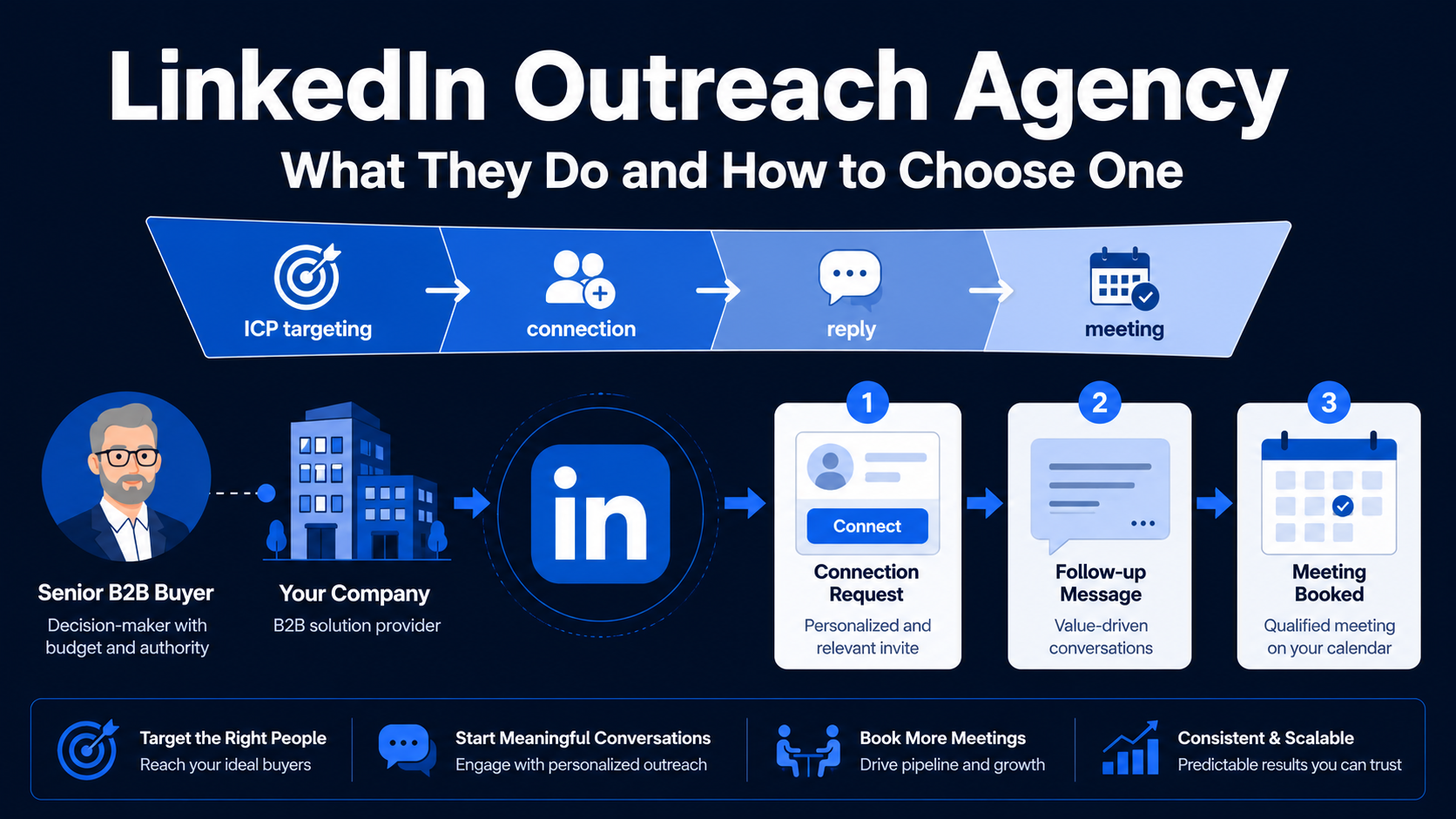
LinkedIn is the primary B2B prospecting channel for most markets outside the US. Senior buyers in fintech, iGaming, SaaS, IT services, and professional services are more reachable on LinkedIn than through cold email, more likely to respond to a well-positioned connection request than a cold call, and more likely to trust a vendor who shows a real professional presence than one who lands in their inbox from a domain they've never seen.
A LinkedIn outreach agency runs this channel systematically — building ICP-targeted prospect lists, managing connection sequences, handling response conversations, qualifying interested contacts, and booking meetings with your team. For B2B companies that know their buyers are on LinkedIn but lack the time, tooling, or expertise to run outreach at scale, an agency closes that gap without requiring an in-house hire.
This guide covers what a LinkedIn outreach agency actually does, what separates quality providers from high-volume operators, and how to evaluate one before committing to an engagement.
What a LinkedIn Outreach Agency Does
ICP mapping and prospect list building
Every LinkedIn outreach engagement starts with precision targeting. At company level: industry, company size, geography, funding stage, technology signals. At contact level: job title, seniority, function, tenure, and recent activity signals (recent role change, post engagement, company news). The quality of the list built at this stage determines more of the meeting rate than any other variable in the campaign.
LinkedIn's targeting is granular enough to reach, for example, Heads of Affiliates at licensed online casino operators in the UK with 50–500 employees. That specificity is what distinguishes LinkedIn outreach from email-based prospecting at scale — the ability to filter by professional profile data with high precision.
Connection request and InMail sequences
The outreach itself runs through personalised connection requests (the primary mechanism on LinkedIn) and InMail messages to prospects outside your network. Connection request messages are constrained to approximately 200–300 characters and must earn an accept before any follow-up conversation can begin — which is why the framing matters enormously.
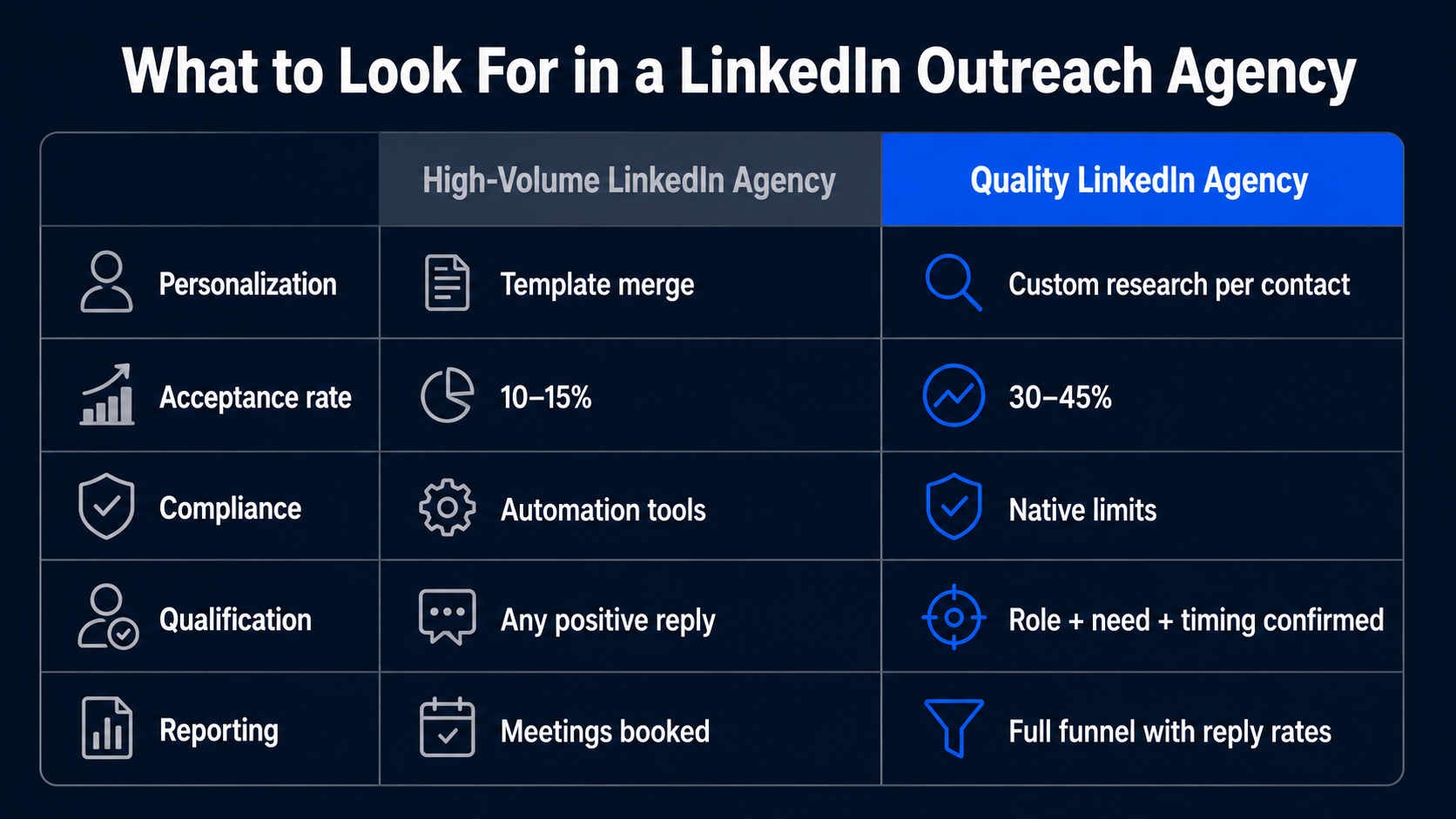
Quality agencies write connection requests that position the value of connecting, not the product being sold. Weak agencies send volume connection requests with immediate pitch content that reads as spam and generates acceptance rates of 10–15%. Strong agencies run sequences that achieve 30–45% acceptance rates through positioning that makes accepting genuinely interesting to the prospect.
Response handling and conversation management
LinkedIn outreach generates three categories of response: genuine interest, polite deflection, and objections. Each requires a different handling approach. Genuine interest needs to be moved efficiently toward a meeting without over-pitching. Polite deflection ("I'm not the right person") can produce a warm referral to the actual decision-maker. Objections ("we already have a provider") contain buying signals that a skilled conversation handler can explore.
Agencies that automate the response layer or use templated reply sequences miss the qualification and referral potential that exists in every non-negative response.
Qualification before booking
Not every interested contact should become a meeting. Qualification — confirming that the contact holds the right authority, that the company fits the ICP, and that the timing suggests a genuine evaluation — is what converts a LinkedIn outreach programme from a meeting-booking exercise into a pipeline programme.
Profile optimisation and positioning
A LinkedIn outreach agency running campaigns from a poorly positioned sender profile faces a structural disadvantage. If the profile looks thin, the headline is generic, and the content section is empty, connection requests from that profile perform poorly regardless of message quality. Quality agencies audit and optimise the sender profile before running campaigns — either the founder's profile, the sales leader's, or a dedicated BDR profile.
What Separates Good LinkedIn Outreach Agencies from Volume Operators
The LinkedIn outreach market contains a wide range of providers, from sophisticated B2B pipeline specialists to offshore volume shops running the same generic sequences for dozens of clients simultaneously. The difference isn't always visible from their website.
Personalisation depth vs. template volume
High-volume agencies run large template libraries across client accounts. Each message is personalised with a name merge and a company name insert — and nothing else. Senior B2B buyers, who receive multiple LinkedIn outreach messages per week, identify template messages immediately and ignore them.
Deep personalisation means referencing something specific to the prospect's company, role, or recent activity — a funding round, a conference they spoke at, a product expansion, a hiring signal. This requires research per contact, which limits volume but produces acceptance and reply rates 2–4× higher than template-only approaches.
LinkedIn-native approach vs. automation abuse
LinkedIn's terms of service restrict automated bulk actions. Agencies that rely on automation tools to send hundreds of connection requests per day risk account restrictions or permanent bans on the profiles they're operating. Quality agencies work within LinkedIn's native rate limits, use LinkedIn automation only where it doesn't violate usage policies, and run campaigns from profiles with genuine activity history.
B2B specialisation by vertical
A LinkedIn outreach agency that works exclusively with B2B technology companies understands what a Chief Revenue Officer at a Series B SaaS company reads, what a Head of Affiliates at an iGaming operator responds to, and how a CFO at a fintech vendor evaluates a vendor message. Generic outreach agencies with broad client portfolios (B2C, eCommerce, HR) apply the same approaches across categories that require entirely different positioning.
EU market capability
GDPR compliance for LinkedIn outreach relates to how prospect data is processed and stored — not LinkedIn messages themselves, which are covered by LinkedIn's user agreement. But EU market expertise goes beyond compliance: it includes understanding of regional professional cultures, decision-making structures that differ from US equivalents, and the channel preference differences across UK, DACH, Nordics, and Southern European markets.
LinkedIn Outreach Agency Evaluation Criteria
| Criterion | What to Ask | Red Flag Answer |
|---|---|---|
| Personalisation approach | How do you personalise beyond name + company? | "We have 50+ tested templates" |
| Acceptance rate benchmark | What connection acceptance rate do you achieve? | "We don't track that separately" |
| LinkedIn compliance | Do you use automation tools? How do you stay within rate limits? | "We use [automation tool name] at scale" |
| Vertical references | References from clients in our industry? | Only case studies, no live references |
| EU capability | Active EU client campaigns and data? | "Yes we do EU" with no specifics |
| Qualification standard | How do you qualify before booking a meeting? | "We book anyone who responds positively" |
| Reporting | Sample of weekly report? | Meetings booked only, no reply rates |
What LinkedIn Outreach Produces at Different Scales
For a B2B company with a defined ICP and a LinkedIn sender profile operating at normal limits:
- Connection requests per month: 400–600 (LinkedIn's practical daily limit at 20–30/day)
- Acceptance rate (quality campaigns): 30–45% → 120–270 new connections/month
- Reply rate from accepted connections: 15–25% → 18–68 replies/month
- Qualified meetings booked: 8–20/month depending on ICP accessibility and offer clarity
These numbers reflect quality outreach — personalised, vertical-specific, with genuine qualification. Volume campaigns from offshore providers may book 30+ meetings per month, but with acceptance rates of 10–15% and reply rates of 5–8%, the meeting quality profile is entirely different.
How VirtuWise Runs LinkedIn Outreach
VirtuWise provides LinkedIn outreach services for B2B companies in fintech, iGaming, SaaS, IT services, and AI — running personalised campaigns from client profiles targeting senior decision-makers in EU and UK markets.
Our LinkedIn outreach engagements include:
- ICP mapping and list building: precision targeting at company and contact level using LinkedIn's native filters combined with external enrichment
- Sender profile audit and optimisation: positioning the sender as a credible peer before launching outreach
- Personalised connection sequences: custom-researched personalisation beyond name and company for senior buyer segments
- Response handling and conversation management: human qualification of every non-negative response, with referral-seeking from wrong-persona contacts
- Meeting booking and logistics: scheduling, confirmation, and rescheduling handled by the team
- Weekly reporting: acceptance rates, reply rates, meeting rates, and meeting quality signals
- Lead Generation: €3,000/month — ICP research, personalised outreach, meeting booking and scheduling, weekly reporting
- Lead Generation Plus: €5,000/month — everything in Lead Generation, plus multi-channel outreach (LinkedIn + email + messengers), A/B testing, higher volume
- Business Development: €7,000/month — full-cycle business development, dedicated senior sales manager, online and offline representation, custom strategy
- Inbound (SEO & AEO): €3,500/month — SEO and AEO run as one service: keyword strategy, content, technical fixes, and AI-crawler visibility (structured data, llms.txt)
- Fractional Growth Partner: Custom — a revenue engine audit, then optional ongoing Advisory or hands-on Implementation
Full details at virtuwise.io/pricing.
Frequently Asked Questions
What does a LinkedIn outreach agency do?A LinkedIn outreach agency builds and manages targeted outreach campaigns on LinkedIn on behalf of B2B clients — identifying decision-maker prospects who match the ICP, sending personalised connection requests and follow-up messages, handling response conversations, qualifying interested contacts against a defined standard, and booking confirmed meetings with the client's sales team.
How many meetings can a LinkedIn outreach agency book per month?Quality LinkedIn outreach agencies targeting a well-defined B2B ICP typically book 8–20 qualified meetings per month per sender profile. The range depends on the accessibility of the ICP on LinkedIn, the strength of the offer, and the depth of personalisation. Volume providers may book more meetings but with significantly lower qualification standards and downstream conversion rates.
What makes a good LinkedIn outreach message?A good LinkedIn outreach message references something specific to the prospect's company, role, or recent activity — not just their name and job title. It communicates a clear, specific value proposition without pitching a product. It asks a question or makes a statement that makes the prospect genuinely interested in connecting, not just tolerant of the request. Connection acceptance rate (30%+ is achievable for quality campaigns) is the primary metric for message quality.
Is LinkedIn outreach GDPR compliant?LinkedIn outreach messages sent through LinkedIn's platform are covered by LinkedIn's user agreement between the platform and its members — they are not cold email and do not require separate consent under GDPR. However, prospect data pulled from LinkedIn and stored externally is subject to GDPR requirements around lawful basis, data minimisation, and retention. Quality agencies understand this distinction and handle data storage accordingly.
How is a LinkedIn outreach agency different from a lead generation agency?A LinkedIn outreach agency specialises specifically in LinkedIn as the primary or only outreach channel. A lead generation agency typically runs multi-channel outreach — LinkedIn and email — and may also handle full pipeline generation including strategy, ICP definition, and reporting. Many LinkedIn outreach agencies offer multi-channel capabilities; the distinction is mainly in specialisation depth and channel emphasis.
Related reading: