
Sales Outsourcing: What It Includes, When It Works, and How to Choose a Provider
Sales outsourcing lets B2B companies build a qualified pipeline without hiring a full sales team. Here's what it includes, when it makes sense, and how to evaluate providers.
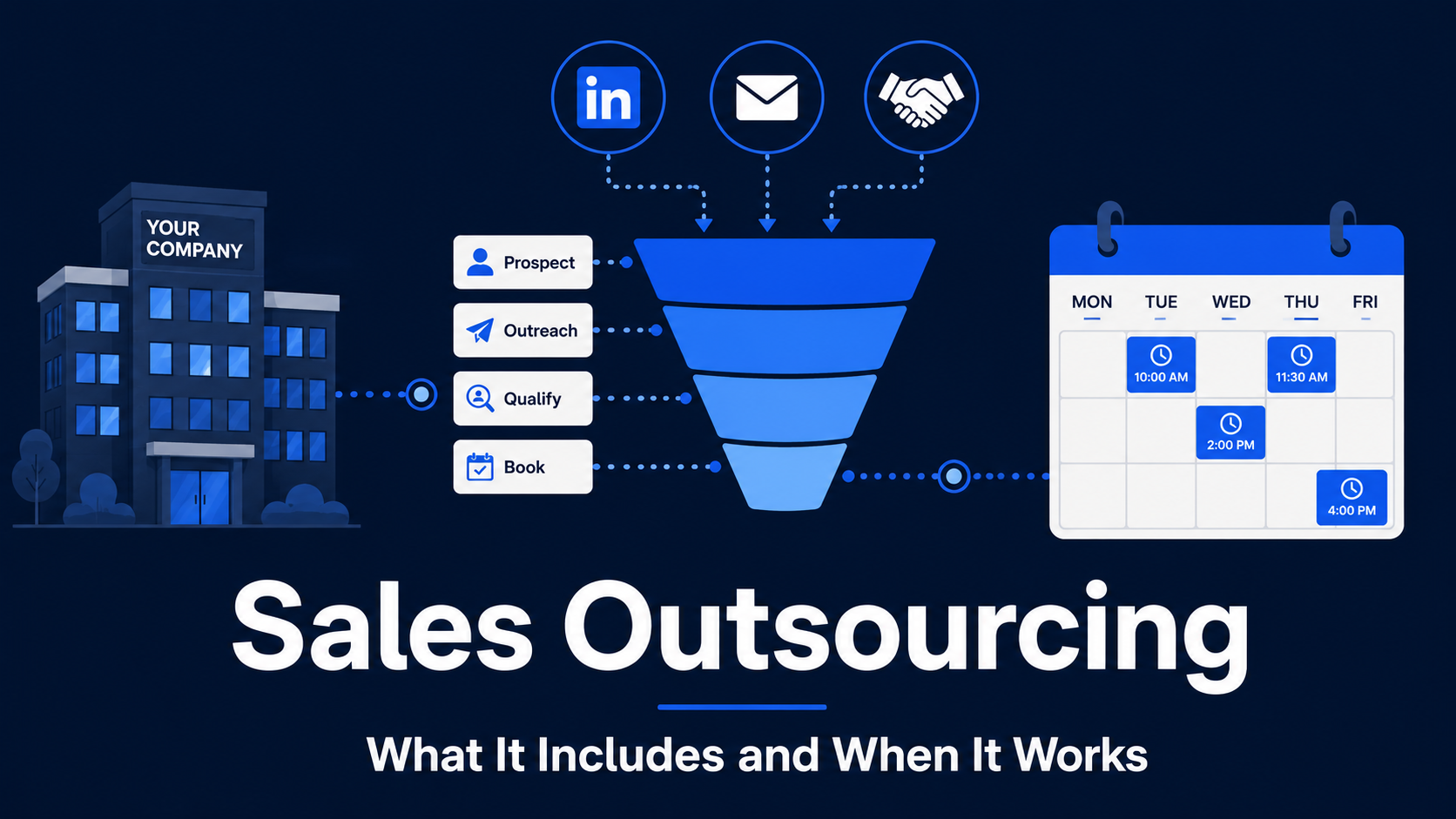
Sales outsourcing is the practice of contracting an external company to run part or all of your sales function — prospecting, outreach, qualification, meeting booking, and in some cases full deal management — rather than building and managing those capabilities in-house. For B2B companies that need pipeline without the cost and time of a full internal sales hire, sales outsourcing has become a structurally significant option.
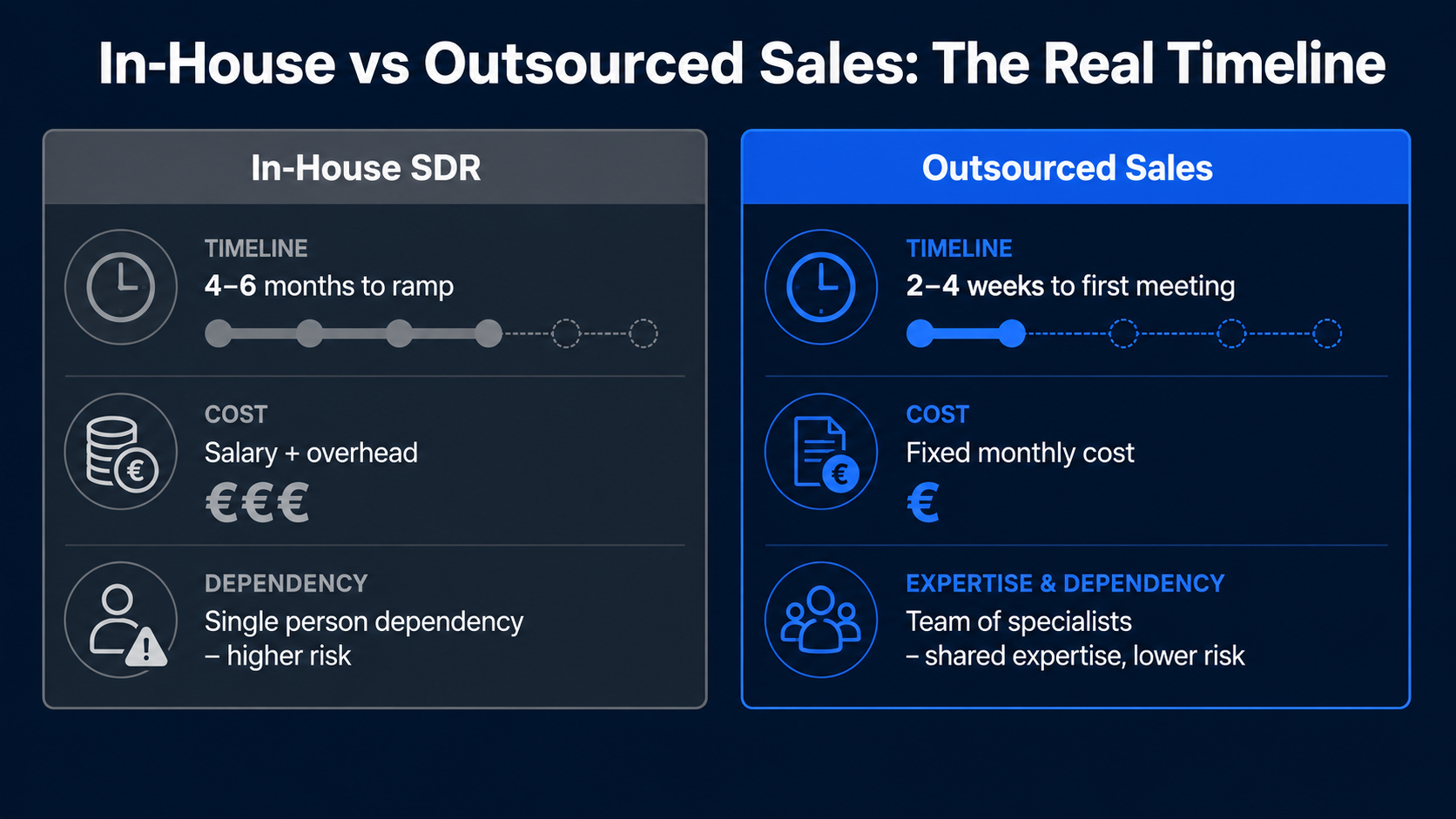
The appeal is straightforward: an experienced outsourced sales team can be operational in weeks rather than months, brings existing market knowledge and outreach infrastructure, and carries a defined monthly cost that's typically a fraction of an equivalent in-house build. The risk is equally clear: an outsourced team working in isolation from your product knowledge and customer feedback can generate meetings that don't convert and attribution that doesn't reflect real pipeline quality.
This guide covers what sales outsourcing actually includes, when it outperforms an in-house team, and how to evaluate providers before committing.
What Sales Outsourcing Includes
Sales outsourcing is not a single service — it spans a range of functions that different providers cover to different depths. Understanding what's included in your specific engagement matters as much as the monthly fee.
Prospecting and list building
The foundation of any outsourced sales engagement is defining who to contact and building verified lists of those people. Strong providers build lists at company and contact level using multiple data sources — firmographic filters (company size, industry, geography, funding stage), technographic signals (tools the company uses), and intent data (companies currently researching relevant solutions). Weak providers use purchased lists with minimal enrichment, which produces high volume and low conversion.
Multi-channel outreach
Outreach is typically run across LinkedIn and email, with the channel balance depending on the target market. LinkedIn is the dominant channel for senior B2B buyers in European markets; email-led approaches work better for high-volume US campaigns or SMB targets. Providers who list multi-channel as a feature but run 90% of their volume through a single channel are not genuinely multi-channel — ask for a breakdown of booked meetings by source.
Qualification and meeting booking
Qualifying responses before booking a meeting is what distinguishes a productive outsourced sales engagement from a volume exercise. A proper qualification step confirms that the contact has relevant authority, a recognisable business need, and genuine timing for a conversation. Providers who book any positive response — "sounds interesting, send me more information" — inflate meeting numbers and collapse your AE's conversion rate.
Meeting logistics
Scheduling, confirmation, reminders, and rescheduling are operational overhead that consumes more time than most companies anticipate before outsourcing. Including this in the engagement means your AEs arrive at calls that are confirmed and expected, not chased.
Reporting and campaign optimisation
Weekly reporting on outreach volume, reply rates, meeting rates, and meeting quality enables continuous improvement. The best outsourced sales teams treat each week's data as a feedback loop that refines targeting and messaging — not just a dashboard that reports what happened.
Full business development (senior engagement model)
Some outsourced sales providers offer a full business development function: dedicated senior sales managers who handle strategy, relationship-building, in-person representation at industry events, and complex multi-stakeholder deals. This model is appropriate for companies with long B2B sales cycles, enterprise ICPs, or market entry requirements.
When Sales Outsourcing Makes Sense
You need pipeline faster than an SDR can ramp
An in-house SDR hire requires 4–6 months of ramp time before producing consistent output — recruitment, onboarding, training, initial outreach calibration, and the first cycle of pipeline feedback. An outsourced sales team that already knows your target market can be in sequence within weeks. For companies with immediate pipeline targets or limited time to first revenue, outsourcing closes a gap that internal hiring cannot.
Your ICP requires market expertise you don't have
Selling into fintech, iGaming, or enterprise IT in European markets requires understanding of how those buyers make decisions, what their objections look like, and which channels they actually respond to. An outsourced provider with established track record in those verticals brings this context on day one. Building it in-house takes time your market window may not allow.
You're entering a new market
Market expansion — geographic or vertical — carries discovery cost. An outsourced sales team absorbs that cost through existing ICP knowledge, while letting your internal team focus on serving existing customers. If the expansion doesn't generate the expected pipeline within a defined test period, the engagement ends without a redundancy process.
Your ACV doesn't yet justify a full sales headcount
For companies with €20,000–€80,000 ACV in early growth stages, the fully-loaded cost of an in-house SDR (salary, NI, benefits, tools, management overhead) typically exceeds 30–40% of the first year's revenue from that hire's pipeline. Outsourcing provides equivalent or superior output at a fraction of the cost until the pipeline volume justifies internal investment.
When Sales Outsourcing Doesn't Work
Sales outsourcing fails predictably in specific scenarios:
- No defined ICP. If you cannot describe your ideal customer at company and contact level — including firmographic profile, decision-maker function, and disqualification criteria — an outsourced team will prospect broadly and produce meetings that don't convert. Define the ICP first.
- No product-market fit signal. Outsourced outreach amplifies what's there. If you have no evidence that outbound converts, outsourcing the function produces expensive non-conversion at scale.
- No AE capacity to run meetings. Booking meetings your team cannot run destroys relationship capital with prospects and wastes the entire engagement.
How to Evaluate Sales Outsourcing Companies
Ask about vertical track record, not just category track record
A provider who has done sales outsourcing for technology companies is not the same as one who has specifically worked with fintech SaaS vendors or iGaming B2B suppliers. Ask for references from clients with a comparable ICP, sales cycle, and market geography.
Require a written definition of qualified
Before signing, agree on a written qualification standard: what role the contact must hold, what they must have confirmed during the exchange, and what disqualifies a response from becoming a meeting. Providers who can't or won't commit to this in the contract are optimising for meeting volume, not pipeline quality.
Evaluate the reporting structure before the meeting volume promise
Ask to see a sample weekly report. Does it show outreach by channel, reply rates, meeting rates, quality signals from AE feedback? Or does it show meetings booked and nothing else? Providers who report only what they control — meetings booked — and not what you need to track — AE conversion rate downstream — cannot help you improve the engagement.
Start with three months
Three months is enough time to see meaningful output from a calibrated sales outsourcing engagement and to evaluate meeting quality across a real pipeline cycle. Providers who require commitments longer than three months before demonstrating results are protecting their own revenue, not your pipeline.
B2B Sales Outsourcing Models
| Model | Best For | Typical Cost Range |
|---|---|---|
| SDR-as-a-service | Pipeline generation, high outreach volume | €2,000–€4,000/month |
| Multi-channel outreach | EU markets, senior buyers, complex ICPs | €3,000–€5,000/month |
| Full business development | Long sales cycles, enterprise ICPs, event-heavy markets | €5,000–€8,000/month |
| Fractional sales director | Strategy + oversight without full-time hire | €3,000–€6,000/month |
| Full outsourced sales team | Complete function replacement, new market entry | €8,000–€15,000/month |
How VirtuWise Runs B2B Sales Outsourcing
VirtuWise provides outsourced sales functions for B2B companies in fintech, iGaming, SaaS, IT services, and AI — with a specific focus on multi-channel pipeline generation across EU and UK markets.
Our outsourced sales engagements include:
- ICP definition and verified list building: company and contact level targeting built from multiple enrichment sources, not purchased lists
- Multi-channel outreach: coordinated LinkedIn and email sequences calibrated for your buyer profile and geography
- Qualification before booking: every meeting confirmed on role, need, and timing before it reaches your AE
- Meeting logistics: scheduling, confirmation, and rescheduling handled end-to-end
- Weekly pipeline reporting: outreach volume, reply rates, meeting rates, quality signals, and AE feedback loop
- Lead Generation: €3,000/month — ICP research, personalised outreach, meeting booking and scheduling, weekly reporting
- Lead Generation Plus: €5,000/month — everything in Lead Generation, plus multi-channel outreach (LinkedIn + email + messengers), A/B testing, higher volume
- Business Development: €7,000/month — full-cycle business development, dedicated senior sales manager, online and offline representation, custom strategy
- Inbound (SEO & AEO): €3,500/month — SEO and AEO run as one service: keyword strategy, content, technical fixes, and AI-crawler visibility (structured data, llms.txt)
- Fractional Growth Partner: Custom — a revenue engine audit, then optional ongoing Advisory or hands-on Implementation
Full details at virtuwise.io/pricing.
Frequently Asked Questions
What does sales outsourcing include?Sales outsourcing typically includes prospect research and list building, multi-channel outreach (LinkedIn and email), response qualification, meeting booking and scheduling, and weekly reporting. More comprehensive engagements include full business development — strategy, senior sales management, event representation, and multi-stakeholder deal support. The scope depends on the provider model and your internal sales capacity.
How much does sales outsourcing cost?B2B sales outsourcing ranges from €2,000/month for SDR-as-a-service to €8,000–€15,000/month for a complete outsourced sales team or full business development function. The relevant benchmark is not the monthly retainer — it's cost per qualified meeting and cost per pipeline opportunity generated. A higher-quality engagement at a higher cost typically produces better ROI than a cheap engagement with high volume and low conversion.
When does sales outsourcing make sense versus hiring in-house?Sales outsourcing typically outperforms hiring in the first 12–18 months of a pipeline programme, when market entry requires immediate expertise, or when ACV doesn't yet justify a fully-loaded in-house SDR. Once you have a validated outbound playbook and consistent pipeline volume, building internal capability alongside the outsourced function makes sense. The two are not mutually exclusive.
How quickly do outsourced sales teams produce results?Quality providers book first meetings within 2–4 weeks of campaign launch. Full velocity — consistent monthly pipeline from an optimised campaign — typically develops by month 2–3 as targeting and messaging are refined on real response data. Expect the first month to be a calibration phase, not peak performance.
What is the difference between sales outsourcing and lead generation outsourcing?Lead generation outsourcing focuses on the top of the funnel — identifying, reaching, and qualifying prospects into meetings. Sales outsourcing is a broader term that can include lead generation but may also encompass later-stage functions: deal progression, relationship management, negotiation support, and in some models full deal closing. Many providers use the terms interchangeably; clarify scope in the contract.
Related reading: