
Revenue Operations Consultant: What They Do, What They Cost, and When to Hire One
A revenue operations consultant aligns sales, marketing, and customer success on shared data and process. Here's what the role covers, what it costs, and how to know if you need one.
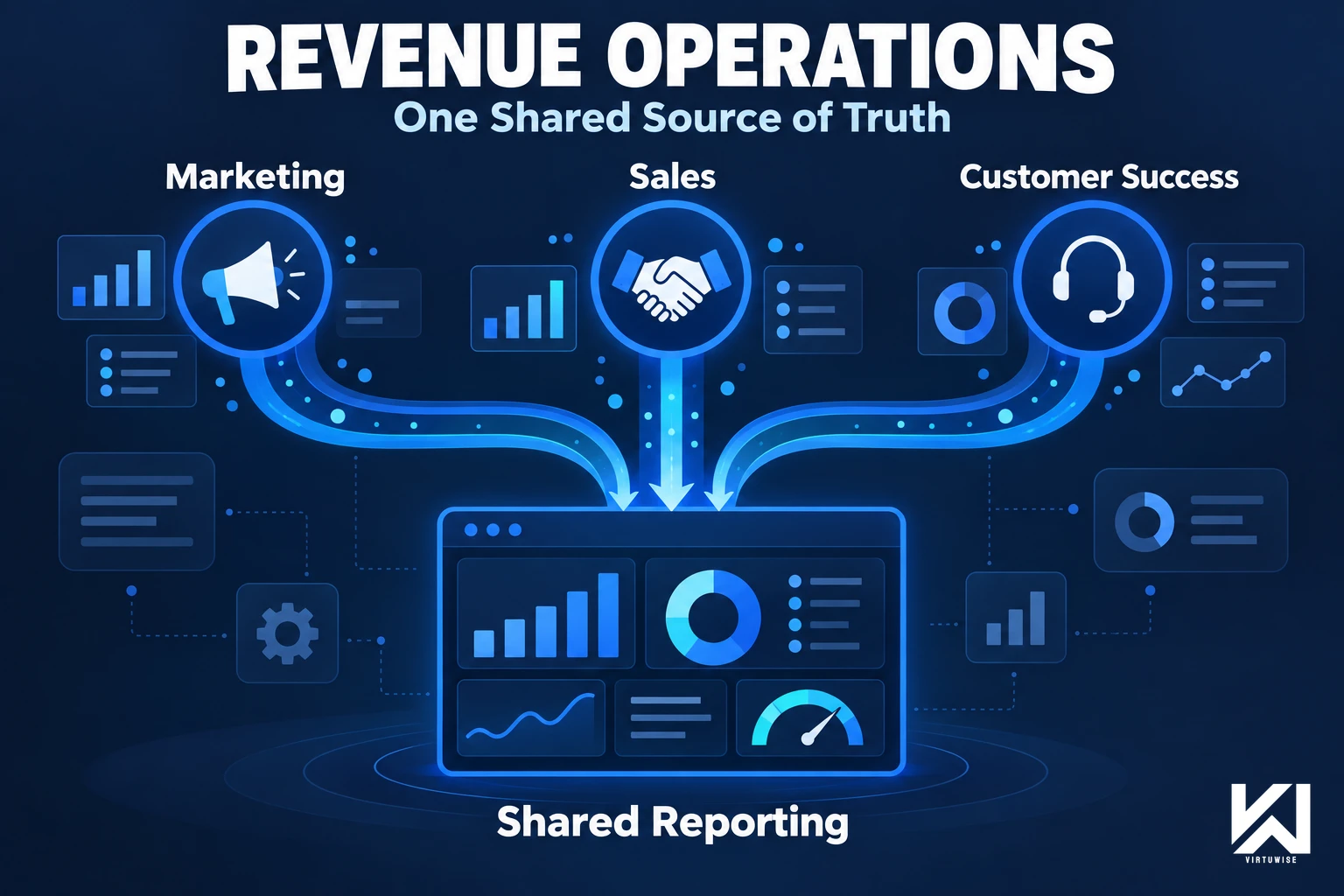
Ask a founder, a VP Sales, and a Head of Marketing at the same company what the current pipeline actually looks like, and it's common to get three different numbers — not because anyone's lying, but because each function is measuring the funnel from inside its own tool, with its own definitions, reporting to its own leadership. Revenue operations exists specifically to close that gap: one shared source of truth, one set of definitions, one process that sales, marketing, and customer success all actually operate from.
This guide covers what a revenue operations consultant actually does, what's typically included in an engagement, what it costs compared to a full-time hire, and how to know if a company genuinely needs one.
What a Revenue Operations Consultant Actually Does
A revenue operations (RevOps) consultant aligns sales, marketing, and customer success operations around shared data, shared metrics, and shared process — rather than letting each function run its own disconnected tooling, definitions, and reporting.
CRM and tech-stack audit
Reviewing what's actually tracked across the revenue tech stack, where data is duplicated or contradictory between tools, and where gaps exist that make basic questions (how many qualified opportunities are open right now?) hard to answer confidently.
Pipeline and forecasting process design
Redesigning how deals move through stages, what qualifies a stage change, and how forecasts get built — the goal being a forecast leadership can actually trust, not one that's consistently off by 30% in either direction.
Cross-functional reporting and dashboards
Building a shared view of the funnel that sales, marketing, and customer success all look at and agree on, replacing the situation where each function pulls its own numbers from its own tool and nobody's totals match.
Compensation and territory alignment
In broader engagements, making sure compensation structures and territory assignments actually incentivize the behavior the go-to-market strategy needs — a RevOps gap here often shows up as reps working at cross purposes with the company's actual priorities.
Full-Time Head of RevOps vs. a Revenue Operations Consultant
| Full-Time Head of RevOps | Revenue Operations Consultant | |
|---|---|---|
| Cost | €120,000–€200,000/yr total comp | Scope-dependent — get a quote against a defined engagement |
| Time to start | 3–5 month search and hire | Typically 2–4 weeks |
| Commitment | Permanent headcount | Part-time or project-based, flexible |
| Best fit | Revenue org large enough to need full-time, ongoing ownership | Validating the RevOps function or fixing specific process gaps before committing to a permanent hire |
A full-time hire makes sense once the revenue organization is large enough that RevOps genuinely needs full-time, ongoing ownership — multiple sales segments, a mature customer success motion, a tech stack complex enough to need continuous management. A consultant makes sense for diagnosing and fixing specific process gaps, or validating that the function is worth a permanent seat before committing to one.
RevOps Agency vs. RevOps Consulting: Different Commitment Shapes
"RevOps agency" and "RevOps consulting" often get used interchangeably, but they describe genuinely different engagement shapes. A RevOps consultant is typically one senior individual, working part-time or project-based, similar in shape to a fractional executive — strong for strategic input, process redesign, and periodic oversight. A RevOps agency provides an ongoing team engagement, sometimes with multiple specialists (CRM administration, analytics, process design) working continuously — a better fit for companies that want hands-on, ongoing implementation support rather than periodic strategic guidance from a single person.
Neither is inherently better — it depends on whether the gap is strategic (a consultant can usually close it) or requires sustained, hands-on execution capacity (an agency's ongoing team is built for that).
When to Hire a Revenue Operations Consultant
- Disconnected data across functions — sales, marketing, and customer success can't agree on basic funnel numbers because each is pulling from its own tool with its own definitions
- Forecasting that's consistently wrong — not occasionally off, but reliably unreliable in a way that's eroding leadership's confidence in the numbers
- Growth outpacing current process — the reporting and process that worked at an earlier stage can't keep up with current deal volume or team size
- Preparing for a fundraise or tighter board reporting — investors and board members will scrutinize the underlying data, and it needs to hold up
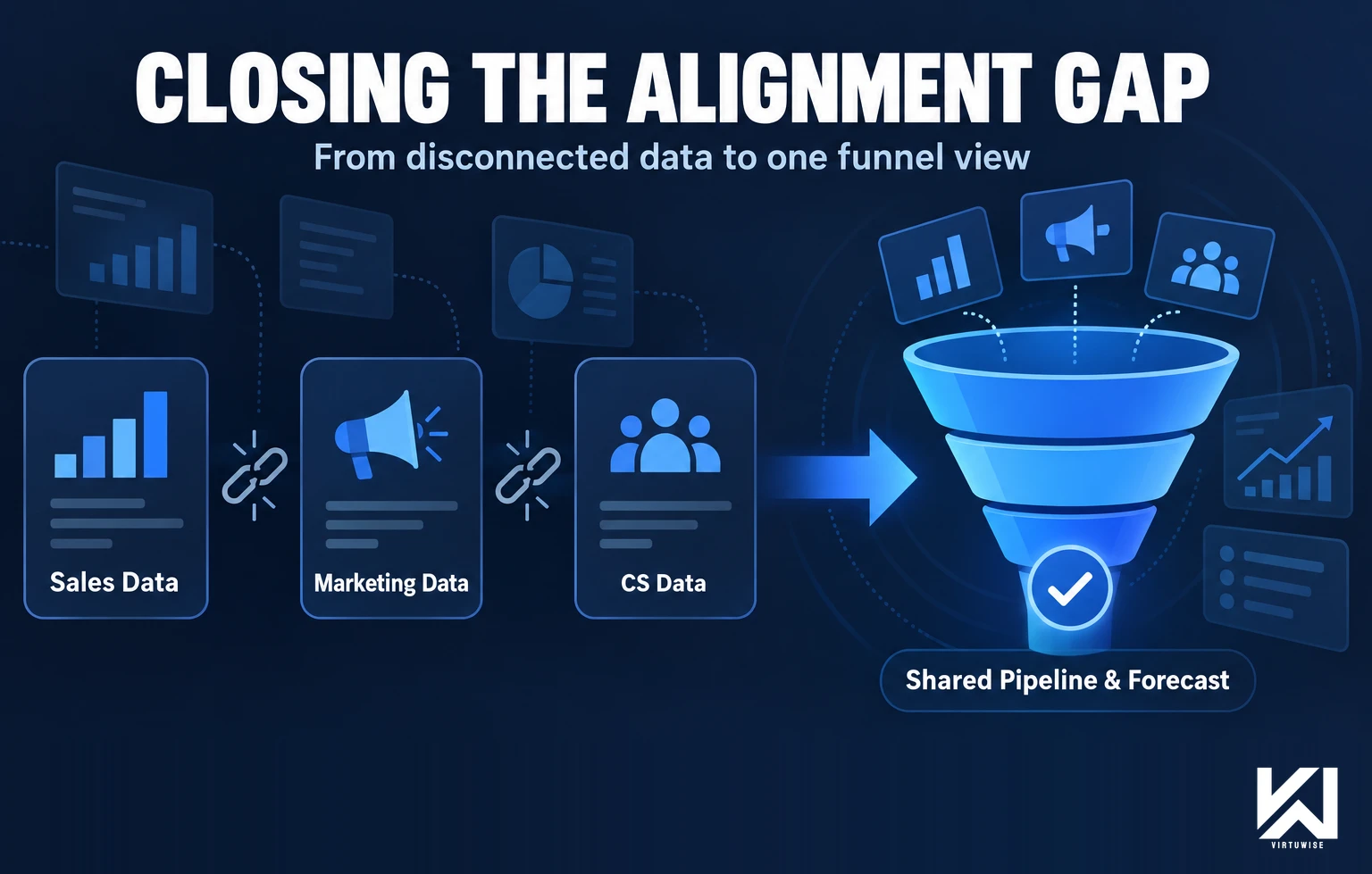
Put together, this is the shape of what a RevOps engagement typically untangles — three functions running on separate data feeding into one shared, trustworthy view:
How This Overlaps With VirtuWise's Fractional Growth Partner
There's real overlap worth being direct about, and a real difference worth being equally direct about. A revenue operations consultant is typically narrower and more operationally focused — the CRM, the reporting mechanics, the forecasting process. VirtuWise's Fractional Growth Partner engagement operates at a broader, more strategic layer: an outsourced-CMO-style audit of ICP and positioning, full-funnel mapping across Outbound, Inbound, and product-led motion, and a prioritized written growth roadmap.
In practice, a company might need one, the other, or both in sequence — the growth-strategy audit surfacing that the underlying RevOps process needs fixing before the strategy can actually execute, for instance. We don't position Fractional Growth Partner as a replacement for hands-on RevOps implementation; it's a different layer of the same problem.
Fractional Growth Partner is Custom-priced and scoped on an initial call, with no obligation to continue past the audit itself. Full details at virtuwise.io/services/fractional-growth-partner and virtuwise.io/pricing.
Frequently Asked Questions
What does a revenue operations consultant do?A revenue operations consultant aligns sales, marketing, and customer success around shared data, shared metrics, and shared process — instead of each function running its own disconnected tooling and reporting. Day-to-day work includes auditing the CRM and tech stack, redesigning pipeline and forecasting process, building cross-functional dashboards, and sometimes aligning compensation or territory structure to the same shared goals.
What's included in revenue operations consulting?Revenue operations consulting typically includes a CRM and tech-stack audit (what's tracked, what's duplicated, what's missing), pipeline and forecasting process redesign, cross-functional reporting and dashboards that give sales, marketing, and customer success a shared view of the funnel, and — depending on scope — compensation and territory alignment work. Scope varies: some engagements focus narrowly on forecasting accuracy, others take broader ownership of the full revenue tech stack and process.
How much does a revenue operations consultant cost?A full-time Head of Revenue Operations at a growth-stage company typically costs €120,000–€200,000 in total compensation (base plus bonus/equity), rising higher at larger scale. Consultant/fractional rates vary widely by scope and seniority — worth getting a specific quote against a defined engagement rather than anchoring to a single published figure. [needs source: independent benchmark data on typical fractional/consultant RevOps monthly rates]
RevOps consultant vs RevOps agency — what's the difference?A RevOps consultant is typically one senior individual working part-time or project-based with a company, similar to a fractional executive. A RevOps agency provides an ongoing team engagement — sometimes across multiple specialists (CRM admin, analytics, process design) — a different commitment shape than a single consultant's part-time involvement, generally suited to companies wanting more hands-on, continuous execution rather than periodic strategic input.
When should a company hire a revenue operations consultant?The clearest signals: sales, marketing, and customer success are working from disconnected data and can't agree on basic funnel numbers; forecasting is consistently wrong in either direction; growth has outpaced the current process and reporting can't keep up; or the company is preparing for a fundraise or more rigorous board reporting and needs the underlying data to actually hold up under scrutiny.