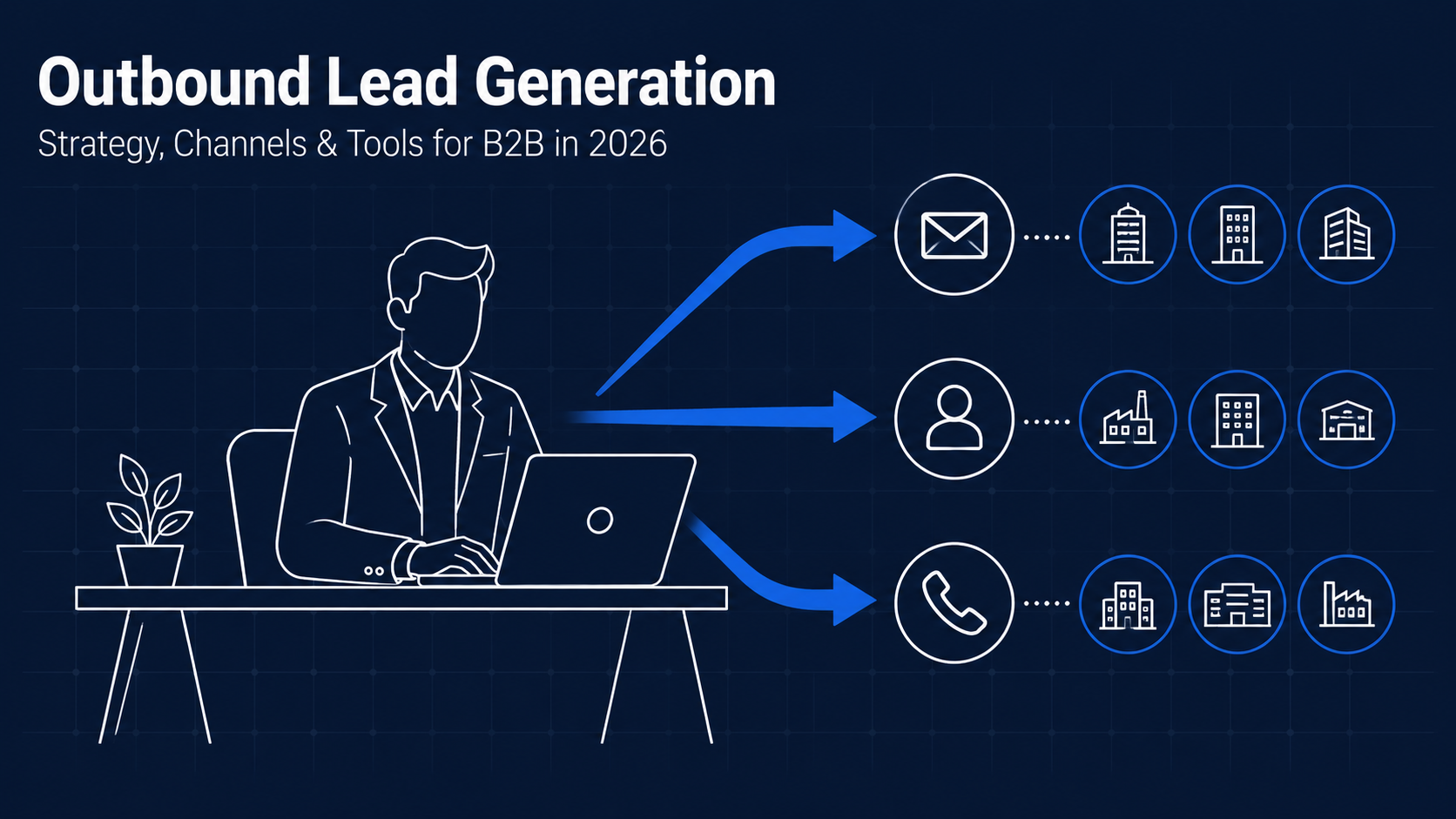
Outbound Lead Generation: Strategy, Channels, and Tools for B2B in 2026
Outbound lead generation gives B2B teams direct control over pipeline. Here's the full strategy framework, channel benchmarks, and what separates high-performing outbound from wasted spend.
Most B2B pipeline problems are not problems of market size or product quality. They are problems of waiting. Companies wait for inbound leads to mature, for content to rank, for word of mouth to spread — while their CRM stays thin and quarterly targets slip.
Outbound lead generation exists to solve exactly this problem. It is proactive, targeted, and controllable. Done correctly, it produces a consistent flow of qualified meetings with the exact decision-makers you want in the room — without depending on search algorithms or content timelines.
This guide covers everything you need to build or improve a B2B outbound system in 2026: the strategic framework, the four core channels, sequence design, benchmarks, tools, and how to decide whether to build in-house or outsource.
What Is Outbound Lead Generation (and How It Differs from Inbound)
Outbound lead generation is the process of proactively reaching out to potential customers who have not previously expressed interest in your product or service. Your team initiates contact — through email, LinkedIn, phone, or a combination — rather than waiting for buyers to find you.
Inbound lead generation works in reverse: you create content, run ads, or build SEO presence that attracts buyers who are already searching. The quality of inbound leads tends to be high because intent is demonstrated. The tradeoff is time — meaningful inbound traffic typically requires 6–18 months to build.
The distinction matters because the two motions require different infrastructure, different skills, and different timelines. For a detailed comparison, see our breakdown of inbound vs outbound sales.
Outbound is not the same as outbound marketing, though the terms overlap. Outbound marketing refers broadly to paid advertising, direct mail, and interruptive media. Outbound lead generation in B2B refers specifically to direct, personalised outreach to targeted decision-makers — through channels like cold email and LinkedIn.
The practical difference:- Inbound: buyer raises hand → you respond → you qualify → you close
- Outbound: you identify buyer → you initiate contact → you earn attention → you qualify → you close
Neither is inherently better. The best B2B revenue organisations use both. But outbound is the faster path to a first meeting, and the only motion that gives you direct control over who you are selling to.
Why Outbound Still Works in 2026 (and Why Most Companies Do It Wrong)
Outbound lead generation has been declared dead approximately once a year since 2015. It keeps working because the underlying dynamic has not changed: decision-makers still buy from people who reach them with relevant messages at the right moment.
What has changed is the noise level. Cold email inboxes are more crowded. LinkedIn connection requests are more frequent. The bar for what counts as a relevant, credible outbound message has risen significantly. The companies that say outbound is dead are almost always doing it the same way they did it in 2018 — mass-blast templates, vague value propositions, and no personalisation.
What makes outbound work in 2026:
- Precision over volume. Sending 5,000 generic emails to a poorly defined list produces worse results than sending 500 targeted emails to a well-defined ICP with research-backed personalisation. Outbound performance is a function of list quality and message relevance, not volume alone.
- Multi-channel coordination. Running email and LinkedIn in a coordinated sequence outperforms either channel in isolation by a factor of 2–3× on reply rate. Decision-makers are more likely to respond when they have seen your name and profile before receiving your message.
- Sequence discipline. Most outbound fails because teams give up after one or two touches. B2B buyers often need 6–12 touchpoints before responding. A structured sequence with the right cadence and the right message at each stage significantly improves conversion.
- Clear ICP. Trying to reach everyone is how you reach no one. High-performing outbound starts with a precise ideal customer profile — industry, company size, geography, tech stack, buyer role — and builds everything else around it.
For a deeper look at how outbound email can function as a revenue channel, see B2B email outreach as a revenue channel.
The Four Outbound Channels: Cold Email, LinkedIn, Phone, and Multi-Channel
Cold Email
Cold email remains the most scalable outbound channel for B2B in terms of cost-per-touch. A well-configured email infrastructure allows one SDR to run sequences across hundreds of prospects simultaneously.
The challenge is deliverability. Gmail and Microsoft have tightened spam filters significantly. Running outbound email in 2026 requires:
- Separate sending domains (not your primary domain)
- Proper SPF, DKIM, and DMARC configuration
- Warm-up periods for new sending infrastructure
- Controlled sending volume and sending patterns
- Monitoring bounce rates and spam complaint rates
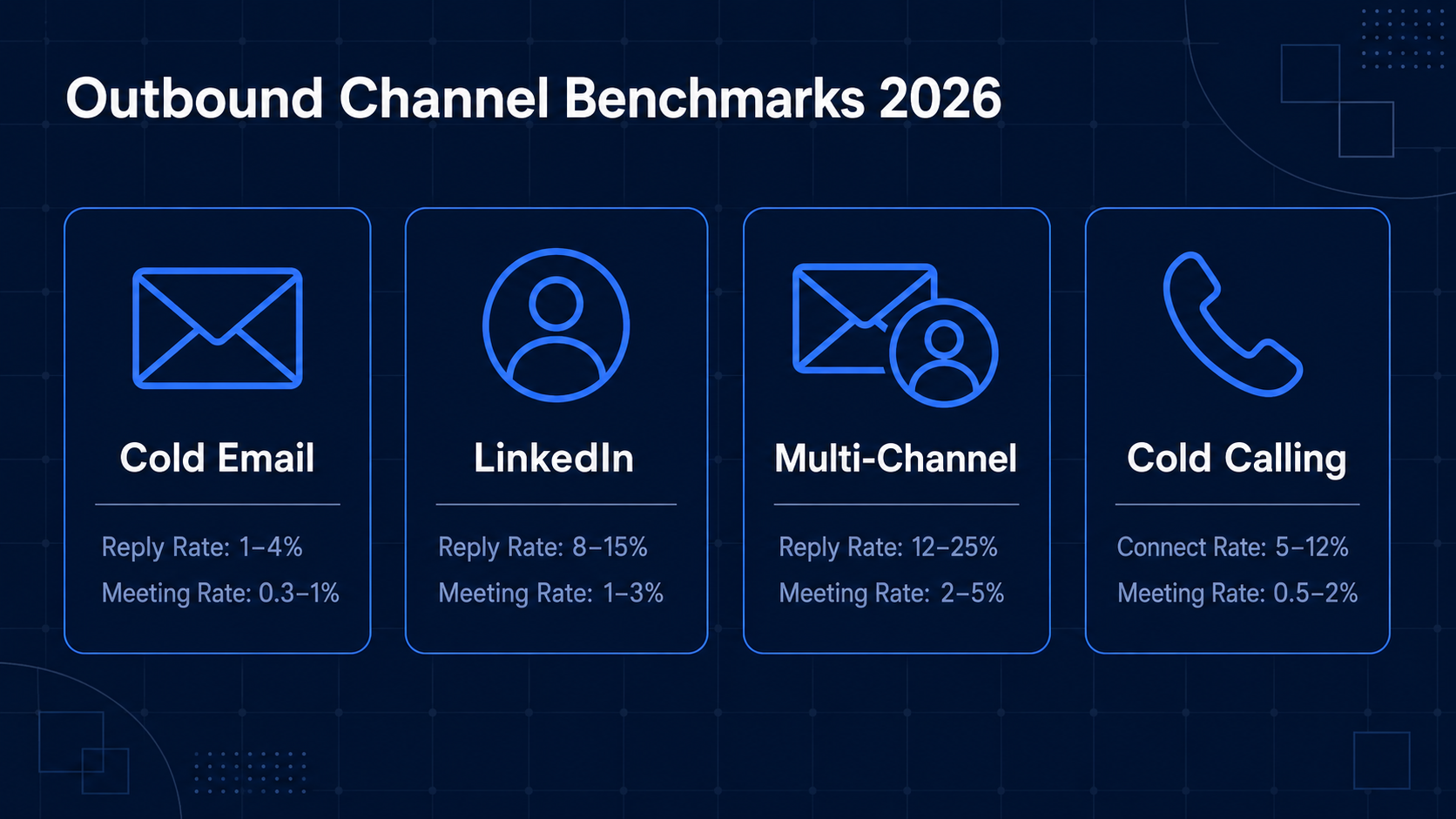
When infrastructure is properly set up, cold email produces typical reply rates of 1–4% across the full list. Positive reply rates (people expressing interest rather than unsubscribing) run at 0.5–1.5%. These numbers look small, but at scale — 1,000 contacts per month — a 1% positive reply rate produces 10 qualified conversations.
Message structure matters as much as delivery. The best-performing cold emails are short (under 120 words), lead with a specific and relevant pain point, and have one clear call to action. See our B2B cold email templates guide for sequence examples that have produced results.
LinkedIn Outreach
LinkedIn is particularly effective in EU and UK markets where cold calling has declined and buyers spend meaningful time on the platform. For fintech, IT services, and AI/SaaS segments, LinkedIn outreach to VPs, C-level, and senior directors produces higher engagement than email alone.
Typical LinkedIn performance metrics for well-targeted B2B outreach:
- Connection acceptance rate: 20–35%
- Reply rate on accepted connections: 15–25%
- Meeting booking rate from LinkedIn conversations: 5–15% of replies
LinkedIn sequences follow a different rhythm than email. Connection requests need to include a brief, non-salesy note. Post-connection messages should start with something genuinely relevant — a shared connection, a recent post they made, a company trigger — before moving to value. Pitching in the first message after connection is the single most common LinkedIn outreach mistake.
Cold Calling
Cold calling in EU markets has declined sharply as buyer preferences shifted toward asynchronous communication and GDPR compliance requirements created friction around unsolicited calls. In the US, calling remains more culturally accepted and continues to work for mid-market and SMB segments.
For EU B2B outbound, cold calling functions best as a follow-up channel — not a primary one. Calling after two or three email touches, when the prospect has at least seen your name, produces better outcomes than cold-call first approaches.
For enterprise accounts (€50K+ ACV), phone conversations become more important later in the qualification cycle, once interest has been established through email or LinkedIn. But the initial contact in EU enterprise outbound is almost always digital.
Multi-Channel Outbound
Combining email and LinkedIn in a coordinated sequence is the standard for high-performing B2B outbound teams in 2026. Reply rates for multi-channel sequences run 2–3× higher than single-channel equivalents.
The reason is simple: multiple touchpoints across different channels create familiarity. A prospect who declined your connection request may still open your email. One who ignored your email may respond when they see your LinkedIn profile has a relevant post in their feed. The combination builds a presence that a single channel cannot.
Adding phone as a third channel — for accounts that justify the extra effort — pushes reply rates higher still, particularly for mid-market segments with high deal values.
Building Your Outbound Strategy: The 6-Step Framework
Effective outbound lead generation is not a series of ad hoc messages. It is a system with clearly defined inputs, processes, and outputs. These are the six components every B2B outbound strategy requires.
Step 1: ICP Definition
Your ideal customer profile is the foundation everything else is built on. An ICP that is too broad produces low reply rates, poor meeting quality, and wasted spend. An ICP that is too narrow limits the addressable market.
A useful ICP for outbound includes: industry vertical, company size range (headcount and/or revenue), geography, tech stack indicators (where relevant), buyer role and seniority, and — where possible — behavioral or situational signals (recent funding, headcount growth, new market entry).
Step 2: List Building
Your list is only as good as your data sources. For EU-compliant B2B outbound, this means sourcing contact data from GDPR-compliant platforms that provide legitimate interest basis for commercial contact. Apollo, Clay, and LinkedIn Sales Navigator are the standard tools. List quality directly determines outreach quality — bad data produces bad results regardless of messaging quality.
For a detailed process, see our B2B prospecting guide.
Step 3: Messaging Development
Outbound messaging should be researched and segmented, not generic. The best-performing message frameworks lead with a pain or trigger specific to the prospect's situation, establish credibility concisely, and propose a low-commitment next step (a short call or a question, not a product demo request on the first touch).
Different ICPs require different messaging angles. A VP of Sales at a 200-person fintech company has different priorities than a Head of Partnerships at an iGaming operator. One message for all is a guaranteed path to low reply rates.
Step 4: Sequence Design
A sequence is the series of touchpoints across channels and timing that constitutes your outreach campaign. See the dedicated section below for sequence structure.
Step 5: Qualification
Not every reply is a qualified opportunity. Qualification criteria should be defined before outreach begins — so that when replies come in, the team responds quickly and moves genuinely interested prospects efficiently to the next stage. Common qualification criteria: budget authority, relevant problem, company size match, decision-making timeline.
Step 6: Handoff
Outbound's job is to generate qualified meetings. The handoff from outbound to account executive (or founder, or whoever runs the sales call) needs to be clean: context on the prospect, their specific situation, what was discussed in the outreach, and what they were promised. A clean handoff protects close rates.
Outbound Sequence Design: How to Structure Your Touchpoints
A common misconception is that outbound means sending one email and following up once. In practice, B2B buyers respond across a wide distribution of touchpoints. Some reply on touch one. Many respond on touch five or six. Giving up early is one of the most expensive mistakes in outbound.
Here is a proven multi-channel outbound sequence structure for B2B:
| Day | Channel | Action |
|---|---|---|
| Day 1 | Send connection request with brief personalised note | |
| Day 3 | First cold email — lead with specific pain or trigger | |
| Day 5 | DM after connection is accepted — short, not a pitch | |
| Day 7 | Follow-up #1 — different angle, add a data point or insight | |
| Day 10 | Follow-up #2 — value-add (relevant resource, case study, or insight) | |
| Day 14 | Breakup email — acknowledge they may not be the right fit, open door |
This sequence produces 8–10 touchpoints across two channels over roughly two weeks. Each message should stand on its own — prospects should not need to have read the previous email to understand the current one.
Key principles:
- Day 1 LinkedIn connect: Do not pitch in the connection note. A brief observation or genuine reason for connecting is enough.
- Day 3 first email: Short. Under 120 words. One clear call to action.
- Day 5 LinkedIn DM: If they accepted the connection, a brief message that references context — not a copy-paste of the email.
- Day 7 follow-up: New angle. Do not just say "following up on my previous email."
- Day 10 value-add: Share something useful — a relevant stat, a short insight, a resource. Makes you memorable even if the timing isn't right.
- Day 14 breakup: The breakup email frequently generates replies from prospects who were interested but had not responded. A polite, non-pressuring sign-off often prompts a response.
After the sequence ends, move non-respondents to a low-frequency nurture track (one email per month) or re-engage in 60–90 days with a fresh angle.
Key Metrics for Outbound Lead Generation
Tracking the right metrics is the difference between knowing your outbound is working and guessing. These are the primary KPIs for B2B outbound, with benchmarks by channel.
Core outbound metrics:- Reply rate: All replies as a percentage of contacts reached
- Positive reply rate: Interested or qualified replies as a percentage of contacts reached
- Meeting rate: Meetings booked as a percentage of contacts reached (or as a percentage of positive replies)
- Qualified meeting rate: Meetings that meet your qualification criteria as a percentage of all meetings booked
- Pipeline value generated: Total pipeline value of opportunities created from outbound
- Cost per meeting: Total outbound spend divided by meetings booked
Outbound Benchmarks by Channel
| Channel | Typical Reply Rate | Positive Reply Rate | Meeting Rate | Cost per Meeting | Best For |
|---|---|---|---|---|---|
| Cold Email (single channel) | 1–4% | 0.5–1.5% | 0.3–1% | €80–€200 | Scale, SMB/mid-market |
| LinkedIn (single channel) | 15–25% of accepted connections | 5–12% of accepted | 2–6% of connected | €120–€300 | EU B2B, enterprise |
| Multi-channel (Email + LinkedIn) | 3–8% of contacts | 1.5–3.5% | 0.8–2.5% | €60–€180 | Mid-market/enterprise |
| Cold Calling (EU) | N/A | 2–6% of dials | 0.5–1.5% | €150–€400 | US markets, SMB |
Note: these benchmarks reflect well-executed outbound with solid ICP definition, good data, and proper infrastructure. Poorly targeted outbound with weak messaging performs significantly below these ranges.
EU Outbound: What's Different From US
B2B outbound in EU markets operates under different rules — legal, cultural, and tactical — than US outbound. Understanding these differences is critical for any company expanding into EU or running EU-focused campaigns.
GDPR complianceEU outbound email must comply with GDPR. This does not mean cold outreach is prohibited — B2B cold email to professional contacts at business addresses is generally permitted under the legitimate interest basis, subject to conditions. However, it does require:
- Sourcing data from compliant providers
- Including unsubscribe/opt-out in every email
- Honouring opt-outs promptly
- Not targeting individual consumers (B2C outbound is different)
Working with an outbound provider who understands GDPR data sourcing is essential for EU campaigns. All VirtuWise campaigns use GDPR-compliant EU data sourcing.
LinkedIn outperforms cold calling in EUIn EU markets — particularly Germany, France, Benelux, and Nordics — cold calling to business contacts is culturally less accepted and produces lower results than in the US. LinkedIn is the primary B2B outreach channel across most EU markets. Decision-makers are reachable, often active, and more likely to respond to well-crafted LinkedIn messages than to unsolicited calls.
Longer sales cyclesEU B2B deals, particularly at €30K+ ACV, run on longer timelines than comparable US deals. Decision-making processes involve more stakeholders, procurement requirements are often more formal, and trust-building takes longer. Outbound in EU markets needs to account for 3–9 month sales cycles. This means pipeline volume, not just meeting volume, needs to be tracked.
Relationship-driven buyingEU buyers — especially in DACH, Nordics, and UK markets — weight supplier relationships and trust more heavily than US counterparts, who are more comfortable with transactional vendor switching. Outbound messaging that leads with credibility signals, references, and relevant social proof outperforms pure features/benefits pitches.
Outbound Tools: What You Actually Need
The outbound technology stack has expanded significantly. Here is what high-performing B2B outbound teams actually use, by function.
Prospecting and list building- Apollo.io — Large database, good filters, EU data included. Works well for most B2B segments. Integrate with CRM directly.
- Clay — Data enrichment and waterfall prospecting across multiple sources. Ideal for building highly targeted lists with custom fields.
- LinkedIn Sales Navigator — Essential for LinkedIn-based prospecting and building lists directly in LinkedIn's ecosystem.
- Instantly — Widely used for outbound email at scale. Good deliverability tools and inbox rotation.
- Smartlead — Alternative to Instantly with strong deliverability features and campaign management.
- Lemlist — Email + LinkedIn sequences, personalisation at scale (personalised images/videos).
- Expandi — Cloud-based LinkedIn automation with safety limits designed for compliant outreach.
- Dripify — LinkedIn drip campaign tool with sequence management and analytics.
- HubSpot — Strong for mid-market outbound teams, good CRM + sequences integration.
- Pipedrive — Simpler pipeline management, popular with SMB and lean sales teams.
The minimum viable outbound stack is: a prospecting tool (Apollo or Sales Navigator), an email sequencing tool (Instantly or Smartlead), and a CRM (HubSpot or Pipedrive). LinkedIn automation adds significant lift for EU and UK markets and should be part of any multi-channel motion.
Do not over-invest in tools before validating your ICP and messaging. The best tools in the world do not compensate for targeting the wrong people with the wrong message.
When to Build Outbound In-House vs Outsource
This is the question most B2B companies eventually face. The answer depends on your current stage, budget, and how validated your ICP and market are.
Outsource outbound when:- You are entering a new market or testing a new ICP and need results faster than an internal hire can deliver
- You do not yet have an SDR function and need to validate outbound before committing to full-time headcount
- Your in-house sales team is at capacity on existing pipeline and you need additional meeting flow without disrupting the current operation
- You want multi-channel outbound (email + LinkedIn) running simultaneously with proper deliverability infrastructure already in place
- Your ICP and messaging are fully validated and you are scaling a proven playbook
- You have enough volume to justify a full-time SDR or outbound team (typically 10+ meetings per month as a minimum baseline)
- You have the management capacity to hire, train, and optimise an SDR function
For a detailed comparison of the economics and risks, see in-house vs outsourced sales and inside sales outsourcing.
VirtuWise: Outbound Lead Generation for EU, UK, and US B2B Markets
VirtuWise is a B2B outbound lead generation agency specialising in fintech, iGaming, IT services, and AI companies operating in EU, UK, and US markets.
Our service model is built around the full outbound stack: ICP definition and list building, multi-channel sequencing (cold email + LinkedIn), GDPR-compliant EU data sourcing, and qualified meeting delivery directly to your sales team or founders.
We have booked over 1,000 meetings for clients across these verticals and maintain a 96% client retention rate over the past six months — not because we promise volume, but because we build outbound programs that generate pipeline that actually closes.
Our service tiers:- Lead Generation — €3,000/month: Multi-channel outbound (email + LinkedIn), ICP definition and list building, GDPR-compliant data sourcing, sequence management, and monthly reporting. Designed for companies running their first structured outbound motion.
- Lead Generation Plus — €5,000/month: Everything in Lead Generation, plus expanded volume, more ICP segments, and dedicated sequence optimisation. For companies scaling an existing outbound motion or running outreach across multiple ICPs simultaneously.
- Business Development — €7,000/month: Full business development service including outbound, partnership development, and senior-level commercial support. For companies that need more than a meeting-booking function.
- Inbound (SEO & AEO) — €3,500/month: SEO and AEO run as one service, for companies whose buyers research before they talk to sales.
- Fractional Growth Partner — custom: a revenue engine audit, then optional ongoing Advisory or hands-on Implementation.
All programmes include full deliverability infrastructure — we do not use your primary sending domain, and we manage all technical setup from day one.
See full pricing and programme details →If you are running outbound now and not seeing results, or if you are planning your first outbound programme, our team can walk through your ICP, your current messaging, and what a realistic outcome looks like for your market. Get in touch →
How to Evaluate an Outbound Lead Generation Programme
Whether you are building in-house or evaluating an outsourced provider, these are the questions that separate functional outbound from wasted spend.
1. Is the ICP specific enough?A well-defined ICP includes industry, size, geography, seniority, and ideally one or two behavioral signals. If the answer to "who are you targeting" is "B2B companies with a sales team," the ICP needs more work.
2. What does the data sourcing process look like?For EU campaigns, data must be GDPR-compliant. Ask specifically: what source do contacts come from, and what is the legal basis for outreach?
3. How is deliverability managed?Cold email that lands in spam is not cold email — it is wasted effort. Ask about infrastructure: separate sending domains, warm-up process, bounce rate monitoring, inbox rotation.
4. What does the sequence look like?Effective outbound has 6–12 touchpoints across multiple channels over 10–14 days. A sequence of two emails is not a sequence — it is an experiment with insufficient data.
5. How is quality measured?Meetings booked is a vanity metric if half the meetings do not show up or are not qualified. Track positive reply rate, show rate, and qualified meeting rate alongside volume.
6. What happens after the sequence?Non-responders should move to nurture. Responders who are not ready should be tracked for re-engagement. Outbound programmes with no post-sequence process leave pipeline on the table.
Frequently Asked Questions
What is outbound lead generation in B2B? Outbound lead generation in B2B is the process of proactively contacting potential customers who have not expressed prior interest. Your team identifies target accounts and decision-makers, then initiates contact through channels like cold email, LinkedIn, or phone to start a conversation and book a meeting. What is a realistic reply rate for B2B outbound? For well-targeted cold email, expect 1–4% total reply rate and 0.5–1.5% positive reply rate. LinkedIn outreach to accepted connections runs at 15–25% reply rate. Multi-channel sequences (email + LinkedIn combined) typically produce 3–8% reply rates on the contacted list. These assume solid ICP definition, clean data, and properly configured deliverability infrastructure. How many touchpoints does B2B outbound require? Most high-performing B2B outbound sequences run 8–12 touchpoints across 10–14 days. Single-touch outreach consistently underperforms because a large proportion of buyers who eventually respond do so after touch four, five, or six. A structured sequence across email and LinkedIn significantly improves conversion versus one or two messages. Is cold outreach GDPR-compliant in the EU? B2B cold email to professional contacts at business email addresses is generally permitted under GDPR's legitimate interest basis, subject to conditions including clear opt-out mechanisms and data sourcing from compliant providers. Cold outreach to individual consumer email addresses follows different rules. Working with an agency experienced in EU outbound is the safest way to ensure compliance. When should a B2B company outsource outbound rather than hire in-house? Outsourcing makes sense when you are testing a new market or ICP, when you need results faster than an internal hire delivers, or when you want multi-channel outbound running without the infrastructure investment. Building in-house makes sense when the ICP is validated, volume justifies full-time headcount, and you have management capacity for an SDR function. What tools do B2B outbound teams use in 2026? The standard stack: Apollo or Clay for prospecting and list building; Instantly, Smartlead, or Lemlist for email sequencing; Expandi or Dripify for LinkedIn automation; HubSpot or Pipedrive as CRM. The minimum viable setup is a prospecting tool, an email sequencer, and a CRM. LinkedIn automation adds significant lift for EU and UK markets.The Bottom Line
Outbound lead generation in 2026 is not about sending more emails or connecting with more people on LinkedIn. It is about building a precise, coordinated system that puts relevant messages in front of the right decision-makers, at the right time, across the right channels.
The framework is clear: define a sharp ICP, build a clean list, develop segment-specific messaging, run a multi-channel sequence with enough touchpoints, track the right metrics, and continuously optimise. Companies that do this consistently generate predictable pipeline regardless of what their SEO or content strategy is doing in any given quarter.
Outbound does not replace inbound. The best revenue organisations use both. But outbound is the lever you can pull today — it does not wait for algorithms or compounding. If your pipeline is inconsistent or you are entering a new market, outbound is how you get qualified meetings on the calendar while everything else matures.
Ready to build a B2B outbound programme that generates qualified meetings? See how VirtuWise works → or review our pricing →
Related reading: - Inbound vs Outbound Sales: Which Model Fits Your Stage - B2B Cold Email Templates That Book Meetings - B2B Prospecting Guide: How to Build a Target List That Converts - Inside Sales Outsourcing: What to Expect and When It Makes Sense