
Best B2B Lead Generation Agency: How to Choose the Right Partner (2026)
Looking for a B2B lead generation agency that actually delivers? We compare the top 7 options in 2026 — models, channels, fit, and red flags to avoid.
Hundreds of options when you search for a B2B lead generation agency in 2026. They all speak the same language: qualified meetings, predictable pipeline, proven methodology.
From the outside, the offers look nearly identical. The differences only become clear after onboarding — usually when the calendar is still empty four weeks in, and the agency is explaining why the ICP needs more "refinement."
Choosing the wrong partner costs more than money. It costs you time, internal momentum, and often the window to prove outbound works before the next budget conversation.
This article covers the agencies worth considering in 2026, what separates them, and how to evaluate them based on what actually predicts results.
What You're Actually Buying When You Hire a Lead Generation Agency
A B2B lead generation agency is supposed to deliver qualified sales meetings — prospects who match your ideal customer profile, have a problem your solution addresses, and have agreed to talk to your sales team.
That sounds simple. In practice, the definition of "qualified" varies enormously between agencies. So does the scope of work. Some agencies handle the full system: ICP definition, list building, outreach execution, response qualification, and meeting coordination. Others handle one piece — usually outreach — and hand off everything else to your team.
Neither model is wrong. But if you're expecting a full-system partner and you're getting a managed email tool, the engagement will disappoint regardless of how well the outreach performs.
In 2026, the market has sorted into three basic models:
Outbound-first agenciesrun LinkedIn outreach, cold email, and multi-channel sequencing. They target decision-makers directly, control the messaging, and can get you that all-important first meeting within weeks. This is a good bet for companies that are in real need of new pipeline or are venturing into new markets.
Demand generation and inbound agenciesbuild pipeline through content, paid media, SEO, and account-based marketing. Lead flow builds slowly but compounds. This model requires runway — typically 6–12 months before it produces consistent volume. It works after product-market fit is established, not before.
Full-cycle business development partnerscover outreach through active deal progression. For companies that need outsourced lead generation to function as a full sales function, not just a source of meetings.
Most confusion in agency selection starts here — picking the model that sounds most sophisticated rather than the one that fits the stage.
The Best B2B Lead Generation Agencies in 2026
Each agency below has a consistent track record across Clutch and G2, verified client outcomes, and a meaningfully different approach. Each is built for a specific situation — and the right fit depends more on your stage and market than on any agency's brand recognition.
Belkins
Model: Outbound appointment setting Best for: Mid-size B2B companies in SaaS, IT services, and professional services Channels: Email outreach, LinkedIn, lead research Pricing: ~$5,000–$14,800+/month depending on scope, with 3–6 month minimum commitmentsBelkins is one of the most reviewed outbound agencies on G2 and Clutch. Their focus is booked appointments — not raw leads, not contact lists. For sales teams that measure success by calendar volume, that distinction matters.
What works: dedicated account managers, a documented methodology, and consistent execution across mid-market B2B. They've handled enough volume across verticals that their sequences and targeting logic reflect real market data, not guesswork.
What to be aware of: the infrastructure runs on their systems. Lists, sequences, domain setup — when the contract ends, most of what was built stays with them, not with you.
CIENCE
Model: Outsourced SDR teams combined with a proprietary data platform Best for: Enterprise teams running high-volume outbound programs across multiple segments simultaneously Channels: Email, phone, LinkedIn, programmatic ads Pricing: Platform plans from $2,400/month; custom SDR services available. Month-to-month contracts, no long-term lock-in.CIENCE operates on a scale that few other agencies can match. Their model combines SDR execution with graph8, their AI-powered platform, which covers intent data, audience intelligence, and multichannel orchestration in one system.
For enterprise teams that need to run 10 simultaneous campaigns across different ICPs and geographies, CIENCE provides infrastructure that would take months to build internally. For a 20-person company testing outbound for the first time, the complexity and minimum commitment exceed what the situation requires.
VirtuWise
Model: Structured outbound system and full-cycle business development Best for: Startups and SMBs in Fintech, SaaS, Gaming, iGaming, IT Services, Logistics, and AI building outbound pipelines across EU, DACH, and US markets Channels: LinkedIn outreach, email campaigns, multi-channel sequencing Pricing: Starts from €3,000/monthVirtuWise builds the system behind the outreach — not just the campaigns. The engagement starts with ICP definition and account research, moves through personalized multi-channel outreach, and ends with qualified meetings handed off to the client's sales team. For business development engagements, the scope extends to follow-ups and active deal progression.
The operational model is designed as a team extension, not an external vendor. That means shared targeting logic, qualification criteria tied to how deals actually close internally, and feedback loops that adjust campaign direction as response data accumulates.
The focus is on sales qualified leads — decision-makers with relevant authority, active problems, and genuine interest in a conversation — rather than meeting volume or contact counts. For high-ticket B2B verticals where a single deal drives meaningful revenue, that distinction determines whether the engagement pays for itself.
According to LinkedIn B2B Institute data, LinkedIn generates 80% of B2B leads sourced through social channels — and is the primary platform for decision-maker access at the scale VirtuWise's outbound programs operate on.
For a full breakdown of how the multi-channel outbound system works in practice: B2B Lead Generation Channels That Actually Work in 2026.
Unlike appointment-setting agencies that optimize for meeting volume, this model focuses on pipeline quality and deal relevance — which becomes critical in high-ticket B2B environments.
Callbox
Model: Multi-channel ABM and appointment setting Best for: Enterprise B2B companies in regulated or technically complex industries Channels: Cold calling, email, LinkedIn, live chat, webinars Pricing: Not published; custom quotes onlyCallbox has been around since 2004 — over two decades of running B2B lead generation programs. They have dedicated teams for multiple verticals: technology, SaaS, cloud, cybersecurity, healthcare, finance, manufacturing, and professional services. These are people who genuinely understand the language and buying behaviour of these markets.
Their Pipeline CRM tracks leads across every touchpoint — critical in enterprise sales where a single deal moves between four or five stakeholders over several months.
The trade-off: longer onboarding, enterprise-level pricing, and less agility than smaller providers. Callbox is built for accounts where a single closed deal justifies the investment. For SMBs or companies moving fast, it's often more than what's needed.
Martal Group
Model: Fractional sales team combined with demand generation Best for: B2B tech and SaaS companies targeting North America Channels: Email, cold calling, intent data-driven prospecting, trade shows Pricing: Custom based on scopeFounded in 2009 in Oakville, Canada, Martal builds prospect lists weekly using intent data signals and runs multi-touchpoint outreach across email, calls, and events. Their fractional model gives companies North American market presence — including reps who handle calls in North American time zones — without the cost and timeline of a local hire.
G2 and Clutch consistently rank them among the top outsourced lead generation providers for B2B companies. They serve 50+ verticals including SaaS, IT services, cybersecurity, healthcare, fintech, and manufacturing.
SalesHive
Model: Outsourced SDR programs with AI-supported analytics Best for: Companies testing outbound before committing to a longer engagement Channels: Cold email, cold calling, LinkedIn Pricing: $4,500–$12,000/month (Philippines-based SDRs from $4,500; US-based from $7,000); month-to-month, no long-term commitmentMost agencies require 3–6 month minimum commitments. SalesHive operates on monthly contracts. For companies that want to validate outbound before scaling it, or that deal with seasonal pipeline variation, that flexibility is a real differentiator.
Their US-based SDR team is backed by a proprietary analytics platform with live campaign reporting. The cost per month runs higher than offshore alternatives, and their email execution is less specialised than agencies focused solely on that channel.
Operatix (now part of memoryBlue)
Model: Multilingual SDR teams for pipeline acceleration Best for: B2B technology companies expanding into European and APAC markets Channels: Email, phone, LinkedIn Pricing: Custom quotes onlyOperatix was acquired by memoryBlue in July 2023 and now operates as part of a combined entity. The Operatix brand continues in Europe; the combined organization covers North America, EMEA, LATAM and APAC and operates in over 20 languages.
Founded in 2012, Operatix built its reputation on multilingual SDR execution for B2B technology vendors expanding across the UK, DACH, Nordics, and Southern Europe. Their teams understand local buying culture and decision-making norms in those regions — not just the language. For technology companies with European expansion goals, that regional depth is difficult to replicate through a generalist provider.
Agency Comparison at a Glance
| Agency | What they do | Best for | Key channels | Contract terms |
|---|---|---|---|---|
| Belkins | Appointment setting | Mid-market B2B teams | Email, LinkedIn | 3–6 mo min |
| CIENCE | SDR teams + AI data | Large / enterprise orgs | Email, phone, LinkedIn, ads | Month-to-month |
| Callbox | Multi-channel ABM | Large / enterprise orgs | Phone, email, LinkedIn, webinars | Custom quote |
| Martal Group | Fractional sales | Mid-market B2B teams | Email, calling, intent data | Custom quote |
| SalesHive | Outsourced SDR | Startups and growth-stage | Email, LinkedIn, calling | Month-to-month |
| Operatix | Multilingual SDR | Companies entering new markets | Email, phone, LinkedIn | Custom quote |
| VirtuWise | Multichannel outreach + End-to-End Sales | Startups to growth-stage, mid-market teams, any market | LinkedIn, email, Telegram, Conferences, custom multi-channel | Monthly basis |
How to Actually Choose the Right Partner
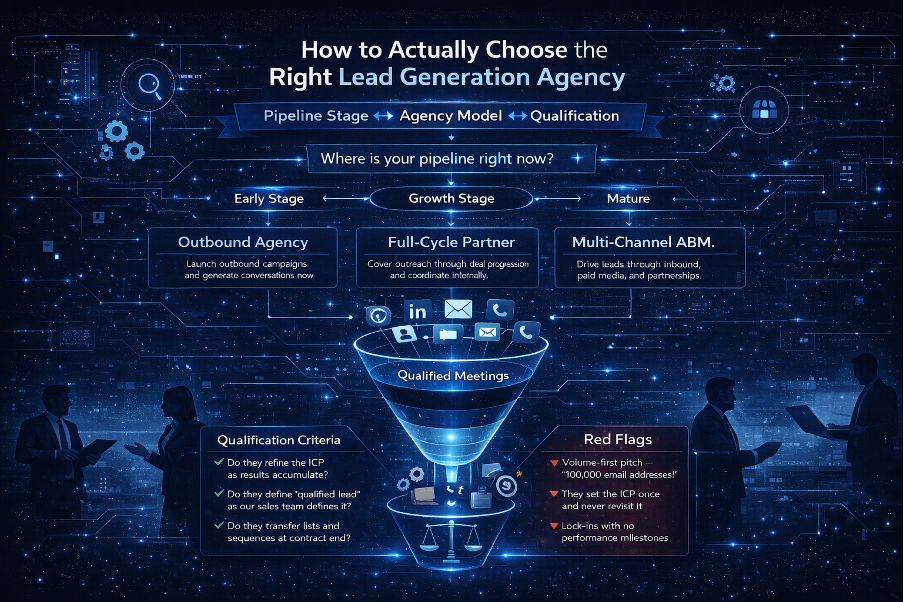
The comparison table narrows options. Deciding which one fits your situation is where most teams get it wrong. The decision depends on three factors specific to your company: pipeline stage, market complexity, and how your sales team defines a qualified opportunity.
Match the model to your pipeline stage
Early-stage companies need meetings fast. Outbound-first agencies that can launch campaigns and produce conversations within 30 days are the right fit. Investing in demand generation or SEO before you know what actually works is a slow and costly way to figure out what paid outreach would have confirmed in three weeks. Growth-stage companies need systems that can scale. The outbound model that proved product-market fit now needs operational depth — tested sequences, defined conversion benchmarks, and inbound building alongside it. Mature companies need coordination. Multiple channels running simultaneously, with shared pipeline reporting and consistent messaging across outbound, inbound, events, and partnerships.Picking an enterprise-scale outsourced lead generation provider when you're at an early stage creates overhead that doesn't serve speed. Picking a boutique outbound shop when you need multi-channel ABM creates a capability gap you'll feel within 60 days.
Ask how they build the ICP — not just whether they do
Most agencies claim to do ICP work. Few treat it as an ongoing process rather than a one-time setup task.
The question to ask: what happens when the first four weeks of data show that the ICP isn't working? Does the agency revisit targeting assumptions based on what's actually getting replies, or do they stick with the original plan?
Agencies that treat targeting as dynamic — always evolving based on actual campaign data — consistently outperform those that set it once and execute. A campaign reaching 300 precise decision-maker matches will outperform one that contacts 3,000 loosely qualified prospects, and that gap widens the longer the engagement runs.
Agree on what "qualified" means before signing
No single word causes more friction in lead generation engagements than "qualified." To one agency, it means anyone who replied. To another, it means a booked meeting. To another, it means BANT criteria met before handoff.
Write the definition into the contract. Define the minimum criteria a prospect must meet before a meeting gets passed to your team. Specify how that gets documented and reported. This conversation, handled upfront, eliminates more friction than any other part of the onboarding process.
Find out what you actually own at the end
Most agencies build outreach infrastructure on their own systems: sending domains, prospect lists, sequence logic, and messaging frameworks. When the engagement ends, that infrastructure stays with them.
For companies building outbound as a long-term channel, the right question is: what transfers when we stop working together? Lists, domain history, sequence templates, and ICP documentation are assets that should accumulate in your own systems.
Agencies that help you build internal capability create significantly more long-term value than those that maintain dependency.
Make reporting a dealbreaker
Before signing, ask: what metrics do you track, how often do you report, and do we get raw data access or just a summary dashboard?
Agencies with detailed reporting — showing exactly what's working, what isn't, and how they're adjusting — create the feedback loops that improve campaigns over time. Agencies that deliver monthly PDFs padded with activity numbers are managing expectations, not building pipeline.
Things to Watch Out For Before You Start
They lead with volume.If an agency's first proof point is how many emails they send or how many contacts they reach, the incentive structure is misaligned. Pipeline comes from precision, not volume.
They can't describe their qualification process.Ask them to walk through exactly what happens when a prospect replies. If the answer is vague, qualification isn't systematic — lead quality will be inconsistent regardless of outreach performance.
They set the ICP once and never revisit it.Targeting sharpens in the first four to six weeks of live campaign data. Agencies that don't build revision cycles into their process leave pipeline on the table.
No named case studies.Testimonials without numbers and anonymised case studies without verifiable details aren't social proof — they're placeholders. Ask for references in your vertical or a closely adjacent one.
Long lock-ins before any results.Six-month minimum commitments with no performance milestones written into the contract protect the agency, not you. Some commitment is reasonable. No accountability window is a warning sign.
Questions to Work Through Before Signing
- How do you define and document your ICP, and when do you change it?
- What's the qualification framework, and how does it match how your sales team closes deals?
- Which tools and infrastructure run on your systems versus ours?
- What does reporting look like — cadence, metrics, and raw data access?
- How long before the first qualified meetings after campaign launch?
- What does our team own at the end of the engagement?
- Can you share named case studies from our vertical?
An agency that answers these questions with specifics has a real system. An agency that deflects with credentials and case studies from unrelated industries is telling you something.
What Separates Agencies That Deliver From Ones That Don't
The agencies that produce consistent pipeline share one characteristic: they think in systems, not campaigns.
A campaign has a start date, an end date, and a plan set in stone. A system has targets, feedback loops, and refinement cycles that improve over time. Targeting tightens. Messaging adjusts based on what's actually getting replies. Qualification criteria evolve to reflect what the sales team can actually close.
When choosing a B2B lead generation agency, three things actually matter: does their operating model fit your stage of growth, does their targeting rigor match your ICP complexity, and does their reporting give you enough visibility to improve over time. Brand recognition and pricing come after those questions, not before.
For more on how outbound, inbound, and business development channels work together as a pipeline system: How to Build a Predictable B2B Sales Pipeline.
Conclusion
The number of B2B lead generation agencies has grown faster than the quality of most of them. Volume-first providers, generic cold email at scale, and six-month lock-ins with no accountability structure are common.
The agencies worth partnering with invest in targeting precision, treat qualification as a defined process, and build toward a system you own — not a dependency you can't exit.
Evaluate partners on what actually predicts results. Prestige and pricing tell you far less than the answers to three questions: what do we own, how do you define qualified, and what happens when the targeting isn't working.
Want to See How a Structured Outbound System Would Work for Your Company?
If you're currently evaluating lead generation partners, let's have a direct conversation. We'll look at your target market, ICP, and current pipeline situation — and give you an honest view of what a structured outbound engagement would include, which channels make sense for your stage, and what realistic results look like in your vertical.