
B2B Prospecting: The Complete Guide to Building Pipeline in 2026
B2B prospecting done right starts with ICP clarity, not a list of 10,000 contacts. Here's the complete framework to find, qualify, and reach the right buyers in 2026.
Most B2B sales teams don't have a closing problem. They have a prospecting problem.
The pipeline is thin, the leads don't match the ICP, and the outreach response rates are low — not because the product isn't good, but because the right people were never identified in the first place. Prospecting is the foundation of every outbound motion, and when it's done poorly, everything downstream suffers.
This guide covers what B2B prospecting actually is (and how it differs from lead generation and outbound), how to build a prospect list that maps to a real ICP, which tools are worth using in 2026, how GDPR shapes prospecting in the EU, and how to decide whether to build this capability internally or outsource it.
What Is B2B Prospecting (and How It Differs from Lead Gen and Outbound)
B2B prospecting is the process of identifying and qualifying potential customers who match your Ideal Customer Profile before any outreach begins. It is a research and filtering activity, not an execution activity.
The distinction matters because these three terms are often used interchangeably, but they describe different parts of the pipeline-building process:
- Prospecting is the research phase. You are identifying companies and contacts that match your ICP, verifying their contact information, and assessing whether they qualify for outreach based on firmographic, technographic, or behavioural signals. No message has been sent yet.
- Lead generation is the broader pipeline-building activity. It encompasses prospecting, but also includes inbound channels, content, paid advertising, events, and referrals. Lead generation is a category that contains prospecting as one of its inputs. For a deeper look at the full channel mix, see our guide to B2B lead generation channels in 2026.
- Outbound is the execution phase. It is what happens after prospecting is complete — sending the emails, running the LinkedIn sequences, making the calls. The quality of outbound is largely determined by the quality of the prospecting that preceded it.
Conflating these phases creates a common failure mode: teams skip thorough prospecting, build poor lists, then wonder why outbound isn't working. The problem is usually three steps upstream.
The ICP Foundation: Why Prospecting Without This Always Fails
ICP stands for Ideal Customer Profile. It is the detailed definition of the type of company most likely to buy your product, derive value from it, and remain a customer. Every effective prospecting process starts here.
Without a defined ICP, prospecting becomes guesswork. You end up targeting companies that are too large, too small, in the wrong industry, or at the wrong stage — and the resulting prospect lists are bloated with contacts who will never convert. Volume becomes a substitute for precision, and both cost and effort scale with poor results.
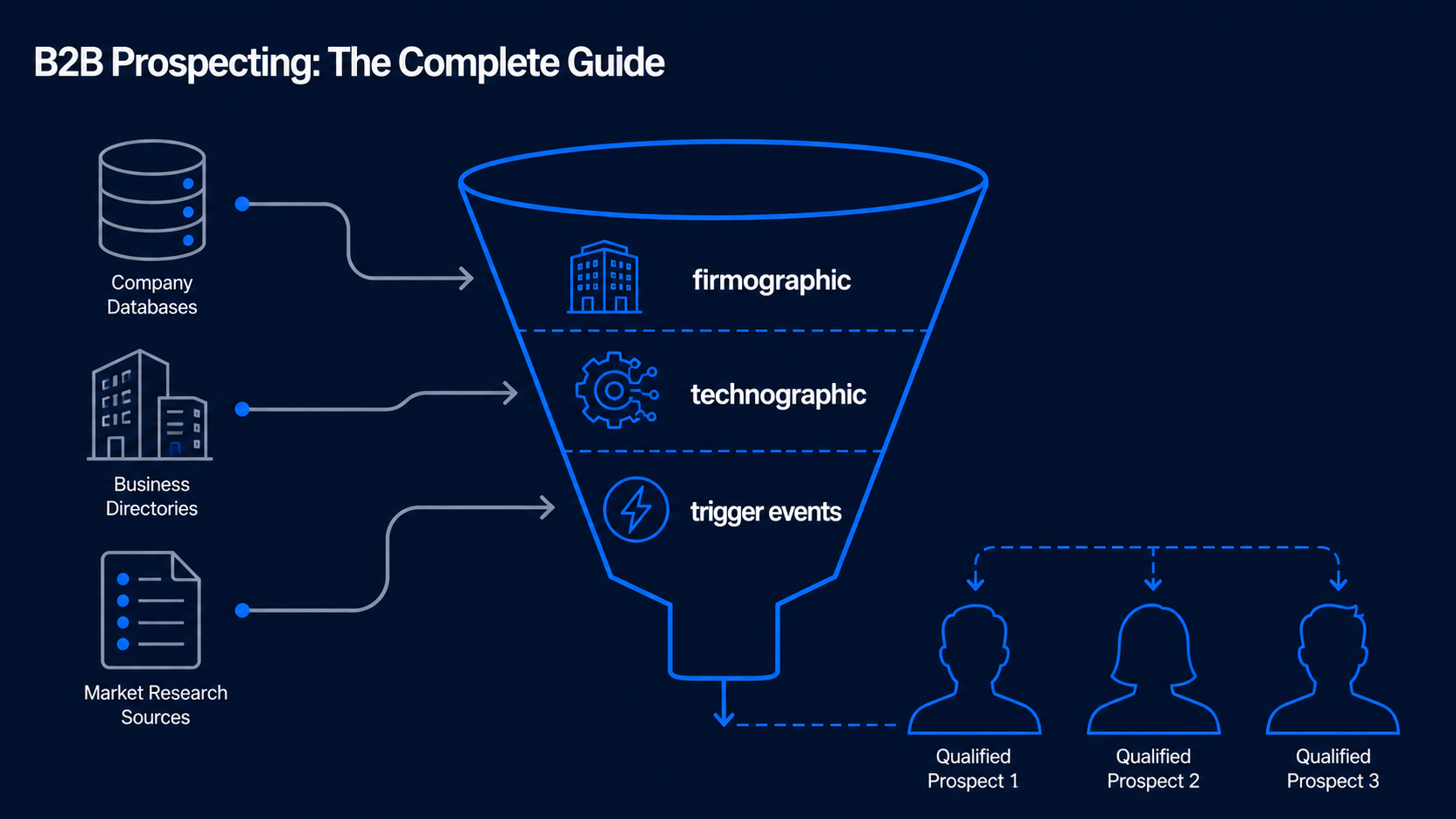
A well-defined ICP for B2B prospecting typically includes:
Firmographic criteria
- Company size (headcount bands: 50–500, 500–5,000, etc.)
- Industry and sub-vertical (fintech, SaaS, iGaming, professional services)
- Geography (EU, UK, US, DACH, Nordics — especially relevant for GDPR compliance)
- Revenue range (if available, either from databases or funding signals)
- Growth stage (seed, Series A/B/C, PE-backed, bootstrapped)
Technographic criteria
- Tech stack (using Salesforce vs HubSpot, AWS vs Azure, specific integrations)
- Software categories in use (CRM, marketing automation, data warehouse)
- Technology signals can indicate sophistication, budget, and workflow fit
Trigger events
- Recent funding rounds (Series A/B suggest budget availability and growth intent)
- Leadership changes (new VP Sales, new CMO — high intent to change vendors)
- Hiring signals (open SDR/BDR roles signal outbound investment)
- Product launches or geographic expansion (active growth phases)
- Mergers and acquisitions
Behavioural signals
- Engagement with competitor content
- Attendance at industry events
- Recent LinkedIn activity from decision-makers on relevant topics
The more precisely you define your ICP, the smaller your addressable prospect universe becomes — and the higher your conversion rate at every subsequent stage. For a full treatment of how ICP connects to predictable pipeline, see how to build a predictable B2B sales pipeline.
B2B Prospecting Methods and Channels
Once the ICP is defined, there are several methods for identifying prospects who match it.
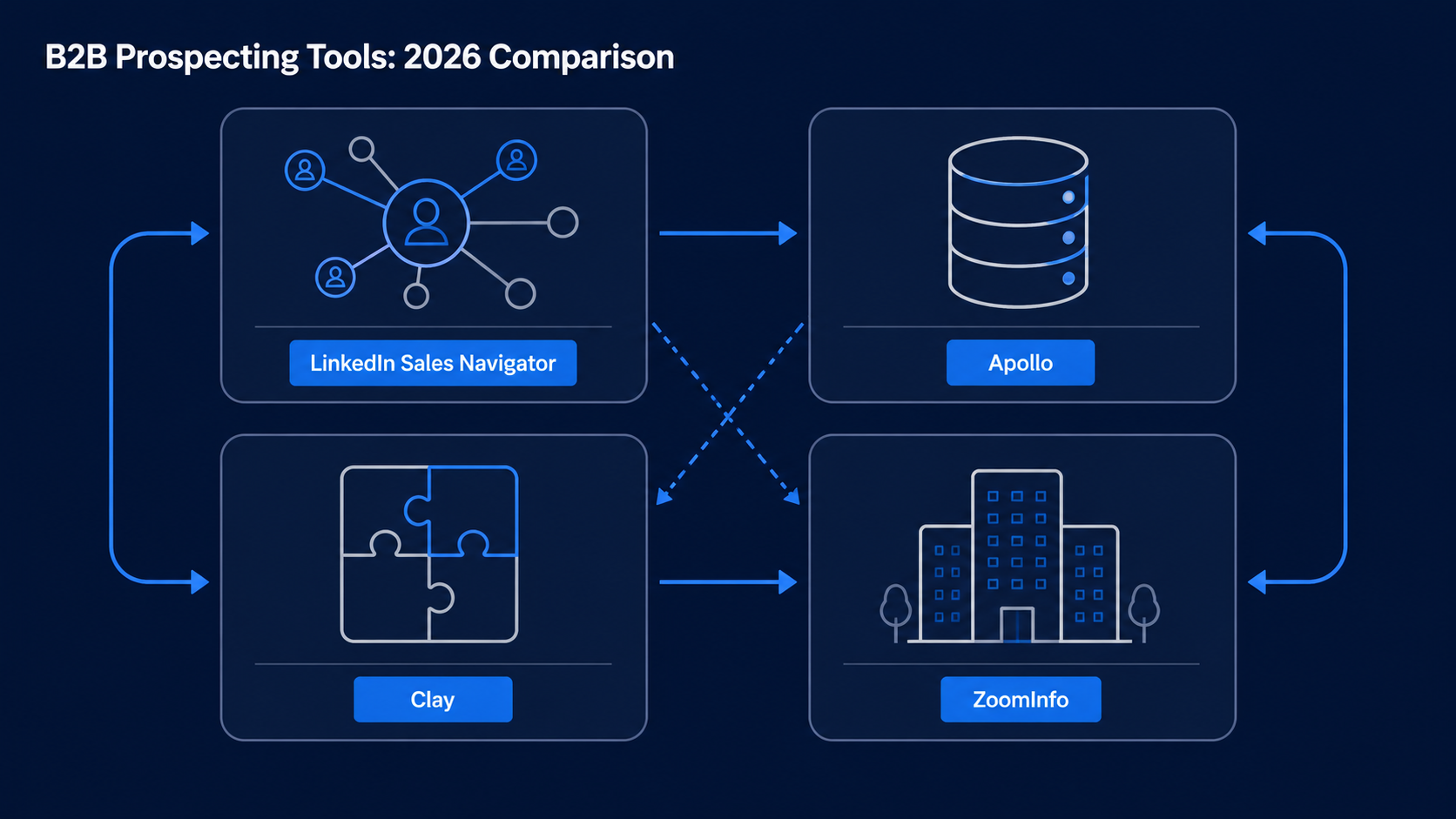
LinkedIn Sales Navigator
The most widely used prospecting tool in B2B, particularly for EU markets. Sales Navigator allows filtering by job title, seniority, company size, industry, geography, growth signals (headcount growth %), and recent activity. It is the primary channel for identifying EU prospects in a GDPR-compliant manner, since contacts are engaging on the platform voluntarily.
Sales Navigator is most effective for outreach targeting individual decision-makers by role and seniority. The search filters are granular enough to build tight ICP-aligned lists. The limitation is that it requires manual list-building unless integrated with enrichment tools like Clay.
Apollo.io
Apollo provides a large contact database with email addresses, direct dials, and firmographic data. It supports technographic filtering and intent signals. Apollo works well for high-volume prospecting where email outreach is the primary channel. Data quality varies by geography — coverage is strong for the US and reasonable for UK; EU coverage, particularly for DACH and Southern Europe, is less consistent.
Clay
Clay is not a data source — it is a prospecting automation and enrichment platform that pulls from multiple sources (LinkedIn, Apollo, Clearbit, Hunter, and others) to build enriched prospect lists. Clay enables sophisticated prospecting workflows: trigger-based list building, AI-generated personalisation fields, waterfall enrichment to verify email validity. It is best suited for teams that have already defined their ICP and want to operationalise list-building at scale.
ZoomInfo
ZoomInfo offers comprehensive firmographic and technographic data, intent signals, and org chart mapping. It is the most feature-complete prospecting platform but carries the highest price point. ZoomInfo is most effective for enterprise sales teams prospecting into large organisations where understanding org structure and decision-maker relationships matters. EU data quality is generally good, though GDPR compliance requires care given that ZoomInfo's data collection practices have faced scrutiny in some EU jurisdictions.
Manual Research
For high-value target accounts — the top 50 or 100 accounts in an ABM (Account-Based Marketing) programme — manual research still produces the highest quality outputs. Reviewing company websites, press releases, LinkedIn company pages, recent news, and hiring activity produces context-rich prospect records that no automated tool replicates. Manual research does not scale to thousands of records, but it scales well to a defined list of priority accounts.
Intent Data Platforms
Intent data (from providers like Bombora, G2, or TechTarget) surfaces companies actively researching topics relevant to your product. A company showing strong intent on topics like "cold email software" or "outbound sales automation" is a warmer prospect than one with no observed intent. Intent data adds a behavioural qualification layer on top of firmographic criteria.
How to Build a B2B Prospect List: Step by Step
A structured prospect list-building process removes the guesswork and produces lists that are usable rather than just large.
Step 1: Confirm ICP criteria
Before opening any tool, write down the specific filters you will use: company size, industry, geography, job titles, seniority levels, and any technographic or trigger-based criteria. If there is disagreement about what the ICP is, resolve it before building the list.
Step 2: Choose your primary data source
Select the tool best suited to your ICP and channel. For EU LinkedIn-first prospecting, start with Sales Navigator. For email-first outreach to US/UK markets, Apollo covers more ground. For multi-source enrichment at scale, use Clay.
Step 3: Apply firmographic filters
Start broad, then narrow. Filter by geography, company size, and industry first. Review the result count — if you are targeting a narrow niche, 2,000–5,000 matching companies may be the total addressable market, not a list size problem.
Step 4: Apply role and seniority filters
Filter by the decision-maker titles relevant to your product. For B2B sales tools: VP Sales, Head of Sales, Sales Director, RevOps Lead. For marketing tech: VP Marketing, CMO, Growth Lead. For HR tech: CHRO, Head of People, Talent Acquisition Director. Include one level above and below your primary target to capture both champions and economic buyers.
Step 5: Layer in trigger and intent signals
Where available, filter for or sort by trigger events: companies that recently raised funding, opened relevant hiring roles, or show intent signals on relevant topics. These prospects are warmer than the general ICP-matching pool.
Step 6: Verify contact data
Before loading any list into an outreach tool, verify email addresses. Use a verification tool (Hunter, NeverBounce, ZeroBounce, or Clay's waterfall enrichment). Unverified lists produce hard bounces that damage domain reputation and deliverability.
Step 7: Segment the list
Do not send the same message to a 50-person startup and a 2,000-person enterprise. Segment by company size, geography, or role before writing sequences. Personalisation at the segment level is the minimum; individual-level personalisation improves results further for high-value accounts.
Step 8: Load and track
Import the verified, segmented list into your outreach platform. Track engagement at the list segment level to identify which ICP segments respond best, and feed that data back into the next list-building cycle.
EU Prospecting: What's Different
Prospecting in the EU operates under different rules than in the US, and ignoring those differences creates legal exposure and lower response rates.
GDPR Compliance
Under GDPR, processing personal data for B2B prospecting requires a lawful basis. For most outbound B2B prospecting, the applicable basis is legitimate interest — the reasonable expectation that a business professional in a relevant role would be interested in a relevant commercial offer. Legitimate interest is a defensible basis for B2B outreach but it requires a genuine interest assessment: the contact must be in a role relevant to your product, at a company that plausibly benefits from your offer, and the outreach must not override their fundamental interests.
Practical implications:
- Data must be recent and accurate (stale data from 2022 may not meet accuracy obligations)
- Every email must include a clear opt-out mechanism
- Contacts who opt out must be suppressed immediately and permanently
- Phone prospecting in some EU jurisdictions (Germany, Austria) faces stricter rules and is rarely viable
- EU data sourced from tools that scraped LinkedIn without consent can create compliance exposure
VirtuWise operates with GDPR-compliant EU data sourcing by design — our prospecting infrastructure sources EU contacts through channels and methods that satisfy legitimate interest requirements.
LinkedIn as the Primary Channel
In the EU, LinkedIn is the dominant prospecting channel for B2B. Cold calling is significantly less common than in the US — business professionals in Germany, France, the Netherlands, and Scandinavia are far less receptive to cold phone outreach than their American counterparts. LinkedIn outreach, when done with relevance and appropriate sequence length, generates strong response rates from EU decision-makers.
For EU prospecting, the sequence is typically: LinkedIn connection request → LinkedIn message sequence → cold email follow-up. Phone is rarely used unless the prospect explicitly indicates a preference.
Language and Localisation
Outreach in English works across most of the EU for senior decision-makers at international companies. For mid-sized local businesses in Germany, France, Poland, or Spain, localised outreach in the local language significantly improves response rates. Treating "EU" as a single homogeneous market misses meaningful variation in communication preferences.
For more on building compliant, effective EU outreach, see our LinkedIn connection request message templates and B2B cold email templates.
B2B Prospecting Tools: What Each One Is Good For
| Tool | Best For | Pricing Range | EU Data Quality | Key Features |
|---|---|---|---|---|
| LinkedIn Sales Navigator | LinkedIn-first prospecting, EU decision-makers, role-level filtering | ~€80–110/user/month | Excellent | Real-time job changes, company growth filters, InMail credits, CRM sync |
| Apollo.io | Email-first prospecting, US/UK markets, high-volume list building | Free tier; paid from ~$49/month | Moderate (varies by country) | 250M+ contact database, email verification, sequences, intent data |
| Clay | Multi-source enrichment, automated list building, AI personalisation | From ~$149/month | Good (aggregated from multiple sources) | Waterfall enrichment, AI field generation, 50+ data source integrations, trigger workflows |
| ZoomInfo | Enterprise prospecting, org chart mapping, intent data at scale | ~$15,000–30,000+/year | Good | Comprehensive firmographic + technographic data, Streaming Intent, Chorus integration |
Qualifying Prospects Before Outreach
Not every ICP-matching company is worth contacting right now. Qualification before outreach reduces wasted effort on contacts who are the right profile but wrong timing.
BANT
The classic qualification framework: Budget (can they afford the solution?), Authority (is this person a decision-maker or influencer?), Need (do they have a problem your product solves?), Timeline (is there urgency or an active initiative?). BANT is a useful starting framework, but it was designed for inbound qualification — applying it rigidly to cold prospecting is difficult because you rarely know budget or timeline before first contact.
MEDDIC
More suitable for complex enterprise B2B sales: Metrics (what quantified business impact does the solution deliver?), Economic Buyer (who controls the budget?), Decision Criteria (what are they evaluating on?), Decision Process (how do they buy?), Identify Pain (what problem is acute?), Champion (who internally will advocate for the purchase?). MEDDIC is a post-meeting qualification framework rather than a pre-outreach one, but knowing which elements you can pre-qualify through research improves prospect list quality.
CHAMP
An alternative to BANT: Challenges (what problems do they have?), Authority (decision-maker?), Money (budget signals?), Prioritisation (is this a priority now?). CHAMP shifts the focus from budget-first to challenge-first, which is more aligned with how effective B2B outreach is framed.
In practice, pre-outreach qualification focuses on signals that are publicly observable: growth stage suggests budget, seniority confirms authority, trigger events suggest timing, job function confirms relevance of the problem. The remainder of qualification happens in the discovery conversation.
When to Outsource Prospecting vs Build In-House
This is a genuinely strategic decision with implications for speed, cost, control, and capability development. For an in-depth treatment, see our comparison of in-house vs outsourced sales.
Build in-house when:- You have a clearly defined, narrow ICP and an existing SDR team
- You are building long-term proprietary prospecting capabilities that create competitive advantage
- Your target market requires deep product knowledge that is difficult to transfer to an agency
- You have the management bandwidth to hire, train, and ramp SDRs (typically 3–6 months to full productivity)
- Volume requirements are moderate and consistent, not requiring rapid scaling
- You need pipeline in a new market quickly without the lead time to build internally
- You are entering the EU market and need GDPR-compliant data sourcing infrastructure
- Your core team lacks outbound prospecting expertise and you are trying to validate an ICP before investing in headcount
- You want to test multiple ICPs or sequences in parallel without building separate teams
- You are a founder or early-stage team where sales bandwidth is the limiting constraint
The hidden cost of in-house prospecting is often underestimated: Sales Navigator licences, data tool subscriptions (Apollo, Clay), a dedicated SDR headcount (fully loaded €60,000–€90,000/year in Western Europe), and 3–6 months of ramp time before productivity. For teams that need results in 60–90 days, the in-house build timeline does not match the urgency.
The role distinctions between SDR and BDR functions are relevant here — see our breakdown of SDR vs BDR roles for clarity on what type of prospecting resource your team actually needs.
VirtuWise: B2B Prospecting and Outreach for EU, UK, and US Markets
VirtuWise is a B2B outbound lead generation agency specialising in EU, UK, and US markets. Our core services — LinkedIn outreach, cold email outreach, and multi-channel B2B lead generation — are built on the prospecting infrastructure described in this guide.
We handle the end-to-end prospecting process for our clients: ICP definition, list building using Sales Navigator, Apollo, and Clay, GDPR-compliant EU data sourcing, contact verification, segmentation, and outreach execution. Clients receive qualified meetings, not raw lists or managed sequences.
- Our verticals: fintech, iGaming and gaming, IT services, AI companies.
- Results: 1,000+ meetings booked, 96% client retention over the past 6 months.
- Our services and pricing:
- Lead Generation — €3,000/month. LinkedIn or cold email outreach, prospect list building, copywriting, and campaign management. Suited to companies testing outbound or operating in a defined single channel. See pricing details.
- Lead Generation Plus — €5,000/month. Multi-channel outreach combining LinkedIn and email, larger monthly prospect volumes, A/B testing across sequences, and full reporting. For teams with validated ICP and higher pipeline targets.
- Business Development — €7,000/month. Full-cycle business development including strategic prospecting, multi-channel outreach, and meeting management. Suited to companies entering new markets or running high-complexity sales cycles. More details at /services/business-development.
- Inbound (SEO & AEO) — €3,500/month. SEO and AEO run as one service, for companies whose buyers research before they talk to sales.
- Fractional Growth Partner — custom. A revenue engine audit, then optional ongoing Advisory or hands-on Implementation.
If your pipeline is inconsistent or you are building outbound from scratch in the EU, book a call with us to discuss what a prospecting programme would look like for your ICP.
Common B2B Prospecting Mistakes
Even experienced sales teams fall into predictable traps. Here are the most common:
1. Targeting too broadlyA prospect list of 50,000 contacts that matches a vague ICP is less valuable than a list of 3,000 contacts that precisely matches a tight one. Broad targeting produces low response rates and trains the team to view outbound as ineffective when the real problem is list quality.
2. Not verifying contactsSending to unverified email lists produces hard bounces. A bounce rate above 2–3% damages domain reputation and reduces deliverability for all subsequent outreach. Verification is a required step, not an optional one.
3. Skipping qualificationAdding every company that matches basic firmographic criteria without checking for disqualifying factors (known competitor customers, too small to benefit, recent relevant hire that indicates they are building internally) wastes outreach capacity on contacts that will not convert.
4. Using outdated dataPeople change roles frequently. A VP of Sales who left their job 8 months ago and is now at a different company is not a useful prospect at their old employer. Data sources should include last-verified dates, and lists older than 90–180 days should be re-verified before use.
5. Treating prospecting as a one-time activityProspect lists decay. Companies get acquired, contacts leave, ICPs evolve. Prospecting should be a continuous process with regular refreshes, not a one-time list-pull at the start of a campaign.
6. Confusing activity with outputMeasuring the team on number of contacts added to a list rather than on qualified prospect rate or meeting-booked rate creates incentive to build large, poorly qualified lists. The metric that matters is pipeline generated per 100 prospected contacts, not list size.
Frequently Asked Questions
What is the difference between B2B prospecting and lead generation? B2B prospecting is the research phase — identifying and qualifying companies and contacts that match your ICP before any outreach begins. Lead generation is the broader pipeline-building activity that includes prospecting but also covers inbound channels, content marketing, paid acquisition, events, and referrals. Prospecting is one input to lead generation, not the same thing. How many prospects should an SDR be working at a time? This depends on the average deal size and ICP size. For mid-market outbound (100–1,000 employee companies), an SDR can effectively manage 200–400 active prospects in a sequence at any time — enough to maintain meaningful personalisation while hitting weekly activity targets. For enterprise ABM targeting large accounts, 30–80 active accounts with deeper multi-stakeholder research is more appropriate. What is a good B2B prospecting response rate? Benchmarks vary by channel and ICP. Cold email reply rates of 3–7% are reasonable for well-targeted outreach; 8–12% indicates strong copy and list quality. LinkedIn connection acceptance rates of 25–40% are typical for targeted outbound; post-connection reply rates of 15–30% are achievable with relevant, non-salesy messaging. These are for quality prospected lists — untargeted mass outreach will produce significantly lower numbers. How does GDPR affect B2B prospecting in the EU? GDPR requires a lawful basis for processing personal data. For B2B outbound prospecting, legitimate interest is the most commonly applicable basis: the contact is in a role relevant to your product, at a company that plausibly benefits from your offer, and the outreach is proportionate. Every email must include a clear opt-out, and opt-outs must be honoured immediately. Phone prospecting has stricter rules in some EU jurisdictions. Using data sourced without a GDPR-compliant process creates legal exposure. What are the best B2B prospecting tools for EU markets? LinkedIn Sales Navigator is the primary tool for EU prospecting — it provides access to accurate, self-maintained professional profiles and is the preferred outreach channel for EU decision-makers. Apollo supplements with email data for cross-channel outreach. Clay enables automated enrichment workflows. For enterprise teams requiring intent data, ZoomInfo is the most complete platform. The right combination depends on your ICP, outreach channel mix, and volume requirements. When does it make sense to outsource B2B prospecting? Outsourcing prospecting makes sense when speed matters more than building internal capability, when you are entering a new market (particularly the EU with GDPR requirements), when your team lacks the tooling infrastructure and data expertise to build high-quality lists, or when the cost of building internally exceeds the agency cost for the required volume. For companies needing qualified meetings in under 90 days without a 3–6 month SDR ramp, outsourced prospecting typically delivers faster ROI.The Bottom Line
B2B prospecting is not a volume game. It is a precision game. The teams that build pipeline consistently are the ones that define their ICP with specificity, build prospect lists that reflect it, verify and qualify before outreach, and treat prospecting as a continuous operational process rather than a one-time list pull.
The tools available in 2026 — Sales Navigator, Apollo, Clay, ZoomInfo — make high-quality prospecting faster and more scalable than it has ever been. But the tools only amplify the process. A well-structured prospecting process with mediocre tools outperforms a sophisticated tech stack applied to a vague ICP every time.
For EU markets specifically, GDPR compliance and a LinkedIn-first channel strategy are non-negotiable. For companies without the in-house expertise or infrastructure to build this correctly, outsourcing to a specialist agency is a faster, lower-risk path to consistent pipeline.
If you are building or rebuilding your outbound prospecting process, start with the ICP. Everything else follows from there.
Ready to build a prospecting programme that fills your pipeline? See our services or review pricing to understand what a managed prospecting and outreach engagement looks like.
Related reading: - In-House vs Outsourced Sales: How to Choose the Right Model - B2B Cold Email Templates That Get Replies in 2026 - LinkedIn Connection Request Message Templates - SDR vs BDR: What's the Difference and Which Do You Need? - B2B Lead Generation Channels in 2026: What Works and What Doesn't - How to Build a Predictable B2B Sales Pipeline