
AI Marketing Strategy for B2B: What to Automate and What Needs a Human
How to build an AI marketing strategy for B2B: which marketing tasks to automate, which decisions stay with people, the risks to manage, and a step-by-step approach.
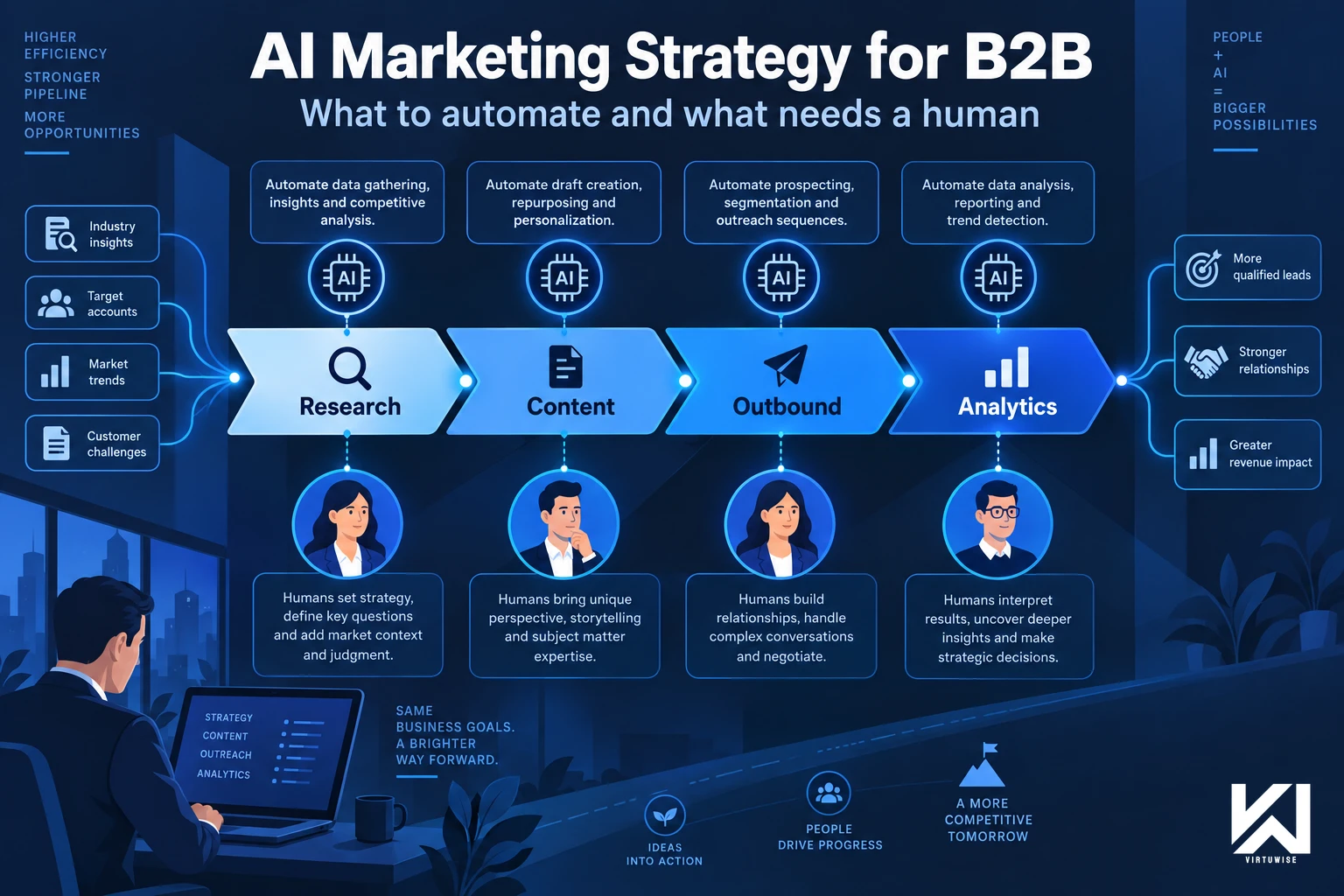
A good AI marketing strategy for B2B starts with the business, not the tools. It decides which marketing tasks AI should speed up, which decisions stay with people, and how results will be measured. AI is strong at processing data, drafting and repetitive work. It is weak at choosing positioning, judging what a buyer actually needs, and taking responsibility for outcomes. Companies that treat AI as a tool inside a clear strategy get faster. Companies that treat it as a replacement for the strategy usually get more output and the same results.
This guide covers where AI helps across the B2B funnel, where a human must stay in charge, the risks to manage (including data protection in Europe), and a practical way to put it together.
What an AI Marketing Strategy Actually Is
An AI marketing strategy is a plan for where AI is used in your marketing, why, and who is accountable for the result. It sits on top of your existing go-to-market strategy and answers four questions:
- Which tasks does AI speed up? Research, drafting, analysis and other work that is repetitive and easy to check.
- Which decisions stay with people? Positioning, target accounts, offer, budget and channel mix.
- How is quality controlled? Who checks facts, tone and compliance before anything reaches a buyer.
- How do we measure it? Pipeline and revenue outcomes, not content volume or time saved.
If a plan does not answer the last two, it is a tool list, not a strategy.
Where AI Helps Across the B2B Funnel
| Stage | Where AI helps | What a human decides |
|---|---|---|
| Research and ICP | Summarise markets, group accounts, spot patterns in customer data | Who the ideal customer is and which segments to prioritise |
| Positioning and messaging | Draft variations, test angles quickly | The core positioning, claims and proof |
| Content | Briefs, first drafts, repurposing, translation drafts | Angle, facts, experience, final edit |
| Outbound | Account research, personalisation drafts, list preparation | Targeting, tone, every reply to a real buyer |
| Inbound and SEO | Keyword clustering, content briefs, data summaries | Strategy, authority building, what to publish |
| Analytics and reporting | Compile data, flag anomalies, draft summaries | What the numbers mean and what to change |
| Sales handoff | Summarise conversations, draft follow-ups | Qualification, relationship and the deal itself |
The common thread: AI produces a draft, a summary or a suggestion, and a person with context makes the call.
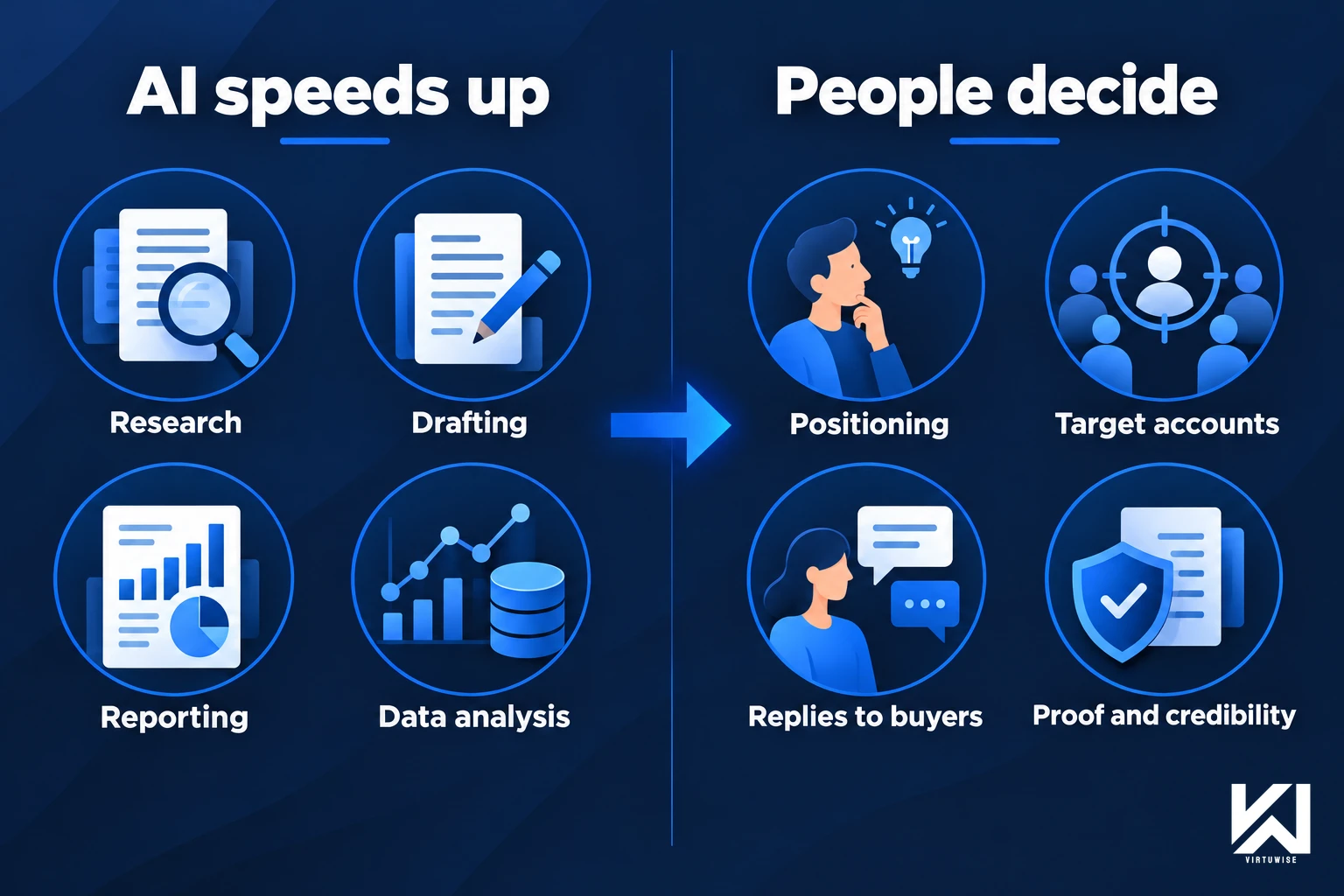
What Needs a Human in B2B Marketing
Positioning and the offer
What you are, who you are for and why you are different is a business decision. AI can generate ten versions of a positioning statement, but it cannot know which one is true and which one you can deliver.
Choosing the buyer and the markets
B2B buying involves committees, long cycles and local differences. Deciding which accounts, roles and countries to focus on depends on knowledge of your sales results and capacity. This matters more when you sell across several European markets, where languages, rules and buying habits differ.
Relationships and replies
Outbound works because a real person responds to a real buyer. Automating the conversation itself removes the thing that creates trust. This is why every reply in our lead generation programmes is read, qualified and answered by a person.
Evidence and credibility
Case studies, results, named clients and first-hand experience are what make B2B content credible. AI cannot produce them. It can only help you present them.
Judgement when data is thin
B2B pipelines are small. A few deals can swing a quarter, and a model trained on limited data can be confidently wrong. Interpreting the numbers needs someone who knows the market and the customers.
Risks to Manage
- Automating a broken process. AI makes an unclear funnel faster, not better. Fix targeting, offer and handoffs first.
- Generic output. If everyone in your category uses the same tools with the same prompts, the content converges. Proof and perspective are the differentiators.
- Inaccurate content. AI can state wrong facts with confidence. Anything published needs a person to verify it.
- Over-personalisation at scale. Mass-produced messages that look personal can damage trust faster than a plain one.
- Data protection. In the EU and UK, personal data about prospects and customers is covered by GDPR. Before putting customer or prospect data into any AI tool, check your lawful basis, the tool's data processing terms and where the data is stored. When unsure, involve your data protection contact.
- Tool sprawl. Many point tools create more handoffs, more cost and no shared view of results.
- Measuring the wrong thing. Counting content produced or hours saved says little about pipeline.
How to Build an AI Marketing Strategy in Five Steps
- Start from the revenue goal. Define the pipeline and revenue targets, the buyer and the markets first.
- Map the workflow. List the recurring marketing tasks and note which are repetitive, data-heavy and easy to check. Those are the candidates for AI.
- Assign an owner to each AI-assisted task. A named person is responsible for quality and results.
- Set quality and data rules. What gets checked before publishing, what data may go into which tools, who approves.
- Measure outcomes and review quarterly. Track qualified meetings, pipeline and revenue. Drop tools that do not change those.
If you are also weighing who should lead this, see our guides on the fractional CMO and the revenue operations consultant.
AI Marketing Agency or In-House Team?
An AI marketing agency uses AI tools to deliver marketing work faster. The label alone tells you little. Ask the same questions you would ask any agency:
- Who owns strategy, and who is accountable for results?
- Who checks facts and compliance before anything goes out?
- How are results reported, and are they tied to pipeline?
- What happens to your data, and which tools see it?
Some companies build the capability in-house, others use an agency for execution and keep strategy internal, and some start with an outside strategic review of the whole revenue engine before deciding. Our growth marketing agency guide compares the options, and the broader SEO side is covered in AI for SEO.
How VirtuWise Approaches This
VirtuWise works across three areas: Outbound, Inbound (SEO and AEO) and the Fractional Growth Partner engagement. We use AI to speed up research, drafting and analysis, while a named person owns strategy, facts and the final edit.
The Fractional Growth Partner engagement is an outsourced-CMO-style review of your revenue engine: ICP, positioning and the funnel across Outbound, Inbound and product-led motion, delivered with a written roadmap. It is scoped and quoted on a call, with no retainer required for the audit. Details are on the pricing page.
Frequently Asked Questions
What is an AI marketing strategy?An AI marketing strategy is a plan for where AI is used in your marketing, which decisions stay with people, how quality is controlled and how results are measured. It sits inside your go-to-market strategy rather than replacing it.
Can AI replace a marketing team?No. AI speeds up research, drafting and analysis, but it cannot set positioning, build relationships, take responsibility for results or supply the proof that makes B2B marketing credible. It works best as a tool that makes a capable team faster.
What marketing tasks should I automate with AI?Start with repetitive, data-heavy tasks that are easy to check: research summaries, content briefs and first drafts, keyword and audience grouping, reporting and data compilation, and follow-up drafts. Keep positioning, targeting, replies to buyers and final approval with people.
Is using AI in marketing compliant with GDPR?It can be, but it depends on how you use it. Personal data about prospects and customers is covered by GDPR in the EU and UK. Check your lawful basis, the tool's data processing terms and where data is stored before entering personal data into any AI tool, and ask your data protection contact when unsure.
How do I start with AI in B2B marketing?Start from the revenue goal, map your recurring tasks, pick two or three repetitive ones to improve with AI, assign an owner to each, set quality and data rules, and measure pipeline outcomes after a quarter before adding more.
Related reading: