
Fractional Head of Sales: Role, Cost Logic and When to Hire One
What a fractional head of sales (or fractional CRO) does, when a B2B company should hire one, how engagements are structured, and how to compare the option with a full-time hire.

A fractional head of sales is an experienced sales leader who works with your company part-time, usually for a fixed monthly engagement, to build and run the sales function without a full-time executive hire. The same idea appears under other names: fractional sales leader, fractional VP of Sales, fractional sales director and, at the broader end, fractional CRO. The title differs; the job is to set up the sales process, coach the team and make revenue more predictable.
This guide explains what the role covers, when it makes sense, how engagements are usually structured and what to ask before you sign.
What Does a Fractional Head of Sales Do?
A fractional head of sales owns the sales system, not just individual deals. Typical responsibilities:
- Defining the ICP and offer. Who you sell to, what problem you solve and how you position against alternatives.
- Designing the sales process. Stages, qualification criteria, handoffs from lead generation to sales and deal rules.
- Setting up outbound and pipeline. Choosing channels, building the first playbooks and defining what a qualified meeting is.
- Hiring and coaching. Writing role scorecards, interviewing sales hires and coaching founders, account executives or SDRs.
- Forecasting and reporting. A pipeline view the founders and board can trust.
- Tooling and discipline. CRM structure, reporting routines and weekly pipeline reviews.
What the role usually does not do is work as a full-time quota-carrying salesperson. The value is leadership and structure, applied for a fraction of the week.
Fractional Head of Sales vs Fractional CRO vs Fractional VP of Sales
The titles overlap, and companies use them loosely. A practical way to read them:
| Title | Typical scope | Fits best when |
|---|---|---|
| Fractional head of sales / sales director | Builds and runs the sales process and team | You have a product and early customers but no structured sales function |
| Fractional VP of Sales | Manages a sales team, forecasting and hiring | You already have several sellers and need leadership |
| Fractional CRO | Covers sales plus marketing, customer success and revenue operations | Revenue is split across several teams with no single owner |
| Fractional sales consultant | Advises on a defined problem for a limited time | You need a process fix, not ongoing leadership |
Ask what a provider means by the title and what they will actually own, because the label alone tells you little.
When Does a Company Need One?
Signals that the role is a fit:
- Founders still run every deal. Sales depends on one or two people and nothing is documented.
- Pipeline is unpredictable. Some months are strong, others empty, and nobody can explain why.
- Several hires have not worked. Reps or SDRs struggle because there is no playbook to follow.
- You are entering a new market. For example, expanding from one European market into DACH or the UK.
- A full-time hire is not justified yet. The company needs senior judgement now but not a full-time executive salary.
Signals that it is not the right move: no product-market fit yet (a sales leader cannot fix that), no budget for the team and tools the leader would put in place, or no one internally who will take ownership after the engagement.
Fractional vs Full-Time: How to Compare
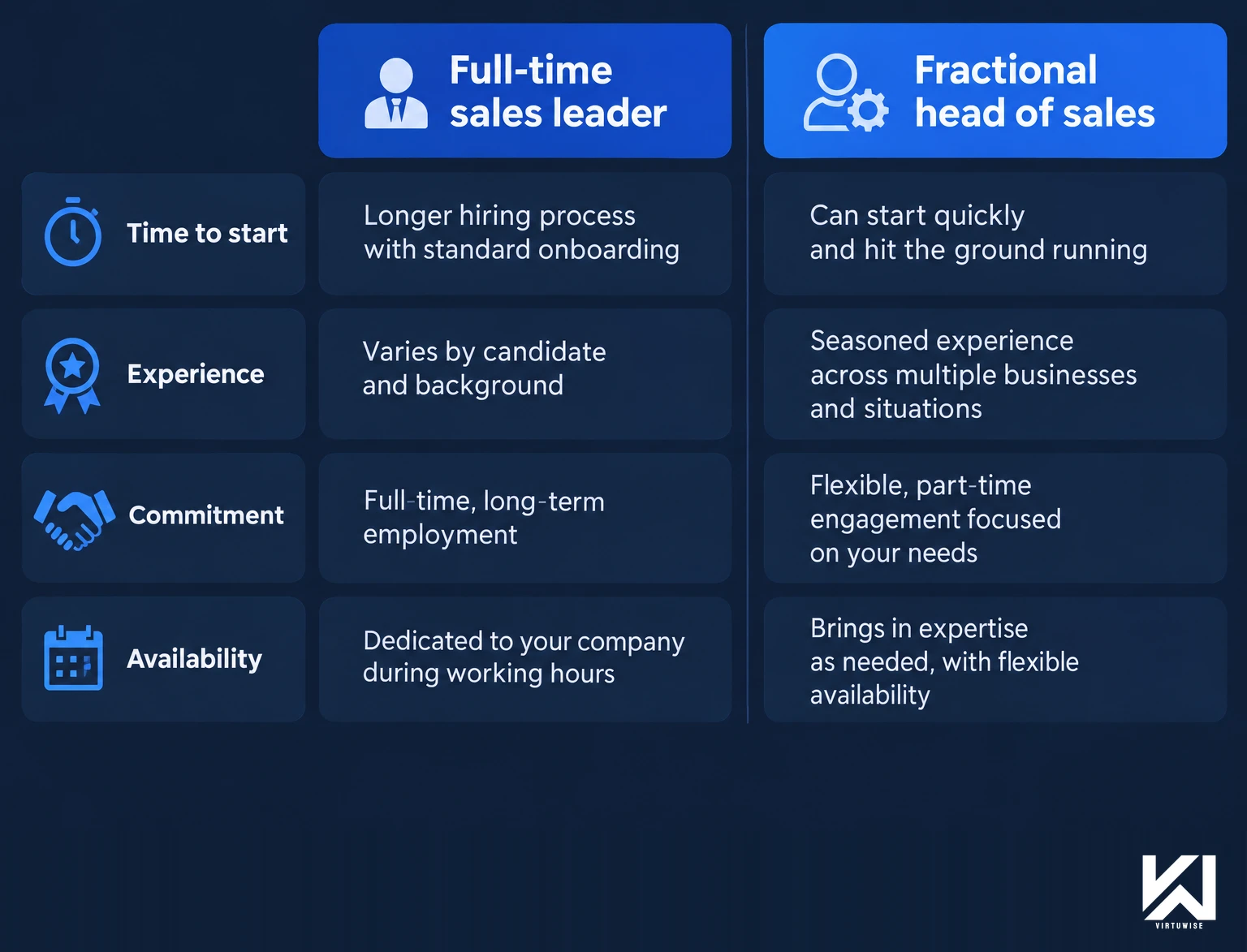
Compare the options on total cost to reach a working sales system, not on salary versus fee.
| Full-time sales leader | Fractional head of sales | |
|---|---|---|
| Cost | Salary, bonus, benefits, equity and recruiting costs | Monthly engagement fee, no benefits or equity in most cases |
| Time to start | Months to recruit and onboard | Often weeks |
| Experience | Depends on who you can attract and afford | Often a senior operator who has built the function several times |
| Availability | Full week, one company | Part of the week, shared across clients |
| Commitment | Long-term, hard to reverse | Flexible term, easier to end or change |
| Best for | Scaling an established team | Building the foundation, or covering a gap |
The honest trade-off is availability. A fractional leader gives you senior thinking and structure, but not constant presence. That works well when you have people to execute and less well when you need someone on every call.
How Engagements Are Structured
Structures vary by provider, so ask for specifics. The common patterns:
- Audit first. A short assessment of ICP, funnel, process and team, ending in a written roadmap.
- Advisory. Regular calls, reviews and recommendations while your team executes.
- Hands-on. The leader builds playbooks, runs pipeline reviews, joins hiring and sometimes the first sales calls.
Before you sign, agree on the scope, the weekly time commitment, the deliverables, the reporting you will receive and how either side ends the engagement. Define success in revenue terms, such as qualified meetings, pipeline created and conversion by stage, not in activity.
Questions to Ask a Fractional Sales Leader
- Which stages and company types have you built sales for, and in which markets?
- What will you own, and what stays with us?
- How many hours or days per week will you give us, and who else is involved?
- What will we have after 30, 60 and 90 days?
- How do you handle handoff so the process works after you leave?
- Can we speak to a client whose situation resembles ours?
If a provider cannot answer these in writing, the engagement is not ready to buy.
Where VirtuWise Fits
VirtuWise runs a Fractional Growth Partner engagement that covers the revenue engine as a whole: ICP, positioning and funnel across outbound, inbound and product-led motion. It starts with an audit and a written roadmap, and can continue as advisory or hands-on implementation. Scope and fee are agreed on a call because they depend on your company and the gap to close.
If what you need is the sales execution itself, our business development service adds full-cycle sales support from first conversation to deal, and our lead generation service fills the pipeline that a sales leader would otherwise have to build. Read more about the engagement on the Fractional Growth Partner page.
Frequently Asked Questions
What does a fractional head of sales do?They build and run the sales function on a part-time basis: define the ICP and offer, design the sales process and qualification rules, set up outbound and pipeline reporting, hire and coach sellers, and give leadership a forecast they can rely on.
What is the difference between a fractional head of sales and a fractional CRO?A fractional head of sales focuses on the sales process and team. A fractional CRO has a broader remit across sales, marketing, customer success and revenue operations. Smaller companies often need the first; companies with revenue split across several teams may need the second.
How much does a fractional head of sales cost?It depends on seniority, time commitment and scope, so ranges vary widely between providers. Compare engagements by what you receive in the first 90 days and what a full-time hire would cost once salary, bonus, benefits and recruiting are included.
When should I hire a full-time sales leader instead?When you have a proven playbook, a team of several sellers and enough pipeline to keep a full-time leader busy. Many companies use a fractional leader to build the foundation and hire full-time once the system works.
Can a fractional head of sales replace SDRs or an agency?No. A sales leader designs and manages the process; someone still has to execute outreach and follow-up. Many teams pair a fractional leader with an outbound provider or in-house SDRs.
Related reading
- Chief Growth Officer: Role, Responsibilities, Salary, and When to Hire One — the broader growth-leadership option
- Revenue Operations Consultant — fixing the process and systems behind the pipeline
- Fractional COO — the operations counterpart to a fractional sales leader