
AI SDR: What It Is, How It Works, and Whether It Replaces Human SDRs
AI SDRs automate prospecting, email writing, and follow-up at scale. Here's what they actually do, where they fall short, and how to decide if one belongs in your outbound stack.
The AI SDR has become one of the most discussed concepts in B2B sales over the past eighteen months. Vendors claim their AI can prospect, personalise, and book meetings autonomously. Sales leaders want to know if it actually works. And SDR managers want to know if their team's jobs are at risk.
The honest answer is more nuanced than either camp suggests. AI SDRs are genuinely useful for specific tasks, particularly at the top of the funnel where volume and speed matter. They are genuinely poor at others — especially the judgment calls, adaptive conversations, and trust-building that drive pipeline quality in complex B2B markets.
This guide covers what AI SDRs actually do, how they compare to human SDRs, which tools are worth evaluating in 2026, and how to make a practical decision about whether one belongs in your outbound stack.
What Is an AI SDR?
An AI SDR (AI Sales Development Representative) is a software system that automates the prospecting and outreach tasks traditionally performed by a human SDR. The core function is the same: identify potential buyers, initiate contact, and try to generate a qualified conversation or meeting.
What changes is who — or what — executes each step. An AI SDR uses large language models, data enrichment APIs, and workflow automation to:
- Build prospect lists based on defined ICP criteria
- Research individual prospects and companies
- Write personalised outreach messages
- Send and sequence those messages across email and sometimes LinkedIn
- Respond to replies based on pre-configured logic
- Route qualified conversations to a human account executive
The phrase "AI SDR" is used loosely in the market. Some vendors use it to describe a fully autonomous agent that operates without human input. Others use it for AI-assisted tools that help human SDRs write faster or personalise at scale. The distinction matters when evaluating what you're actually buying.
What AI SDRs Can and Cannot Do
Understanding AI SDR capabilities honestly requires separating what current technology does well from what it still does poorly.
What AI SDRs do well
- High-volume list building. AI SDRs can pull ICP-matching contacts from data providers (Apollo, Clay, LinkedIn, Clearbit) and build lists at a speed and scale no human team can match. A task that takes an SDR two days takes an AI SDR minutes.
- First-draft personalisation at scale. AI can research a prospect's LinkedIn activity, company news, job listings, and funding history, then insert relevant context into an email template. This produces personalisation that goes beyond just inserting a first name — though it is still pattern-matching, not genuine understanding.
- Consistent follow-up. AI SDRs never forget to send follow-up #3 or ghost a promising thread. Sequence execution is reliable in a way that human SDRs, managing hundreds of active prospects simultaneously, often are not.
- Speed. An AI SDR can launch a campaign within hours of ICP definition. A human SDR doing the same quality of list research, personalisation, and sequencing would need days.
- Cost at scale. Once set up, an AI SDR handles thousands of contacts for a fraction of the fully loaded cost of a human hire.
What AI SDRs do poorly
- Handling replies. Most AI SDRs struggle significantly with inbound replies. A prospect who responds with "we just signed a contract with a competitor — check back in Q3" requires nuance, timing sensitivity, and relationship management that current AI handles clumsily or not at all. Many AI SDR tools simply route all replies to a human, defeating part of the automation premise.
- Complex, multi-stakeholder accounts. Enterprise outreach that requires understanding org charts, navigating political dynamics between stakeholders, and building relationships over months is not an AI SDR use case.
- Industry-specific trust signals. In verticals like fintech, iGaming, and regulated industries, buyers evaluate vendors partly on credibility signals — references, brand awareness, in-person relationship history. An AI SDR generating its third outreach email to a compliance officer at a payment processor is not the same as a human who understands that buyer's world.
- Genuine discovery. The best SDRs are skilled at extracting information about a prospect's situation through conversation. An AI SDR cannot have that conversation. It can initiate contact, but it cannot replace the human capacity for active listening, follow-up questions, and contextual qualification.
AI SDR vs Human SDR: How They Compare
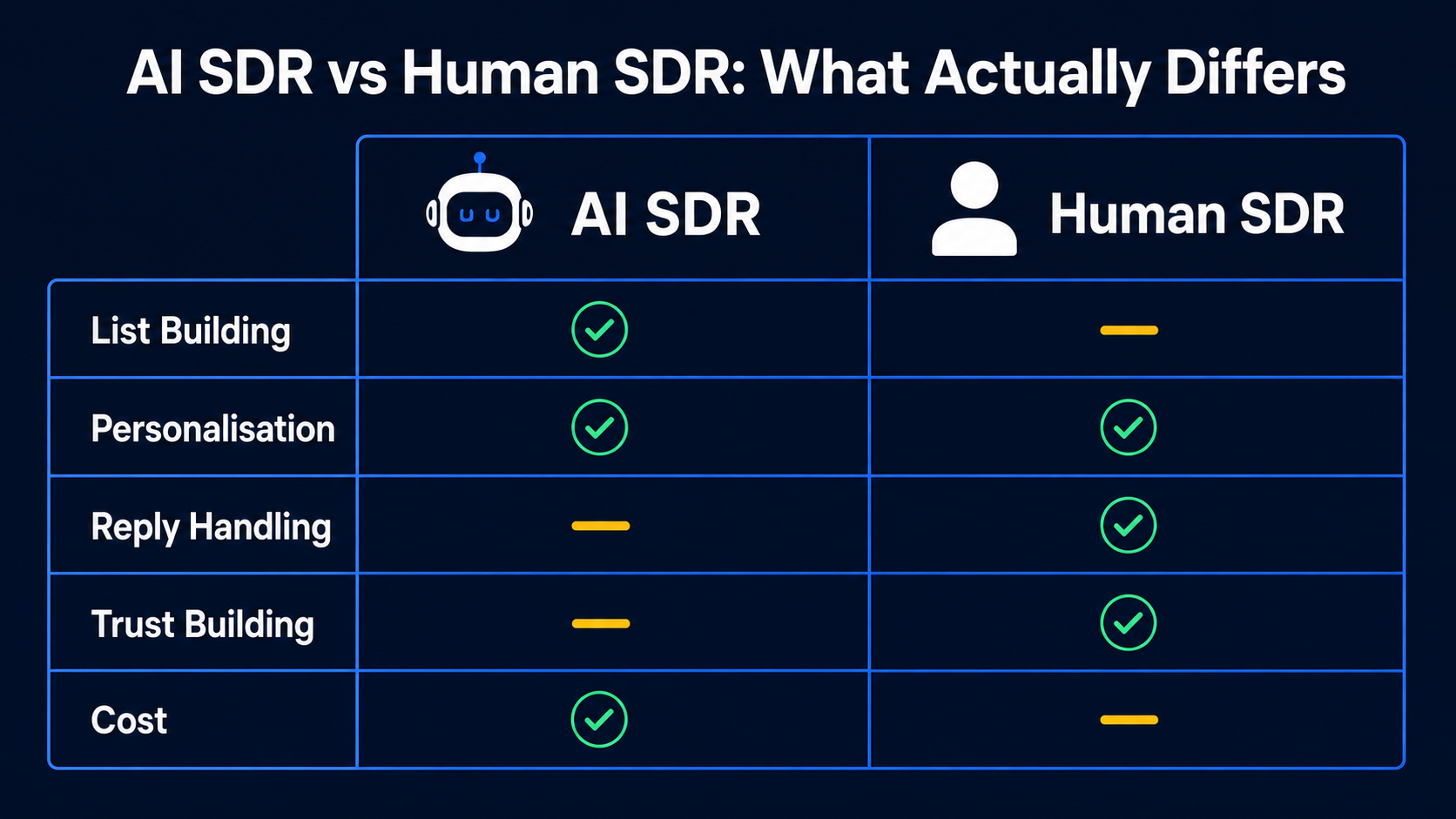
| AI SDR | Human SDR | |
|---|---|---|
| List building speed | Minutes for thousands | Hours to days |
| Personalisation | Pattern-based at scale | Genuine, context-aware |
| Reply handling | Limited, rule-based | Adaptive, conversational |
| Trust-building | None | High (human relationship) |
| Cost (per contact) | Very low | Higher (fully loaded €60–90K/year EU) |
| Ramp time | Days (setup) | 3–6 months (productivity) |
| Complex accounts | Poor | Strong |
| Consistency | Perfect | Variable |
| EU GDPR compliance | Depends on data sourcing | Depends on process |
The comparison suggests a hybrid model for most teams: AI handles the top-of-funnel volume (list building, first outreach, follow-up sequences) and humans manage reply conversations, qualification, and anything requiring judgment.
For a full breakdown of how SDR and BDR roles are structured, see our guide to SDR vs BDR differences and when to hire each.
Best AI SDR Tools in 2026
The AI SDR category has grown rapidly, with dozens of vendors claiming the title. The most mature platforms as of 2026:
11x
One of the most widely referenced AI SDR platforms. 11x's "Alice" agent handles list building, personalised email writing, multi-step sequences, and basic reply handling. Works well for high-volume outbound in US and UK markets. EU data coverage is less robust.
Artisan
Artisan's "Ava" AI SDR handles end-to-end prospecting and outreach. Strong emphasis on personalisation quality — researches each prospect across LinkedIn, company news, and intent signals before writing. Better suited to accounts where personalisation justifies the cost.
Amplemarket
Combines AI-assisted outreach with a traditional sales engagement platform. Strong deliverability infrastructure and LinkedIn integration. Used by mid-market sales teams who want AI assistance without full automation — a good middle ground for teams not ready for fully autonomous AI SDR.
Clay
Clay is not a traditional AI SDR — it is a data enrichment and workflow automation platform. But it is often the backbone of AI-assisted SDR programmes: pulling data from 50+ sources, enriching contacts, and using AI to generate personalised fields at scale. Many AI SDR setups use Clay for list building and enrichment, then feed into Instantly or Smartlead for sending.
Regie.ai
Focused on AI-assisted content generation for outbound — email writing, sequence building, A/B variant generation. Less of a full AI SDR and more of an AI co-pilot for human SDRs looking to write faster and personalise at scale.
Piper (Qualified)
Website-focused AI SDR designed for converting inbound website visitors. Different use case from outbound — best for companies with meaningful inbound traffic who want AI to qualify and engage visitors in real time.
When an AI SDR Makes Business Sense
AI SDRs are not universally appropriate. The conditions where they deliver genuine value:
- High-volume outbound to a well-defined ICP. If you know exactly who you're targeting — firmographic criteria, job titles, company size, geography — and you need to reach thousands of them with relevant messaging, an AI SDR excels at execution.
- Repetitive, low-complexity first-touch outreach. Initial outreach to cold contacts in a defined market is the AI SDR's strongest use case. The first email is pattern-matchable. The reply conversation is not.
- Supplementing (not replacing) an existing SDR team. AI SDRs that handle list building, sequence execution, and data entry free human SDRs to focus on conversations, qualification, and relationship building — the tasks where humans add disproportionate value.
- Markets where speed of follow-up matters. In some categories, responding to a trigger event (a funding round, a new hire posting) within hours dramatically improves response rates. AI SDRs can do this automatically.
When AI SDRs are not the right choice
- Regulated industries with high trust thresholds. Fintech compliance officers and iGaming procurement teams respond poorly to obvious automation. Credibility requires human judgment and relationship investment.
- Complex, multi-stakeholder enterprise sales. If your deal cycle involves six decision-makers across three departments over nine months, the top-of-funnel meeting is a fraction of the challenge. AI SDR helps with less than it seems.
- Early-stage companies without validated ICP. An AI SDR amplifies a good ICP but also amplifies a bad one. If you don't yet know who you're targeting and why, AI SDR produces high volume of the wrong outreach fast.
- EU markets with GDPR-sensitive buyers. Outbound to EU decision-makers, particularly in regulated verticals, requires data sourcing that satisfies GDPR's legitimate interest test. Not all AI SDR platforms are built with this in mind — and European buyers notice and react negatively to outreach that doesn't meet basic compliance standards.
The Hybrid Model: What Most High-Performing Teams Actually Use
The framing of "AI SDR vs Human SDR" is a false binary. Most B2B teams generating consistent pipeline use a hybrid structure:
AI handles: - ICP-matched list building from multiple data sources - Contact enrichment and verification - First-touch email personalisation and sequencing - Follow-up automation through the sequence - Data entry and CRM updates Humans handle: - Inbound reply management and qualification - Adaptive conversations with interested prospects - Multi-stakeholder account navigation - Relationship development in strategic accounts - ICP refinement based on what's convertingThis model produces higher volume than pure human outbound while maintaining the quality that AI cannot replicate at the conversation layer. It also reduces the risk of AI SDR's biggest failure mode: sending robotic responses to interested prospects and losing qualified opportunities.
For a detailed comparison of outsourced models vs in-house builds, see in-house vs outsourced sales and best outsourced SDR companies in 2026.
VirtuWise: AI-Enhanced Outbound for EU, UK, and US Markets
VirtuWise runs multi-channel B2B outbound for fintech, iGaming, IT services, and AI companies. Our programmes combine AI-assisted prospecting and personalisation with human-led reply management and qualification — the hybrid model that produces consistent pipeline without the reply-handling failures that fully autonomous AI SDRs introduce.
What this means in practice: AI tools handle our list building, enrichment, and first-touch personalisation at scale. Our team manages inbound replies, qualifies conversations, and books meetings that are genuinely worth your team's time.
Our service tiers:- Lead Generation — €3,000/month. Multi-channel outbound (LinkedIn + email), ICP definition, list building, GDPR-compliant EU data sourcing, sequence management.
- Lead Generation Plus — €5,000/month. Expanded volume, multiple ICP segments, A/B testing across sequences, full reporting.
- Business Development — €7,000/month. Full-cycle business development including strategic prospecting, multi-channel outreach, and meeting management. Details at /services/business-development.
- Inbound (SEO & AEO) — €3,500/month. SEO and AEO run as one service: keyword strategy, content, technical fixes, and AI-crawler visibility.
- Fractional Growth Partner — custom. A revenue engine audit, then optional ongoing Advisory or hands-on Implementation.
1,000+ meetings booked. 96% client retention. See pricing or book a call.
Frequently Asked Questions
What does an AI SDR do?An AI SDR automates the prospecting and outreach tasks traditionally done by a human sales development representative. This includes building ICP-matched contact lists, researching prospects, writing personalised outreach emails, executing multi-step sequences, and in some cases handling initial replies. The degree of automation varies by platform — some require human oversight at each stage, others operate more autonomously.
Can an AI SDR replace a human SDR?Not fully, and not in most B2B contexts. AI SDRs excel at high-volume, consistent top-of-funnel tasks: list building, sequencing, and first-touch personalisation. They struggle with reply handling, multi-stakeholder account navigation, and relationship-building. Most high-performing teams use AI SDRs to supplement human capacity rather than replace it — AI executes the volume work, humans manage conversations and qualification.
What are the best AI SDR tools in 2026?The most mature platforms include 11x (Alice), Artisan (Ava), Amplemarket, and Regie.ai. Clay is widely used as the data enrichment backbone for AI SDR programmes. The right choice depends on your outbound channel mix, ICP, and how much human oversight you want to maintain.
How much does an AI SDR cost?AI SDR platforms range from approximately $500/month for basic tools to $3,000–5,000+/month for full-featured platforms like 11x or Artisan at meaningful volume. This compares to a fully loaded human SDR cost of €60,000–€90,000/year in Western Europe. The cost comparison favours AI SDR for pure volume outreach, but not when you account for the human management overhead required to handle replies and convert interest into qualified pipeline.
Are AI SDRs GDPR-compliant for EU outreach?This depends on the platform and the data sources it uses. GDPR requires a lawful basis for processing personal data — for B2B outbound, legitimate interest is the standard basis. Many AI SDR platforms source data from US providers with limited EU data quality and questionable GDPR compliance. If you're running outbound into EU markets, verify the platform's EU data sourcing practices explicitly.
What is the difference between an AI SDR and AI sales outreach tools?AI SDRs are systems designed to automate the full SDR workflow — from list building through outreach. AI sales outreach tools are narrower: they assist with specific tasks like email writing, personalisation, or sequence management, but don't necessarily automate the full prospecting workflow. Clay, for example, is a data enrichment and workflow platform, not an AI SDR in the full sense.
The Bottom Line
AI SDRs are a real capability with genuine value — not vendor hype and not a replacement for human sales development. The specific value is in volume, consistency, and speed at the top of the funnel. The specific limitation is in the conversations, judgment calls, and relationship-building that drive qualified pipeline in complex B2B markets.
The most productive framing is not "AI SDR or human SDR" but "what does each do better?" Most outbound programmes in 2026 that generate consistent pipeline use AI for the work where consistency and scale matter, and humans for the work where judgment and relationships matter.
If you're evaluating whether an AI-assisted outbound programme makes sense for your market and ICP, the architecture of the programme matters as much as the tools in it.
Thinking about outbound that combines AI efficiency with human judgment? See how VirtuWise works or review our pricing.
Related reading: - SDR vs BDR: Roles, Differences, and Which to Hire First - Best Outsourced SDR Companies 2026: 7 Providers Compared - B2B Prospecting: The Complete Guide - Outbound Lead Generation: Strategy, Channels, and Tools - In-House vs Outsourced Sales: How to Choose