
Game Development Outsourcing: How Studios Find Publisher and Developer Clients
Game development outsourcing studios compete in a crowded B2B market. Here's how publishers and developers evaluate outsourcing partners — and how studios build consistent client pipelines.
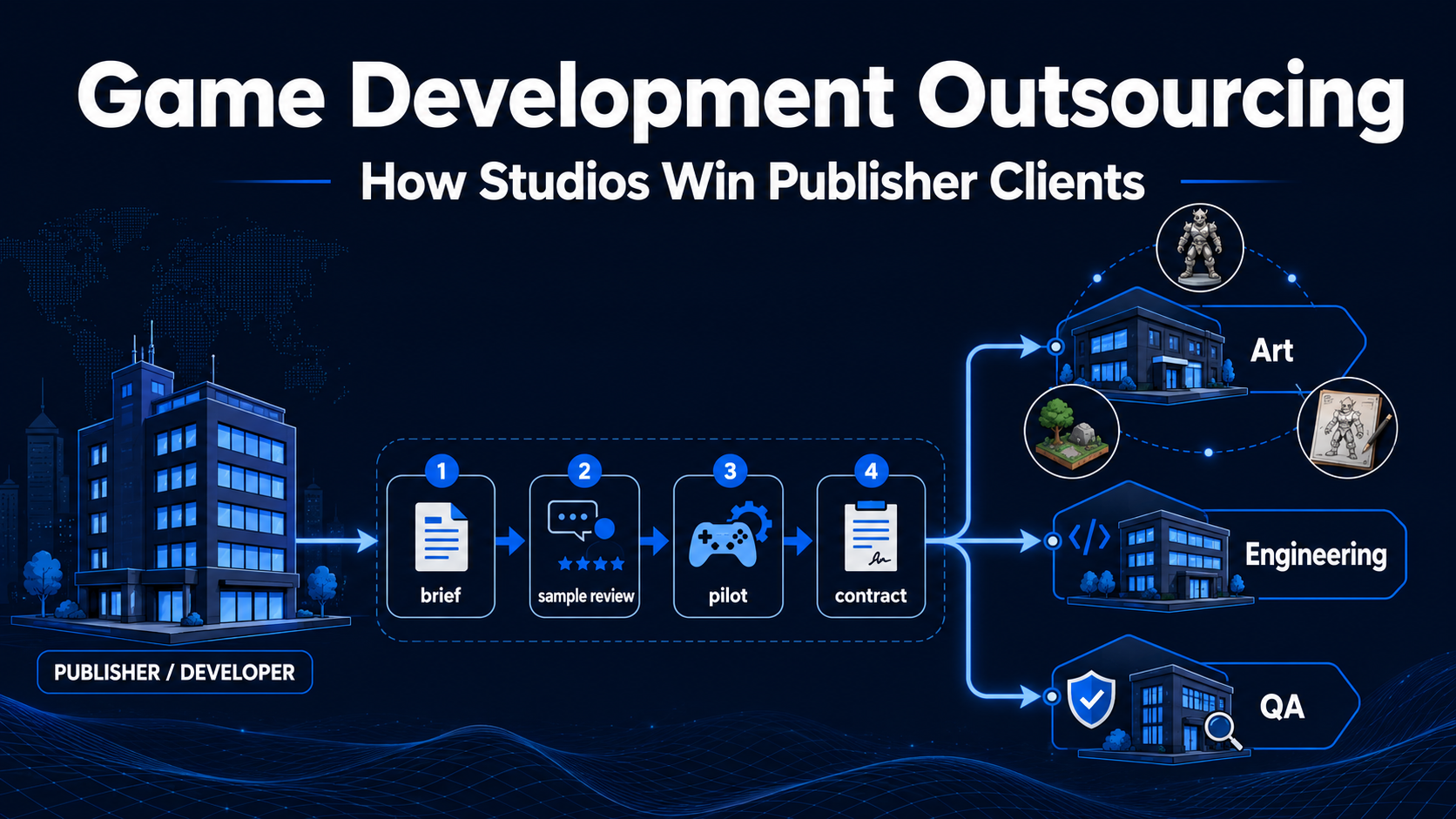
Game development outsourcing is a structurally significant part of how modern game studios operate. Publishers and developers outsource programming, art production, QA, localisation, and audio work to external studios — often to access specific skills, increase production capacity without headcount, or manage the project-based nature of game production where workloads spike and fall between titles. For the studios providing these outsourcing services, the market is large and the work is genuinely needed.
The challenge for game development outsourcing studios is not capability — most have strong technical and creative credentials. The challenge is building a consistent client pipeline in a market where decisions are made through relationships, conference encounters, and referrals rather than inbound marketing and procurement processes. Getting in front of the right producers, leads, and technical directors at publishers and developers — before they've already awarded a project — requires a structured sales approach that most outsourcing studios haven't built.
This guide covers how game publishers and developers evaluate outsourcing partners, what the sales process looks like in practice, and how game development outsourcing studios build a consistent flow of client conversations.
What Game Development Outsourcing Covers
Game development outsourcing spans a wide range of production functions. Understanding where your studio sits in this map — and how publishers classify those functions internally — shapes how you approach business development.
Art production outsourcing
Art is the largest category of game outsourcing by volume. Publishers and developers outsource concept art, 2D game art, 3D modelling and animation, environment art, UI/UX design, character art, VFX, and cinematic production to external studios. The scope ranges from single-asset contracts to full art outsourcing relationships where the studio handles all art production for a title or franchise across multiple projects.
Art outsourcing decisions are made by Art Directors, Lead Artists, and Producers — not by procurement teams. The evaluation is highly sample-driven: studios live and die by their portfolio quality relative to the specific style and technical requirements of the client's project.
Programming and engineering outsourcing
Code outsourcing covers gameplay programming, engine work, porting and platform optimisation, tools development, backend and live services engineering, and specialised technical functions (physics, AI, rendering). Publishers outsource programming to access specific engine expertise (Unreal, Unity), platform knowledge (console certification, mobile optimisation), or to add team capacity during crunch without permanent headcount.
Engineering decisions are made by Technical Directors, Lead Programmers, and Head of Production. Sample evaluation focuses on technical documentation, shipped titles, and — increasingly — the studio's specific engine or platform track record.
QA and testing outsourcing
Quality assurance is one of the most consistently outsourced functions in game development. Publishers outsource functional testing, localisation QA, accessibility testing, platform compliance, and live game monitoring to QA studios. The decisions are made by QA Managers and Producers, with a strong preference for studios that have certification experience on specific platforms (PlayStation, Xbox, Nintendo, Steam, mobile stores).
Localisation and audio outsourcing
Localisation — translation, cultural adaptation, voiceover recording, and lip-sync implementation — is routinely outsourced to specialist studios that maintain language networks, recording infrastructure, and quality pipelines. Audio — music composition, sound design, and implementation — follows a similar model.
How Publishers and Developers Evaluate Game Outsourcing Studios
The evaluation process for a game development outsourcing partner is rarely a formal RFP. It's typically a combination of inbound interest triggered by a referral or conference encounter, followed by a sample review, a technical or style brief, and a test task or paid pilot.
Portfolio specificity over breadth
Publishers don't evaluate on quantity of portfolio samples — they evaluate on relevance to their specific project requirements. A studio with 20 samples in the art style the publisher needs outperforms a studio with 200 samples across 15 different styles. Before any serious conversation, publishers and developers ask one question implicitly: have you done something that looks like what we need?
This means game development outsourcing studios should segment their portfolio by style, platform, genre, and technical specification — and lead with the most relevant segment for each prospect, not their full catalogue.
Pipeline and workflow transparency
Publishers outsourcing production work are delegating creative and technical execution that's on the critical path to their release. They need confidence that the outsourcing studio has production processes that match their own: revision cycles, feedback loops, file formats, engine compatibility, and communication cadence. Studios that can demonstrate production workflows — not just finished samples — convert better at the evaluation stage.
Shipped titles and platform experience
A portfolio of finished work from shipped games on relevant platforms (mobile, PC, console) signals production reliability that concept samples alone cannot. Publishers and developers weight shipped-title experience heavily, particularly for engineering and QA outsourcing where untested studios carry delivery risk.
Communication and project management capability
Art and engineering leads at publishers spend significant time managing external relationships. Studios that create friction — slow feedback responses, unclear revision processes, communication gaps — get replaced regardless of output quality. Studios that provide structured project management, proactive updates, and transparent capacity planning reduce management overhead and become preferred long-term partners.
Pricing model and capacity transparency
Publishers evaluate outsourcing studios on value (quality per unit cost), not just day rate. Transparent pricing — per asset, per milestone, or per time-and-materials — reduces the friction of initial negotiation. Equally important: honest capacity communication. Studios that overpromise on delivery timelines and underdeliver lose repeat business. Studios that give accurate forecasts and deliver against them build trust that generates contract renewals and referrals.
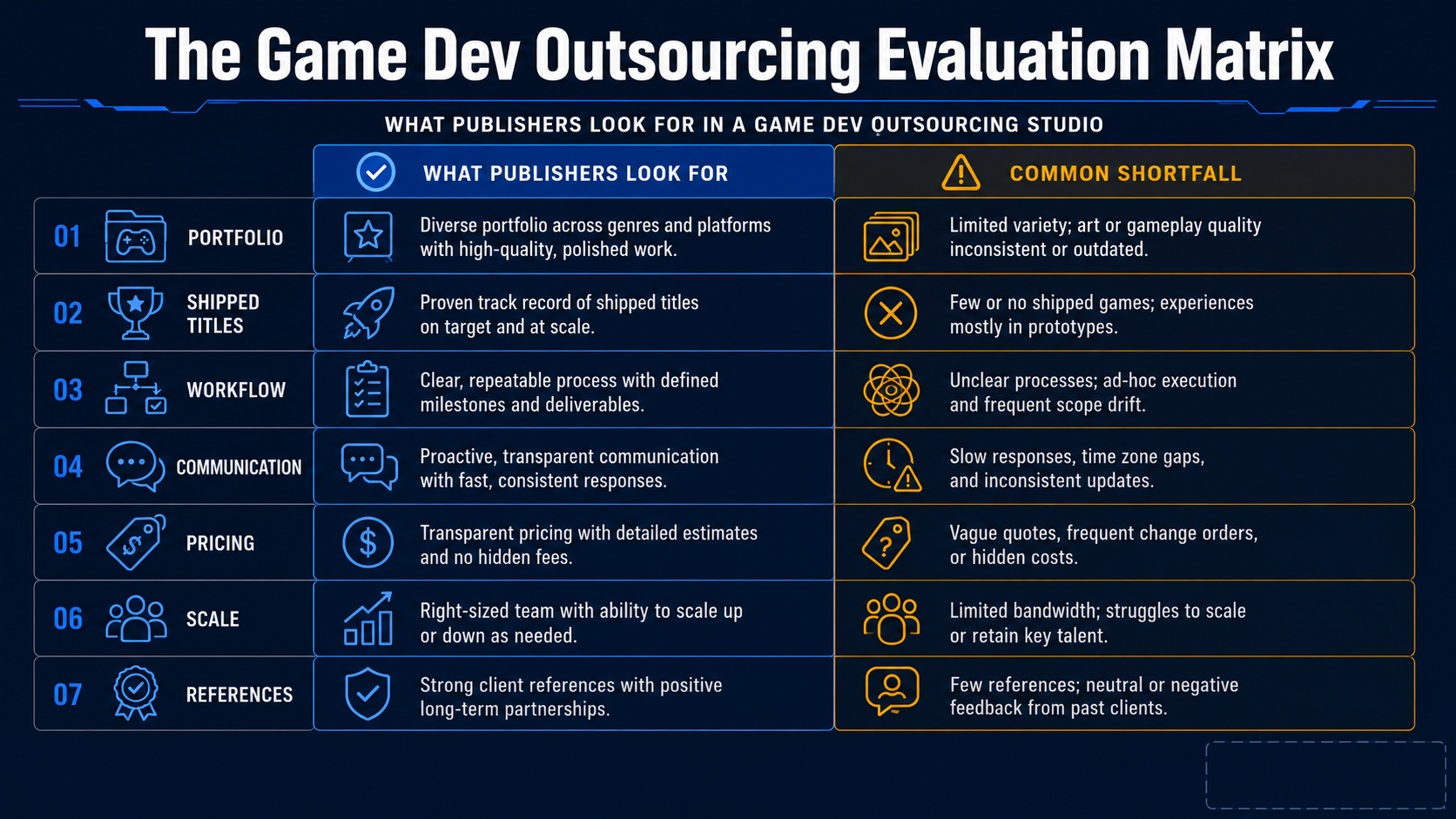
The Game Development Outsourcing Evaluation Matrix
| Evaluation Criterion | What Publishers Look For | Common Shortfall |
|---|---|---|
| Portfolio relevance | Samples matching project style and tech requirements | Generic portfolio without vertical segmentation |
| Shipped titles | Credits on released games in relevant genre/platform | Only pre-production or concept samples |
| Production workflow | Documented revision cycles, file formats, engine compatibility | "We're flexible" with no documented process |
| Communication cadence | Proactive updates, clear feedback loops, fast response times | Client-driven communication with slow response |
| Pricing transparency | Per-asset or per-milestone pricing with clear scope | Vague T&M with no reference benchmarks |
| Scale and capacity | Honest team size, realistic throughput, no overpromising | Quoted capacity that doesn't match actual delivery |
| References | Contactable Art Directors or Producers from past engagements | Case studies without live references |
How Game Development Outsourcing Studios Build Client Pipeline
The sales process for game outsourcing is relationship-driven, conference-dependent, and referral-heavy. Publishers and developers who need outsourcing partners don't typically search online for providers — they ask their network, attend industry events, and respond to warm introductions.
The conference circuit is non-optional
GDC (San Francisco), Gamescom (Cologne), GameDev Days, Casual Connect, and the Nordic Games Summit are where outsourcing decisions are seeded. The Art Director who meets a studio at GDC and receives a follow-up portfolio review is significantly more likely to award a test task than one who receives a cold LinkedIn message.
For outsourcing studios at conferences, the objective is not immediate conversion — it's establishing the first portfolio review with the right contact. The sale happens in the weeks after the event through proposal and sample review.
Pre-conference outreach is what fills your conference schedule
Walking the show floor and hoping to meet the right Art Director at the right moment is an inefficient strategy. Studios that consistently win business from conferences run structured pre-conference outreach: identifying who from target publishers and developers is attending, reaching out 4–6 weeks before the event to propose a meeting, and arriving with a full schedule rather than relying on serendipity.
This requires knowing who attends (conference attendee lists, LinkedIn research, industry network intelligence), which contacts within those studios make or influence outsourcing decisions, and how to open a conversation that leads to a portfolio review rather than a booth card exchange.
LinkedIn as a pre-conference and inter-conference channel
Between events, LinkedIn is the highest-leverage channel for game development outsourcing studios to reach Art Directors, Technical Directors, and Producers at target publishers and developers. A connection request from a studio that demonstrates knowledge of the publisher's titles — referencing a specific game, art style, or technical requirement — performs significantly better than a generic studio introduction.
Referrals need to be built systematically
Referrals are the highest-converting source of outsourcing business. An Art Director who recommends a studio to a peer at another publisher converts at 3–4× the rate of a cold introduction. But referrals don't happen automatically — they require studios to actively maintain relationships with past clients, ask for introductions explicitly, and provide a reason for referrals (a portfolio review, a pilot offer, a specific new capability).
How VirtuWise Supports Game Development Outsourcing Studios
VirtuWise builds B2B pipelines for game development outsourcing studios targeting publishers and developers in mobile, PC, and console markets — handling the outreach, qualification, and meeting booking that most studios have never systematised.
For game dev outsourcing studios, our work typically includes:
- Decision-maker mapping: identifying Art Directors, Technical Directors, and Producers at target publishers and developers with current role data and relationship signals
- Pre-conference outreach: scheduling qualified portfolio reviews and meetings with attending publishers before GDC, Gamescom, and key regional events
- LinkedIn and email outreach: reaching outsourcing decision-makers with personalised messaging anchored in portfolio relevance and specific project context
- Pipeline reporting: weekly outreach volume, response rates, meeting rates, and pipeline progression tracking
- Lead Generation: €3,000/month — ICP research, personalised outreach, meeting booking and scheduling, weekly reporting
- Lead Generation Plus: €5,000/month — everything in Lead Generation, plus multi-channel outreach (LinkedIn + email + messengers), A/B testing, higher volume
- Business Development: €7,000/month — full-cycle business development, dedicated senior sales manager, online and offline representation, custom strategy
- Inbound (SEO & AEO): €3,500/month — SEO and AEO run as one service: keyword strategy, content, technical fixes, and AI-crawler visibility (structured data, llms.txt)
- Fractional Growth Partner: Custom — a revenue engine audit, then optional ongoing Advisory or hands-on Implementation
Full details at virtuwise.io/pricing.
Frequently Asked Questions
What is game development outsourcing?Game development outsourcing is the practice of game publishers and developers contracting external studios to handle specific production functions — art production, programming, QA, localisation, and audio — rather than building those capabilities in-house. For publishers, it provides access to specialist skills and scalable production capacity without permanent headcount. For outsourcing studios, it's the primary business model.
How do game publishers find outsourcing studios?Publishers primarily find outsourcing studios through referrals from trusted colleagues, encounters at industry conferences (GDC, Gamescom, regional game developer events), and existing vendor relationships that expand into adjacent services. Cold outreach from unknown studios converts poorly without a portfolio anchor — the most productive approaches combine a relevant portfolio with a warm introduction or conference context.
What do publishers evaluate when choosing a game development outsourcing partner?Publishers evaluate portfolio relevance to the specific project style and technical requirements, shipped title credits on relevant platforms, production workflow transparency, communication reliability, pricing model clarity, and live references from Art Directors or Producers at studios they've previously worked with. Quality of samples matters most at initial evaluation; process reliability and communication quality matter most for repeat and ongoing relationships.
How do game development outsourcing studios win their first clients?First clients typically come from the founder or leadership team's existing professional network — prior employers, colleagues who've moved to publishers, conference contacts. Studios that don't have an established network use conference presence and LinkedIn outreach to build initial relationships, offer pilot projects or reduced-scope test tasks to reduce evaluation risk, and invest heavily in portfolio quality and relevance before approaching target publishers.
What is the difference between game development outsourcing and co-development?Outsourcing typically refers to studios working on specific production tasks or assets under the direction of the publisher's internal team — delivering to a brief with limited creative input. Co-development involves the external studio taking greater ownership of a production area, contributing creative and production decisions alongside the publisher, and often receiving co-developer credits on the shipped title. Co-development relationships are typically larger, longer, and involve more trust than standard outsourcing contracts.
Related reading:
- B2B Marketing for iGaming Software Providers: A Practical Playbook
- How to Choose an iGaming Software Provider (2026)
- B2B Appointment Setting Companies: How to Choose One That Delivers Qualified Meetings
- Sales Outsourcing: What It Includes, When It Works, and How to Choose a Provider
- Gaming Industry Lead Generation